
Award Force
€2,625Growth, per year, billed annually, up to 10k annual entries, unlimited users
Best for prestigious awards programs where trust and polish matter
- Free plan
- No
- Rubric
- 8.5 of 10
Ten awards platforms compared on judging depth, published pricing and scale, from €2,625 annual programs to free contests, with prices checked on November 25, 2026.

IThe short answer
Best awards management software for November 2026 depends on who is running the program. Award Force suits prestigious programs where trust and polish matter, at €2,625 per year on Growth for up to 10k annual entries and unlimited users. Dapple fits awards, open calls, grants and fellowships that want AI-assisted triage, from $69 per month on Starter. OpenWater fits associations and universities running awards alongside grants or scholarships, with quote-based pricing. The other seven tools below cover contests, startup challenges and enterprise grantmaking, with prices checked on November 25, 2026.
10 tools compared from vendor pages on November 25, 2026. 3 publish a starting price we could read; the rest say "See website".
IITop three berths
Register order is editorial fit for the buyer each entry describes. Prices are the starting figures read on November 25, 2026.
€2,625Growth, per year, billed annually, up to 10k annual entries, unlimited users
Best for prestigious awards programs where trust and polish matter

$69Starter, per month, billed monthly, up to 500 submissions a year, up to 5 users
Best for awards, open calls, grants and fellowships on one AI-assisted platform

See websiteQuote-based
Best for associations and universities managing awards alongside grants or scholarships
How this page is paid for. All 10 tools here are unpaid editorial picks.
A paid listing's position can be part of what the vendor pays for. Every entry, paid or not, is scored on the same rubric and keeps its limits in print. Advertising disclosure.
IIIThe register
Starting prices as shown on each vendor's pricing page on November 25, 2026. "See website" means no figure we could confirm.
| No. | Tool | From | Free plan | Trial | Rubric | Actions |
|---|---|---|---|---|---|---|
| 01 | Award ForcePrestigious awards programs where trust and polish matter | €2,625Growth, per year, billed annually, up to 10k annual entries, unlimited usersUpdated on vendor page | No | No | 8.5 | |
| 02 | DappleAwards, open calls, grants and fellowships on one AI-assisted platform | $69Starter, per month, billed monthly, up to 500 submissions a year, up to 5 usersRead on vendor page | No | Free trial | 7.8 | |
| 03 | OpenWaterAssociations and universities managing awards alongside grants or scholarships | See websiteQuote-basedNot shown publicly | No | No | 6.7 | |
| 04 | SubmittableFoundations, governments and companies running grants, scholarships or CSR programs | See websiteQuote-based enterprise pricingNot shown publicly | No | No | 7.2 | |
| 05 |  EvalatoOrganizers who want a polished program fast without enterprise budget | €2500Grow, per program, valid 365 days, limited entriesRead on vendor page | Yes | Free unlimited testing, no card required | 7.9 | |
| 06 |  ReviewrSimple, low-friction submission collection and review | See websiteQuote-based, ask about entry-level packagesNot shown publicly | No | No | 5.5 | |
| 07 |  JudgifyContests, abstract competitions and awards events of any size | See websiteQuote-based for paid programs, no charge for events with free ticketsNot shown publicly | Yes | Free registration to get started | 6.1 | |
| 08 |  Good GrantsGrantmakers wanting sophisticated software without enterprise pricing | See websiteNo per-seat pricing, unlimited users on every planNot shown publicly | No | No | 7.2 | |
| 09 |  YouNoodleStartup competitions, accelerators and innovation challenges | See websiteStarter, per month, scales with program sizeNot shown publicly | No | No | 6.5 | |
| 10 |  SurveyMonkey ApplyUniversities and nonprofits wanting polished application portals with automation | See websiteQuote-basedNot shown publicly | No | No | 6.5 |
Pinned:
IVMethod
How fast a team can get a branded entry form, categories and program pages live without developer help.
Round structure, blind review, scoring models, panel management and the defensibility of the final decision.
Whether a buyer can see a real number before a sales call, and whether plan limits are stated plainly.
Connections to CRM, membership, payment and identity systems, plus API and webhook access on which tier.
Security certifications, data residency, translation coverage and behavior when entry volume spikes.
VMethod
We scored each platform against five criteria, weighted for buyers who are choosing software rather than browsing feature lists. Program setup and branding carries 20 percent, because the public entry form is the first thing an entrant sees. Judging and review depth carries 25 percent, the largest share, because review is where awards programs actually fail: weak scoring, no blind mode, no panel management. Pricing clarity carries 20 percent, which is why quote-only vendors score low here even when the product is strong. Integrations and data flow carries 15 percent, and scale and compliance carries 20 percent, covering security certifications, data residency, translation coverage and behavior under high entry volume.
Every price in this list was read from the vendor's own pricing page on November 25, 2026. Where a page could not be fetched, we say so in the entry and mark the pricing note as unconfirmed rather than filling the gap with a guess. No currency is converted; each price appears in the currency and form the vendor publishes. Where a vendor sells by program rather than by month, we say that too, because a per-program fee and a monthly subscription are not comparable.
One listing in this format may be a paid Featured placement. Featured vendors are scored on the same rubric with the same weights and carry the same kind of cons as everyone else. Placement changes prominence, not the assessment.
The order below is editorial. It reflects which buyer each entry fits best, not a calculated total, so read the pick and skip lines before the numbers.
The full routine, from price reads to corrections, is on the methodology page. Paid listings follow the advertising disclosure.
Entry I of X / Compliance and polish

Our verdict
The safest pick for high-profile programs that need deep compliance, wide language coverage and unlimited judges without per-seat fees.
Award Force is built for awards programs where the shortlist itself is news. Entries arrive through a branded submission site, judging runs across multiple rounds with scoring and evaluation, and results and reporting come out the other side. Program managers, judges, entrants and uploads are all unlimited, so adding a category or a hundred judges does not change the bill.
The compliance story is unusually deep for this category. Award Force holds SOC 2 Type II, ISO/IEC 27001 and PCI-DSS, offers regional data residency, and ships more than 40 interface translations. The optional privacy-first AI assessment runs inside the vendor's own cloud environment with no data retention and keeps humans in the decision loop. Customers named by the company include the BBC, NASA, Microsoft, the Commonwealth and the Eurovision Song Contest, which explains the polish.
Pricing is now published rather than quoted. The Growth plan is €2,625 per year billed annually for up to 10k annual entries with unlimited users, and the vendor also lists a Pro tier with fixed annual prices. Entry volume, not seat count, drives the limits, which suits programs that expect a heavy public response. There is no free plan and no trial, so evaluation happens through a sales conversation.
The trade-off is weight. Configuration depth can overwhelm a small program, and using the platform fully takes real onboarding effort rather than an afternoon of setup. Budget time for that. It fits prestigious national and international programs with a budget and a reputation to protect, and it rewards the buyer who will actually use the depth.
The program carries public reputational weight and you need security credentials a board will accept.
You run one small competition a year and want to be live in a week without a sales process.
Entry II of X / AI triage pipeline
Our verdict
The best value here for teams that want AI triage and Stripe entry fees without an enterprise contract or a sales cycle.
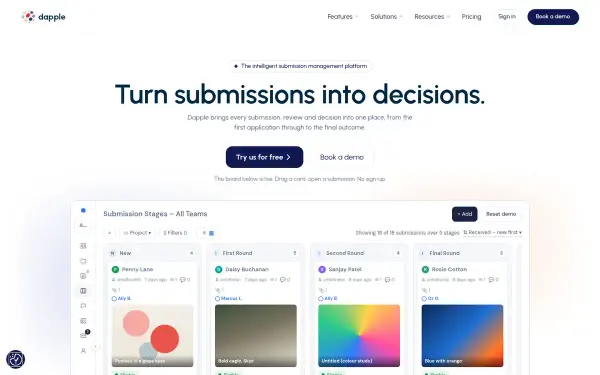
Dapple treats an awards program as a pipeline. Every submission moves through a visual stages board, and AI handles eligibility checks, summaries, tagging and routing while people make the final calls. Reviewers work through multiple rounds with ratings or weighted rubrics, blind review hides identifying fields, and review pools split the judging load across a large panel.
Entry fees are collected through Stripe with tiers, waivers and VAT invoices, and the money lands in the organizer's own Stripe account rather than sitting with the vendor. A public gallery supports voting, and an MCP connection hooks the platform to Claude, ChatGPT and Cursor for analysis and reporting. Several programs can run together on one board, which suits agencies and foundations with more than one call open at a time.
Pricing is the clearest in this list. Starter is $69 per month billed monthly for up to 500 submissions a year and up to 5 users. Growth is $239 per month for 2,500 submissions a year and adds multi-round review, MCP, galleries and award fund management. Registered charities and non-profits get 10% off annual Growth and Pro plans, and a free trial is offered.
The limits matter more than the feature list. Starter is capped at a single review round, so any program with a shortlist stage needs Growth. SSO, API and webhooks sit on Pro, which will stop larger IT departments. AI agents and post-award tracking are listed as coming soon, so buyers who need disbursement today should wait. Named users include Florida International University, the Scottish Arts Trust and Liberty London.
You want modern review tooling and a real published price without a procurement cycle.
You need SSO, API access or multi-round judging on the entry-level plan.
Entry III of X / CRM integrations
Our verdict
Choose it when awards data must land in a membership CRM; choose something else when the prize itself is the whole product.
OpenWater is the awards system that already speaks to the rest of the association stack. Custom-branded submission portals collect entries, judging runs either online or in person, automated email marketing keeps entrants and judges moving, and entry fees come in through PayPal and Authorize.net. Awards, grants, scholarships, fellowships and abstracts all live in one console rather than in separate tools with separate logins.
The differentiator is integration. OpenWater syncs natively with iMIS, Salesforce, Avectra, Personify and Dynamics, so submission and judging data land in the membership system the organization already runs. That matters when the awards record has to sit next to dues, events and committee history. The company is part of Advanced Solutions International and reports serving more than 1,000 associations, which is the footprint you would expect from a product built around member organizations rather than a single gala.
Pricing is quote-based. No pricing page could be fetched when we checked on November 25, 2026, so the quote note stands unconfirmed and any buyer will need a sales conversation to get a number. That is normal for association software, and it means the first step is a sales conversation.
Two honest limits. The awards tooling is less specialized than dedicated prize platforms, so a program built around one high-profile ceremony may find it generic next to Award Force or Evalato. Setup nuances reward an experienced administrator, and a new admin will lean on support during the first cycle. It fits associations and universities that run awards alongside grants or scholarships and want one system feeding their CRM.
Your association already runs a membership CRM and wants submissions to land inside it.
Your awards program is a standalone ceremony with no CRM behind it.
Entry IV of X / Post-award coverage

Our verdict
Overkill for a single prize, but the strongest option when an award is really the start of a funded relationship.
Submittable is grantmaking software with an awards module, and that is the honest way to describe it. Multi-stage review workflows handle selection, identity verification counters fraud at intake, CRM-style applicant records hold history across years, tailored award agreements cover what happens after the winner is chosen, and real-time budget tracking plus impact reporting close the loop.
Forms are built with a drag-and-drop builder, so program staff can change questions without a developer. The public-sector record is substantial: the company has run programs such as Washington State small business grants and Minnesota frontline worker relief, holds a Texas DIR contract for state agencies, and reports use by more than 45 US state governments. That record is why procurement teams recognize the name.
Pricing is enterprise and quote-based. No pricing page text was available on November 25, 2026, so we cannot confirm a starting number, and buyers should expect a sales process sized to the contract, including security review and procurement paperwork. Small programs should ask early whether a lighter package exists, and should get the module list in writing before signing, because scope drives the number.
The mismatch to watch is breadth. A pure awards program with one ceremony and a few hundred entries will pay for grant modules it never touches, and awards are one module among several rather than the center of the product. Enterprise pricing means a sales conversation before you can use the product. It fits foundations, governments and companies running grants, scholarships or CSR programs where the award starts a longer relationship with the recipient.
The award comes with money attached and you need agreements, payments and reporting in the same system.
You need one ceremony shortlist and want a price you can read on a website today.
Entry V of X / Per-program pricing
Our verdict
Published per-program pricing and free testing make it the easiest platform on this list to evaluate and budget for.
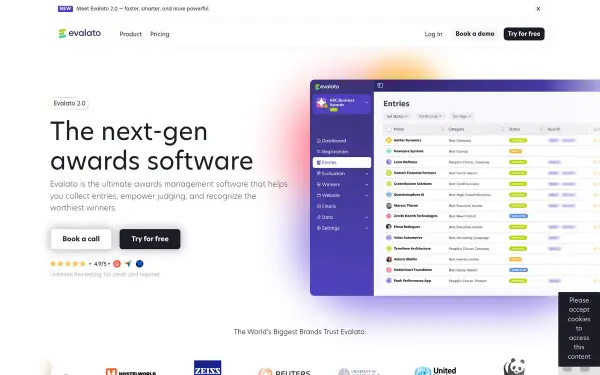
Evalato sells per program rather than per seat or per month, which makes budgeting unusually simple. The Grow plan is €2500 per program, valid 365 days, with entry limits, and the vendor lists a Pro tier at €5,500 on its own FAQ. Ready-made templates and a drag-and-drop form builder get a program live quickly, and the embeddable FastApply portal keeps the entry form inside the organizer's own site.
Payments run through 30-plus methods and 160-plus currencies. Judging supports multiple evaluation rounds with six voting types, public voting with social login, and PreciseSelect for winner selection. The interface is available in 40-plus languages, and the vendor treats privacy compliance as part of the package rather than an upsell. Free unlimited testing is offered without a credit card, which is a genuine way to evaluate the product before committing.
The company reports 7,000-plus customers across 80-plus countries, with names including the UN, Reuters and the University of Oxford. That is a credible reference list for a vendor that is not the biggest name in the category, and it suggests the product holds up in multilingual, high-visibility programs where the entry form is fully public.
The constraints are volume and brand. Lower tiers carry entry caps and higher entry volumes cost extra, so a program expecting a surge of entries should price that in before launch rather than after. Evalato is also a smaller name than the category leaders, which matters if procurement wants a long reference list or a large support organization behind the account. It fits organizers who want a polished program launched fast without an enterprise budget or a sales cycle.
You run defined programs with known entry volumes and want to test the whole thing for free first.
Your entry numbers swing wildly year to year and you need uncapped volume on a fixed fee.
Entry VI of X / Audit-trail judging
Our verdict
Plain, defensible submission and review tooling with audit trails, best suited to programs that do not need an ecosystem.
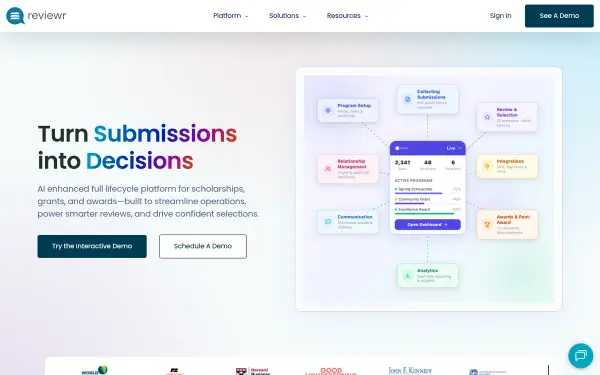
Reviewr covers the basics well and does not pretend to be more. Entrant and entry management sit alongside entry fee processing, blind judging and scoring, voting management, and white-labeled portals for both applicants and reviewers. Reviewer management includes audit trails, which is the feature that makes decisions defensible if a result is challenged after the ceremony.
The product spans awards, grants, scholarships and competitions rather than specializing in one. Blind judging and scoring are standard rather than an upgrade, and the portals carry the organization's branding rather than the vendor's. For a program that needs a clean submission form, a fair review process and a record of who scored what and when, that covers the job without adding modules nobody will open.
Pricing is quote-based. No pricing page text was available when we checked on November 25, 2026, so the quote note is unconfirmed. Smaller programs should ask directly about entry-level packages rather than assuming the enterprise shape applies to them, because a quote built for a national award will not reflect what a single-category competition actually needs.
The honest constraint is size. Reviewr is based in Nebraska and operates with a team of roughly 1 to 10 employees, so the integration ecosystem is small and buyers with unusual requirements should confirm them in writing before signing. Brand recognition is lower than the larger competitors, which can slow procurement inside a conservative organization that wants three comparable bids. It fits programs that want simple, low-friction submission collection and review with audit trails.
You need a defensible review record and white-labeled portals without paying for grant modules.
You need deep CRM integration or a vendor with a large partner network behind it.
Entry VII of X / Ceremony ticketing
Our verdict
A contest platform with ceremony ticketing built in, priced free for events that do not sell tickets.
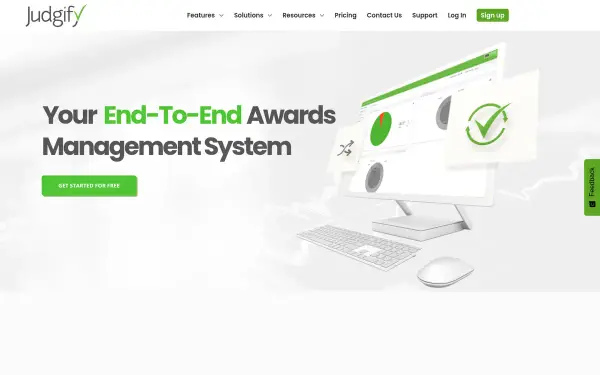
Judgify is built for contests and competitions, and the feature set follows that focus. A drag-and-drop landing page builder with analytics snapshots gets the public-facing site up, entry forms and abstract management collect submissions, judges are assigned randomly, manually or by category, and scoring runs on multiple criteria. Public voting and a reporting suite come with it rather than as upgrades.
The unusual inclusion is ticketing. Judgify has a module for ceremony tables and seats, so selling the gala is part of the same platform rather than a separate product or a plugin. For an awards event where the ceremony is the revenue line, that removes a spreadsheet and a reconciliation problem between two systems that were never meant to talk.
Pricing splits by event type. Paid programs are quoted rather than listed, but contests that issue free tickets run at no charge, and registration is free to get started. We could not fetch the pricing page on November 25, 2026, so the free-for-free-ticket arrangement stays unverified and should be confirmed in writing before a program is announced as free to enter.
The company is based in Singapore and reports hosting hundreds of events worldwide, with named work for Clarion Events and Mubadala. Two honest limits: paid programs require a quote, so comparison takes longer, and the product heritage leans toward contests rather than grants. Branding is functional rather than premium, so a luxury awards brand may want more design control. It fits contests, abstract competitions and awards events of any size.
Your awards event sells ceremony seats and you want entries, judging and ticketing in one place.
You distribute funding to winners and need agreements or payment tracking.
Entry VIII of X / Unlimited users
Our verdict
Review depth and unlimited seats at a mid-market position, as long as your program is funding rather than a gala.
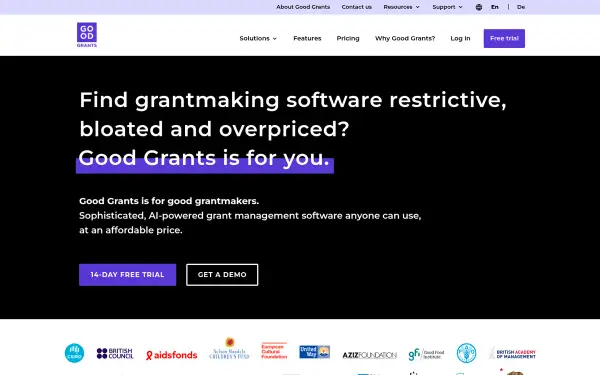
Good Grants is aimed at grantmakers who want serious review tooling without enterprise contracts. Every plan includes unlimited users, admins, form fields and file capacity, so a large panel of reviewers does not create a per-seat bill. Five review modes run across multiple rounds, panel management supports recusal and abstention, and results update in real time as scores come in.
The rest of the lifecycle is covered too: opportunity announcement and application management, agreement signing, funding management, 40-plus translations and data residency options. The Australian vendor lists SOC 2 Type 2, ISO/IEC 27001 and WCAG 2.2 AA accessibility compliance, which is a stronger credential set than the price positioning would suggest, and accessibility compliance matters for publicly funded programs.
Pricing is not published. No page text was retrievable on November 25, 2026, so the unlimited-user plan pricing remains unverified and buyers need a quote. The vendor positions itself as an affordable alternative to heavier grantmaking suites, but affordable is a claim to test against two other quotes rather than a number you can compare here.
The gaps are specific. Awards ceremony capabilities are thin, so a program whose centerpiece is a gala will need another tool for the event itself. Post-award evaluation tooling is still in development, so impact measurement after funding is not there yet. Programs with a strong prize-fund or scholarship flavor fit best, because review depth is the reason to buy. It fits grantmakers who need review depth and unlimited seats more than ceremony polish.
You review hundreds of applications with a large rotating panel and refuse to pay per reviewer.
The awards night is the main event and you need shortlist presentation and ticketing.
Entry IX of X / Applicant network
Our verdict
The pick when applicant volume is the bottleneck, less so when the award is traditional grants or arts prizes.
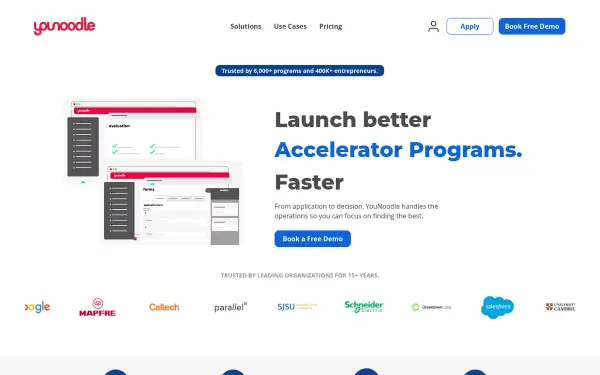
YouNoodle comes with an audience, not just software. Branded program pages, custom application forms with automated emails and smart reminders, automatic reviewer assignment with criteria-based scoring, real-time dashboards and a workflow from application through winner selection are the product. Setup is quoted at 1 to 5 business days.
Behind the tooling sits an entrepreneur network of 400,000-plus founders that can be pointed at a competition. That network is the reason to choose it: a startup competition with a thin applicant pool gets distribution as well as forms. The track record is long, with the company founded in 2010 in San Francisco and reporting more than 400 competitions across 100 countries, including Stanford BASES, the Amazon Startup Challenge, NASA and Start-Up Chile.
Pricing is on the vendor site. The Starter plan is listed per month and scales with program size, and no free tier is offered. We could not reach a pricing page on November 25, 2026 to confirm the Starter rate, so get the current figure in writing before you build a budget around it.
Two limits follow from the focus. The applicant network is startup-specific, so an arts prize or a nursing award gets nothing from it and pays for a feature it cannot use. Traditional grants and arts awards are not the strength either. It fits startup competitions, accelerators and innovation challenges where applicant volume is the bottleneck and review is criteria-based scoring rather than nuanced panel discussion.
You run a startup competition and the hardest part is getting enough credible applicants.
Your entrants are artists, researchers or community groups rather than founders.
Entry X of X / Applicant portal experience
Our verdict
The strongest applicant portal and post-award automation here, held back by quote-only pricing and no ceremony tooling.
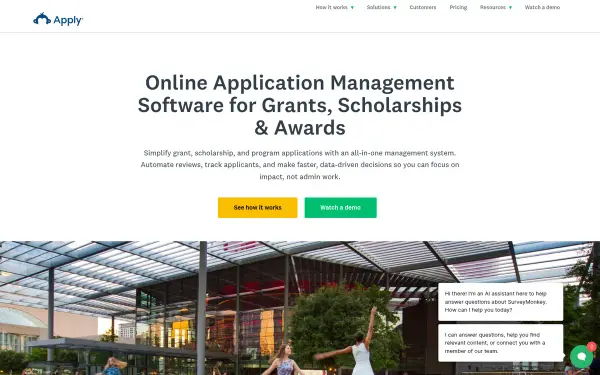
SurveyMonkey Apply wins on the applicant experience. Branded portals collect submissions through dynamic forms with 20-plus question types and skip logic, applicants can collaborate on proposals in real time, and automated workflows track progress without staff chasing each stage by hand. That combination is why universities keep it.
Post-award is more developed than most of this list. Stages after the decision carry forms, uploads and evaluations, and automated reminders keep grantees compliant with reporting deadlines. Implementation and onboarding are included at no cost, and support is unlimited, which removes two line items that other vendors bill as professional services.
Pricing is quote-based. No page text was returned on November 25, 2026, so the quote note could not be confirmed and any number requires a sales conversation. Ask what the quote includes for implementation and support, because those are the items most often quoted separately elsewhere and here they are bundled.
The positioning is grants and scholarships rather than pure awards, and that shows. A program built around a single ceremony will find the product focused on grants and scholarships rather than event production. The SurveyMonkey brand travels with the product, which is an advantage in a university procurement office and less so for a design-led awards brand. Users named by the company include Harvard, the British Science Association and Girls Who Code. It fits universities and nonprofits that want polished application portals with strong automation more than event production.
A clean applicant portal and automated post-award reminders matter more than the awards night itself.
You need public voting, a shortlist gallery or ceremony ticketing.
VIBackground
Answer first: it runs the whole arc of a competition or prize in one place, from the public call for entries to the announcement of a winner, replacing the spreadsheet and email chain most programs start with.
The arc has four stages. Intake is the public part: a branded entry form, eligibility questions, file uploads, sometimes an entry fee. Review is the internal part: assigning judges, splitting a large panel into pools, blind scoring where identifying fields are hidden, and multiple rounds that narrow a long list. Decision is the output: weighted totals, panel discussion, a ranked shortlist. Results and aftercare is the part buyers forget: notifying winners, publishing a gallery, reporting to a board, and in grant-flavored programs, agreements, payments and follow-up reporting.
Typical capabilities across the category:
What separates one platform from another is rarely the form builder. It is how deep the review tooling goes, whether security credentials clear a public-sector bar, whether the vendor publishes a price, and whether the product stops at the winner or continues into funding and impact reporting. A program that runs a gala also needs shortlist presentation and ceremony ticketing. A program that funds recipients needs agreements and disbursement, which most pure awards tools do not do.
The category also splits by buyer. Prizes and competitions care about entry volume, public voting and ceremony polish. Grants and scholarships care about multi-stage review, panel recusal, agreements and post-award reporting. Several products here straddle both, and that straddle is where most buying mistakes happen: teams pay for modules they will never run, or buy a ceremony tool for a funding program.
Volume drives cost more than seats. Most vendors on this list either do not charge per user or price by entry volume, so estimate entries before you compare quotes.
This comparison sits in the software register. Further along the shore: baby tracking app and e signature software.
VIIPricing
Answer first: there are four pricing models on this list, and the model a vendor uses tells you more about fit than the number does.
| Model | How it bills | Typical fit | Example from this list |
|---|---|---|---|
| Published annual platform fee | Per year, billed annually, capped by entry volume | Flagship programs with steady budgets | Award Force at €2,625 on Growth, up to 10k annual entries |
| Published monthly subscription | Per month, capped by submissions and users | Smaller teams and new programs | Dapple at $69 on Starter, up to 500 submissions and 5 users |
| Per program pack | One fee for 365 days of a single program | Agencies and one-off competitions | Evalato at €2500 on Grow, valid 365 days |
| Quote-based enterprise | Custom contract after a sales conversation | Associations, governments, universities | Submittable, OpenWater, SurveyMonkey Apply, Good Grants |
Seven of the ten vendors here will not put a number on a web page. That is not automatically a red flag, but it does mean your first comparison is a calendar problem: two vendors at quote-only can take weeks to produce figures you can line up against a published plan.
Three things drive the number once a quote arrives. Entry volume is the biggest, which is why Award Force caps Growth at 10k annual entries and Evalato tiers by program size. Feature tier is second: Dapple puts SSO, API and webhooks on Pro, and Evalato charges extra above its entry caps. Seats are usually not a factor, because Good Grants, Award Force and others do not charge per user at all.
Watch for what sits outside the headline. Implementation is billed separately by some vendors and included by others; SurveyMonkey Apply includes implementation and unlimited support. Free testing is a real way to de-risk: Evalato offers unlimited free testing with no card, and Dapple offers a free trial. Judgify charges nothing for contests that issue free tickets, which makes it the cheapest entry point on this list for the right event.
Each entry card shows the starting price as it appeared on the vendor's own pricing page on November 25, 2026. When a vendor shows no figure we could confirm, or only a promotional rate, the card says "See website" or gives the regular price instead of a guess. Usage, overage and add-on rates in the text change more often than plan prices, so confirm them on the vendor page before you set a budget. To test the numbers against your own volume, try the free User Research Budget Planner. The Event Break-Even Calculator is a second way to check the same decision.
VIIIDecision
Count entries and judges first. Write down last year's entry number, the expected peak, and how many people score each submission. Volume, not seats, is the line item that moves most quotes on this list.
Decide whether the winner is the end. If money, agreements or reporting follow the decision, you need a grant-flavored tool like Submittable, SurveyMonkey Apply or Good Grants. If the winner is the end, a contest tool will do.
Match the pricing model to your calendar. A per-program fee such as Evalato's €2500 Grow suits one dated competition. A monthly plan such as Dapple at $69 suits rolling calls. An annual plan such as Award Force at €2,625 suits a program that runs continuously.
Test the review flow, not the entry form. Build a dummy round, assign a blind score, and see what a judge actually faces. Review is where programs break, and it is the hardest thing to change after launch.
Confirm the compliance bar in writing. If you are a public body or a broadcaster, ask for the certification list and data residency options before the demo. Award Force publishes SOC 2 Type II, ISO/IEC 27001 and PCI-DSS; most of this list does not.
Get the quote with caps written down. Ask for entry ceilings, overage rates, implementation fees and what happens if you double your entries in year two. Unwritten assumptions are where awards software budgets fail.
IXPitfalls
Buying for the entry form only. A pretty portal is easy to build. The cost lands later when judges cannot score in rounds, or when there is no audit trail for a challenged result.
Ignoring entry caps until year two. Published plans are capped by volume, and a program that grows past its tier pays overage. Check what happens at double your current entries before signing.
Assuming quote-only means expensive. It sometimes does, and sometimes a quote lands below a published plan because scope is smaller. Get two quotes before ruling a vendor out.
Paying for grant modules you will never run. Enterprise platforms such as Submittable carry agreements, payments and impact reporting. A single prize ceremony does not need them and should not fund them.
Skipping the free test. Evalato offers unlimited free testing without a card and Dapple offers a trial. Running your real rubric through a test instance for an afternoon beats a second demo call.
XQuestions
It handles intake, review, decision and results in one system. Entrants submit through a branded form, judges are assigned and score in rounds (often blind), results are calculated and published, and winners are notified. Grant-flavored platforms add agreements, payments and post-award reporting. The practical value is that entry data, scores and audit history live in one place rather than across spreadsheets and email threads.
Three publish a starting price: Award Force at €2,625 per year on Growth billed annually, Dapple at $69 per month on Starter billed monthly, and Evalato at €2500 per program on Grow. Seven quote privately: OpenWater, Submittable, Reviewr, Judgify, Good Grants, YouNoodle and SurveyMonkey Apply. Judgify is free for contests that issue free tickets. All prices were checked on November 25, 2026 and several quote-only pages could not be fetched.
Public voting is a module attached to the review workflow. Dapple runs a public gallery with voting, Evalato offers public voting with social login, and Judgify and Reviewr both include voting management. Social login is the most common control because it ties a vote to an account. Ask each vendor in writing how repeat votes, shared networks and bulk voting are handled before you publish a vote-weighted award.
The line is what happens after the winner is chosen. Awards software stops at results, notification and reporting. Grants software keeps going into agreements, disbursement, budget tracking and impact reporting. Submittable, SurveyMonkey Apply and Good Grants sit on the grants side; Award Force, Evalato and Judgify sit on the awards side. Buy the side that matches your actual process, because the modules are not cheap.
Judgify is free for events with free tickets and free to register. Evalato offers unlimited free testing without a credit card. Dapple offers a free trial on its published plans. No other vendor on this list offers a free plan, and Award Force, OpenWater, Submittable, Reviewr, Good Grants, YouNoodle and SurveyMonkey Apply all require a sales conversation before you can use the product.
Simple programs can be live in days. YouNoodle quotes setup at 1 to 5 business days, and Evalato's templates are designed for quick launch. Complex programs take weeks: Award Force requires real onboarding effort to use its configuration depth, and Submittable's implementation timeline is not published. SurveyMonkey Apply includes implementation and onboarding at no cost, which shortens the path without removing the work.
XIFurther along the shore
Vendors can ask for a correction or apply for a Featured listing. Paid or not, the entry is scored on the same rubric and its limits stay in print. Partner with Umberlake.
Free tools
Our free browser tools turn the prices on this page into a figure for your own volume. Nothing you type leaves your device.