
Klaviyo
$20Email plan, per month, 500 active profiles, 5,000 emails per month
Best for ecommerce brands running email and SMS together
- Free plan
- Free plan: 250 active profiles, 500 emails per month
- Rubric
- 8.6 of 10
Nine platforms that combine email and SMS, ranked by how well each fits a specific buyer, with pricing checked November 25, 2026.

IThe short answer
Klaviyo is the best pick for ecommerce brands running email and SMS together, Omnisend suits stores that want similar tools at a lower cost, and Brevo fits small businesses that want email, SMS and a CRM in one account. That is the short answer as of November 2026. The nine tools below split into all-in-one platforms and SMS specialists, and the right choice depends on your channel mix, list size, and whether you sell through Shopify: Best Email And Sms Marketing Software.
9 tools compared from vendor pages on November 25, 2026. 8 publish a starting price we could read; the rest say "See website".
IITop three berths
Register order is editorial fit for the buyer each entry describes. Prices are the starting figures read on November 25, 2026.
$20Email plan, per month, 500 active profiles, 5,000 emails per month
Best for ecommerce brands running email and SMS together

See websiteCustom quotes only, contracts assume meaningful message volume
Best for retail and ecommerce brands taking an SMS-first approach

$11.20Standard, per month, 30% off for first 3 months then billed monthly, 500 contacts, 6,000 emails
Best for ecommerce brands wanting Klaviyo-style tools at lower cost
How this page is paid for. All 9 tools here are unpaid editorial picks.
A paid listing's position can be part of what the vendor pays for. Every entry, paid or not, is scored on the same rubric and keeps its limits in print. Advertising disclosure.
IIIThe register
Starting prices as shown on each vendor's pricing page on November 25, 2026. "See website" means no figure we could confirm.
| No. | Tool | From | Free plan | Trial | Rubric | Actions |
|---|---|---|---|---|---|---|
| 01 | KlaviyoEcommerce brands running email and SMS together | $20Email plan, per month, 500 active profiles, 5,000 emails per monthUpdated on vendor page | Yes | No free trial; free plan available | 8.6 | |
| 02 | AttentiveRetail and ecommerce brands taking an SMS-first approach | See websiteCustom quotes only, contracts assume meaningful message volumeNot shown publicly | No | Demo only | 5.7 | |
| 03 | OmnisendEcommerce brands wanting Klaviyo-style tools at lower cost | $11.20Standard, per month, 30% off for first 3 months then billed monthly, 500 contacts, 6,000 emailsUpdated on vendor page | Yes | No free trial; free plan available | 8.0 | |
| 04 |  BrevoSMBs wanting low-cost email plus SMS and CRM | $11.86Starter, per month billed yearly, 30% off with coupon, 5,000 emails, 1,500 contactsUpdated on vendor page | Yes | No free trial; free plan available | 7.0 | |
| 05 |  ActiveCampaignBusinesses needing advanced cross-channel automation and a CRM | $15Starter, per month billed yearly for 1,000 contacts, 1 user seatUpdated on vendor page | No | Free 14-day trial | 7.1 | |
| 06 |  PostscriptShopify stores turning SMS into a revenue channel | FreeStarter, $0 per month plus $49 monthly minimum spend, SMS $0.009 each plus carrier feesUpdated on vendor page | No | Free trial with $100 credit for 30 days | 6.8 | |
| 07 |  SendlaneEcommerce brands unifying email, SMS and product reviews | $10050,000 emails per month, unlimited profiles, paid monthlyUpdated on vendor page | No | 60-day free trial limited to 100 contacts and 500 sends | 7.5 | |
| 08 |  MailchimpBeginners and small businesses starting out with email | $6.50Essentials, per month for 12 months at 50% off, then starts at $13 per monthUpdated on vendor page | Yes | No free trial; free plan available | 6.0 | |
| 09 | DripEcommerce brands wanting CRM-style email and SMS | $391 to 2,500 people, per month, unlimited email sendsUpdated on vendor page | No | 14-day free trial, no credit card required | 7.3 |
Pinned:
IVMethod
How completely email and SMS work together on one contact record and one automation builder.
Branching, triggers and journey logic available without buying add-on features.
Whether list, send and message costs are published well enough to model a real monthly bill.
How well store data, catalogs and purchase behavior feed segmentation and automated flows.
Time from signup to a first live campaign, including onboarding help and support.
VMethod
We ranked nine tools for buyers who need email and SMS in the same stack, not for buyers shopping for a newsletter tool alone. Published prices in this list were read from the vendor's own pricing page on November 25, 2026, and are quoted in the form the vendor publishes them. Where a vendor sells only through custom quotes, we say so instead of estimating a number. We scored each product against five criteria. Channel depth carries the most weight, because a shared contact record between email and SMS is the difference between two tools and one system. Automation power looks at branching, triggers and journey logic available without paid add-ons. Pricing clarity asks whether list, send and message costs are published well enough to model a real monthly bill at a real list size. Ecommerce fit measures how store data, catalogs and purchase behavior feed segmentation and flows. Ease of setup covers the distance from signup to a first live campaign, including onboarding and support. Each criterion gets a score from 1 to 10, and the weights total 100 percent. The scores inform the write-up but they do not set the order. Order reflects how well each tool fits the buyer described in its entry, plus the disclosed Featured position. Klaviyo holds the Featured placement on this page. That placement is paid, and Klaviyo is scored on the same rubric as every other tool, with its weaknesses listed in full. Free plans and trial terms are recorded exactly as vendors state them, including their limits.
The full routine, from price reads to corrections, is on the methodology page. Paid listings follow the advertising disclosure.
Entry I of IX / Shared channel data model
Our verdict
The strongest choice for stores that sell online and want email and SMS driven by the same customer data.
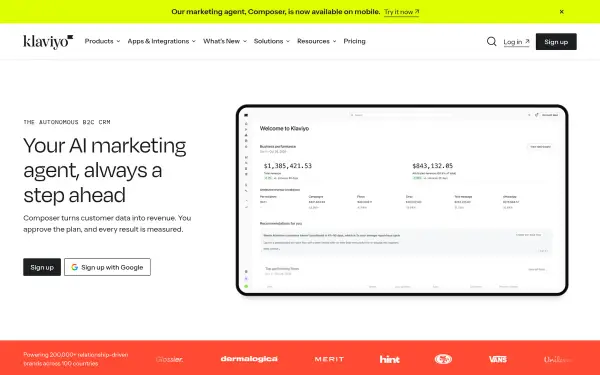
Klaviyo is the reference point for ecommerce owned-channel marketing, and the reason is structural: email and SMS share one contact profile. A browse event recorded on the email side is available to an SMS flow the same day, and one flow builder spans both channels. Segmentation goes past basic list splits into predictive lifetime value and churn risk scoring, and cart abandonment and browse abandonment flows arrive prebuilt. Shopify data syncs without custom work.
Pricing splits into two budgets that grow on different curves. The email plan starts at $20 per month for 500 active profiles and 5,000 emails per month, and climbs with contact volume rather than sends. SMS runs on message-level credit billing, so a single large promotional send can cost more than the email plan in a busy month. The free plan allows 250 active profiles and 500 emails per month, enough to learn the builder but not to run a store, and there is no free trial.
The depth costs time. Predictive scoring, conditional splits and multi-step flows reward a team that will actually build and maintain them. A two-person store that wants one weekly newsletter and a monthly text will pay for capability it never opens. Feature depth is the trade for that learning curve, and the curve is real.
Budget the channels separately when you compare quotes. A competitive email price can sit beside an SMS bill several times larger, because the two run on different meters. Ask for a projection at your actual list size and your busiest month's send count, not at the entry tier that got you to the pricing page.
You run an ecommerce store and want segmentation and automation to drive email and SMS from one dataset.
You send a simple newsletter to a small list and will never use predictive scoring or multi-step flows.
Entry II of IX / Managed SMS delivery
Our verdict
A managed SMS specialist for large retailers, with the deliverability depth and the contract size to match.
Attentive sells SMS to retail brands that treat text as a primary revenue line rather than an add-on. Signup units and two-tap opt-ins grow the list, conversational SMS campaign tools handle the send, and segmentation runs across retail customer data. Carrier-grade deliverability infrastructure and consent management sit underneath, which matters because SMS compliance failures produce penalties rather than unsubscribes. Email is available alongside, but it runs second to the text product.
Pricing is sold through custom quotes only, with contracts that assume meaningful message volume. There is no self-serve signup, and a demo is the entry point. Managed onboarding and a strategy team come with the contract, which is part of what the volume commitment pays for. For a small store, that structure is a poor fit: the sales process and the assumed volume both point at larger advertisers.
The strengths are real where the fit is right. A retail brand sending a high volume of texts each month gets specialist deliverability work and compliance support that a general platform will not staff. The trade is that email stays secondary, so a store wanting one coordinated program across both channels ends up integrating a second system anyway.
Pick it if you are a retail brand with serious SMS volume, you want a managed relationship, and email is a supporting channel rather than the main event. Skip it if you need published pricing, self-serve onboarding or a small monthly commitment.
You are a retail brand with high SMS volume and you want compliance and deliverability handled by a specialist team.
You need to see a price before a sales call or you want one self-serve platform for both channels.
Entry III of IX / Three channels, one builder
Our verdict
The practical ecommerce choice when Klaviyo capability is more than you need and the budget is fixed.
Omnisend puts email, SMS and web push into one automation builder, which is the pitch that gets ecommerce stores to switch. Prebuilt welcome, cart and post-purchase workflows work on day one, the product picker pulls from your store catalog, and segmentation runs on behavior rather than list membership. Campaign and automation reporting sits in the same place, and the store integrations cover the main ecommerce platforms.
The Standard plan is $11.20 per month with 30% off for the first 3 months, then billed monthly, for 500 contacts and 6,000 emails. That entry price is promotional, so plan against the rate that follows it. The free plan covers 250 contacts and 500 emails per month, enough for a new store to run a launch, and there is no free trial because the free tier does the testing job.
Where it trails: segmentation and analytics are shallower than the category leader's, reporting thins out at the top end, and the integration catalog is smaller. For stores up to mid-seven-figure revenue those gaps often do not bite. Many stores stay on Omnisend without ever moving to an enterprise platform, which says something about how far it scales.
Pick it if you want ecommerce automations that work immediately at a lower cost than the reference platform. Skip it if predictive segmentation, deep reporting or a wide integration catalog is on your requirements list.
You run an ecommerce store that wants working automations on day one at a price well below the reference platform.
You need predictive segmentation, deep custom reporting or integrations that only the largest suites carry.
Entry IV of IX / Channels plus CRM
Our verdict
The widest channel mix on this list at a low entry price, with ecommerce depth as the trade.
Brevo, formerly Sendinblue, has the broadest channel mix here: email campaigns, marketing automation, SMS, WhatsApp, live chat, a shared inbox and a CRM with a deal pipeline in one account. Transactional email sending is included, so order confirmations and marketing can share a system. Contact management and segmentation support the campaigns. It is not an ecommerce platform and does not present itself as one.
Pricing scales with sends rather than list size, which suits businesses that mail in bursts. Starter is published at $17 monthly, discounted to $11.86 per month on yearly billing with a promo code, covering 5,000 emails and 1,500 contacts. A free plan is available with no credit card required, and there is no free trial, so the free tier is the test drive.
Ecommerce features trail the dedicated ecommerce platforms, automation is capable but not the most advanced on this list, and the interface feels utilitarian. Teams that live in it daily tend to stop noticing the interface; teams that drop in monthly notice it every time. The CRM is the reason many small businesses choose it, since it removes a separate subscription from the stack.
Pick it if you sell services rather than products, or you run a small catalog and want one bill for email, text, chat and pipeline. Skip it if revenue attribution per flow, deep branching automation or Shopify-native segmentation decides your purchase.
You run a service business or a small catalog and want email, SMS, WhatsApp, chat and a CRM on one bill.
You need ecommerce-grade segmentation, revenue attribution per flow or advanced branching automation.
Entry V of IX / Automation branching depth
Our verdict
The deepest automation builder at this price level, built for funnels and a sales pipeline rather than a newsletter.
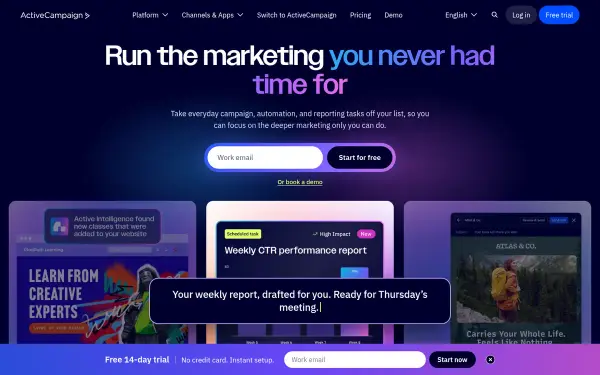
ActiveCampaign builds the most capable automation at this price level, and that is the whole reason to buy it. Branching logic, conditional paths, split automations, lead scoring and contact tagging let you assemble multi-step funnels that react to what a person did and when. Email, SMS and on-site messaging run inside the same flow, and site and event tracking feed it. A CRM with sales pipeline stages sits alongside, so a marketing sequence hands off to a deal.
Starter is $15 per month billed yearly for 1,000 contacts and 1 user seat. There is no free plan, and a 14-day free trial is the entry point. Costs climb with contacts and add-on features, and the single seat on Starter is a hard constraint for a team of three. Model actual contact and feature usage before choosing a tier, because plan costs compound quickly as both grow.
Complexity is the trade. A business that wants a weekly newsletter will find the builder heavy next to Mailchimp or Brevo, and will pay more for it. SMS is capable but not the core strength; stores treating text as a primary channel should look at Klaviyo or Postscript. Deliverability tooling is solid, and reporting covers automation performance rather than channel revenue.
Pick it if you are a B2B or service business running multi-step funnels with lead scoring and a sales pipeline in the same system. Skip it if you want simple campaigns, one bill at the $15 Starter rate and no configuration work.
You run multi-step funnels with lead scoring and want the sales pipeline working from the same contact record.
Your marketing is one weekly newsletter and you have no appetite for building conditional automation.
Entry VI of IX / Shopify-native texting
Our verdict
The best Shopify-native SMS tool here, provided you accept it does not replace your email platform.
Postscript does SMS for Shopify stores and little else, which is the point. Store purchase and browsing data feed segmentation, automated SMS flows fire on store events, and two-way conversational texting handles replies rather than broadcasting into a void. AI-assisted replies draft responses to common customer messages. Keyword and opt-in tools grow the list, and deliverability monitoring plus compliance tooling sit around all of it.
The Starter tier is listed as Free, with $0 per month plus a $49 monthly minimum spend, and SMS at $0.009 each plus carrier fees. The next tier is $100 per month. A free trial includes $100 credit for 30 days. Per-message costs grow with volume, so a heavy promotional calendar needs a real projection rather than the headline rate, and carrier fees sit outside the per-message number.
The obvious limit is that there is no email. Postscript runs alongside an email platform, so you budget for two vendors and maintain a sync between them. Value drops sharply outside Shopify, because the segmentation depends on store data. The compliance tooling is a differentiator rather than a checkbox, since US SMS rules carry registration requirements and real penalties for getting them wrong.
Pick it if you run Shopify, text is a serious revenue channel, and you want conversational SMS with compliance handled. Skip it if you need one platform for both channels or you sell somewhere other than Shopify.
You run Shopify and want a compliant, conversational SMS channel sitting next to your existing email platform.
You are not on Shopify or you want one vendor and one bill covering both channels.
Entry VII of IX / Reviews in the bundle
Our verdict
A consolidation play that pays off only if you genuinely use all three bundled tools, reviews included.
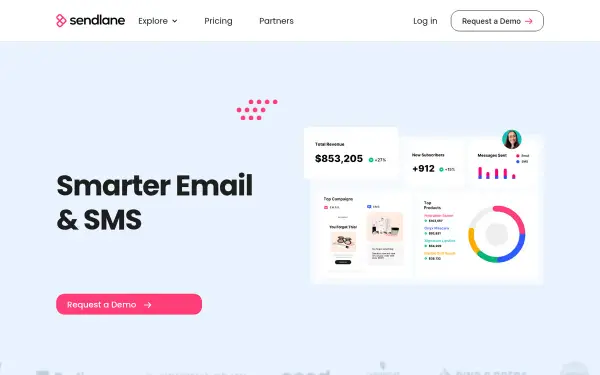
Sendlane bundles three things most stores buy separately: email marketing, SMS and product reviews. One contact record spans the channels, automation triggers on customer behavior, and segmentation and list management run off store data. Ecommerce integrations pull the catalog and order history, and campaign reporting covers all three tools from a single account rather than three dashboards.
Pricing is published as $100 per month for 50,000 emails per month, unlimited profiles, paid monthly. That is send-volume pricing rather than contact-tier pricing, which changes the math: a large list receiving modest volume looks cheap, a small list mailed constantly does not. Tier structures need close comparison at your actual volume. A 60-day free trial is available but limited to 100 contacts and 500 sends.
The value case depends on using all three bundled capabilities. A store with a review app it likes is paying for a feature it will not run. Sendlane has a smaller market presence than the category leader, and its reviews product is relatively new, so check deliverability and support record given the shorter history. For a store replacing two or three subscriptions, the consolidation argument is genuine.
Pick it if you want email, SMS and reviews on one bill, send-based pricing suits your mailing pattern, and you will use all three. Skip it if you need a deep partner ecosystem or a long track record to show your finance team.
You want email, SMS and product reviews consolidated onto one bill with unlimited profiles.
You already run a review app you like or you need a long public track record before signing.
Entry VIII of IX / Fast first campaign
Our verdict
The quickest first campaign in the category, and a steep price curve once your list grows.
Mailchimp is the fastest route to a first email campaign. The campaign builder and templates are straightforward, the free plan covers lists under 250 contacts, and the template and app integration catalog is the largest here. Landing pages and signup forms come bundled. Basic automation journeys and audience segmentation with tags handle welcome and re-engagement sequences without a consultant.
Essentials is the entry paid plan at $6.50 per month for 12 months at 50% off, then from $13 per month. Pricing jumps steeply as lists expand, so the cheap entry does not hold at scale. SMS is an add-on in supported regions rather than a native channel, which limits it for cross-border programs and is a structural gap against every all-in-one on this list.
Advanced automation trails the dedicated platforms. Branching, lead scoring and cross-channel journeys are limited next to ActiveCampaign or Klaviyo. For a small business sending a newsletter, an offer and a welcome series, that hardly matters. For a store trying to coordinate email and text around purchase behavior, it matters a great deal, and the workaround is a second vendor and another login.
Treat it as a starting point with a planned migration path. The free tier and the low opening rate make the first year cheap, and the templates get you live quickly. Plan the move before the list gets large, because the price curve steepens and the SMS gap widens as email becomes a revenue channel.
You are sending your first campaigns to a small list and want the shortest path from signup to a live send.
SMS is central to your plan or your list is already large enough for the price curve to bite.
Entry IX of IX / Customer timeline records
Our verdict
A CRM-shaped email and SMS tool for teams that plan around customer journeys, not one-off campaigns.
Drip frames itself as a CRM for ecommerce rather than an email tool, and the customer timeline is the reason. Every profile carries behavior history, segmentation runs on purchase behavior, and revenue attribution is reported per flow. Email automation workflows and SMS automation share one visual workflow builder, and ecommerce integrations bring order and product data in. The profile view reads well for a team that thinks in customers rather than lists.
Pricing starts at $39 per month for 1 to 2,500 people, with unlimited email sends. That is contact-tier pricing without a send cap, which suits a store that mails often. A 14-day free trial requires no credit card, and there is no free plan, so evaluation means committing to the trial window and rebuilding a real flow inside it before you can judge the product.
The ecosystem is smaller than the category leader's: fewer integrations, less partner content, fewer people who have already solved your exact problem. Pricing scales with contact count, so a fast-growing list moves the bill. The visual builder is strong, and teams that plan around customer journeys get more out of it than teams that plan around one-off campaigns.
Pick it if you want CRM-style records, email and SMS in one workflow builder, and unlimited sends at your contact tier. Skip it if you need a free tier, a large app catalog or SMS as a primary channel.
You plan campaigns around customer journeys and want email and SMS automation in one visual builder.
You need a free plan, a large integration catalog or SMS as your primary channel.
VIBackground
Email and SMS marketing software stores your audience, builds messages, and sends them on a schedule or in response to behavior. The category split matters more than the feature list, because the two channels bill differently and carry different legal risk.
Email is cheap per message and governed by consent rules like opt-in handling and unsubscribe processing. SMS is expensive per message and governed by carrier registration in the US, plus quiet hours and opt-out keywords. A platform that treats SMS as an add-on usually handles consent adequately and deliverability lightly. A platform built around SMS handles registration, carrier filtering and two-way conversation as core product.
Most tools here do four jobs:
The integration between the two channels is where quality varies. A shared profile means a customer who abandons a cart gets one coordinated sequence, not an email and a text arriving four minutes apart with different offers. Separate contact databases produce exactly that, and it is the most common reason stores consolidate onto one platform.
Automation depth is the second differentiator. Basic tools send a welcome series and an abandoned cart reminder. Advanced tools branch on what a customer did, wait for conditions, score leads and hand off to a sales pipeline. ActiveCampaign pushes furthest in that direction; Mailchimp stops well short of it.
Pricing follows the data model. Contact-tier pricing charges for stored profiles and includes a send allowance. Send-volume pricing charges for messages and leaves profiles unconstrained. Per-message SMS pricing charges by the segment. None of these is cheaper in the abstract; each is cheaper at different list sizes and sending habits, which is why modeling your own numbers beats comparing headline prices.
This comparison sits in the marketing register. Further along the shore: Maze alternatives and ticket sales platform.
VIIPricing
Two meters run at once, and they rarely move together. Email is priced by contacts stored or messages sent, depending on the vendor. SMS is priced per message segment plus carrier fees. A store with a large list and modest sends will find contact-tier email affordable and will watch its send allowance. A store with a small list that mails weekly will usually find send-volume pricing cheaper.
Entry prices are the least useful number on any pricing page. Klaviyo's $20 per month covers 500 active profiles and 5,000 emails, which is a testing tier rather than a store tier. Sendlane's $100 per month covers 50,000 emails with unlimited profiles, a different shape of deal entirely.
Promotional rates distort comparisons. Omnisend's $11.20 applies for the first 3 months before the standard rate resumes. Brevo's $11.86 assumes yearly billing and a promo code against a published $17. Mailchimp's $6.50 runs for 12 months before reverting to $13. Compare the rate you will pay in month thirteen.
| Model | How it bills | Typical fit | Example from this list |
|---|---|---|---|
| Contact tier with a send cap | Monthly fee set by active profiles, with an email allowance included | Stores with a growing list and predictable sends | Klaviyo at $20 per month for 500 active profiles and 5,000 emails |
| Send volume | Fee set by emails sent, with profiles unconstrained | Businesses mailing often to a modest list | Sendlane at $100 per month for 50,000 emails and unlimited profiles |
| Per-message SMS | Charge per message plus carrier fees, often with a monthly minimum | Stores adding text on top of an email platform | Postscript at $0.009 per SMS plus carrier fees, on a $49 monthly minimum |
| Custom contract | Quoted rate against committed volume, onboarding included | Large retailers with a dedicated SMS program | Attentive, custom quotes only |
| Promotional entry rate | Discounted opening months, then a published standard rate | Small teams testing a platform | Mailchimp at $6.50 for 12 months, then from $13 |
SMS deserves its own line in any budget. Postscript charges $0.009 per message plus carrier fees on a $49 monthly minimum. Klaviyo meters SMS by message-level credit. Attentive quotes a contract. Three different shapes, one shared trait: the bill tracks volume, not seats.
Each entry card shows the starting price as it appeared on the vendor's own pricing page on November 25, 2026. When a vendor shows no figure we could confirm, or only a promotional rate, the card says "See website" or gives the regular price instead of a guess. Usage, overage and add-on rates in the text change more often than plan prices, so confirm them on the vendor page before you set a budget. To test the numbers against your own volume, try the free User Research Budget Planner. The Event Break-Even Calculator is a second way to check the same decision.
VIIIDecision
IXPitfalls
XQuestions
One platform wins when you want the same segmentation to drive both channels and you would rather not reconcile two contact databases. Separate tools win when SMS is your primary revenue channel and email is secondary, because SMS specialists go deeper on consent, deliverability and conversational features. Two vendors means two bills and a sync to maintain, so decide whether you are buying integration or channel depth.
SMS bills per message segment rather than per campaign. A long text can split into several segments, so a promotional message with a link and a first name can count as more than one message. Carriers also pass through fees, which vendors usually show as a separate line. Postscript publishes $0.009 per SMS plus carrier fees and a $49 monthly minimum spend, the clearest example here.
10DLC stands for 10-digit long code, the ordinary ten-digit number most US businesses text from. US carriers require brands and campaigns sending application-to-person messages to register before traffic is allowed through, and unregistered traffic gets filtered or blocked. Registration means submitting business identity details and describing the message types you will send. It takes time, so start early. This is why consent tooling from Attentive and Postscript matters.
Klaviyo and Postscript are the two most Shopify-centered products here. Klaviyo syncs store data into one profile shared by email and SMS, which supports browse and cart abandonment across both channels. Postscript is Shopify-native for SMS, pulling purchase and browsing data into segmentation, but it is SMS only, so most stores run it next to an email platform. Omnisend and Drip also carry ecommerce integrations, with published entry prices.
Export contacts with consent timestamps and custom fields, not just email addresses, then import and verify that opt-in status survived. Automations rarely export in usable form, so rebuild your five most important flows first and document the logic of the rest. Run both systems in parallel for one send cycle, check deliverability, then cut over. Drip's 14-day trial with no credit card gives a fixed window to rebuild.
Choose a specialist when text is a primary revenue channel, your volume justifies a contract, and consent and deliverability risk need dedicated tooling. Choose all-in-one when you want one contact record, one segmentation model and one bill, and SMS supports rather than leads. Attentive and Postscript sit on the specialist side. Klaviyo, Omnisend, Brevo and Sendlane sit on the all-in-one side, with different depth in each channel.
XIFurther along the shore
Vendors can ask for a correction or apply for a Featured listing. Paid or not, the entry is scored on the same rubric and its limits stay in print. Partner with Umberlake.
Free tools
Our free browser tools turn the prices on this page into a figure for your own volume. Nothing you type leaves your device.