H&R Block
See website
Best for filers who want a free tier plus local office backup
- Free plan
- Yes
- Rubric
- 7.0 of 10
Eight DIY filing tools ranked by who they actually fit, from a $0 federal return to a flat fee that covers every state you file.

IThe short answer
Turbo tax alternatives in November 2026 come down to how complex your return is. H&R Block suits filers who want a free tier plus a local office to walk into, FreeTaxUSA suits confident do-it-yourselfers who want a free federal return and a flat $15.99 state fee, and Cash App Taxes suits simple to moderate returns that can be filed free on both sides. Prices below were checked on November 26, 2026 at each vendor's own pages where one loaded.
8 tools compared from vendor pages on November 25, 2026. 2 publish a starting price we could read; the rest say "See website".
IITop three berths
Register order is editorial fit for the buyer each entry describes. Prices are the starting figures read on November 25, 2026.
See website
Best for filers who want a free tier plus local office backup

FreeFederal always free, state $15.99 per state, optional Deluxe support $7.99
Best for confident do-it-yourself filers chasing the lowest accurate price
See website
Best for cost-focused filers with simple to moderate returns
How this page is paid for. All 8 tools here are unpaid editorial picks.
A paid listing's position can be part of what the vendor pays for. Every entry, paid or not, is scored on the same rubric and keeps its limits in print. Advertising disclosure.
IIIThe register
Starting prices as shown on each vendor's pricing page on November 25, 2026. "See website" means no figure we could confirm.
| No. | Tool | From | Free plan | Trial | Rubric | Actions |
|---|---|---|---|---|---|---|
| 01 | H&R BlockFilers who want a free tier plus local office backup | See websiteNot shown publicly | Yes | No | 7.0 | |
| 02 | FreeTaxUSAConfident do-it-yourself filers chasing the lowest accurate price | FreeFederal always free, state $15.99 per state, optional Deluxe support $7.99Read on vendor page | Yes | No | 8.5 | |
| 03 | Cash App TaxesCost-focused filers with simple to moderate returns | See websiteNot shown publicly | Yes | No | 7.9 | |
| 04 |  TaxActBudget filers who want a mainstream guided product | See websiteNot shown publicly | Yes | No | 6.0 | |
| 05 | TaxSlayerValue shoppers with moderately complex returns | See websiteNot shown publicly | Yes | No | 5.9 | |
| 06 | Jackson Hewitt OnlineMulti-state filers wanting one flat federal plus state price | See websiteNot shown publicly | No | No | 5.5 | |
| 07 | IRS Free FileLower and moderate income filers seeking an official free route | FreeGuided partner software for AGI $95,000 or less, closed until January 2027Read on vendor page | Yes | No | 6.8 | |
| 08 |  OLTFreelancers and solo owners filing Schedule C cheaply | See websiteNot shown publicly | Yes | No | 6.8 |
Pinned:
IVMethod
We scored each product against five criteria and weighted them for a practical comparison: free tier value at 30 percent, state filing cost at 20 percent, form coverage at 20 percent, price transparency at 15 percent and guidance and support at 15 percent. Free tier value asks whether a real person with a real return can file for nothing. State filing cost tracks the line that most often turns a cheap federal return into an expensive total. Form coverage checks whether self-employment, rental and investment income are supported. Price transparency rewards products that publish a number and stick to it. Guidance and support covers both in-product help and access to a human.
Prices and plan details come from each vendor's own pricing pages, checked on November 26, 2026. Several pages did not load or redirected to an error, and where that happened we say so in the entry and treat the figure as unconfirmed rather than presenting it as verified. We did not convert currencies or estimate missing numbers.
The order is editorial. It reflects how well each product fits the specific buyer described in its entry, not a weighted total. Any entry marked Featured is a paid placement and is scored with the same rubric as every other entry, cons included.
The full routine, from price reads to corrections, is on the methodology page. Paid listings follow the advertising disclosure.
Whether a real filer with a real return can complete a federal return at no charge.
What the state return adds, since that line usually decides the total.
Whether self-employment, rental, investment and business income are supported.
How clearly the vendor publishes a number and holds to it at checkout.
The depth of in-product guidance and the routes available to reach a human.
Entry I of VIII / Office network backup

Our verdict
Best for filers who want a no-cost entry tier and a retail office nearby when a question gets complicated.
H&R Block runs four consumer tiers. The Free Online tier files a federal return at $0 and a state return at $0 for simple returns, and it accepts a wider range of forms than several free tiers at competing products. Deluxe adds investment and rental income, Premium covers more involved situations, and the Self-Employed tier handles business income. Every tier carries an accuracy guarantee on the return as filed.
Pricing is the weak point. Starting prices were not confirmed when we checked on November 26, 2026, and paid federal tier pricing is on the vendor site. State filing is billed separately on paid tiers, so the number at the top of the page is not the number at checkout. The listing also notes that prices rise as the April deadline approaches, which penalizes late filers for the same product.
The reason to choose H&R Block is the office network. Thousands of retail locations mean a filer can start online and hand the return to a preparer in person when a question about rental property, a side business or a life event gets beyond the guided interview. A free entry tier plus physical backup is a useful combination.
It fits a filer with a simple return who wants a free option now and a human option later. It fits less well if you have already decided to file entirely yourself, since FreeTaxUSA charges a flat $15.99 per state.
You want a free start, a wide free-tier form list and the option to finish with a preparer down the street.
You are filing one simple state return yourself, where the separate state charge erases the free federal headline.
Entry II of VIII / Free federal, always

Our verdict
A confirmed low-cost route for a confident filer: free federal in every situation and a flat $15.99 per state.
FreeTaxUSA charges nothing for a federal return in every situation it supports, including self-employment, rental and investment income. State returns cost a flat $15.99 per state, and an optional Deluxe upgrade at $7.99 adds extra support. That is the whole model. There are few in-product upsells, and the price you are quoted is close to the price you pay, which is helpful.
The state fee is the number to plan around. A filer in one state pays $15.99 on top of a free federal return. State pricing at other vendors is on their sites. A filer with three states pays $15.99 per state. The optional support tier is a choice, not a requirement to file.
The trade-off is hand-holding. Guidance is lighter than at full-service style tools, so the product suits someone who has filed before and knows which forms apply. If you want an interview that slows down to explain each concept, or a person to call mid-return, this is not the product. If you want to file accurately for the least money and already understand your own return, it is a strong choice for cost-focused filers.
We checked the pricing page on November 26, 2026 and it confirms free federal filing, paid state returns and the optional support upgrade.
You have filed before, know your forms and want the lowest confirmed total for a federal plus state return.
You want a guided interview that explains each step or expect someone to review the return with you.
Entry III of VIII / Zero cost both ways
Our verdict
Free federal and free state with no income cap, as long as your return stays simple enough to self-serve.
Cash App Taxes files federal and state returns at no cost, includes every form it supports, and applies no income cap to eligibility. There are no paid tiers and no upgrade prompts to click past, which removes the most common frustration with free filing products: a free entry point that turns into a bill on the state page. It is positioned as a fully free option in this list.
The limits are about complexity and help. Filing is self-service with limited access to professionals, so a return that needs a review conversation has nowhere to go. Highly complex situations, such as several rental properties, a business sale or part-year moves across states, are better handled by a paid tool with expert review or by a preparer. The design target is simple to moderate returns.
Pricing is also unconfirmed. No official pricing page was available when we checked on November 26, 2026, so the free federal and free state claim rests on the vendor's published description rather than a live page. Confirm it before you start, since a mid-season change would change the math.
It fits a cost-focused filer with a W-2, some interest income and one state, who wants to pay nothing and does not need a human. It fits badly for a filer who expects support during the process or has a return with several schedules attached.
Your return is straightforward, you file one state and you want to pay nothing at all.
You want expert review, own several rentals or sold a business this year.
Entry IV of VIII / Guided interview value

Our verdict
A familiar guided interview at a budget headline, with separate state fees and a processing charge.
TaxAct sells a tiered lineup built around a guided interview, and the free tier is narrower than the name suggests. It covers W-2 employees, students and filers claiming the Child Tax Credit. Deluxe adds investment and rental income, Premier covers more involved returns, and Self-Employed is aimed at business income. Expert help is an add-on rather than part of the base price, and accuracy coverage comes with the filed return.
Pricing is where the budget positioning weakens. Paid federal tiers and state filing are priced on the vendor site, and a processing fee applies to some options. State returns are billed separately and can add significantly to the total. The pricing page returned no content when we checked on November 26, 2026, so confirm pricing on the vendor site before you file.
The guided interview is the reason people pick it: the questions follow a familiar order, expert help is available when a form is unfamiliar, and accuracy coverage is included rather than sold separately. That structure suits a first-time or returning filer who wants a mainstream product and is filing one state with straightforward income.
It fits worst for multi-state filers, and for simple W-2 returns where a genuinely free product does the same job. State pricing is a key difference from FreeTaxUSA.
You want a mainstream guided product with expert help available and you file a single state.
You file two or more states or your return is simple enough for a fully free product.
Entry V of VIII / Broad forms, low price
Our verdict
Wide form coverage at a low mid-tier price, with a free tier that is narrowly scoped.
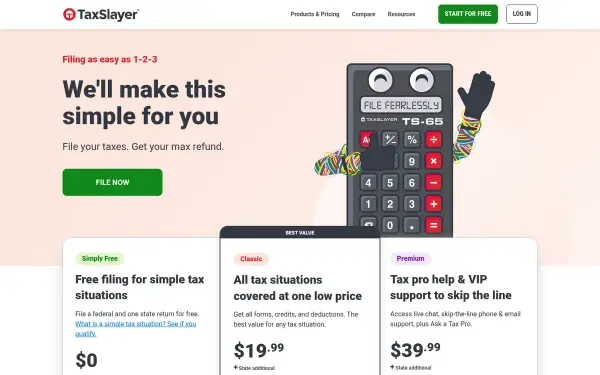
TaxSlayer runs three tiers. Simply Free files a federal return at $0 but only for strict simple returns, and eligibility is tight enough that plenty of filers will not qualify. Classic covers most filers, and Self-Employed handles business income, with pricing on the vendor site. Form coverage across the paid tiers is broad for the price, and military members can file federally for free.
State returns are billed separately, with pricing on the vendor site. The pricing page redirected to an error when we checked on November 26, 2026, so confirm pricing on the vendor site.
The value case is a mid-tier plan priced below many competing products with wide form coverage. That suits a filer with a moderately complex return who does not want premium prices and does not need a brand-name interview. The catch is the free tier: it is promoted prominently but scoped so tightly that you may land on Classic or Self-Employed once your forms are entered.
It fits value shoppers filing one state with a return that includes a few extra forms. It fits poorly if you expect a usable free option for a normal return, or if you file several states, where the per-state charge stacks up quickly.
You have a moderately complex single-state return and want broad form support without premium pricing.
You are counting on the free tier or filing several states.
Entry VI of VIII / One flat price

Our verdict
One flat price for federal plus unlimited states, which favors multi-state filers and penalizes simple ones.
Jackson Hewitt Online takes a different approach from the rest of this list: one flat fee covers the federal return and state returns, and the same price applies to every tax situation it accepts. Pricing is on the vendor site, and there are no per-state charges, so a filer with three states pays what a filer with one state pays. In-person help is available inside Walmart stores through the retail partnership.
That model is either excellent or irrelevant depending on your return. Multi-state filers come out ahead, because a per-state product would add a charge for each state before the federal return is even counted. Filers with a single simple return come out behind, because H&R Block, TaxAct, TaxSlayer, FreeTaxUSA and Cash App Taxes all offer a $0 federal path, and several of those extend free or cheap filing to the state return.
There is no free tier at all, which is the main reason this sits below the free-federal products. Guidance is also lighter than at full-service style competitors, so the flat price buys software plus a counter you can visit, not a review by a preparer.
The flat fee was not confirmed on a live pricing page when we checked on November 26, 2026, so confirm pricing on the vendor site before you file.
It fits multi-state filers who want one number and no surprises. It fits badly for a single-state filer who qualifies for free filing elsewhere.
You file two or more state returns and want a single predictable total.
You file one simple state return that a free product would cover at no cost.
Entry VII of VIII / Official free route
Our verdict
The official free route for lower and moderate incomes, currently closed and capped by an income threshold.
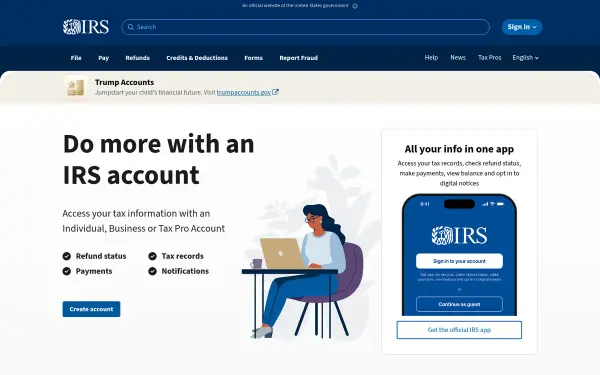
IRS Free File is the government program that routes eligible filers into partner software at no charge for the federal return. It is not a product in its own right: the guided interview you use belongs to one of the participating companies. The agency itself does not upsell inside the program, and state filing terms depend on which partner you land with, so a state return can be free or paid depending on the route you pick.
Eligibility turns on adjusted gross income. The current plan note lists $95,000 or less, while the feature description in the same listing still shows $89,000, so confirm the live threshold at irs.gov before planning around it. The program is also closed until January 2027, which matters if you are filing now rather than waiting for the next season. The agency retired its separate Direct File tool ahead of the 2026 season, so the government-run options should be re-checked rather than assumed.
Set expectations accordingly. This is the right route for a lower or moderate income filer who wants an official starting point with no commercial pitch and can work inside the open window. It is the wrong route for a higher earner, for anyone filing outside that window, and for a filer who wants support from the program itself rather than from a partner's help desk.
Check irs.gov for the current partner list, because participants change between seasons.
Your adjusted gross income falls under the cap and you want an official free starting point next season.
You earn above the threshold or need to file a return before the program reopens in January 2027.
Entry VIII of VIII / Cheap Schedule C
Our verdict
A low-cost niche pick for Schedule C freelancers who want a cheap return and do not need much hand-holding.
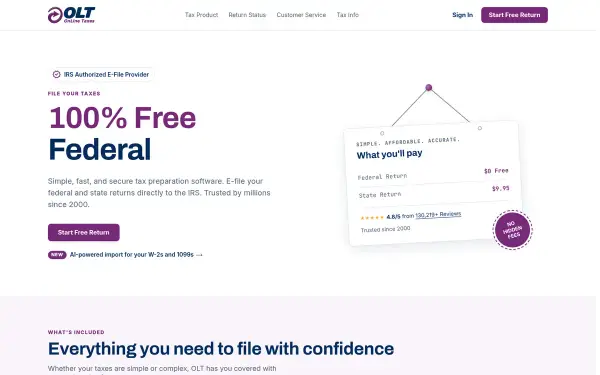
OLT, formerly Online Taxes, is a small operation aimed at one job: filing a Schedule C self-employment return cheaply. It supports Schedule C returns on both the free and paid options, prepares and e-files online, and prices state returns below most competitors in this group. For a freelancer or solo owner with a straightforward business and a couple of 1099s, the pricing is aimed at cost-sensitive filers.
The trade-off is depth. Guidance is thinner than at H&R Block or TaxAct, the brand is smaller with less market presence, and there are fewer support channels when something goes wrong mid-return. If your Schedule C includes a home office allocation, mileage records, depreciation or a mid-year entity change, you will be doing more of the thinking yourself, and a wrong entry costs more than the price difference.
Pricing was not confirmed. No official pricing page was captured when we checked on November 26, 2026, so the free and paid tier amounts could not be verified, and pricing is on the vendor site. Check the vendor site for current pricing before you file.
It fits a cost-sensitive freelancer with a simple business return who is comfortable working without much guidance. It fits badly if you want an interview that catches errors for you, or your business return has more than one moving part and you would rather pay for review.
You file a simple Schedule C return, watch cost closely and can work without much guidance.
Your business return has depreciation, a home office or an entity change you want reviewed.
VBackground
Turbo tax alternatives are online products that walk you through a tax return, fill the forms from your answers and e-file it for you. They replace the tax preparer's interview with a question-and-answer flow, and they price that flow in tiers. Many products in this list have a similar shape: a free or low-cost entry point, paid tiers above it, and a separate charge for state returns.
The tier you land on is set by the forms you need, not by your income. A W-2 employee with the standard deduction may fit a free tier. Add a rental property, a brokerage account or a Schedule C business and you move up a tier, sometimes two. That is why two filers with similar salaries can pay different amounts to the same vendor.
The billing split is the part worth understanding before you shop:
The guidance layer is the other difference. Some products are close to self-service and expect you to know which forms apply. Others slow down, explain the rules and offer paid access to a person. Neither is automatically better; it depends on whether you want a checker or a teacher. Below the paid products sits IRS Free File, a government program that routes eligible filers into partner software rather than selling its own.
This comparison sits in the software register. Further along the shore: baby tracking app and kennel software.
VIPricing
Pricing in this category is a federal headline plus a set of charges that appear later, so the only number worth comparing is the all-in total for your own return. A $0 federal tier can still come with a separate state bill, and a paid federal tier can sit next to a separate state fee.
The main models look like this:
| Model | How it bills | Typical fit | Example from this list |
|---|---|---|---|
| Free federal, paid state | No federal charge, flat per-state fee | Confident filers with one or two states | FreeTaxUSA at $15.99 per state |
| Fully free | No charge for federal or state | Simple to moderate returns | Cash App Taxes |
| Flat all-in | One price covers federal and every state | Multi-state filers | Jackson Hewitt Online, pricing on vendor site |
| Tiered federal plus state | Federal priced by tier, state billed separately | Filers who want a guided brand product | H&R Block, pricing on vendor site |
| Income-capped program | Free federal through partner software | Lower and moderate incomes | IRS Free File, capped by income |
Three variables move the total after you choose a product. Eligibility rules decide whether the free tier is real for your forms. Add-ons, such as support upgrades, expert help and processing fees, sit outside the headline. Timing matters too: at least one vendor here notes that prices rise as the April deadline approaches, so filing later can cost more than filing early.
Where a vendor's page did not load on November 26, 2026, we flag the figure as unconfirmed rather than presenting it as settled. Confirm at checkout.
Each entry card shows the starting price as it appeared on the vendor's own pricing page on November 25, 2026. When a vendor shows no figure we could confirm, or only a promotional rate, the card says "See website" or gives the regular price instead of a guess. Usage, overage and add-on rates in the text change more often than plan prices, so confirm them on the vendor page before you set a budget. To test the numbers against your own volume, try the free User Research Budget Planner. The Event Break-Even Calculator is a second way to check the same decision.
VIIDecision
Count your states first. State returns add a separate charge to the total. One state favors a per-state product, two or more favor Jackson Hewitt's flat fee or a free option like Cash App Taxes.
List the forms you actually have. A W-2 plus interest income fits nearly every free tier. Rental property, Schedule C business income or a brokerage account moves you into paid tiers, so check coverage before you check price.
Add the all-in number. Federal tier plus every state fee plus any support upgrade or processing charge. Compare that total, not the number on the homepage, because the gaps between products live in the add-ons.
Decide how much help you need. Self-service products are cheaper and faster if you know your return. If a form is unfamiliar, an add-on expert session or an office visit is cheaper than an amended return.
Check the calendar and the thresholds. Prices rise near the April deadline at some vendors, and the government program is closed until January 2027. Confirm both before you start.
Confirm the quote. Finish the interview to the review screen, where every charge shows, and only then decide.
VIIIPitfalls
Shopping on the federal headline. The federal price is one line of several. Add the state fee, any support upgrade and any processing charge before you compare two products on cost.
Assuming the free tier fits your forms. Free tiers are scoped by form type and sometimes by income. Read the eligibility rule against your actual documents, not against how simple the return feels.
Filing in the last two weeks. At least one vendor here raises prices as the April deadline nears, so the same return can cost more later in the season for no extra value.
Guessing at the government program. The listing materials show two different income thresholds and the program is closed until January 2027. Check irs.gov rather than relying on an old article or a memory of last season.
Buying guidance your return does not need, or skipping it when it does. A W-2 return rarely needs expert review; a business return with depreciation often does, and a wrong entry costs more than the upgrade.
IXQuestions
FreeTaxUSA has a confirmed total: $0 federal and $15.99 per state. Cash App Taxes is free on both returns but is self-service and best for simple to moderate situations. For two or more states, Jackson Hewitt Online's single flat fee, with pricing on its site, may suit multi-state filers better than per-state pricing.
FreeTaxUSA and Cash App Taxes are the two that do not narrow eligibility by income or form type. H&R Block, TaxAct and TaxSlayer all advertise a free tier, but each scopes it to specific situations, and TaxSlayer's Simply Free is described as very restrictive. IRS Free File is free but capped by income.
H&R Block has thousands of retail offices where a return started online can be finished with a preparer, and every tier carries an accuracy guarantee. Jackson Hewitt Online offers in-person help inside Walmart stores. Check the cost of an office visit, then weigh it against the software price.
Yes, at least at H&R Block, whose listing notes that pricing rises as the April deadline approaches. That makes early filing likely cheaper than filing later in the season for the same product. Prices can change, so confirm the quote before you file.
When the return has more moving parts than the software can check: a business sale, depreciation across rentals, part-year moves between several states, or a notice about a prior year. The flat-fee and free products here target straightforward returns, and a preparer can help avoid errors on a complex return.
IRS Free File is limited to adjusted gross income at or below $95,000 according to the current plan note, though the same listing still shows $89,000, so check irs.gov. The program is closed until January 2027, and the agency retired its separate Direct File tool ahead of the 2026 season.
XFurther along the shore
Vendors can ask for a correction or apply for a Featured listing. Paid or not, the entry is scored on the same rubric and its limits stay in print. Partner with Umberlake.
Free tools
Our free browser tools turn the prices on this page into a figure for your own volume. Nothing you type leaves your device.