
Breezy HR
$157Startup, per month, billed annually, unlimited users and positions
Best for founders making their first hires on a zero-cost plan
- Free plan
- No
- Rubric
- 7.2 of 10
Eight recruiting tools ranked by fit for early-stage teams, with published starting prices where available, free-plan limits and setup effort, checked on November 26, 2026.

IThe short answer
The top recruiting software for startups in November 2026 depends on how many roles you have open. Breezy HR suits founders making their first hires, on a flat fee with unlimited users. Freshteam suits small teams that want a free ATS plus HR basics for up to 50 employees. JazzHR suits budget teams that want a flat-fee applicant tracking system with unlimited seats. All eight tools were checked on November 26, 2026, and every price below comes from the vendor's own pricing sheet.
8 tools compared from vendor pages on November 25, 2026. 5 publish a starting price we could read; the rest say "See website".
IITop three berths
Register order is editorial fit for the buyer each entry describes. Prices are the starting figures read on November 25, 2026.
$157Startup, per month, billed annually, unlimited users and positions
Best for founders making their first hires on a zero-cost plan
See website
Best for small teams wanting a free ATS plus HR basics

$1,000Hero, per year, billed annually, 3 active jobs, unlimited users
Best for budget teams wanting a flat-fee applicant tracking system
How this page is paid for. All 8 tools here are unpaid editorial picks.
A paid listing's position can be part of what the vendor pays for. Every entry, paid or not, is scored on the same rubric and keeps its limits in print. Advertising disclosure.
IIIThe register
Starting prices as shown on each vendor's pricing page on November 25, 2026. "See website" means no figure we could confirm.
| No. | Tool | From | Free plan | Trial | Rubric | Actions |
|---|---|---|---|---|---|---|
| 01 | Breezy HRFounders making their first hires on a zero-cost plan | $157Startup, per month, billed annually, unlimited users and positionsUpdated on vendor page | No | 14-day free trial | 7.2 | |
| 02 | FreshteamSmall teams wanting a free ATS plus HR basics | See websiteNot shown publicly | Yes | Free trial on signup | 7.3 | |
| 03 | JazzHRBudget teams wanting a flat-fee applicant tracking system | $1,000Hero, per year, billed annually, 3 active jobs, unlimited usersUpdated on vendor page | No | Free trial | 6.5 | |
| 04 |  ManatalLean teams sourcing on LinkedIn with AI shortlisting | $15Professional, per user per month, billed annually, up to 15 jobs and 10,000 candidatesRead on vendor page | No | 14-day free trial, no credit card required | 6.5 | |
| 05 |  WorkableStartups wanting hiring and core HR in one subscription | $299Standard, per month, for 1 to 20 employees, annual billing option shownRead on vendor page | No | 15-day free trial, no credit card required | 5.9 | |
| 06 |  AshbyScaling tech teams hiring every week | $400Foundations, per month, up to 100 employees, 10 percent discount for annual commitmentsRead on vendor page | No | No | 5.7 | |
| 07 |  RecruiteeCollaborative hiring teams with cyclical open roles | See websiteNot shown publicly | No | 18-day free trial | 5.6 | |
| 08 |  LeverStartups with dedicated recruiters hiring at volume | See websitecustom quoteNot shown publicly | No | No | 5.2 |
Pinned:
IVMethod
We scored each tool on five things a startup feels in the first month: entry cost, free plan value, core ATS depth, setup speed and how far the product stretches as headcount grows. Entry cost carried 25 percent because a founder's budget is fixed. Free plan value (20 percent) separates a lasting no-cost tier from a 14-day trial. Core ATS depth (25 percent) covers posting, parsing, pipelines, scheduling, scorecards and reporting. Setup speed (15 percent) reflects how much of a week you lose before the first candidate lands. Scale ceiling (15 percent) asks whether the same system survives your tenth hire and your first dedicated recruiter.
Prices, plan names, trial lengths and free-plan limits in this list come from vendor pricing pages where those pages published them, checked on November 26, 2026. Where a vendor publishes no figure, we say pricing is on the vendor site rather than quoting a number we cannot confirm. Where a plan changed, such as Breezy HR's free tier, we show the current paid entry price and say so.
A Featured placement is a paid position on this page. It is scored with the same rubric and written with the same willingness to list cons as every other entry. The order is editorial: it reflects fit for the buyer each entry describes, not a calculated total.
The full routine, from price reads to corrections, is on the methodology page. Paid listings follow the advertising disclosure.
What the cheapest useful paid plan costs per month at a realistic startup size.
Whether a no-cost tier lasts and how far its limits stretch before you must upgrade.
Coverage of posting, parsing, pipelines, scheduling, scorecards and reporting out of the box.
How much calendar time passes between signup and the first real candidate in the pipeline.
Whether the same system survives your tenth hire and your first full-time recruiter.
Entry I of VIII / One-click board posting
Our verdict
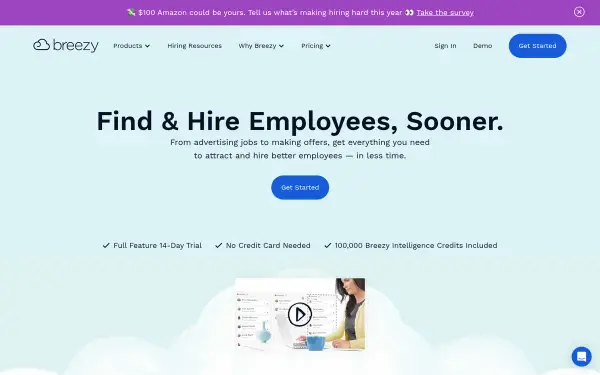
Flat fee, unlimited seats and one-click posting to 50-plus boards, with paid plans starting at $157 per month billed annually.
Breezy HR is built around a visual pipeline: you drag candidates between stages, send screening questionnaires and run video meetings without leaving the browser. It parses resumes into candidate profiles, distributes a job to 50-plus job boards in one click and keeps unlimited users and candidates on paid plans. GDPR tooling is included for teams hiring in Europe.
Pricing is a flat monthly fee rather than a per-seat charge. Startup is $157 per month billed annually, or $189 month to month, with unlimited users and positions. Growth is $273 and Business is $439. The vendor page now states there is no free plan, so the lowest paid tier is the entry point; earlier descriptions of a free tier limited it to one active position.
The catch is tiering. Scorecards and eSignatures require Growth, and SMS, onboarding and AI credits are paid add-ons. If your process is one interview loop and a written offer, those gaps rarely bite. If you want structured scorecards from day one, budget for Growth rather than Startup.
It fits founders making their first hires who want unlimited seats without a per-seat bill, and small teams posting to many boards at once. It fits less well once you need onboarding included at the entry price, since it is a paid add-on.
You want unlimited hiring seats on a flat monthly fee and post to many boards at once.
You need scorecards, eSignatures or onboarding included at the entry price.
Entry II of VIII / Free HR plus ATS
Our verdict
Free for up to 50 employees and one of the few tools here that also handles time off and onboarding.
Freshteam pairs a lightweight applicant tracking system with the HR basics a small company needs. Recruiting runs on kanban-style pipelines with email templates and a career site; the same login covers an employee directory, an org chart, time-off requests and onboarding workflows. It connects to Slack, Zoom and Google Calendar, and paid tiers add recruiting autopilot, custom pipelines, scorecards and offer management.
The free plan is the reason to look: it covers up to 50 active employees at no cost, which is rare among ATS products. The limit to know is that the free tier caps published job postings at 3, so running four roles at once forces an upgrade. Growth lifts that cap to 20 jobs and unlocks the automation.
Pricing sits on the vendor site rather than in a headline figure, so check current plan rates there. The platform fee sits on top of the per-employee charge, so the base fee is only part of the monthly cost.
It fits small teams that want one inexpensive system for hiring and basic HR admin, and companies already using Freshworks products. Customization and integrations are thinner than dedicated ATS tools, so teams running many concurrent roles with structured interview loops will outgrow it.
You are under 50 employees and want a free ATS plus basic HR admin on one login.
You keep more than three roles live at once or need deep pipeline customization.
Entry III of VIII / Unlimited seats, flat fee
Our verdict
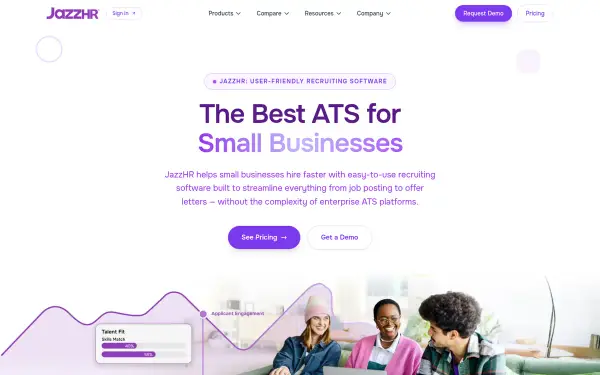
Published flat-fee pricing, unlimited seats and a 3-job entry plan for teams that hire in bursts.
JazzHR is a straightforward applicant tracking system. Jobs are posted and syndicated to multiple boards, resumes are parsed into profiles, and candidates move through custom hiring stages with interview scheduling and interviewer evaluations attached. Hiring reporting is included, every plan carries unlimited users, and texting and eSignatures are available as add-ons.
Pricing is published and flat. Hero is $1,000 per year billed annually, about $83 per month, and covers 3 active jobs with unlimited users; month to month it is $99. Plus is $269 billed annually ($325 monthly) with 200 jobs, and Pro is $420 ($499 monthly) with unlimited jobs. Extra job slots on Hero cost about $9 each per month.
That structure suits a startup that hires in bursts: you pay for seats without counting them, and you buy job slots only when a role opens. The trade-off is depth. Texting, eSignatures and advanced reporting cost extra, and there is no HRIS layer, so onboarding, time off and payroll live elsewhere. There is no permanent free plan, though a free trial lets you test the workflow first.
It fits budget teams that want a flat fee, unlimited seats and quick setup, and small companies that already run HR on separate tools. It fits less well for teams that want recruiting and HR admin in a single subscription.
You want a flat annual fee with unlimited seats and three or fewer live roles.
You run many openings at once or want onboarding and time off included.
Entry IV of VIII / AI candidate scoring
Our verdict
The cheapest AI-assisted entry here at $15 per user per month, with LinkedIn sourcing built in.
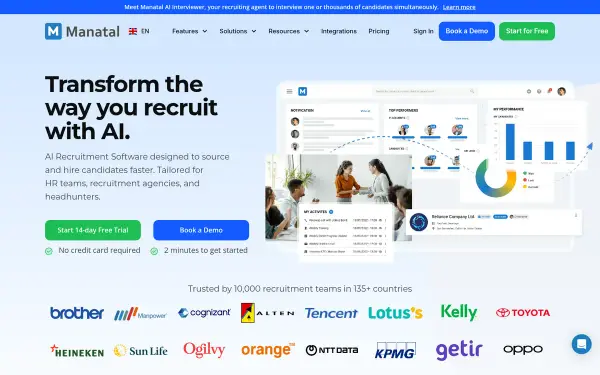
Manatal combines an applicant tracking system with a recruiting CRM and leans on AI for shortlisting. It recommends and scores candidates, enriches profiles from LinkedIn and social sources, and ships a Chrome extension for sourcing while you browse. A branded career page builder, a candidate database and talent pools cover the rest of the funnel.
Pricing is per user. Professional is $15 per user per month billed annually ($19 on monthly billing) and allows up to 15 jobs and 10,000 candidates. Enterprise is $35 and Enterprise Plus is $55 per user per month, with workflow automations from Enterprise and API access plus SSO on Enterprise Plus. The 14-day trial requires no credit card.
The per-seat model cuts both ways. Each recruiter on Professional pays the per-user rate, the lowest AI-assisted entry on this list. Add more hiring managers and the bill climbs, and the caps on open jobs and candidates arrive sooner for teams hiring continuously.
It fits lean teams that source on LinkedIn and want AI shortlisting without a sales call, and small agencies hiring from a shared candidate pool. It fits less well if you need automations or SSO on a tight budget, since both sit on higher tiers. There is no free plan.
You source on LinkedIn and want AI scoring at the lowest per-seat price here.
You need automations or SSO without moving to a higher per-user tier.
Entry V of VIII / Hiring plus HR
Our verdict
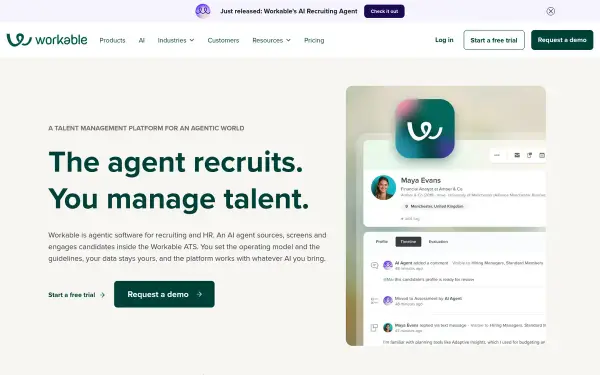
One subscription for recruiting and HR admin, priced per company at $299 per month for up to 20 employees.
Workable sells hiring and core HR in one subscription. The ATS side covers AI-powered candidate sourcing, posting to 200-plus job boards and video interviews on higher tiers; the HR side covers onboarding workflows, time off and payroll preparation. It lists 270-plus integrations and prices per company rather than per seat, with AI sourcing credits included on Standard.
Standard is $299 per month for companies of 1 to 20 employees, shown with an annual billing option, and annual billing is charged upfront at the same monthly rate. Premier is $599 and Enterprise is $719. A 15-day free trial requires no credit card.
The pricing curve is the thing to model before you commit: cost rises with headcount above 20 employees, so a team planning to double in a year should ask for the numbers at larger headcounts. Texting, video interviews, assessments and performance reviews are add-ons rather than included features.
It fits startups that want one vendor for recruiting and HR admin, a published price and a wide integration marketplace. It fits less well for a small company that only needs an ATS, where a flat-fee tool or a free plan costs far less. There is no free plan.
You want recruiting and HR admin from one vendor at a published per-company price.
You only need an ATS for a handful of hires this year.
Entry VI of VIII / Pipeline analytics depth
Our verdict
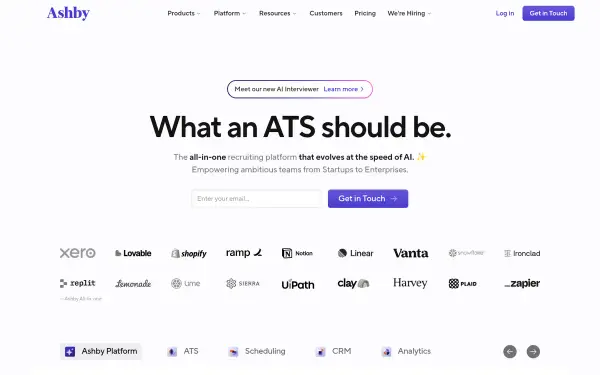
Deep ATS and CRM analytics for teams hiring every week, with a $400 monthly floor and no trial.
Ashby puts applicant tracking and candidate relationship management in one system, which removes the usual handoff between a sourcing tool and an interview tool. It automates interview scheduling, handles offer management and produces hiring analytics such as pipeline health and time to hire. Sourcing and outreach tooling sits alongside the pipeline, and an advanced scheduling add-on plus an AI notetaker add-on extend the core.
The entry price is published: Foundations is $400 per month for companies up to 100 employees, with a 10 percent discount for annual commitments. Plus and Enterprise are quote-based, larger deals carry implementation costs, and there is no free trial or free plan.
At $400 per month before add-ons, the math only works if hiring is continuous. A team running several roles every week gets real value from consolidated scheduling, structured feedback and time-to-hire reporting. A pre-seed company making two hires a year pays for depth it will not use, and onboarding takes weeks rather than hours.
It fits scaling tech teams with a recruiter or a founder who owns hiring full time. It fits less well for occasional hiring, for teams that want to trial before signing, or for companies that want recruiting and payroll from one vendor.
You hire every week and want pipeline analytics in the same system as your ATS.
You are pre-seed, hire a few times a year, or need a trial before committing.
Entry VII of VIII / Collaborative hiring workflow
Our verdict
Job-slot pricing and strong collaboration for teams whose open roles rise and fall through the year.
Recruitee is a collaborative applicant tracking system built around shared hiring work. It covers the standard pipeline plus employer branding and branded career pages, sourcing tools, hiring analytics and team scorecards, and it connects to 250-plus job boards. Texting and WhatsApp hiring are available as add-ons.
Pricing is job-slot based: you pay for the open roles you carry and the users who work them, rather than for headcount. The vendor site describes Start, Advance and Optimize plans but shows no price figures, so you have to request rates. Older figures are unreliable for budgeting, so confirm current rates on the vendor site.
The slot model suits companies with cyclical hiring: a startup that opens eight roles in one quarter and two the next pays closer to what it uses. The trade-offs are that costs scale with both users and open slots, messaging add-ons cost extra, and there is no free plan. The 18-day trial is longer than most here, which gives a small team time to run a real hiring round before deciding.
Recruitee is part of Tellent and started in Amsterdam. It fits small teams who collaborate on hiring and want branding controls without an enterprise contract. It fits less well if you need a published price before you will book a call.
Your open roles swing up and down and several people share the hiring work.
You need a published price before you will start a conversation.
Entry VIII of VIII / CRM-first nurture
Our verdict
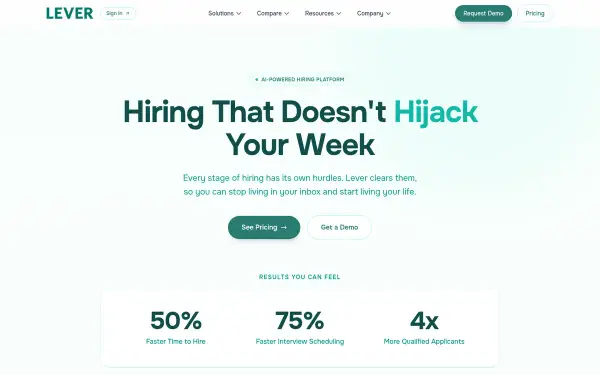
A CRM-first platform for dedicated recruiters, sold on custom quotes with no trial or published price.
Lever is a candidate relationship management system first and an applicant tracking system second. Sourcing campaign management, talent nurture pipelines and talent pools sit at the center, with referral management, recruiting automation, interview scheduling and offer management around them. Analytics and reporting are aimed at talent teams that review pipeline data every week.
There is no published pricing. Lever sells through a custom quote and an enterprise-style sales process, and the vendor publishes no trial or free plan. That means you cannot benchmark cost without a conversation, and you should expect a contract and onboarding shaped by the vendor rather than a self-serve signup.
The product rewards teams that treat recruiting as a pipeline: nurture sequences for candidates who were not ready last quarter, referrals tracked properly, automation that keeps follow-ups from slipping. For a startup making a few hires a year, that machinery is overhead, and the sales cycle will outlast the hiring need.
It fits startups with at least one dedicated recruiter hiring at volume in a competitive talent market. It fits less well for founders making their first hires, teams that need a published price or a self-serve trial, and anyone who wants recruiting and HR admin from one vendor.
You have a recruiter and hire at volume in a market where candidates go cold.
You need a published price, a trial, or a self-serve signup this week.
VBackground
Recruiting software is the system of record for hiring. It holds every job you open, every applicant who applies and every note, scorecard and interview slot attached to them, so the pipeline lives in one place instead of across a spreadsheet, a shared inbox and a calendar thread.
An applicant tracking system handles the active pipeline end to end. You publish a role to job boards or your careers page, applications arrive and resumes are parsed into structured profiles, candidates move through stages, interviewers leave evaluations, and an offer goes out with approvals attached. Reporting shows where candidates drop out and how long each stage takes.
A recruiting CRM adds the longer view: talent pools, nurture sequences and sourcing outreach for people you are not hiring right now. Some tools here combine both (Manatal, Ashby, Lever), while others stay close to the active pipeline (JazzHR, Freshteam).
What separates the tools in practice:
For a small team the job is simple: one place where every candidate, decision and next step is visible to whoever is hiring.
This comparison sits in the software register. Further along the shore: baby tracking app and kennel software.
VIPricing
Pricing falls into five models, and the model matters more than the sticker price because it decides what you pay as the team grows. Flat fees reward adding hiring managers; per-user and per-employee models punish it.
| Model | How it bills | Typical fit | Example from this list |
|---|---|---|---|
| Flat fee per company | One monthly or annual price, unlimited users | Teams that add interviewers freely | Breezy HR at $157 per month billed annually; JazzHR at $1,000 per year on Hero |
| Per user per month | Charged for each seat | Small recruiting teams with few users | Manatal at $15 per user per month billed annually |
| Per employee plus platform fee | Headcount-based charge on top of a base fee | Teams that also want HR basics | Freshteam, with pricing on the vendor site |
| Job-slot based | Priced by open roles and the users working them | Cyclical or project hiring | Recruitee, which sells on open job slots |
| Quote only | Custom contract after a sales process | Larger or volume hiring teams | Lever, and Ashby's Plus and Enterprise tiers |
Two numbers decide the real cost. The first is what happens above 20 employees: Workable Standard is $299 per month for 1 to 20 employees and rises with headcount, while Ashby Foundations holds at $400 per month up to 100 employees. The second is add-ons. Breezy HR puts scorecards and eSignatures on Growth, JazzHR sells texting and eSignatures separately, and Workable charges extra for video interviews and assessments.
Free tiers are rare. Freshteam covers up to 50 employees but caps published job postings at 3. Breezy HR, JazzHR, Manatal, Workable and Recruitee offer trials, while Ashby and Lever offer neither a trial nor a free plan.
Where a vendor publishes no figure, pricing is on the vendor site and has to be requested.
Each entry card shows the starting price as it appeared on the vendor's own pricing page on November 25, 2026. When a vendor shows no figure we could confirm, or only a promotional rate, the card says "See website" or gives the regular price instead of a guess. Usage, overage and add-on rates in the text change more often than plan prices, so confirm them on the vendor page before you set a budget. To test the numbers against your own volume, try the free User Research Budget Planner. The Event Break-Even Calculator is a second way to check the same decision.
VIIDecision
Count your live roles and your interviewers. Write down how many jobs will be open in the next six months and how many people will sit in on interviews. That single number rules out per-user tools or confirms them, and it tells you whether a 3-job entry plan is enough.
Set a monthly ceiling before you look. Decide the most you will pay per month, including add-ons. Compare against real entries: $15 per user at Manatal, $157 per month at Breezy HR, $299 at Workable, $400 at Ashby, and a quote at Lever.
Decide whether you need HR basics. If you also want onboarding, time off or payroll preparation in the same login, start with Freshteam or Workable. If recruiting is the only job, a dedicated ATS such as JazzHR or Breezy HR keeps the bill down.
Read the free plan's limits, not its headline. Freshteam is free up to 50 employees but caps published job postings at 3. Check every cap that touches your hiring plan, including active jobs, candidate records and users.
Run one real role through a trial. Breezy HR offers 14 days, Manatal 14, Workable 15 and Recruitee 18. Post a live job, schedule two interviews and write one scorecard. Ashby and Lever offer no trial, so ask for a guided walkthrough instead.
Recheck the price the week you sign. Vendors change tiers and add-ons. Confirm the figure on the pricing sheet before you commit for a year.
VIIIPitfalls
Buying on seat price alone. A $15 per user plan sounds cheap until several hiring managers need access. Multiply the per-user price by everyone who will log in before you compare it to a flat fee.
Ignoring the add-on list. Scorecards on Breezy HR sit on Growth, and texting, eSignatures and video interviews are extras on JazzHR and Workable. Price the bundle you actually need, not the entry tier.
Choosing a quote-only platform for two hires a year. Lever and Ashby's upper tiers sell through a sales process. If you hire twice a year, the contract and onboarding will consume more time than the hiring itself.
Assuming a free plan scales. Freshteam's free tier is generous on headcount but caps published job postings at 3. Map your hiring calendar against that cap before you build a process on top of it.
Skipping the trial and the recheck. Fourteen to eighteen days of trial is enough to run a live role. Use it, then confirm the current price and limits on the vendor pricing sheet the week you sign.
IXQuestions
Freshteam is the only tool in this list with a lasting free plan. It covers up to 50 active employees, but the free tier caps published job postings at 3, so you can run a small number of roles comfortably. Breezy HR was once described with a free tier; the vendor page checked on November 26, 2026 states there is no free plan, with paid plans from $157 per month billed annually. Ashby and Lever offer neither a trial nor a free plan.
It moves one hire from job posting to signed offer in a single place. You publish a role to job boards, applications land in a candidate database, resumes are parsed into profiles, and candidates move through stages with scheduling, interview scorecards and offer approval attached. Reporting shows where candidates drop out. It replaces the spreadsheet, the shared inbox and the calendar thread with one record that the whole hiring team can see.
It stops being enough the moment more than one person touches candidates and versions start to disagree. A spreadsheet cannot parse resumes, schedule interviews, keep scorecards consistent or show where a candidate stalled. The break usually arrives once several roles are open, or when the second interviewer joins. At that point a free plan such as Freshteam, or a flat fee such as JazzHR at $1,000 per year, costs less than the admin time lost.
An ATS runs the active pipeline for a specific job; a recruiting CRM keeps in touch with people you are not hiring yet. Manatal, Ashby and Lever combine both, with talent pools, nurture campaigns and sourcing outreach alongside hiring stages. If you hire the same kind of role repeatedly, the CRM half earns its keep because warm candidates stay reachable. If you hire once or twice a year, a plain applicant tracking system is enough.
Self-serve tools are typically live in days. Breezy HR, JazzHR and Manatal run on signup with guided configuration, and trials of 14 to 18 days are enough to push a real role through. Sales-led platforms take longer: Ashby's implementation is measured in weeks rather than hours, and Lever's quote-based contract brings its own onboarding. Budget the calendar time, not only the subscription, when you compare options.
Expect $15 per user per month to $157 per month at the earliest stage. Manatal starts at $15 per user per month billed annually, Breezy HR at $157 per month billed annually, and JazzHR at $1,000 per year on Hero, about $83 per month. Growth-stage teams adding HR basics land between $299 and $400 per month on Workable Standard or Ashby Foundations. Quote-only platforms such as Lever require a custom quote.
XFurther along the shore
Vendors can ask for a correction or apply for a Featured listing. Paid or not, the entry is scored on the same rubric and its limits stay in print. Partner with Umberlake.
Free tools
Our free browser tools turn the prices on this page into a figure for your own volume. Nothing you type leaves your device.