Epic
See website
Best for large hospitals and integrated health systems
- Free plan
- No
- Rubric
- 7.2 of 10
Eight medical software and EHR platforms compared for fit, pricing structure, implementation effort and billing support, with prices checked on November 26, 2026.

IThe short answer
The top medical software companies for November 2026 are a fit question first, a brand question second. Epic suits large hospitals and integrated health systems, Oracle Health suits hospitals and systems standardizing on Oracle, and athenahealth suits ambulatory practices that want billing included. The eight platforms below cover inpatient, ambulatory and specialty workflows, with prices checked on November 26, 2026. Most publish no list price, so compare quote scope, implementation load and the cost of interfaces before you shortlist.
8 tools compared from vendor pages on November 25, 2026. 0 publish a starting price we could read; the rest say "See website".
IITop three berths
Register order is editorial fit for the buyer each entry describes. Prices are the starting figures read on November 25, 2026.
See website
Best for large hospitals and integrated health systems
See website
Best for hospitals and systems standardizing on Oracle
See website
Best for ambulatory practices that want billing included
How this page is paid for. All 8 tools here are unpaid editorial picks.
A paid listing's position can be part of what the vendor pays for. Every entry, paid or not, is scored on the same rubric and keeps its limits in print. Advertising disclosure.
IIIThe register
Starting prices as shown on each vendor's pricing page on November 25, 2026. "See website" means no figure we could confirm.
| No. | Tool | From | Free plan | Trial | Rubric | Actions |
|---|---|---|---|---|---|---|
| 01 | EpicLarge hospitals and integrated health systems | See websiteNot shown publicly | No | No | 7.2 | |
| 02 | Oracle HealthHospitals and systems standardizing on Oracle | See websiteNot shown publicly | No | No | 6.6 | |
| 03 | athenahealthAmbulatory practices that want billing included | See websiteNot shown publicly | No | No | 7.4 | |
| 04 |  eClinicalWorksMid market and multi site practices | See websiteNot shown publicly | No | No | 6.3 | |
| 05 | MEDITECHCommunity hospitals and mid size facilities | See websiteNot shown publicly | No | No | 6.3 | |
| 06 |  NextGen HealthcareSpecialty practices with deep templates | See websiteNot shown publicly | No | No | 6.3 | |
| 07 |  AdvancedMDIndependent clinics that want an integrated suite | See websiteNot shown publicly | No | No | 6.2 | |
| 08 | Elation HealthPrimary care practices that value fast charting | See websitecustom quoteQuote only | No | No | 6.2 |
Pinned:
IVMethod
We compared the eight platforms on five criteria: clinical fit (25%), implementation ease (20%), revenue cycle strength (20%), data exchange (20%) and pricing clarity (15%). Scores run from 1 to 10. They are a comparison aid, not a sorting formula: the order is editorial and follows the buyer each entry describes.
Pricing comes from vendor pricing pages checked on November 26, 2026. Most entries show See website because the vendor quotes per organization, provider count or module, or because no public price was visible during the check. We do not estimate a number or convert a currency. Where a plan note exists, it is stated in the entry. For athenahealth, the facts note that some contracts price as a share of collections, so we treat that model as a cost and revenue question rather than a fixed subscription.
This edition has no Featured entry. A Featured entry, when present, is a paid placement and is scored with the same rubric as every other tool; it would receive the same scrutiny on pricing, limits and fit. We do not accept vendor copy as proof of workflow quality. The review text sticks to the features, strengths, weaknesses and pricing facts supplied for each tool.
Readers should use the scores to spot tradeoffs, not to assume a single winner. A high clinical fit score does not make a hospital platform right for a small clinic, and a lower price clarity score may simply reflect a negotiated enterprise sale.
The full routine, from price reads to corrections, is on the methodology page. Paid listings follow the advertising disclosure.
Depth of clinical workflow coverage for the buyer the entry targets.
Higher scores mean lighter setup, training and go live effort.
How clearly a buyer can see and compare the full cost before signing.
Strength of billing, claims and collections support inside the platform.
Breadth of health information exchange, referral and patient access connections.
Entry I of VIII / Integrated clinical record
Our verdict
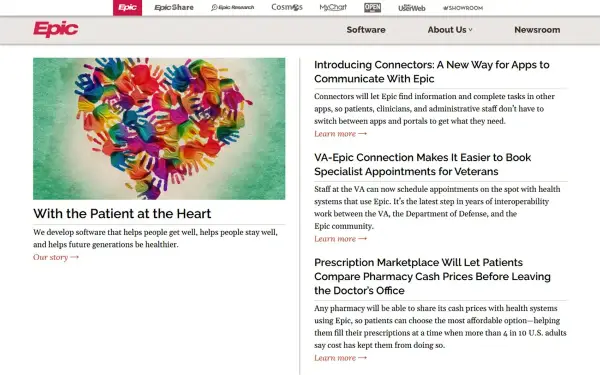
Epic is the enterprise choice for large systems that can absorb a long rollout and need one clinical and financial record.
Epic fits large hospitals and integrated health systems because it combines inpatient and ambulatory documentation, emergency department and laboratory workflows, pharmacy and revenue cycle work in one record. MyChart gives patients a portal many already recognize, and the app marketplace lets a system add specialty tools without replacing the core. Community Connect extends hosting to smaller affiliated groups, though those groups usually access Epic through a host organization rather than buying directly.
The limits are practical. Pricing is negotiated per organization, with licensing, interfaces and training bundled into an agreement, so pricing is on the vendor site and no public number is available to compare. Large system rollouts commonly run 12 to 36 months, and ongoing updates require dedicated internal staff. The buying work is therefore scope control: name every interface, training hour, upgrade responsibility and support term before signing.
Epic is not a light purchase, and it is not meant to be. The financial case rests on replacing several disconnected clinical and financial systems with one record, then running it with a trained internal team. A smaller group that wants a fast, self serve purchase should look at ambulatory tools first.
Pick Epic if you are a multi hospital system that needs clinical, ancillary and financial work in one record and can staff a long implementation. Skip it if you are a small independent practice that needs a quick purchase and light support.
You are a multi hospital system that can staff a 12 to 36 month rollout and wants one clinical and financial record.
You are a small independent practice that needs a quick purchase and light support.
Entry II of VIII / Oracle cloud ties
Our verdict
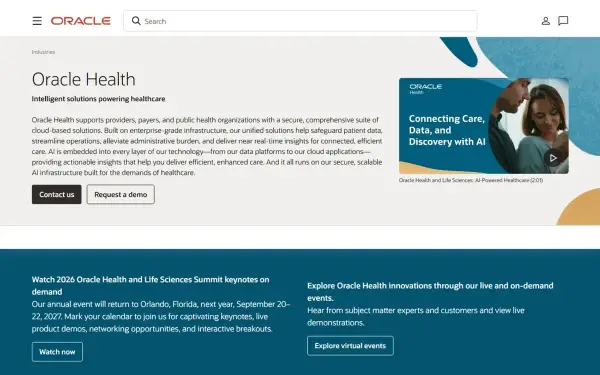
Oracle Health suits hospitals with an Oracle cloud strategy, provided buyers pin down roadmap, support and migration terms.
Oracle Health fits hospitals and systems that want to standardize clinical and financial work on Oracle. The platform covers inpatient documentation and orders, ambulatory clinic workflows, laboratory and pharmacy modules, revenue cycle management and cloud hosting, with integration into Oracle data and cloud applications. Its hospital footprint comes from the Cerner lineage, so many buyers will already know the core workflows and the training burden that comes with them.
Pricing is on the vendor site with no public price to compare, so the real comparison is scope: interfaces, migration, training and support. Implementation remains a multi month project for mid size hospitals, and the Oracle acquisition makes roadmap and support continuity fair questions. Ask for a written product roadmap, named support contacts and a migration plan that separates old Cerner obligations from new Oracle terms.
The Oracle tie is the differentiator. A system already using Oracle database, cloud or enterprise applications may value the integration path, while a hospital without that stack should test whether the connection earns its place in the total cost.
Pick Oracle Health if you are a hospital or system with an Oracle cloud strategy and can manage a multi month rollout. Skip it if you need a quick ambulatory-only start or want published pricing before a sales conversation.
You are a hospital or system with an Oracle cloud strategy and can manage a multi month rollout.
You need a quick ambulatory-only start or want published pricing before a sales conversation.
Entry III of VIII / Bundled billing service

Our verdict
athenahealth fits general ambulatory practices that want cloud charting and managed billing, but collections based fees need modeling.
athenahealth fits ambulatory practices that want clinical charting and billing support from one cloud vendor. athenaOne covers charting, scheduling and registration, a patient portal, telehealth, payer connectivity and claims clearinghouse links, while managed revenue cycle services reduce follow up work for the front office. The cloud model keeps on site infrastructure light and gives smaller teams a broad network of payer connections.
The pricing model needs care. Many contracts price as a share of collections, so cost scales with revenue, and pricing is on the vendor site rather than a public list. The system is less customizable than enterprise grade platforms, which makes it a poor fit for unusual specialty workflows. Model costs at current and projected revenue, then ask exactly which billing tasks the managed service owns and which stay with your staff.
The strongest case is a general ambulatory practice that would rather buy billing service than build a billing team. The weakest case is a specialty practice with workflows that need heavy configuration or a buyer who wants a fixed software fee.
Pick athenahealth if you run a general ambulatory practice and want billing service bundled with the EHR. Skip it if you need deep specialty customization or prefer a fixed software fee that does not move with collections.
You run a general ambulatory practice and want billing service bundled with cloud charting.
You need deep specialty customization or a fixed software fee that does not move with collections.
Entry IV of VIII / Multi site reporting
Our verdict
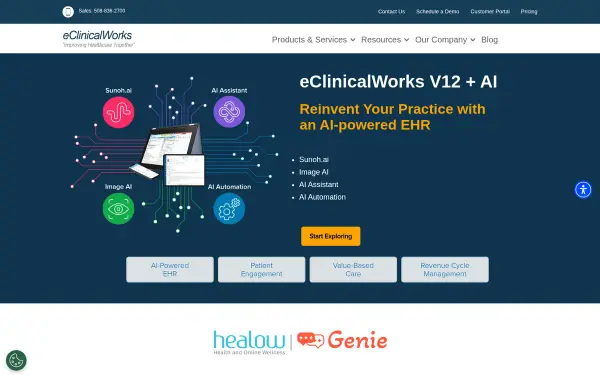
eClinicalWorks gives multi site practices broad ambulatory coverage, with a dense interface and implementation quality that vary by team.
eClinicalWorks fits mid market and multi site practices that want broad ambulatory coverage in one system. It includes electronic health records, practice management and scheduling, ePrescribing, telehealth, patient portal and engagement tools, specialty content for common ambulatory fields and consolidated reporting across locations. A single record across sites simplifies reporting and billing, and owners can compare locations without exporting data from separate systems.
The tradeoffs are interface density and implementation variance. The interface is dense enough that usability complaints are common, and training quality depends heavily on the implementation team you get. Pricing is quote based, assembled from provider count, location count and selected modules, with pricing on the vendor site. Ask for an itemized total that includes interfaces and implementation, then request a demo built around your own specialty workflow rather than a generic script.
The product is broad rather than minimal. That helps a multi site group standardize, but it also means clinicians need real training before go live and a plan for template cleanup after launch.
Pick eClinicalWorks if you need one ambulatory system across several sites and can invest in training. Skip it if your clinicians need a sparse interface or your specialty workflow falls outside the common templates.
You need one ambulatory system across several sites and can invest in training and template cleanup.
Your clinicians need a sparse interface or your specialty workflow falls outside the common templates.
Entry V of VIII / Hospital first Expanse
Our verdict
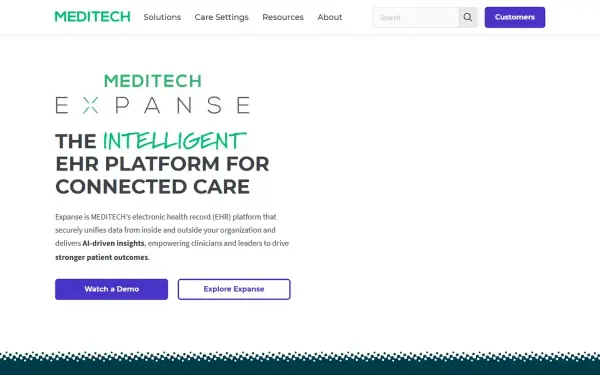
MEDITECH is a hospital first platform for community facilities, not a quick buy for small independent practices.
MEDITECH fits community hospitals and mid size facilities that want a hospital first platform. Expanse provides a web based clinical interface, inpatient documentation and orders, emergency department workflows, ambulatory clinic support, revenue cycle management, a patient portal and interoperability tools for referrals and record exchange. The implementation and support model is scaled for mid size facilities rather than only academic centers, which is the main reason to keep it on a hospital shortlist.
Cost and effort still reflect hospital scale. MEDITECH is oversized and costly for small independent practices, implementation is a hospital scale project, and interface costs plus upgrade cadence need to be priced over several years. Pricing is on the vendor site with no public price to compare, so compare a multi year view rather than the first year license alone. Ask for third party app support terms and a clear list of which interfaces are included.
The web based Expanse interface is the modern face of the product, but the buying decision still turns on hospital workflows, support capacity and long term interface costs.
Pick MEDITECH if you are a community hospital that wants a web based record across inpatient and ambulatory settings. Skip it if you are an independent practice or need a fast, low overhead ambulatory-only system.
You are a community hospital that wants a web based record across inpatient and ambulatory settings.
You are an independent practice or need a fast, low overhead ambulatory-only system.
Entry VI of VIII / Specialty template depth
Our verdict
NextGen Healthcare earns its place when specialty template depth matters more than a fast, minimal setup.
NextGen Healthcare fits specialty practices that need deep templates rather than generic ambulatory screens. Orthopedics, ophthalmology and cardiology get specialty clinical content, coding support tied to that content, practice management, customizable revenue cycle workflows, specialty reporting and ambulatory EHR functions. The ambulatory focus keeps the product closer to clinic work than a hospital platform that treats outpatient care as one module.
Customization is both the draw and the drag. Building templates, interfaces and reports adds setup time, and quote based pricing varies with specialty content and modules, so two practices can see very different totals. Pricing is on the vendor site. Budget for training that covers your practice specific workflows, not only general navigation, and ask which reports are standard versus built for you.
The best buyer has a clear specialty workflow and the patience to configure it. A practice that wants a simple chart with minimal setup should compare lighter primary care tools before committing to a customization project.
Pick NextGen Healthcare if your specialty needs deep templates and you can invest in configuration. Skip it if you want a simple primary care chart or a system you can switch on with minimal customization.
Your specialty needs deep templates and you can invest time in configuration and workflow training.
You want a simple primary care chart or a system you can switch on with minimal customization.
Entry VII of VIII / Suite for clinics
Our verdict
AdvancedMD suits independent clinics that want one suite for charting, scheduling and billing, with tier limits to check.
AdvancedMD fits independent clinics that want clinical charting, scheduling, billing, reminders, patient intake and messaging from one vendor. The suite covers the patient journey from appointment to claim, and dashboard reporting gives owners a view of appointments, claims and collections without stitching together separate tools. For a small front desk team, automated reminders and intake can remove manual steps, though the facts do not quantify the effect.
The catch is tiering. Advanced reporting and automation sit on higher tiers, and a smaller clinic may pay for modules it never uses. Pricing is on the vendor site; no public price was visible to verify, so compare total suite cost by tier and ask what each tier includes. Data migration and staff training still take weeks, so request a migration plan and a training schedule before signing.
The suite approach is the main benefit. A clinic that wants one vendor relationship and simple owner reporting will see less integration work than a clinic assembling separate tools.
Pick AdvancedMD if you run an independent clinic and want one integrated suite with owner friendly reporting. Skip it if you need advanced automation at the lowest tier or expect implementation to be instant.
You run an independent clinic and want one integrated suite with owner friendly reporting.
You need advanced automation at the lowest tier or expect implementation to be instant.
Entry VIII of VIII / Fast clinical charting
Our verdict
Elation Health fits primary care teams that want faster charting and lighter onboarding than hospital systems offer.
Elation Health fits primary care practices that value fast charting over specialty depth. The clinical first interface puts the note and patient history at the center, with primary care workflow templates, scheduling, patient management, portal messaging, billing support tools and referral exchange. Onboarding is faster than hospital or specialty systems, which matters for a small practice without a dedicated IT team.
The limits follow that focus. Specialty content is thin for fields such as orthopedics or ophthalmology, advanced billing may require a separate partner, and subscription pricing is a custom quote driven by provider count. Pricing is on the vendor site as a quote, so confirm what is included at your provider count and which billing tasks stay outside the platform.
The product is built around the clinical note, so a primary care clinician who feels slowed down by a heavier EHR should test note speed and patient history views first. A specialty practice with complex templates should not assume the same fit.
Pick Elation Health if you are a primary care practice that wants a clean charting experience and lighter onboarding. Skip it if you need deep specialty templates or full advanced billing inside one vendor relationship.
You are a primary care practice that wants a clean charting experience and lighter onboarding.
You need deep specialty templates or full advanced billing inside one vendor relationship.
VBackground
Medical software companies build the systems that run clinical, financial and patient-facing work. An EHR holds the clinical record: notes, orders, results and medications. Practice management software handles scheduling, registration, eligibility, claims and collections. Many practices buy both because the chart and the claim touch the same patient visit, and a single vendor can reduce duplicate entry, though some suites combine both in one product.
The category splits by setting. Hospital platforms such as Epic, Oracle Health and MEDITECH cover inpatient clinical work and revenue cycle management, with Epic also listing emergency department and laboratory workflows and Oracle Health listing laboratory and pharmacy modules. Ambulatory systems such as athenahealth, eClinicalWorks, NextGen Healthcare, AdvancedMD and Elation Health focus on clinic workflows, with varying depth in specialty templates and billing.
Go live time follows scope. AdvancedMD notes that data migration and staff training still take weeks; Oracle Health implementation remains a multi month project for mid size hospitals; and a large system rollout at Epic commonly runs 12 to 36 months. The work includes data migration, interface testing, training and workflow redesign, not just software installation.
FHIR support matters for referrals, lab results and patient access because it gives buyers a standard way to ask how data moves between systems. Ask vendors which workflows use FHIR, which interfaces are included and which carry extra cost. That question is more useful than a generic interoperability claim.
This comparison sits in the software register. Further along the shore: baby tracking app and kennel software.
VIPricing
Medical software pricing is usually a quote, not a list price. Most tools here show See website because the vendor prices by organization size, provider count, modules, interfaces and implementation scope. Two buyers can license the same product and pay very different totals.
The table below maps the pricing models described in the facts for this list. Use it to frame questions, not to estimate a number. Ask for an itemized quote that separates license, implementation, interfaces, training and ongoing support.
| Model | How it bills | Typical fit | Example from this list |
|---|---|---|---|
| Per organization quote | License, interfaces and training bundled into a negotiated agreement | Large hospitals and integrated systems | Epic |
| See website | No public price was available to verify; ask for an itemized quote | Hospitals and health systems | Oracle Health, MEDITECH |
| Share of collections | Some contracts price as a percentage of collections, so cost scales with revenue | Ambulatory practices that want managed billing | athenahealth |
| Provider and site quote | Total assembled from provider count, location count and selected modules | Mid market and multi site practices | eClinicalWorks |
| Specialty content quote | Price varies with specialty templates and selected modules | Specialty practices with deep templates | NextGen Healthcare |
| Provider count quote | Subscription quote driven by provider count | Primary care practices | Elation Health |
| Suite tier | Reporting and automation move to higher tiers; sold as a suite | Independent clinics | AdvancedMD |
For enterprise systems, the quote often bundles licensing, interfaces and training into one negotiated agreement. That makes scope control the main defense against cost creep. For ambulatory suites, provider count and selected modules drive the total, and specialty content can add setup work. For athenahealth, some contracts price as a share of collections, so a revenue projection changes the cost picture.
Before comparing totals, normalize the quote. Confirm the term, what is included, which interfaces are extra, how many training hours are covered and what happens at renewal. If a vendor cannot show the scope in writing, the comparison is not ready.
Each entry card shows the starting price as it appeared on the vendor's own pricing page on November 25, 2026. When a vendor shows no figure we could confirm, or only a promotional rate, the card says "See website" or gives the regular price instead of a guess. Usage, overage and add-on rates in the text change more often than plan prices, so confirm them on the vendor page before you set a budget. To test the numbers against your own volume, try the free User Research Budget Planner. The Event Break-Even Calculator is a second way to check the same decision.
VIIDecision
Choose by care setting and billing model first, then test workflow and quote scope. The path below keeps the comparison practical.
Define the care setting. Start with inpatient, ambulatory or mixed. A hospital first platform such as Epic, Oracle Health or MEDITECH carries more implementation weight than an ambulatory suite, so setting decides which shortlist is credible.
Map the billing work. Decide whether you want software only or managed billing. athenahealth bundles managed revenue cycle services and may price as a share of collections, while other tools leave more billing work with your staff.
Test the clinical workflow. Ask for a demo built around your specialty and your busiest visit type. Check note speed, template depth, orders and results review with the clinicians who will use the system daily.
Price the full scope. Request an itemized quote covering license, implementation, interfaces, training and support. For hospital systems, ask for a multi year view because interface and upgrade costs can extend beyond year one.
Check interoperability. Ask how referrals, lab results and patient access data move, which interfaces are included and what FHIR support changes in practice. Get the answer in writing with named interfaces.
Plan go live and support. Match the rollout plan to your staff capacity. Large system rollouts commonly run 12 to 36 months, while smaller clinic migrations still take weeks and need training and data cleanup.
VIIIPitfalls
The expensive mistakes are predictable: buying a brand before defining the workflow, then discovering the quote excludes the interfaces and training you need.
IXQuestions
An EHR holds the clinical record, while practice management software runs scheduling, registration, claims and collections. Practices buy both because the chart and the claim depend on the same patient and visit data. Buying from one vendor can reduce duplicate entry, but confirm whether the suite covers your billing work or needs a separate partner.
Quoted pricing usually follows provider count, site count, selected modules, interfaces, implementation and training. Specialty content can add setup work, and some athenahealth contracts price as a share of collections. Ask for an itemized quote that separates each line, then compare total scope rather than a headline number that may exclude interfaces.
AdvancedMD notes that data migration and staff training still take weeks, and Oracle Health implementation remains a multi month project for mid size hospitals. Large system rollouts at Epic commonly run 12 to 36 months. The work includes migration, interface testing and training, so match the timeline to internal staff capacity.
FHIR support gives buyers a standard way to ask how clinical data moves between systems. For referrals, lab results and patient access, the practical questions are which workflows use FHIR, which interfaces are included and which cost extra. Ask for named interfaces in the quote rather than accepting a general interoperability claim.
Usually not directly. Epic notes that smaller groups typically access its system indirectly through a host organization under Community Connect rather than buying directly. MEDITECH is also oversized and costly for small independent practices. A small practice should start with ambulatory suites built for clinic scale and light support.
Managed billing wins when follow up work and payer connectivity consume more front office time than you can staff. athenahealth bundles managed revenue cycle services, and some contracts price as a share of collections. Model current and projected revenue before signing, because a collections based fee rises with the revenue it supports.
XFurther along the shore
Vendors can ask for a correction or apply for a Featured listing. Paid or not, the entry is scored on the same rubric and its limits stay in print. Partner with Umberlake.
Free tools
Our free browser tools turn the prices on this page into a figure for your own volume. Nothing you type leaves your device.