
Jira Service Management
FreeFree forever for up to 3 agents, Standard $21.50 per agent per month
Best for atlassian and DevOps teams
- Free plan
- Yes, up to 3 agents
- Rubric
- 7.3 of 10
Eight ITSM tools that can replace ServiceNow, matched to team size, budget, deployment model and AI needs, with prices checked on November 26, 2026.

IThe short answer
Jira Service Management, Freshservice and ManageEngine ServiceDesk Plus are the three strongest ServiceNow alternatives for most buyers in November 2026. Jira Service Management suits Atlassian and DevOps teams that want incidents linked to engineering work. Freshservice suits mid-market teams that want ITIL processes live in weeks. ManageEngine ServiceDesk Plus suits budget-conscious IT teams that need ITIL, asset management and a CMDB in one product, with a free edition for five technicians. Each takes a different route away from ServiceNow's license cost and implementation weight.
8 tools compared from vendor pages on November 25, 2026. 6 publish a starting price we could read; the rest say "See website".
IITop three berths
Register order is editorial fit for the buyer each entry describes. Prices are the starting figures read on November 25, 2026.
FreeFree forever for up to 3 agents, Standard $21.50 per agent per month
Best for atlassian and DevOps teams

$19Starter, per agent per month, billed annually
Best for fast mid-market ITSM
FreeFree for up to 5 technicians, Standard from US$ 13 per technician per month
Best for budget ITIL
How this page is paid for. All 8 tools here are unpaid editorial picks.
A paid listing's position can be part of what the vendor pays for. Every entry, paid or not, is scored on the same rubric and keeps its limits in print. Advertising disclosure.
IIIThe register
Starting prices as shown on each vendor's pricing page on November 25, 2026. "See website" means no figure we could confirm.
| No. | Tool | From | Free plan | Trial | Rubric | Actions |
|---|---|---|---|---|---|---|
| 01 | Jira Service ManagementAtlassian and DevOps teams | FreeFree forever for up to 3 agents, Standard $21.50 per agent per monthRead on vendor page | Yes | Free trial | 7.3 | |
| 02 | FreshserviceFast mid-market ITSM | $19Starter, per agent per month, billed annuallyRead on vendor page | No | 14-day free trial | 7.3 | |
| 03 | ManageEngine ServiceDesk PlusBudget ITIL | FreeFree for up to 5 technicians, Standard from US$ 13 per technician per monthRead on vendor page | Yes | 30-day free trial | 7.6 | |
| 04 |  ZendeskAI-driven service | $19Support Team, per agent per month, paid yearly, Suite Team now $55Read on vendor page | No | 14-day free trial | 6.4 | |
| 05 |  BMC Helix ITSMLarge regulated enterprises | See websitecustom quoteNot shown publicly | No | No | 6.5 | |
| 06 |  Ivanti Neurons for ITSMEndpoint-heavy enterprises | See websitecustom quoteNot shown publicly | No | No | 5.7 | |
| 07 | SysAidAI-first service management | $59Professional, per agent per month, example at 70 agents billed annuallyUpdated on vendor page | No | Free trial | 7.1 | |
| 08 |  HaloITSMAll-inclusive ITIL licensing | £69per agent, per month, billed annually, United Kingdom region, onboarding package extraUpdated on vendor page | No | Free trial | 7.7 |
Pinned:
IVMethod
Every tool here was scored on the same five criteria: ITIL depth at 25 percent, time to value at 20, pricing clarity at 20, AI and automation at 20, and deployment flexibility at 15. The order is editorial. It reflects how well each tool fits the buyer described in its entry, not a calculated total.
Prices, plan names, free tier limits and trial lengths come from vendor pricing pages checked on November 26, 2026. Where a vendor publishes no price, the entry says pricing is on the vendor site, and no figure was estimated. Currencies were not converted, so HaloITSM stays in pounds and ManageEngine stays in US dollars. Deployment ranges are the figures given for each vendor in this comparison.
A Featured placement is paid, and it is scored with the same rubric as every other entry, including the cons. No vendor sees a draft or approves a verdict before publication.
Where a public price differs from older published figures, we used the current one: Jira Service Management Standard now shows $21.50 per agent per month, Zendesk's entry plan is named Support Team with Suite Team at $55, SysAid's entry price now shows $59 per agent per month, and HaloITSM publishes in pounds per agent rather than dollars per user. We left the older figures out rather than blending them into one number.
The full routine, from price reads to corrections, is on the methodology page. Paid listings follow the advertising disclosure.
How completely the tool covers incident, problem, change, asset and configuration management without add-ons.
How quickly a mid-size team can get a working service desk live, based on typical deployment ranges.
Whether a buyer can find a real per-agent or per-technician price, a free tier or a trial without a sales call.
The strength of virtual agents, AI assistants and workflow automation, and how they are billed.
Whether the product runs in the cloud, on premises or both, and how well each option is supported.
Entry I of VIII / Jira issue linking

Our verdict
Best for teams already running Jira, where incidents sit beside the engineering work that fixes them.
Jira Service Management makes the most sense when engineering already lives in Jira. Incidents, requests, changes and problems are tracked in the same data model as software issues, so a support ticket can link straight to the bug or pipeline that resolves it. That link is the reason teams pick it over a standalone service desk: requesters get a self-service portal, agents get SLA tracking and automation, and engineers keep working in the tool they already use.
The free tier covers up to three agents, which is enough for a small team or a pilot. Paid access starts at $21.50 per agent per month on Standard. Virtual agent features sit on higher plans, so budget for an upgrade if you want automated self-service conversations rather than forms. Knowledge management leans on Confluence, which is convenient for teams already working inside Atlassian.
Deployment can be cloud or self-hosted. Plan for four to eight weeks for a full rollout: workflows, portal branding and SLA rules all need configuration, and ITIL specialists will notice the product is shallower than BMC or ServiceNow on process depth. Most teams that adopt it are not trying to run textbook ITIL anyway. They want tickets, changes and engineering work connected in one place.
Your software teams already use Atlassian and you want service tickets linked to engineering work.
You need deep ITIL process coverage or a virtual agent on the entry plan.
Entry II of VIII / Fast ITIL setup
Our verdict
The quickest route to working ITIL processes for a mid-market team that does not want a long implementation.
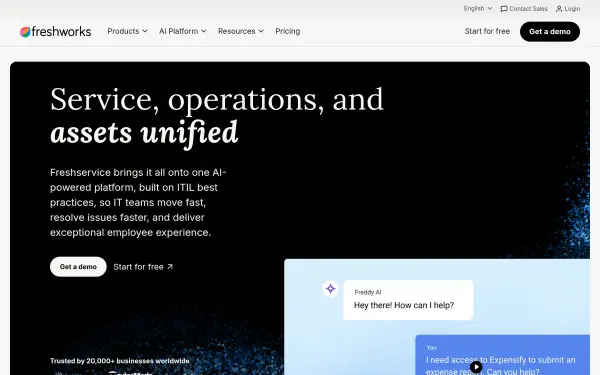
Freshservice is the option to shortlist when ITIL processes matter but a six-month program does not. Incident, problem and change management arrive close to ready, with asset management and a CMDB underneath, so a service desk can track configuration items without a second product. The self-service portal and workflow automation cover what requesters expect, and SLA management is built in rather than bolted on.
Pricing starts at $19 per agent per month on Starter with annual billing. There is no free plan, only a 14-day trial. AI agents sit on higher tiers, which is the main cost trap: the headline price buys a solid service desk, not an autonomous front line. Deployments commonly finish in two to six weeks, and the interface is easy for both agents and requesters to learn, which shortens training and reduces tickets about the ticketing tool itself.
The limit is depth. Freshservice is cloud only, so regulated or air-gapped environments are out, and large enterprises with complex approval chains and multi-vendor service maps will hit ceilings that BMC and ServiceNow do not have. For a 50 to 500 seat IT team that wants ITIL running this quarter, those trade-offs are usually worth it.
You want ITIL incident, change and asset processes live within a couple of months.
You need on-premises deployment or very complex enterprise approval chains.
Entry III of VIII / Free for five
Our verdict
The value pick for budget IT teams that need the service desk, the asset register and the CMDB in one purchase.
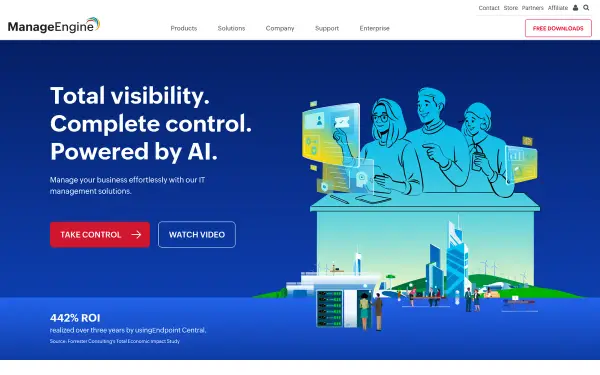
ManageEngine ServiceDesk Plus is the value play. A free edition covers five technicians, which makes it one of only two tools here with a permanent free tier, and Standard pricing begins at US$ 13 per technician per month. For that money you get an ITIL service desk, IT asset management and a CMDB in one product, plus SLA and workflow automation. A 30-day free trial lets you test before committing.
Deployment runs in the cloud or on premises, which matters for teams that keep asset data inside their own network. The trade-off is polish. The interface looks older than Freshservice, navigation takes some learning, and setup often takes four to eight weeks because asset discovery, CMDB relationships and approval workflows all need configuration. Autonomous AI agents are reserved for higher plans, so do not buy the entry tier expecting a modern conversational front door.
It fits IT teams with tight budgets and a real need for asset and configuration data next to the service desk. It fits less well if your agents will judge the tool by how quickly it feels modern, or if you want AI handling first-line requests on the plan you can actually afford.
Budget is tight and you want asset and CMDB data inside the same tool as the service desk.
Your agents expect a modern interface or AI triage on the entry plan.
Entry IV of VIII / AI across channels

Our verdict
An AI-driven service platform that wins on channels and reply speed, not on ITIL process depth.
Zendesk is a customer service platform that IT teams borrow for employee support, and it is strongest when the channel mix matters more than ITIL. Chat, email, voice and social land in one agent workspace, the help center and knowledge base do the deflection work, and Copilot drafts replies so agents start from a suggestion instead of a blank box. AI agents handle self-service conversations and are billed per resolution, on top of seat fees.
Entry pricing is $19 per agent per month on Support Team with yearly billing, and Suite Team is $55. There is no free plan, but there is a 14-day trial. Setup commonly takes two to four weeks, among the fastest here, and the app marketplace covers integrations that would otherwise need custom work.
The gap is ITIL. Change management, problem management and CMDB depth are thin compared with dedicated ITSM suites, and enterprise ITSM needs add-ons that change the total cost. Per-resolution AI billing is the other thing to model carefully: a busy service desk can spend more on resolutions than on seats. Buy it for AI-driven service and omnichannel support, not for a textbook ITIL implementation.
Your service desk lives on chat, email and voice, and AI deflection is the priority.
You need change management and CMDB depth as core, licensed features.
Entry V of VIII / Deep ITIL coverage
Our verdict
The deepest ITIL coverage here, built for regulated enterprises that can staff a long implementation.
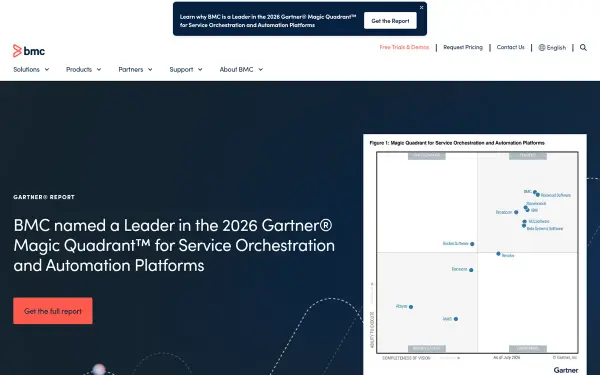
BMC Helix ITSM is the choice for organizations that treat ITSM as a regulated process, not a help desk. ITIL coverage runs deeper than anything else on this list, with the process discipline and audit trail large enterprises need. HelixGPT provides AI assistance and supports a bring-your-own-LLM setup, which lets a security team keep model traffic inside an approved boundary, a real differentiator for banks, insurers and public sector buyers.
Pricing is available only by quote, so there is no public price to plan against, no free plan and no trial. Budget cycles need to start early. Deployment often takes six to nine months or longer and requires dedicated staff, which is the same objection buyers raise about ServiceNow and the reason some of them end up comparing the two rather than replacing one with the other. SaaS and hybrid deployment are both supported.
If your evaluation criteria include process depth, data residency and control over which model handles your data, BMC Helix ITSM earns its place on the shortlist. If you need something live this quarter, or you have no full-time platform owner, it will likely sit half-implemented while the contract runs. That staffing question is the one to answer before the first call.
You are a regulated enterprise that needs process depth, data control and hybrid deployment.
You need a public price, a trial or a go-live inside six months.
Entry VI of VIII / Endpoint to ticket
Our verdict
Best where Ivanti already manages the endpoints, since device fixes feed straight into service records.
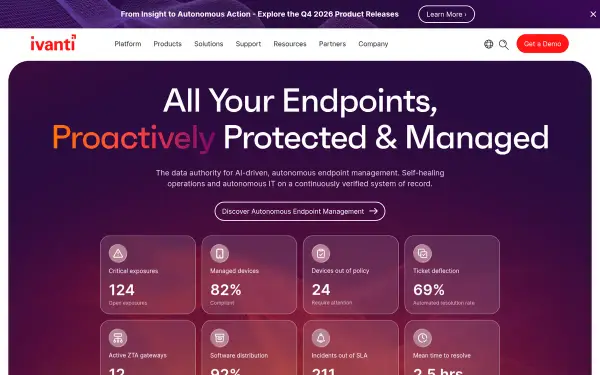
Ivanti Neurons for ITSM makes most sense inside an organization that already runs Ivanti endpoint management. The pitch is the connection: device remediation actions feed into service records, so an agent working a ticket can see the state of the device and act on it without switching tools. Routine IT tasks can be automated, and endpoint management, security tooling and ITSM come from one vendor and one contract.
There is no public price, no free plan and no trial, so this is a quote-based purchase. Setup usually takes three to six months, shorter than BMC Helix but long enough to need a named owner. The value case weakens sharply if you do not already use Ivanti for endpoints, because you would be buying the integration benefit without the installed base that makes it pay off.
It suits endpoint-heavy enterprises: organizations with thousands of managed devices, a security team already standardized on Ivanti, and a service desk that spends its day on device problems. It fits poorly for a mid-market team that wants a clean ITIL service desk and nothing else, and for any team that needs to see a price before the first meeting.
Ivanti already manages your endpoints and your tickets are mostly device problems.
You want a standalone service desk with a published price.
Entry VII of VIII / Guardrailed AI agents
Our verdict
An AI-first service desk with guardrails administrators can control, at a lower entry price than before.
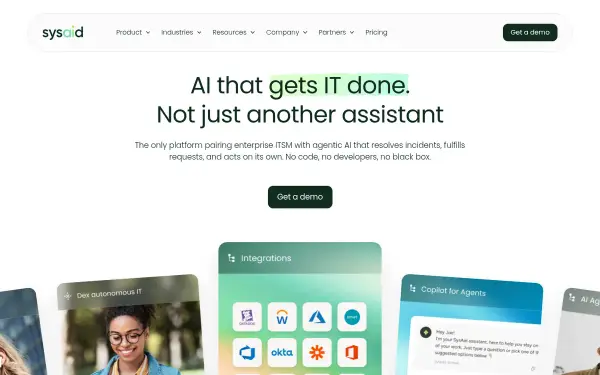
SysAid positions itself as AI-first service management, and the AI is the reason to look at it. Prebuilt AI agents handle triage, routing and request resolution, and configurable guardrails let administrators set what the agents may and may not do, which is the control question most IT managers ask first. The service management workflows underneath are conventional and adequate.
Pricing starts at $59 per agent per month on Professional, quoted as an example at 70 agents billed annually, so smaller teams should expect a conversation rather than a checkout page. There is no free plan but there is a free trial. ITIL licensing is flat rather than gated by module, which simplifies budgeting compared with suites that sell change management as a separate line.
Two cautions. AI depth varies by use case, so test the specific workflows you care about rather than judging from a demo. And the partner ecosystem is smaller than Atlassian's or Freshworks', which matters if you rely on third-party implementation help. The product is positioned as simpler to deploy than ServiceNow, and for teams leaving ServiceNow because of implementation weight, that claim is the one worth verifying in a trial.
You want AI triage and resolution with admin-set guardrails, and flat ITIL licensing.
You need a large partner network or predictable list pricing at small seat counts.
Entry VIII of VIII / All-inclusive licensing
Our verdict
One license covers every ITIL module and the AI features, which makes per-agent cost easy to forecast.
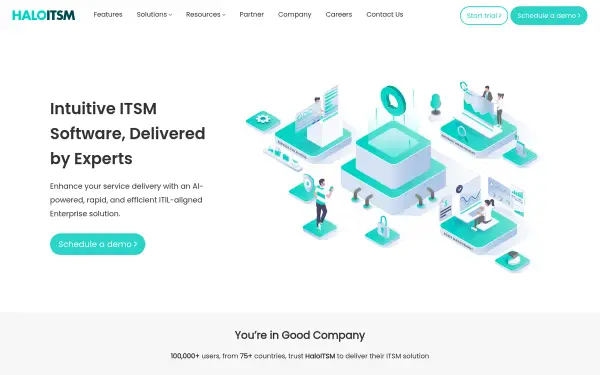
HaloITSM sells simplicity in licensing. Every ITIL module is included in one license, AI features come with it rather than as an add-on, and the price is published in pounds: £69 per agent per month billed annually for the United Kingdom region. Onboarding is a separate package, so factor that into the first-year number. A free trial is available and there is no free plan.
The product covers the service desk basics well: asset management, change control and the standard ITIL workflows, with cloud or on-premises deployment. Teams that have been quoted for five add-ons elsewhere tend to like the all-inclusive structure, because the cost per agent is the whole cost per agent and forecasting stops being a negotiation each renewal.
The trade-offs are brand and planning effort. HaloITSM is a smaller name than Atlassian or Freshworks, so fewer partners know it, and implementation help may be harder to source locally. Setup and migration need planning, particularly if you are moving years of tickets and configuration items across. It fits organizations that want full ITIL coverage and a predictable per-agent cost, and it fits less well if procurement requires a large systems integrator on the vendor list.
You want every ITIL module and the AI features in one predictable license.
You need a large integrator network or a purely dollar-denominated quote.
VBackground
ITSM software is the system a service desk runs on. It records incidents and requests, routes them to the right person, tracks SLAs, and keeps a record of the assets and configuration items behind each service. ServiceNow is a well known product in that category, and process depth is its reputation. The reasons buyers look for ServiceNow alternatives are usually cost and effort. That means the license cost, the long implementation, and the dedicated administrator the platform needs afterward.
The alternatives here fall into three groups:
Three shifts matter for 2026 buying decisions. AI agents have moved from demo to priced line item, and vendors bill them in different ways: some include AI in the license, some charge per resolution, and some reserve agents for higher tiers. Deployment flexibility has narrowed, with Freshservice and Zendesk cloud only while Jira Service Management, ManageEngine and HaloITSM still offer on-premises. And free tiers have become a genuine evaluation route, with Jira Service Management covering three agents and ManageEngine covering five technicians on permanent free plans.
This comparison sits in the software register. Further along the shore: baby tracking app and kennel software.
VIPricing
Most of these tools price per agent per month, but the qualifiers decide the real number. A billed annually rate is lower than a monthly rate, a free tier usually caps seats rather than time, and AI agents are increasingly billed per resolution on top of seats. Two vendors on this list publish no price at all and sell only by quote, so the budget conversation starts with a sales call.
| Model | How it bills | Typical fit | Example from this list |
|---|---|---|---|
| Free tier plus per agent | Free up to a seat cap, then per agent per month | Small teams and pilots | Jira Service Management, free for up to 3 agents, Standard $21.50 per agent per month |
| Per agent, billed annually | Per agent per month on an annual term | Mid-market service desks | Freshservice Starter at $19 per agent per month |
| Free edition plus per technician | Free for a set number of technicians, then per technician per month | Budget ITIL teams | ManageEngine ServiceDesk Plus, free for up to 5 technicians, Standard from US$ 13 per technician per month |
| Per agent plus usage | Seat fee plus AI billed per resolution | Omnichannel support teams | Zendesk Support Team at $19 per agent per month paid yearly, Suite Team $55 |
| Per agent at volume | Per agent per month, quoted at a seat band | AI-first service desks | SysAid Professional at $59 per agent per month, example at 70 agents billed annually |
| Per agent, local currency | Per agent per month billed annually, region specific | All-inclusive ITIL buyers | HaloITSM at £69 per agent per month, United Kingdom region, onboarding package extra |
| Custom quote | Negotiated contract | Regulated enterprises | BMC Helix ITSM and Ivanti Neurons for ITSM, pricing on the vendor site |
Watch the exclusions as closely as the price. Virtual agent features at Jira Service Management, AI agents at Freshservice and autonomous agents at ManageEngine all require higher plans, and the HaloITSM onboarding package is extra. Those items move first-year cost far more than the per-seat rate does.
Each entry card shows the starting price as it appeared on the vendor's own pricing page on November 25, 2026. When a vendor shows no figure we could confirm, or only a promotional rate, the card says "See website" or gives the regular price instead of a guess. Usage, overage and add-on rates in the text change more often than plan prices, so confirm them on the vendor page before you set a budget. To test the numbers against your own volume, try the free User Research Budget Planner. The Event Break-Even Calculator is a second way to check the same decision.
VIIDecision
VIIIPitfalls
IXQuestions
Freshservice is the usual mid-market fit: ITIL processes work with little configuration and deployments commonly finish in two to six weeks, at $19 per agent per month billed annually. For large regulated enterprises, BMC Helix ITSM is the closest match on process depth and supports SaaS or hybrid deployment, though pricing is only available by quote and rollouts often take six to nine months or longer.
Yes. Jira Service Management is free forever for up to 3 agents, and ManageEngine ServiceDesk Plus has a free edition for up to 5 technicians. Freshservice and Zendesk offer 14-day free trials, ManageEngine offers 30 days, and SysAid and HaloITSM offer free trials. BMC Helix ITSM and Ivanti Neurons for ITSM list no free plan and no trial, and sell by quote.
Zendesk is fastest at two to four weeks, Freshservice takes two to six weeks, and Jira Service Management and ManageEngine ServiceDesk Plus usually take four to eight weeks. SysAid is positioned as simpler than ServiceNow, Ivanti Neurons for ITSM takes three to six months, and BMC Helix ITSM often runs six to nine months or longer with dedicated staff.
Most of them, at different tiers. Jira Service Management has a virtual agent on higher plans, Freshservice has AI agents on higher tiers, Zendesk has AI agents billed per resolution plus Copilot drafting, SysAid ships prebuilt agents with configurable guardrails, and BMC Helix ITSM offers HelixGPT with a bring-your-own-LLM option. ManageEngine limits autonomous agents to higher plans, and HaloITSM includes AI features in the license.
Jira Service Management, ManageEngine ServiceDesk Plus and HaloITSM offer cloud or on-premises deployment, and BMC Helix ITSM supports SaaS and hybrid. Freshservice and Zendesk are cloud only, which rules them out where data must stay inside your own network. If on-premises is a requirement, confirm the option and its version in writing during evaluation.
Yes, and most teams should. Start with incident and request management, add a self-service portal and knowledge base, then bring in change and problem workflows once agents trust the queue. Flat licensing makes this easier: HaloITSM includes all ITIL modules in one license and SysAid does not gate ITIL by module. Tools that gate modules behind tiers make phased adoption more expensive.
XFurther along the shore
Vendors can ask for a correction or apply for a Featured listing. Paid or not, the entry is scored on the same rubric and its limits stay in print. Partner with Umberlake.
Free tools
Our free browser tools turn the prices on this page into a figure for your own volume. Nothing you type leaves your device.