PostgreSQL
See website
Best for strong standards-compliant relational database
- Free plan
- Yes
- Rubric
- 6.8 of 10
Eight databases that can replace MySQL, matched to the workload each one handles best, with prices checked on November 26, 2026.
IThe short answer
MySQL alternatives start with PostgreSQL for standards-heavy relational work, MariaDB for a drop-in swap, and SQLite for embedded or local storage. That is the short answer as of November 2026. PostgreSQL gives you rich indexing, JSON storage and PostGIS; MariaDB keeps MySQL protocol and syntax so migrations stay small; SQLite removes the server entirely. The other five entries cover distributed SQL, MySQL-compatible performance forks, HTAP, and enterprise stacks from Microsoft and Oracle. All prices below were checked on November 26, 2026.
8 tools compared from vendor pages on November 25, 2026. 3 publish a starting price we could read; the rest say "See website".
IITop three berths
Register order is editorial fit for the buyer each entry describes. Prices are the starting figures read on November 25, 2026.
See website
Best for strong standards-compliant relational database

See websitecustom quote
Best for drop-in MySQL replacement

See website
Best for embedded and local databases
How this page is paid for. All 8 tools here are unpaid editorial picks.
A paid listing's position can be part of what the vendor pays for. Every entry, paid or not, is scored on the same rubric and keeps its limits in print. Advertising disclosure.
IIIThe register
Starting prices as shown on each vendor's pricing page on November 25, 2026. "See website" means no figure we could confirm.
| No. | Tool | From | Free plan | Trial | Rubric | Actions |
|---|---|---|---|---|---|---|
| 01 | PostgreSQLStrong standards-compliant relational database | See websiteNot shown publicly | Yes | No | 6.8 | |
| 02 | MariaDBDrop-in MySQL replacement | See websitecustom quoteQuote only | Yes | No | 7.9 | |
| 03 | SQLiteEmbedded and local databases | See websiteNot shown publicly | Yes | No | 6.9 | |
| 04 | CockroachDBDistributed SQL at scale | $0.092Standard, per vCPU-hour, usage-based billing, free trial with $400 creditUpdated on vendor page | Yes | 30-day free trial with $400 credit | 6.6 | |
| 05 |  Percona ServerMySQL-compatible performance | See websiteNot shown publicly | Yes | No | 7.3 | |
| 06 |  TiDBDistributed MySQL-compatible HTAP | FreeStarter, per month, free monthly allowance then pay for usageRead on vendor page | Yes | No | 7.4 | |
| 07 | Microsoft SQL ServerMicrosoft and .NET enterprises | FreeRead on vendor page | Yes | No | 6.1 | |
| 08 |  Oracle DatabaseMission-critical enterprise workloads | See websiteNot shown publicly | Yes | No | 5.4 |
Pinned:
IVMethod
Every entry here was scored against the same five criteria: MySQL compatibility (how much of an existing MySQL application survives the move), scaling model (whether growth means a bigger server or more servers), operational fit (how much specialist knowledge the database demands), ecosystem depth (libraries, hosting options, people who have run it) and cost clarity (whether you can work out a bill before you sign). Compatibility carries the most weight because most readers are leaving MySQL, not starting from nothing.
Prices and plan details come from vendor pricing pages, checked on November 26, 2026. Where a vendor publishes no public pricing, the entry says so and points to a quote or a free edition rather than a guessed number. Where a vendor page had changed since earlier research, for example CockroachDB moving to usage-based pricing, the newer page wins and the note explains it.
The order is editorial. Each position reflects fit for the buyer described in that entry, so a free embedded database can sit above a large enterprise platform without contradiction.
Paid placements, where they appear on this page, are labeled clearly so you can see which entries are commercial.
The full routine, from price reads to corrections, is on the methodology page. Paid listings follow the advertising disclosure.
How much of an existing MySQL application keeps working after the move.
Whether growth means a bigger server, more servers, or a distributed cluster.
How much specialist database knowledge the platform demands from your team.
Libraries, hosting options, tooling and people who have already run it in production.
Whether you can work out a realistic bill before you sign anything.
Entry I of VIII / Extension ecosystem
Our verdict
The default upgrade when you want more SQL power than MySQL offers and can accept a real migration.
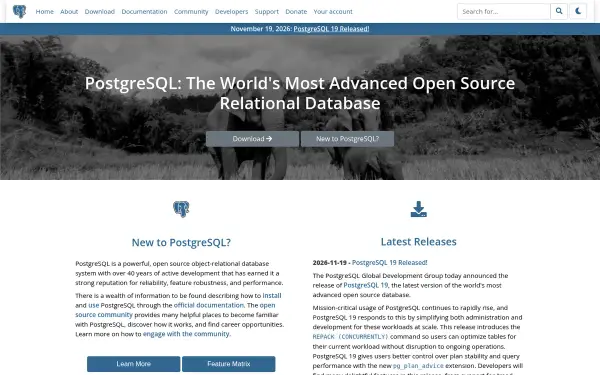
PostgreSQL is the strongest standards-compliant relational database on this list. If your team keeps running into MySQL's limits on complex queries, strict typing or advanced indexing, PostgreSQL is the natural next step. It gives you rich index types, built-in full-text search, stored procedures and JSON document storage, so document-shaped data and relational data can live in one engine instead of two.
The extension model is the real differentiator. PostGIS adds geospatial types and functions, and logical replication lets you stream changes to other systems or build read replicas with more control than MySQL's replication gives you. Transactional integrity is taken seriously here, which matters for financial, inventory and audit workloads where a partially applied transaction is unacceptable.
The trade-offs are operational. Horizontal scaling needs extra tooling, usually sharding or a distributed extension, and that is a project rather than a checkbox. Tuning for extreme write throughput takes experienced hands. Self-hosting is free because the software is open source, and there is no official pricing page; managed versions are sold by major cloud providers and add cost, which is the usual path for teams that do not want to run clusters themselves.
Pick it if you want the broadest SQL feature set and a deep extension ecosystem. Skip it if you need MySQL wire compatibility or multi-region writes without adding components.
You want more SQL capability than MySQL offers and your team can absorb a genuine migration.
You need MySQL wire compatibility or distributed writes out of the box.
Entry II of VIII / Drop-in swap
Our verdict
The lowest-effort exit from MySQL: same protocol, same syntax, and a free community server you can run today.
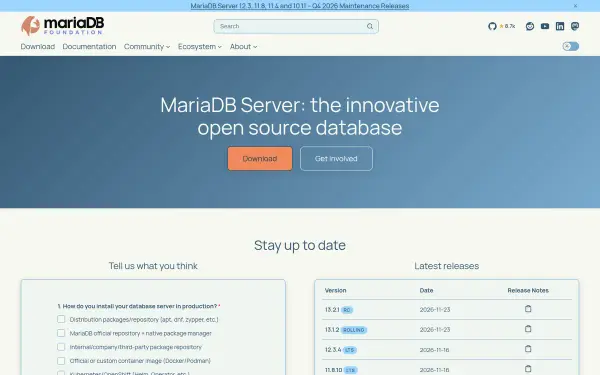
MariaDB speaks the MySQL protocol and syntax, so drivers, ORMs and admin tools keep working and most applications move over without touching code. It supports multiple storage engines, which lets you keep transactional tables next to engines tuned for other jobs, and the project ships performance enhancements over the code it forked from.
The community server edition is free and open source. Commercial enterprise platforms add support and cloud-scale features, and those tiers are quote only, so you need a conversation with sales before you can put a number in a budget.
Two cautions. Not every MySQL feature is identical across forks, so test the specific ones you depend on, including replication modes, authentication and JSON behavior, before committing. Some cloud integrations also vary by provider, and a managed MariaDB service is not always a like-for-like swap for a managed MySQL one.
For teams already on MySQL that want a lower-risk change of vendor, this is the shortest path available. For teams building something new with no MySQL history, PostgreSQL usually gives more headroom and a wider ecosystem. The compatibility advantage is real but it is also narrow: it pays off in proportion to how much MySQL-specific code you already own.
You already run MySQL and want a change of vendor without a rewrite.
You are starting fresh and want the widest feature and extension set.
Entry III of VIII / Zero configuration
Our verdict
The right database for a single application, and the wrong one the moment you need a shared server.
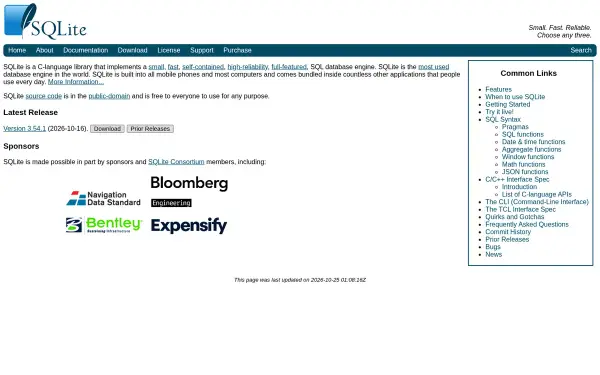
SQLite is an embedded database, not a server. The entire database lives in a single file, there is zero configuration, and your application links the library directly. That makes it the right choice for desktop apps, mobile apps, edge devices, test suites and small internal tools where running a database server would be pure overhead.
It is not a toy. SQLite gives you ACID transactions, JSON support, full-text search and standard SQL, and backup is as simple as copying the file. The license is public domain, so there is no fee, no attribution requirement and no vendor to negotiate with. That also means there is no pricing page: you cannot buy a supported commercial edition here, only use the software.
The limits are architectural. There is no horizontal scaling and no built-in replication, so you cannot spread traffic across machines. Advanced indexing is limited compared to PostgreSQL, and the single-file design constrains how many writers can work at once. If the application grows into a multi-server service, you will eventually move the data into a client-server database.
It fits applications that ship to users rather than serving them over a network, and it fits development environments where a full server would slow everyone down. It does not fit a shared production service with concurrent writers across several machines.
The database ships inside the application or lives on a single machine.
Several servers need to write to the same data.
Entry IV of VIII / Multi-region scaling
Our verdict
Distributed SQL with ACID transactions and built-in replication, priced per vCPU-hour for teams that need multi-region writes.
CockroachDB is distributed SQL: one logical database spread across nodes and regions, with ACID transactions, built-in replication and advanced indexing. It handles node failure without an operator stepping in, and horizontal scaling is part of the architecture rather than a bolt-on. If your MySQL deployment is straining under write volume, or you need data close to users in several regions, this is the category built for that problem.
Pricing is usage-based. The Standard plan is listed at $0.092 per vCPU-hour with usage-based billing, and there is a 30-day free trial with $400 credit. The pricing page now leads with this usage-based model rather than a flat free tier, so check what any free allowance actually covers before you size a production footprint around it.
The license is the CockroachDB Software License, not a fully open source one, which matters if your legal team reviews dependencies. Extensibility is narrower than PostgreSQL's, so do not expect a PostGIS-style extension ecosystem. Distributed systems also carry operational complexity, from cluster sizing to rebalancing during topology changes, and that work does not disappear because the vendor calls it managed.
It fits teams with platform engineering capacity and a real multi-region or high-write requirement. A single-region application with modest traffic will pay for complexity it does not need, and a compatible fork will be cheaper to run and easier to staff.
You need ACID writes across regions and can staff a distributed system.
One primary in one region already meets your traffic.
Entry V of VIII / Instrumentation and tooling
Our verdict
A MySQL-compatible server with better instrumentation and free backup and monitoring tools, backed by paid support.
Percona Server is a MySQL-compatible server with an emphasis on performance and operations. It drops into MySQL-shaped deployments, keeps the same protocol and syntax, and adds performance enhancements plus a tooling set covering backup, monitoring, diagnostics and instrumentation. For teams whose main complaint about MySQL is that they cannot see what it is doing under load, the instrumentation is the draw.
The server is GPL licensed, so self-hosting costs nothing in license fees. Enterprise support is paid, which is the usual arrangement: the software is free, the accountability is not. Pricing is not published on a page we could fetch, so treat support as a quote and ask for it early if procurement needs a number.
Limits worth knowing before you commit. Horizontal scaling is limited, so this is a scale-up and read-replica story rather than a distributed one. The community is smaller than MySQL's, which means fewer answers when you hit an unusual failure, and third-party tooling is generally built with MySQL's behavior as the reference rather than Percona's.
It fits teams already invested in MySQL operations that want more performance headroom and better diagnostics without a rewrite. If you have no MySQL footprint, the compatibility advantage disappears and the smaller community becomes a straightforward cost.
You run MySQL and want better visibility and tuning without changing engines.
You need distributed writes or a large community to lean on.
Entry VI of VIII / HTAP in one system
Our verdict
MySQL compatibility plus horizontal scaling and HTAP, with a free Starter allowance that makes evaluation cheap.
TiDB is a distributed, MySQL-compatible database that combines transactional and analytical processing in one system. It speaks the MySQL protocol, scales horizontally, and runs analytical queries next to live transactions, which removes the usual extract, transform and load pipeline between an operational MySQL database and a separate analytics warehouse. The license is Apache 2.0.
The Starter plan is listed as free per month with a free monthly allowance, and you pay for usage beyond that allowance. That makes it cheap to evaluate against a real workload rather than a toy dataset, and the bill tracks consumption rather than seats.
The trade-offs are familiar for distributed systems. Operational complexity is higher than a managed single-node database, so cluster topology, upgrades and monitoring need an owner. Extensibility is limited compared to PostgreSQL, and the ecosystem is smaller than PostgreSQL's, which affects library support, hiring and how many people have debugged your exact failure before.
It fits teams with MySQL-shaped applications that need to scale writes or run heavy analytics without maintaining two systems. Teams with modest data volume in a single region will usually find a managed MySQL or MariaDB instance simpler and cheaper to operate, and the MySQL compatibility makes moving back less painful than moving off a proprietary engine.
You need MySQL compatibility plus write scaling and analytics in one place.
Your data fits on one node and nobody owns cluster operations.
Entry VII of VIII / Microsoft stack fit
Our verdict
The obvious pick for .NET and Azure shops, with free Express and Developer editions and expensive Enterprise cores.
Microsoft SQL Server is the pragmatic choice when your stack is already Microsoft. Azure integration, .NET integration and Microsoft tooling integration are not marketing lines here; they are the reason teams pick it. Reporting services, integration services and analysis services give you a BI and data movement stack in the same product family, which removes a class of glue work that other teams build themselves.
Two editions are free. Express and Developer editions are free downloads, so development, prototyping and small production workloads cost nothing in license fees. Production licensing at scale needs planning, and the number to anchor on is Enterprise at $15,123 per 2 core pack. Core-based licensing rewards dense, well-provisioned hardware and punishes sprawl, so consolidation is often cheaper than adding boxes.
The honest limits: licensing complexity at scale, a Windows and Azure bias in tooling and documentation, and a smaller open source ecosystem than PostgreSQL or MySQL. If your team runs Linux and open source tooling, you will spend time working against defaults rather than with them.
It fits Microsoft-centered enterprises with .NET applications, existing Azure commitments and staff who already know the stack. It is a poor fit for a small team that wants a free database on Linux with no licensing paperwork.
Your applications, identity and cloud spend already sit inside the Microsoft stack.
You run Linux and open source tooling end to end.
Entry VIII of VIII / Enterprise reliability
Our verdict
The enterprise platform for compliance-heavy workloads, with a free edition for development and licensing that needs a sales call.
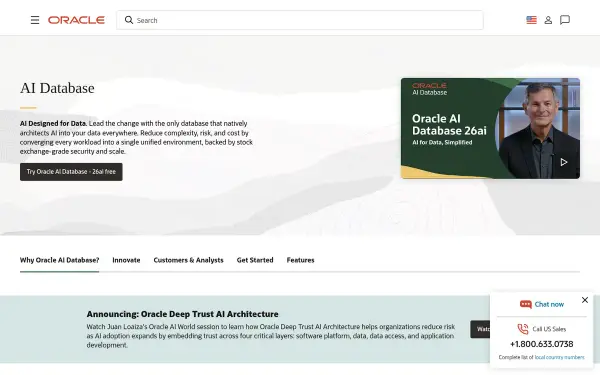
Oracle Database is built for mission-critical and compliance-heavy workloads, and it is priced accordingly. Enterprise support, advanced database features and a long record in large-scale enterprise deployments are the reasons regulated organizations keep it. If your requirements list includes audit trails, vendor accountability and a support contract that covers a production outage, Oracle is going to be on the shortlist whether or not your engineers like it.
A free edition exists for development and small use, which is a genuine way to evaluate the platform and run non-critical systems without a purchase order. For production at scale, licensing costs are substantial and the public site does not give you a number you can budget from directly, so treat pricing as a sales conversation and start it early.
The other cost is complexity. Oracle is aimed at large organizations with dedicated database administrators, and the operational surface is wide. Small teams without a DBA will find it heavy next to PostgreSQL, and the licensing model itself takes time to understand before you can compare it to anything.
It fits enterprises with compliance obligations, existing Oracle skills and a budget that assumes a support contract. It does not fit a startup comparing free databases, and it is an odd choice for a team leaving MySQL for simplicity rather than for enterprise guarantees.
Compliance, support contracts and enterprise scale are non-negotiable requirements.
You have no DBA and your main goal is leaving MySQL for something simpler.
VBackground
MySQL alternatives are databases you can run in place of MySQL, either as a compatible fork that keeps your existing applications working or as a different engine that solves a problem MySQL handles poorly. The distinction matters more than any feature list, because it decides how much of your migration is configuration and how much is rewriting queries.
Compatible options keep the MySQL protocol and a large share of its syntax. MariaDB and Percona Server live here, and TiDB adds horizontal scaling while keeping the protocol. Moving to one of these is usually measured in test cycles, not quarters.
Different engines ask for a real migration. PostgreSQL offers stronger SQL standards support, richer indexing, JSON storage and an extension ecosystem that includes PostGIS. CockroachDB and TiDB handle distribution. SQLite is embedded. SQL Server and Oracle serve organizations already committed to those platforms.
Three questions narrow the field quickly:
If none of those apply and you simply want more headroom, PostgreSQL is the usual destination. Pricing rarely decides this. Every database on this list has a free path, so the real costs are migration effort and the staff needed to run the result.
This comparison sits in the software register. Further along the shore: baby tracking app and kennel software.
VIPricing
Pricing in this category follows six shapes, and only some of them give you a number you can put in a budget without a phone call.
| Model | How it bills | Typical fit | Example from this list |
|---|---|---|---|
| Open source self-hosted | No license fee; you pay for servers and staff time | Teams with operational capacity | PostgreSQL, SQLite, Percona Server |
| Community plus commercial | Free community edition, quote-based enterprise platform | Teams that want vendor support later | MariaDB |
| Usage-based cloud | Per vCPU-hour billing | Variable or spiky demand | CockroachDB at $0.092 per vCPU-hour |
| Free allowance then usage | Free monthly allowance, then pay for usage | Small projects and evaluation | TiDB Starter |
| Edition-based licensing | Free developer and express editions, paid core packs in production | Microsoft-centered enterprises | SQL Server at $15,123 per 2 core pack |
| Vendor-listed enterprise pricing | Pricing is listed on the vendor website | Regulated, mission-critical workloads | Oracle Database |
The pattern to notice is that the open source engines are free as software, so the real cost is people. A self-hosted PostgreSQL cluster has no license line but needs someone who can tune it. MariaDB's enterprise platform is quote only, so the number depends on your negotiating position and your deployment size, while Oracle lists its pricing on its website. CockroachDB and TiDB bill for usage, so cost tracks traffic rather than headcount, which is friendlier at small scale and harder to forecast at large scale.
Before comparing any two vendors, decide which of these you are buying: a license, a support contract, or capacity. Teams that confuse the three end up comparing a free download against an enterprise quote and drawing the wrong conclusion.
Each entry card shows the starting price as it appeared on the vendor's own pricing page on November 25, 2026. When a vendor shows no figure we could confirm, or only a promotional rate, the card says "See website" or gives the regular price instead of a guess. Usage, overage and add-on rates in the text change more often than plan prices, so confirm them on the vendor page before you set a budget. To test the numbers against your own volume, try the free User Research Budget Planner. The Event Break-Even Calculator is a second way to check the same decision.
VIIDecision
VIIIPitfalls
IXQuestions
MariaDB and Percona Server are the closest. Both speak the MySQL protocol and syntax, so drivers, ORMs and existing queries usually keep working, and MariaDB is the more common drop-in target. TiDB is MySQL-compatible too but trades some familiarity for horizontal scaling and HTAP. Test the specific features you rely on, because forks diverge in places.
Usually yes. MariaDB keeps MySQL protocol and syntax compatibility and the community server is free, so many applications move with minimal code changes. The caveat is that not every MySQL feature is identical across forks, and some cloud integrations vary by provider. Run your test suite and check replication, authentication and JSON behavior before moving production traffic.
CockroachDB and TiDB are the two built for it. CockroachDB is distributed SQL with ACID transactions, built-in replication and multi-region deployment. TiDB pairs horizontal scaling with HTAP so transactional and analytical queries share one system. Both add operational complexity, and CockroachDB uses the CockroachDB Software License rather than a fully open source one; TiDB is Apache 2.0.
SQLite is the clear answer. It stores the database in a single file, needs zero configuration and links directly into your application, with ACID transactions, JSON support and full-text search. It is public domain, so there is nothing to license. Its limits are real: no horizontal scaling, no replication and limited advanced indexing, so plan an exit if traffic becomes multi-server.
Vendors rarely publish one monthly number. CockroachDB lists $0.092 per vCPU-hour on its Standard plan, so the bill follows capacity and traffic. TiDB has a free Starter allowance and then charges for usage. MariaDB enterprise tiers are quote only, Oracle lists its pricing on its website, and managed PostgreSQL variants add cost on top of a free core. Model your own usage rather than shopping for a headline price.
Self-host when you have the operational staff, predictable workloads and a reason to control the stack, such as data residency or deep tuning. PostgreSQL, MariaDB, Percona Server and SQLite are free to self-host, so the cost becomes people and hardware. Choose managed when nobody owns database operations, because a managed instance buys backups, patching and someone else's on-call rotation.
XFurther along the shore
Vendors can ask for a correction or apply for a Featured listing. Paid or not, the entry is scored on the same rubric and its limits stay in print. Partner with Umberlake.
Free tools
Our free browser tools turn the prices on this page into a figure for your own volume. Nothing you type leaves your device.