
Cookiebot
See website
Best for small and mid-sized businesses needing GDPR consent
- Free plan
- Yes
- Rubric
- 7.4 of 10
Eight consent platforms ranked for fit, from a free WordPress plugin to enterprise governance suites, with prices checked on 26 November 2026.

IThe short answer
The best cookieyes alternatives in November 2026 depend on how much consent work you want to hand off. Cookiebot suits small and mid-sized businesses that need GDPR consent fast, Usercentrics suits larger teams scaling consent and AI data governance, and Termly suits small sites that also need privacy policies. The other five cover WordPress plugins, agency multi-domain dashboards and full enterprise governance. Prices below were checked on 26 November 2026.
8 tools compared from vendor pages on November 25, 2026. 5 publish a starting price we could read; the rest say "See website".
IITop three berths
Register order is editorial fit for the buyer each entry describes. Prices are the starting figures read on November 25, 2026.
See website
Best for small and mid-sized businesses needing GDPR consent

€7Essential, per month, up to 1,500 sessions, 1 domain
Best for larger teams scaling consent and AI data governance

$10Starter, per website per month, billed annually, 5 users included
Best for small sites that also need privacy policies
How this page is paid for. All 8 tools here are unpaid editorial picks.
A paid listing's position can be part of what the vendor pays for. Every entry, paid or not, is scored on the same rubric and keeps its limits in print. Advertising disclosure.
IIIThe register
Starting prices as shown on each vendor's pricing page on November 25, 2026. "See website" means no figure we could confirm.
| No. | Tool | From | Free plan | Trial | Rubric | Actions |
|---|---|---|---|---|---|---|
| 01 | Cookiebotsmall and mid-sized businesses needing GDPR consent | See websiteNot shown publicly | Yes | See website | 7.4 | |
| 02 | Usercentricslarger teams scaling consent and AI data governance | €7Essential, per month, up to 1,500 sessions, 1 domainUpdated on vendor page | Yes | 14-day free trial | 8.0 | |
| 03 | Termlysmall sites that also need privacy policies | $10Starter, per website per month, billed annually, 5 users includedRead on vendor page | Yes | See website | 7.3 | |
| 04 |  Osanoteams building a broader privacy programme | See websiteNot shown publicly | Yes | See website | 6.8 | |
| 05 |  iubendaEU-focused sites needing multilingual policy coverage | €499, Essentials, per site per month, billed yearly, up to 25K pageviewsUpdated on vendor page | Yes | 14 days risk free | 7.3 | |
| 06 |  ComplianzWordPress and Shopify site owners | £52Personal, per year, 1 WordPress website, 1 year of updates and supportUpdated on vendor page | Yes | No | 6.8 | |
| 07 | OneTrustenterprises running full governance programmes | See websiteNot shown publicly | No | Demo only | 6.8 | |
| 08 |  Enzuzoagencies and mid-market teams with many domains | $22Growth, per month, billed annually at $264, 4 domains, 10k monthly visitorsUpdated on vendor page | Yes | No | 7.3 |
Pinned:
IVMethod
Every entry was assessed against the same five criteria, weighted for how consent software is actually bought rather than for feature list length. Consent coverage (25%) looks at regulations, prior blocking and banner behavior. Pricing clarity (20%) asks whether plans, limits and free tiers are published well enough to estimate a bill without a demo. Setup speed (20%) covers time to a live banner with consent records flowing. Platform integrations (20%) covers Consent Mode, tag managers, CMS connections and ad platform signals. Governance scope (15%) covers everything past the banner: subject rights, data mapping, vendor risk and AI controls.
Vendor pricing pages and published plan notes were checked on 26 November 2026 for every tool where a pricing page returned content. Where a page returned no content, or only a demo request form, the entry says pricing is on the vendor site and no figure is guessed. Prices appear in the form each vendor publishes, in the vendor's own currency, with no conversion and no annualized estimates we were not given.
Position reflects fit for the buyer each entry describes, so two tools aimed at the same buyer are separated by pricing clarity and setup speed rather than by order of arrival.
The full routine, from price reads to corrections, is on the methodology page. Paid listings follow the advertising disclosure.
How many regulations, banner behaviors and prior-blocking controls the platform covers without custom work.
Whether published plans, free tiers and domain or visitor limits let you estimate a bill before talking to sales.
How quickly a working banner, blocked tags and stored consent records can be live without developer or legal hand-holding.
Depth of Consent Mode, tag manager, CMS and ad platform connections that keep consent enforced downstream.
Breadth of subject rights, data mapping, vendor risk and AI governance features that sit beyond the cookie banner.
Entry I of VIII / Automated tracker scanning
Our verdict
Template-led GDPR consent that goes live fast, with strong ad platform signals but per-domain billing that penalises subdomains.
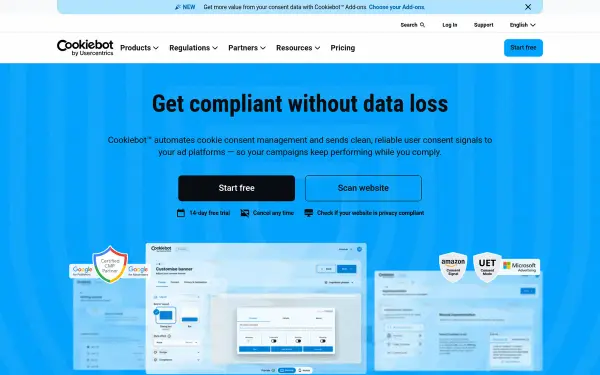
Cookiebot does the work that usually stalls a consent rollout: it scans the site for cookies and trackers, sorts them into categories, and blocks tags until a visitor agrees. Pre-built banner templates keep the first deploy quick, and the preference centre gives visitors per-category control rather than a single accept button. Consent signals can be passed to Google, Microsoft and Amazon advertising tools, which matters if media buying depends on Consent Mode.
The platform is now presented as a consent platform from Usercentrics, its parent company. Published tiers run from Essential up to Business on a monthly basis, but the pricing page returned no content on 26 November 2026, so treat the vendor site as the source of truth and confirm whether you need one domain or several. That point is the main trap: billing is per domain, and subdomains count as separate domains, so a blog on blog.example.com adds another billable domain.
Support is limited to email and tickets on many plans, and there is no bundled legal policy generation, so documents come from elsewhere. It fits small and mid-sized businesses that want automated tracker detection and ad-platform signals without a services contract. Skip it if you run dozens of subdomains or want policies included in the same purchase.
You want automated scanning and ad-platform consent signals live quickly on one or two domains.
You run many subdomains or need privacy policies generated in the same tool.
Entry II of VIII / Web, app and AI
Our verdict
One platform for web, app and AI consent, priced from €7 but built for teams larger than a single small site.
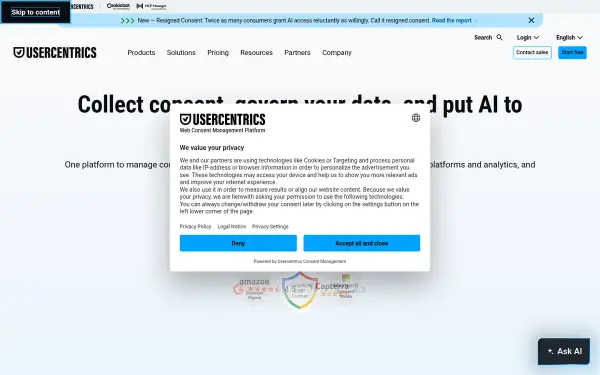
Usercentrics treats consent as one layer of a wider data operation. The same platform covers websites and mobile apps, forwards consent signals to advertising and analytics tools, and adds controls over what data AI agents are allowed to reach. A free compliance scanner gives a preliminary view of what is firing before you buy anything.
Pricing starts at €7 per month on the Essential plan, which covers up to 1,500 sessions and one domain. There is a free tier for fewer than 1,000 monthly sessions on one domain, plus a 14-day free trial. Above that, plans scale toward larger organisations rather than single sites. The company reports 2.4 million websites and apps across 195 countries and 8.8 billion monthly consents, which is the install base you are joining.
Setup is heavier than a simple banner tool, because dataflows and sources need configuring before the picture is complete. Smaller sites are usually steered toward Cookiebot instead, and since Usercentrics owns Cookiebot, that migration path runs in both directions. It fits larger teams that want web consent, app tracking and AI data governance under one contract. Skip it if you have one small website and need a banner running this afternoon.
You need web, app and AI data consent governed from one platform with a real support relationship.
You run one small site and want the cheapest banner that works.
Entry III of VIII / Policy generation built in
Our verdict
Banner plus policy generator at $10 per site per month, ideal for small sites that need documents as well as consent.
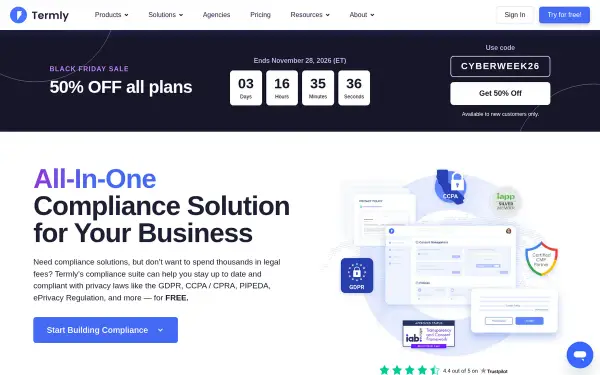
Termly is the pick for a small site that needs a banner and the paperwork behind it. The cookie consent manager generates a banner and preference centre, adds a DSAR submission form, and scans the site for cookies. Alongside that, the same dashboard produces attorney-crafted privacy policies and terms, covering GDPR, CCPA and CPRA, PIPEDA and ePrivacy, with IAB TCF 2.3 support for advertising consent.
Pricing is unusually clear. The Starter plan is $10 per website per month, billed annually, with five users included, and Pro Plus is $15. A free tier at $0 covers one basic legal policy and 10,000 monthly banner views, enough to test the workflow on a low-traffic site. Termly says it serves more than 2 million businesses across 150-plus countries at 1.7 billion banner views a month, and it holds Google CMP Partner Gold status.
The trade-offs are real. Banner configuration is thinner than enterprise consent platforms offer, governance features for complex organisations are limited, and generated policies are a starting point rather than a substitute for legal review. It fits freelancers, small agencies and content sites that want a single bill for consent and documents. Skip it if you need deep tag governance or multi-brand administration.
You need a compliant banner and privacy policy from one vendor at a predictable per-site price.
You need deep tag governance or multi-brand administration.
Entry IV of VIII / DSAR and vendor risk
Our verdict
A privacy programme in one contract, with DSARs, data mapping and vendor risk, priced for teams well beyond banner-only budgets.
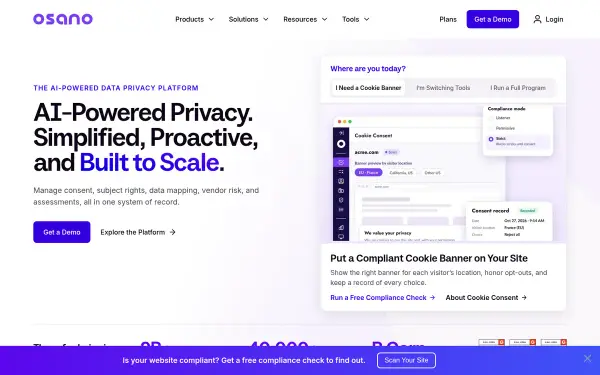
Osano sells a privacy programme, not a cookie banner. Consent management is one module inside a stack that also handles subject rights with a centralised DSAR workflow, compliance monitoring for consent and policy gaps, data mapping, ISO and NIST based assessments, and vendor risk scoring across more than 11,000 vendors. Banners are jurisdiction-aware and can honour Global Privacy Control signals.
Pricing is quote based. The page reached on 26 November 2026 was a demo request form with no plan prices, so budget for a sales conversation and expect the entry point to sit far above banner-only tools. A free tier is listed, which is useful for a look at the interface but not for running production governance.
The upside is consolidation: teams that would otherwise stitch together a banner, a DSAR spreadsheet, a data map and a vendor questionnaire can run them in one place. A no-fines, no-penalties guarantee is offered subject to conditions, which is worth reading closely rather than assuming. Onboarding takes real effort and an owner.
It fits privacy leads at mid-sized and large companies building a programme. Skip it for a single small website where a banner and a policy page are the whole job.
You are consolidating DSARs, data mapping and vendor risk into one privacy programme.
Your only requirement is a cookie banner on one small site.
Entry V of VIII / 27-language policies
Our verdict
Policy, terms and banner in one dashboard with 27-language coverage, a natural fit for EU sites but light on enterprise governance.
iubenda bundles the three documents most sites struggle with: privacy and cookie policies, terms and conditions, and the consent banner that ties them together. Policies are drafted by an in-house legal team and generated in up to 27 languages without AI translation, which is the differentiator for anyone serving several EU markets. Cookie consent, a preference layer and accessibility tools sit in the same dashboard, with IAB TCF 2.4 support.
Pricing starts at €4 per site per month on the Essentials plan, billed yearly, for up to 25K pageviews, and a free plan is available. A 14 days risk free period lets you test before committing. The vendor reports more than 150,000 customers, 400,000-plus sites and apps supported and more than 15 years in digital compliance, and it holds Google-certified CMP Partner status.
Two frictions remain. Plan detail is easier to get from a sales conversation than from the homepage, and the product is EU-first, so a US-only audience gets less from the multilingual policy work. The overall scope is broader than a banner but narrower than an enterprise governance suite.
It fits EU-focused sites and small agencies that want policies, consent and terms from one vendor. Skip it if you need data mapping and vendor risk management in the same contract.
You serve several European markets and want policies, terms and consent from one vendor.
You need data mapping operations or a US-first compliance playbook.
Entry VI of VIII / Native WordPress plugin
Our verdict
Consent handled inside WordPress for £52 a year, straightforward and cheap, but only sensible if you publish on WordPress or Shopify.
Complianz keeps consent inside the tool you already log into. The WordPress plugin configures region-based banners, scans for cookies, blocks them before consent and records registrations, all from the WordPress dashboard rather than a separate SaaS console. A guided wizard walks through the awkward parts, such as which regions to target and which services to declare, which is why it suits owners who do not want to read a consent spec.
Pricing for the Personal tier is £52 per year for one WordPress website, including a year of updates and support, with a 30-day money-back guarantee. A free WordPress plugin covers testing, and no trial is offered because the free version plays that role. The Shopify app, launched on 30 May 2025, extends the same approach to Shopify stores, and the vendor reports more than 1 million users.
The limits follow from the design. It is WordPress-first, so headless builds, custom applications and multi-CMS estates get less value, and the scope is narrower than standalone consent platforms, with fewer governance features. Pricing is also easier to confirm at checkout than from the homepage.
It fits WordPress and Shopify owners who want compliance handled where they publish. Skip it if your stack is neither, or if you need governance beyond the banner.
You publish on WordPress or Shopify and want consent handled inside the dashboard you already use.
Your site is headless, built on another CMS, or needs DSAR and vendor risk tools.
Entry VII of VIII / Full governance suite
Our verdict
Full privacy, AI and third-party governance for enterprises with staff to run it, far too much for a single small website.
OneTrust is the enterprise answer, and it is priced and implemented like one. Consent and preference management sits alongside AI-assisted privacy assessments, real-time monitoring, an AI governance module, data use governance, technology risk and compliance, and third-party management. The pitch is that privacy, data, AI and vendor risk stop being four programmes with four budgets.
There is no free plan, no self-serve checkout and no demo without a conversation, so treat pricing as a project cost rather than a subscription. The vendor states that more than half of the Fortune 500 use the platform, which tells you the reference scale it is built for. Implementation spans modules and adds complexity before anything is live.
For a single website this is excessive: you would pay for governance modules you never open and spend significant setup time before the banner appears. For a company with a privacy office, regulatory scrutiny and an AI inventory to document, the breadth is the point, and the reporting goes further than any banner tool here.
It fits enterprises running a full governance programme with staff to run it. Skip it if you need a banner live this week, or if nobody on your team owns privacy as a job title.
You have a privacy office and need privacy, AI governance and vendor risk in one governed system.
You need a banner live this week or have nobody dedicated to privacy work.
Entry VIII of VIII / Flat-rate multi-domain billing
Our verdict
Visitor-based billing across all domains from $22 per month, a good fit for agencies that would otherwise pay per site.
Enzuzo competes on billing shape as much as features. It charges by monthly unique visitors across all your domains rather than per domain, so subdomains and extra sites do not trigger surcharges. The Growth plan is $22 per month, billed annually at $264, covering four domains and 10k monthly visitors, and there is a free forever tier for one site with 5k monthly visitors.
The product covers the operational basics well: real-time consent logs and an audit trail, DSAR forms, opt-in rate tracking by region, a compliance health score dashboard, and multi-domain management from one dashboard. Microsoft Consent Mode is supported alongside Google CMP Partner Gold status and IAB Europe TCF v2.3, and API and webhook integrations push consent data into your own systems. The vendor reports SOC 2 and trust from 30,000-plus businesses.
The caveats are maturity and ceiling. It is a newer brand than the established consent vendors, it aims at mid-market rather than enterprise, and it has fewer governance modules than full privacy suites, so data mapping and vendor risk work stays elsewhere.
It fits agencies and mid-market teams juggling many domains who want predictable bills. Skip it if you need deep governance or a long enterprise track record.
You manage several domains and want one predictable visitor-based bill instead of per-site charges.
You need enterprise governance modules or a vendor with a long track record.
VBackground
A cookie consent management platform sits between your pages and every tag that wants to run. Before a visitor makes a choice, the platform holds back analytics, advertising and other non-essential scripts. When the visitor accepts, rejects or customises, it stores that decision, applies it to the categories involved, and forwards the resulting signal to the tools that need it, including Google Consent Mode and advertising platforms.
The category splits into three rough groups. Banner-first tools focus on the pop-up, the preference centre and fast deployment. Privacy suites add data mapping, subject rights requests and vendor risk so consent becomes one module in a wider programme. CMS plugins put the same controls inside WordPress or Shopify so site owners never leave their dashboard.
Consent platforms typically handle a core set of jobs:
What separates them is billing, governance depth and how much work setup takes. The alternatives below cover the same ground with different trade-offs: free tiers, per-domain or per-visitor billing, multilingual policy generation, and enterprise modules that go well past the banner. If you only need a compliant banner on one site, a plugin or a small plan is enough. If you have multiple domains, apps and an AI inventory, the decision shifts toward platforms built for programmes rather than pages.
This comparison sits in the software register. Further along the shore: baby tracking app and kennel software.
VIPricing
Prices in this category follow the billing unit more than the feature list. Two tools can look identical in a demo and diverge sharply over a year because one charges per domain and the other per visitor.
| Model | How it bills | Typical fit | Example from this list |
|---|---|---|---|
| Per domain | A fee for each domain, with subdomains counted separately on some plans | One or two sites with careful domain planning | Cookiebot |
| Per session or visitor | Price steps up with monthly sessions or unique visitors across domains | Sites with predictable traffic | Usercentrics at €7 for 1,500 sessions; Enzuzo at $22 for 10k visitors across four domains |
| Per site with documents | Flat fee per website, with policy and terms generation included | Small sites short on legal paperwork | Termly at $10 per website per month, billed annually |
| Annual CMS license | A yearly fee for one install, with updates and support included | WordPress and Shopify owners | Complianz at £52 per year for one WordPress site |
| Quote based | Custom contract after a demo, often with onboarding work | Enterprises running several modules | OneTrust and Osano |
Free tiers are common but narrow. Termly gives one basic legal policy and 10,000 monthly banner views at $0. Usercentrics covers fewer than 1,000 monthly sessions on one domain. Complianz offers a free WordPress plugin, iubenda lists a free plan, and Enzuzo is free forever for one site with 5k monthly visitors. Trials are less common: Usercentrics runs a 14-day free trial and iubenda offers 14 days risk free, while Complianz and Enzuzo offer none.
Confirm two things before you buy: whether subdomains count as separate domains, and what the bill looks like when traffic doubles. Prices were checked on 26 November 2026 where the vendor publishes them.
Each entry card shows the starting price as it appeared on the vendor's own pricing page on November 25, 2026. When a vendor shows no figure we could confirm, or only a promotional rate, the card says "See website" or gives the regular price instead of a guess. Usage, overage and add-on rates in the text change more often than plan prices, so confirm them on the vendor page before you set a budget. To test the numbers against your own volume, try the free User Research Budget Planner. The Event Break-Even Calculator is a second way to check the same decision.
VIIDecision
VIIIPitfalls
IXQuestions
It blocks non-essential tags until a visitor chooses, records that choice, and forwards the consent signal to analytics and ad tools. It also shows a region-aware banner and preference centre, and keeps logs you can produce during an audit. The entries here do the same core job with different billing, policy generation and governance depth.
No single federal statute requires one. State privacy laws do give consumers rights over the sale and sharing of personal data, and California requires businesses to honor Global Privacy Control opt-out signals. If you serve EU or UK visitors, GDPR and ePrivacy expectations apply regardless of where you are based. Ask a lawyer which states apply to you.
Seven do. Termly gives one basic legal policy and 10,000 monthly banner views at $0. Usercentrics covers fewer than 1,000 monthly sessions on one domain. iubenda lists a free plan, Complianz offers a free WordPress plugin, Osano lists a free tier, and Enzuzo is free forever for one site with 5k monthly visitors. Cookiebot also lists a free plan. OneTrust does not.
Complianz, because the plugin puts scanning, region rules and consent records inside the WordPress dashboard for £52 per year on one site, with a free plugin to test first. Termly and iubenda sell banners plus policy generation, which some owners prefer when documents are the bigger gap. Standalone platforms work too but add a second console to manage.
Enzuzo, because it bills by monthly unique visitors across all domains instead of per domain and manages them from one dashboard. The Growth plan is $22 per month, billed annually at $264, for four domains and 10k monthly visitors. Per-domain tools such as Cookiebot get expensive quickly once subdomains multiply.
No. They generate documents and record consent, but they cannot assess your contracts, sector rules or data flows. Termly offers attorney-crafted policy generators and iubenda has an in-house legal team behind its documents, which raises the baseline quality, yet the finished policy still deserves review. Use them to cut drafting time, not to skip advice.
XFurther along the shore
Vendors can ask for a correction or apply for a Featured listing. Paid or not, the entry is scored on the same rubric and its limits stay in print. Partner with Umberlake.
Free tools
Our free browser tools turn the prices on this page into a figure for your own volume. Nothing you type leaves your device.