BP TaxPro
See websitePTIN software package, one-time charge for the full season, unlimited federal 1040, schedules and state returns
Best for pTIN-only preparers who want no revenue split
- Free plan
- No
- Rubric
- 7.0 of 10
Seven programs that let you prepare paid returns without an EFIN, ranked by fit, pricing transparency and how much control you keep.

IThe short answer
The best tax software for tax preparers no efin required in November 2026 is BP TaxPro for PTIN-only preparers who want no revenue split, Tax Dragon Pro for preparers who want software and training in one partnership, and Opulux for new preparers who need coaching alongside software. All seven entries work without an EFIN at the preparation stage, though e-filing still requires credentials or a bureau.
7 tools compared from vendor pages on November 25, 2026. 0 publish a starting price we could read; the rest say "See website".
IITop three berths
Register order is editorial fit for the buyer each entry describes. Prices are the starting figures read on November 25, 2026.
See websitePTIN software package, one-time charge for the full season, unlimited federal 1040, schedules and state returns
Best for pTIN-only preparers who want no revenue split
See websitePartnership packages with volume-based pricing, rates not published
Best for preparers who want software plus training in one partnership
See websiteStarter PTIN package carries a 60/40 revenue split, full pricing shared on a strategy call
Best for new preparers who need coaching alongside software
How this page is paid for. All 7 tools here are unpaid editorial picks.
A paid listing's position can be part of what the vendor pays for. Every entry, paid or not, is scored on the same rubric and keeps its limits in print. Advertising disclosure.
IIIThe register
Starting prices as shown on each vendor's pricing page on November 25, 2026. "See website" means no figure we could confirm.
| No. | Tool | From | Free plan | Trial | Rubric | Actions |
|---|---|---|---|---|---|---|
| 01 | BP TaxProPTIN-only preparers who want no revenue split | See websitePTIN software package, one-time charge for the full season, unlimited federal 1040, schedules and state returnsNot shown publicly | No | No | 7.0 | |
| 02 | Tax Dragon ProPreparers who want software plus training in one partnership | See websitePartnership packages with volume-based pricing, rates not publishedNot shown publicly | No | No | 6.7 | |
| 03 | OpuluxNew preparers who need coaching alongside software | See websiteStarter PTIN package carries a 60/40 revenue split, full pricing shared on a strategy callNot shown publicly | No | No | 6.5 | |
| 04 | TaxSlayer ProEstablished preparers who rely on bank products | See websitePro Classic is all-inclusive with unlimited filing and all states, rates quoted on requestNot shown publicly | No | No | 6.5 | |
| 05 | Drake SoftwareFirms wanting a full desktop or cloud workflow suite | See websiteDrake Tax Online and Drake Tax Desktop editions, rates quoted on requestNot shown publicly | No | No | 5.9 | |
| 06 | OLTProPreparers who want published prices and a free evaluation | See website25-Return package per season, includes free e-filing, all states, multi-user setup and supportNot shown publicly | No | Free evaluation, no credit card required | 6.3 | |
| 07 | CrossLinkPreparers who want AI-assisted data entry | See websiteRates quoted on requestNot shown publicly | No | No | 5.3 |
Pinned:
IVMethod
We started with a narrow buyer: a preparer who holds a PTIN, may prepare paid returns, and does not have an EFIN. That buyer needs a clear route to preparation, a workable filing plan, and pricing that does not hide the real cost. Each entry was scored on five criteria: PTIN-only fit (25 percent), pricing clarity (20 percent), training and support (20 percent), bank products (15 percent), and workflow depth (20 percent). Scores reward published terms, workable preparation without credentials, and support that helps a small practice survive the season. They penalize quote-only pricing and arrangements where the preparer gives up control without a clear return.
Prices and plan details come from vendor pricing pages checked on November 26, 2026. Where a page returned no text or a fetch failed, we say so in the entry and do not guess a number. Several vendors publish no rates at all, so "See website" is the honest answer, not a placeholder. The order is editorial: it reflects fit for the buyer described in each entry, plus any disclosed Featured position. A Featured listing, where present, is a paid placement and was scored with the same rubric, the same evidence rules and the same honest cons as every other entry.
The full routine, from price reads to corrections, is on the methodology page. Paid listings follow the advertising disclosure.
How well the package works for a preparer who has a PTIN but no EFIN.
Whether rates, splits and seasonal fees are published or require a call.
Depth of onboarding, coaching and help available during the season.
Access to refund-based fee collection and advance products.
Breadth of preparation, document, signature and client tools in one place.
Entry I of VII / Zero revenue split
Our verdict
A strong fit for PTIN-only preparers who want a seasonal package without handing over a share of fees.
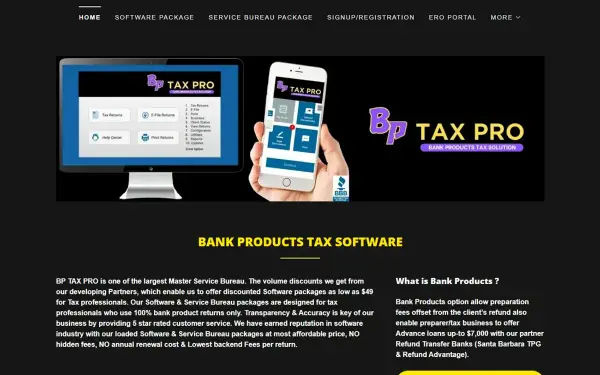
BP TaxPro is built for the preparer who wants to work under a bureau rather than stand up an EFIN from scratch. The PTIN software package covers unlimited federal 1040 returns, schedules and state returns for a one-time seasonal charge, and the vendor positions it as a route to bank products from Santa Barbara TPG and Refund Advantage. Fees can be withheld from client refunds, so the preparer does not have to collect the full preparation fee up front. The entry package carries zero revenue split, which means the preparer keeps preparation and e-file fees. A branded mobile app gives clients a place to interact with the practice.
The trade-off is structural. E-filing happens under the bureau credentials, so the practice is not fully independent, and the entry route is built around bank-product returns. Preparers who fund more than 100 bank-product returns can move to a service bureau tier. Pricing is on the vendor site; the plan note describes a one-time charge for the full season, but the page fetch returned no text, so the package price could not be checked on November 26, 2026. That makes the model attractive on paper but worth confirming before signing. It suits a preparer who is comfortable with refund-based fee collection and a bureau partnership. It does not suit a firm that wants standalone software, full control of transmission and a simple published price with no bank-product dependency.
You want a PTIN-only seasonal package and are comfortable filing under a bureau.
You need standalone software with your own EFIN and full control of transmission.
Entry II of VII / Training included
Our verdict
A useful partnership for preparers who want cloud software, training and marketing from one vendor, provided they can live with quote-only pricing.
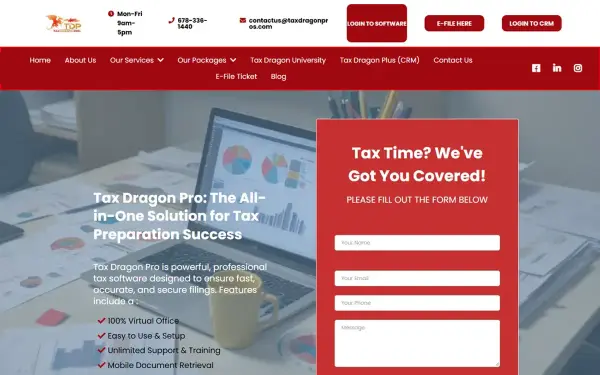
Tax Dragon Pro targets the preparer who wants a business in a box rather than a software license. The cloud professional platform includes mobile document retrieval, electronic signatures, audit protection, marketing services and unlimited support and training. The company says it accepts preparers with or without an EFIN, which puts it in a small group of vendors that speak directly to the PTIN-only buyer. For a new practice, the bundled training can matter as much as the return preparation screens, because it covers how to run the work rather than only where to type.
Pricing is the weak point. The plan note describes partnership packages with volume-based pricing, and the rates are not published. No page text was available on November 26, 2026, so the unpublished volume terms stand as recorded. Volume-based cost reductions also require higher return counts, which means the best economics arrive after the practice has grown. The partnership arrangement gives the vendor a hand in the practice, so a preparer should read the terms carefully and understand who controls client data, branding and filing. The company is based in Atlanta and frames the offer as a way to avoid assembling separate software, marketing and back-office vendors. It fits a preparer who values coaching and a single relationship. It does not fit a preparer who wants a published seasonal fee, a short contract and no shared control.
You want software, training and marketing from one partner and can negotiate the terms.
You need published rates and full control of your practice from day one.
Entry III of VII / Coaching package

Our verdict
A coaching-heavy starter route for new preparers, with a revenue split that makes the low-friction entry cost real.
Opulux sells a practice-building package rather than a bare software license. The starter PTIN package requires no EFIN and adds software mastery training, help with IRS registration, Opulux Tax Academy coursework, a marketing blueprint and compliance review. That combination is aimed at someone who is new to paid preparation and needs a guided path through both the software and the business side. Higher tiers add CRM access and branded software, and the tier comparison is laid out clearly enough to see what changes as the practice grows.
The catch is the commercial model. The starter PTIN package carries a 60/40 revenue split, so the preparer gives up a share of revenue in exchange for the lower-friction start. Full pricing is shared on a strategy call, and the fetch failed on November 26, 2026, so the strategy-call terms and revenue split remain unchecked. The Solo, Boss and Leadership tiers require both a PTIN and an EFIN, which means the no-EFIN route is really a starter route, not a permanent home. A preparer who wants to keep all preparation fees should compare the split against a flat seasonal package before committing. Opulux fits a new preparer who values coaching, coursework and a marketing plan more than immediate margin. It does not fit an experienced preparer who already has clients and wants a clean seasonal fee.
You are new to paid preparation and want coaching, coursework and a marketing plan in one package.
You want to keep all preparation revenue and avoid a strategy call.
Entry IV of VII / Bank products
Our verdict
A mature preparation platform with deep bank-product support, but the EFIN requirement keeps it from being a pure no-EFIN answer.
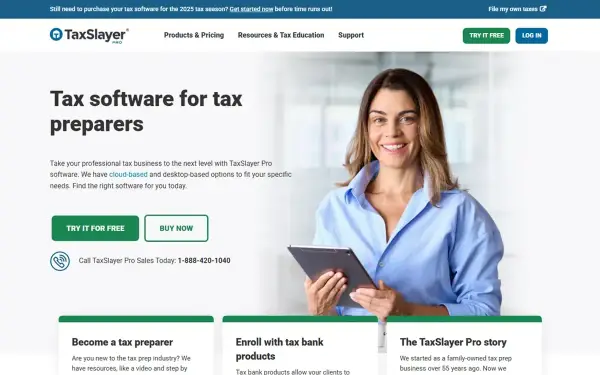
TaxSlayer Pro is a full professional preparation system with 1040 federal, state and local return preparation, filing and transmission, unlimited filing across all states, and both cloud and desktop deployment. The bank-product integrations are the main draw for preparers who collect fees from client refunds. The platform supports fee deduction from refunds and refund advance options, and the company has a long history that began in family tax preparation more than 55 years ago. Unlimited support is included, which matters in a season when a transmission problem can stall the whole office.
The EFIN question is where the fit gets narrower. E-filing needs an EFIN or a bureau arrangement, so a preparer without credentials can still prepare returns in the software but must file on paper or work through a service bureau. Pricing is not published, and no official pricing text was captured on November 26, 2026, so the Pro Classic all-inclusive rate remains quote-only. That is workable for an established office that already knows its volume, but it is a poor fit for a preparer who wants to compare a seasonal fee before committing. BP TaxPro's branded offering runs on TaxSlayer software, which shows how the platform can sit behind a bureau relationship. TaxSlayer Pro fits an established preparer who relies on bank products and wants a known workflow. It does not fit a PTIN-only preparer who needs e-filing without any bureau or paper fallback.
You run an established office, use bank products and can work through an EFIN or bureau.
You need a published seasonal price and must e-file without an EFIN.
Entry V of VII / Full workflow suite
Our verdict
The broadest workflow suite here, but the EFIN requirement and quote-only pricing make it a fit for established firms rather than PTIN-only startups.
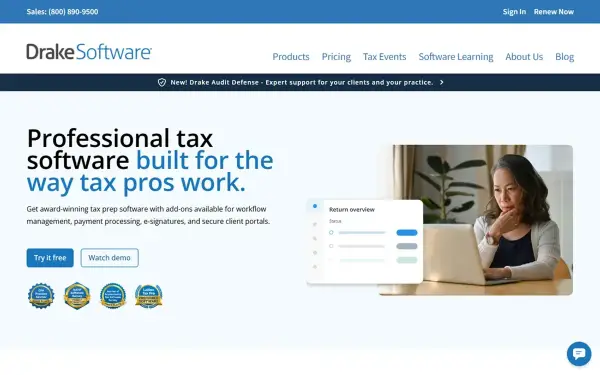
Drake Software is a full ecosystem: Drake Tax Online for cloud preparation, Drake Tax Desktop for installed software, Drake Portals for client document exchange, Drake E-Sign for signatures, Drake Pay for client payments and Drake SmartExtract for AI W-2 data extraction. Organizers and a paper filing workflow are part of the package, which matters for a preparer who cannot e-file. The appeal is consolidation. A firm can keep documents, signatures, payments and preparation in one vendor relationship instead of stitching together separate tools. Support is repeatedly noted for reaching a person quickly, a practical advantage when a return stalls.
The limits are just as clear. E-filing requires an EFIN, so a PTIN-only preparer can use the software for preparation, organizers and paper filing but cannot transmit returns independently. Pricing is not published, and the page was empty on November 26, 2026, so the Drake Tax Online and Drake Tax Desktop editions remain quote-only. The broad ecosystem also carries a learning curve, especially for a small office that only needs 1040 work. A preparer should weigh the workflow depth against the time required to learn modules that may never be used. Drake fits a firm that wants a full desktop or cloud workflow and already has credentials or a bureau plan. It does not fit a solo PTIN-only preparer who wants the shortest path to a filed return.
You want one vendor for preparation, portals, signatures and payments, and you have an EFIN or bureau plan.
You are PTIN-only and need to e-file without credentials.
Entry VI of VII / Free evaluation
Our verdict
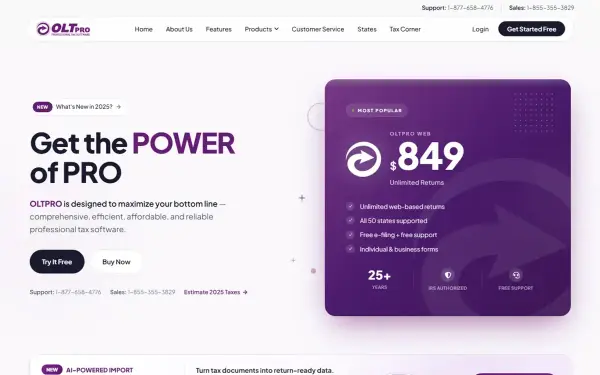
The clearest published-price option in this group, with a free evaluation that lets a preparer test the workflow before buying.
OLTPro stands out because it publishes prices, which is rare in this category. The 25-Return package is sold per season and includes free e-filing, all states, multi-user setup and support. The platform covers individual 1040 preparation plus business forms including 1120, 1120S, 1065, 1041 and 990, with a document manager, taxpayer portal, e-signature and K-1 import. Web and Desktop editions carry unlimited returns at higher seasonal rates. A free evaluation with no credit card required lets a preparer run test returns before committing, which is a practical way to check form coverage and screen flow.
The EFIN limit is important. E-filing needs an EFIN, so the software is not a complete answer for a preparer who has no credentials at all. The entry package caps at 25 returns, which suits a small practice but not a growing one. The vendor FAQ also shows a second, lower set of older prices, so a buyer should confirm the current rate at checkout rather than rely on a cached page. No page text was returned on November 26, 2026, so the season package price could not be verified. Even so, the published structure and the free evaluation make OLTPro easier to evaluate than the quote-only vendors. It fits a preparer who wants to see a price, test the software and handle a modest volume. It does not fit a preparer who needs unlimited returns from day one or must e-file without an EFIN.
You want published pricing, a free evaluation and a small seasonal package.
You need unlimited returns immediately or cannot e-file without an EFIN.
Entry VII of VII / AI data entry
Our verdict
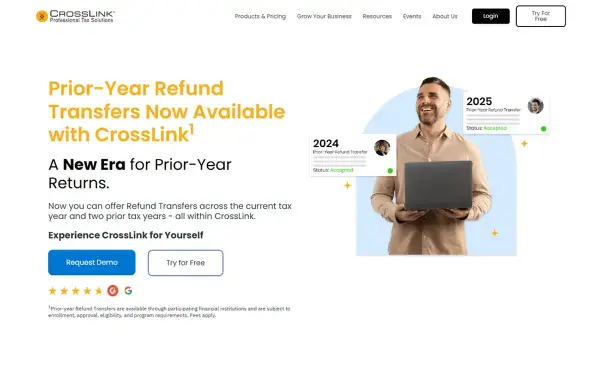
A long-established platform with useful AI extraction and messaging, but it still needs an EFIN or bureau for e-filing and publishes no rates.
CrossLink has been in tax preparation since 1989, and its current pitch centers on automation. CrossLink Agent Intelligence reads W-2s, 1099s and IDs and imports the data into the return, while real-time guidance runs during preparation. Built-in remote signature and unlimited texting through TextLink Plus are included rather than sold as separate add-ons. A client mobile app supports document sharing, and a secure document archive keeps the file organized. For an office that spends too much time keying client documents, the extraction feature is the main reason to look.
The no-EFIN story is less complete. E-filing needs an EFIN or a service bureau, so a preparer without credentials must still solve transmission separately. Pricing is not published, and the page fetch produced nothing on November 26, 2026, so the rate remains quote on request. Automation also depends on clean client documents; a blurry W-2 or a mismatched ID can turn a fast import into manual cleanup. The platform is aimed at firms that want AI-assisted data entry and client messaging in one system, not at a solo preparer who only needs a low-cost 1040 package. CrossLink fits a practice with document volume and a plan for e-filing. It does not fit a PTIN-only preparer who wants a published price and a complete filing path in one purchase.
You want AI document extraction, texting and signatures in one established platform.
You are PTIN-only and need a published rate plus a complete e-filing path.
VBackground
PTIN-only tax software is professional return preparation software sold to a preparer who has a Preparer Tax Identification Number but no Electronic Filing Identification Number. A PTIN lets a preparer sign and prepare returns for compensation. An EFIN is the credential the IRS issues to a firm for electronic transmission. The two are related but not the same, and that gap is the whole category: the software can prepare a return, but the e-filing path needs an EFIN or a service bureau relationship.
Most programs in this group handle the preparation work well. They calculate forms, store client documents, support signatures and print or paper-file a return. The differences show up in three places. First, how the vendor handles transmission when the buyer has no EFIN. Some bundle a bureau arrangement; others leave the preparer to find one. Second, how the vendor charges. A flat seasonal package, a revenue split and a quote-only partnership can look similar on a demo and behave very differently over a season. Third, how much control the preparer keeps over branding, client data and fees.
A service bureau is the common bridge. The bureau holds the transmission credentials, and the preparer works under that arrangement. Bank products often sit alongside the bureau: the preparer can have fees withheld from a client refund or offer a refund advance through a bank partner. That can reduce upfront collection work, but it also ties the practice to the bureau and the bank's rules. A preparer should ask who controls the client relationship, what happens if a return is rejected, and whether the arrangement can later convert to an independent EFIN. The best tax software for tax preparers no efin required is the one that answers those questions in writing, not just in a demo.
This comparison sits in the software register. Further along the shore: baby tracking app and kennel software.
VIPricing
Pricing in this category is not one model, and the cheapest entry point is rarely the cheapest season. A vendor can quote a flat seasonal fee, take a share of revenue, bundle software into a partnership, or refuse to publish a rate until a call. The model changes who carries the risk and when the preparer pays.
| Model | How it bills | Typical fit | Example from this list |
|---|---|---|---|
| One-time seasonal package | A single charge for the full season, with return and state limits set by plan | PTIN-only preparer who wants a known cost | BP TaxPro PTIN package |
| Revenue split | Vendor takes a percentage of preparation revenue in exchange for a starter package | New preparer who needs coaching and lower entry friction | Opulux starter PTIN package |
| Volume-based partnership | Rates vary with return volume and are shared in a partnership discussion | Preparer who wants software, training and marketing from one partner | Tax Dragon Pro partnership packages |
| All-inclusive quote | Unlimited filing and states with a rate quoted on request | Established firm with predictable volume | TaxSlayer Pro Classic |
| Published seasonal package with evaluation | A set package price plus a free evaluation before purchase | Small practice that wants to test before buying | OLTPro 25-Return package |
A flat fee is easier to budget, but it may include bank-product assumptions or return caps. A revenue split lowers the entry barrier, but the preparer gives up part of each fee and may need a strategy call to see the full terms. Quote-only pricing is not automatically bad; it can fit a firm with known volume. The problem is comparison. Ask for the full seasonal cost, the return cap, the state treatment, the e-filing path and the exit terms in one document. All starting prices in this list are on the vendor site, and several were not available on November 26, 2026, so confirm before signing.
Each entry card shows the starting price as it appeared on the vendor's own pricing page on November 25, 2026. When a vendor shows no figure we could confirm, or only a promotional rate, the card says "See website" or gives the regular price instead of a guess. Usage, overage and add-on rates in the text change more often than plan prices, so confirm them on the vendor page before you set a budget. To test the numbers against your own volume, try the free User Research Budget Planner. The Event Break-Even Calculator is a second way to check the same decision.
VIIDecision
VIIIPitfalls
IXQuestions
Yes, a PTIN is enough to prepare returns for compensation, but not to e-file them. A paid preparer needs a PTIN, and electronic transmission requires an EFIN held by the firm or a service bureau arrangement. Confirm the filing route before choosing software, because a preparation package alone does not create transmission credentials.
An EFIN is required when the firm transmits returns electronically to the IRS. The IRS controls the application and approval process, and processing time can vary by season and application quality, so check current IRS guidance for the expected window. Until approval, plan for paper filing or a bureau.
A service bureau provides the transmission credentials and back-office route that a PTIN-only preparer lacks. The preparer works under the bureau's arrangement, which may include bank products, fee collection and support. The trade-off is control: the bureau may hold the e-file credentials and shape the client experience.
Bank products let a preparer collect fees from a client refund instead of charging up front. The bank partner advances or processes the refund, and the preparer receives the fee through that flow. The arrangement can reduce collection work, but it ties the practice to the bank's rules and the bureau that offers the product.
Choose a flat seasonal fee if you want to keep all preparation revenue and can pay upfront. A revenue split can lower the entry barrier and bundle training, but the vendor takes a share all season. Model both at your expected volume, including return caps and support.
Start by asking the bureau how it handles client data, branding and transmission during and after the transition. Then apply for an EFIN and confirm that your software can switch to your own credentials. A clean exit plan matters as much as the entry price.
XFurther along the shore
Vendors can ask for a correction or apply for a Featured listing. Paid or not, the entry is scored on the same rubric and its limits stay in print. Partner with Umberlake.
Free tools
Our free browser tools turn the prices on this page into a figure for your own volume. Nothing you type leaves your device.