
Lattice
$4Engagement module, per seat per month, billed annually
Best for mid-market and larger firms running performance and compensation
- Free plan
- No
- Rubric
- 8.3 of 10
We ranked nine talent management platforms by published pricing, performance depth and fit, from continuous feedback tools to full enterprise HCM suites.

IThe short answer
Lattice, 15Five and BambooHR are the top picks in our November 2026 guide to the best talent management software. Lattice suits mid-market and larger firms running formal review cycles and compensation, 15Five suits teams building a continuous feedback habit, and BambooHR suits small businesses that want HR records and performance in one place. Prices were checked on November 26, 2026. Nine tools are ranked below, from $4 per seat modules to enterprise suites quoted per contract.
9 tools compared from vendor pages on November 25, 2026. 3 publish a starting price we could read; the rest say "See website".
IITop three berths
Register order is editorial fit for the buyer each entry describes. Prices are the starting figures read on November 25, 2026.
$4Engagement module, per seat per month, billed annually
Best for mid-market and larger firms running performance and compensation

$4Engage, per user per month, billed annually
Best for teams building a continuous feedback culture

$10Core, per employee per month, volume discounts available
Best for sMBs wanting HR records and performance in one system
How this page is paid for. All 9 tools here are unpaid editorial picks.
A paid listing's position can be part of what the vendor pays for. Every entry, paid or not, is scored on the same rubric and keeps its limits in print. Advertising disclosure.
IIIThe register
Starting prices as shown on each vendor's pricing page on November 25, 2026. "See website" means no figure we could confirm.
| No. | Tool | From | Free plan | Trial | Rubric | Actions |
|---|---|---|---|---|---|---|
| 01 | LatticeMid-market and larger firms running performance and compensation | $4Engagement module, per seat per month, billed annuallyRead on vendor page | No | No | 8.3 | |
| 02 | 15FiveTeams building a continuous feedback culture | $4Engage, per user per month, billed annuallyUpdated on vendor page | No | Free trial | 6.7 | |
| 03 | BambooHRSMBs wanting HR records and performance in one system | $10Core, per employee per month, volume discounts availableUpdated on vendor page | No | Free trial | 7.1 | |
| 04 |  LeapsomeEuropean-built modular people platform with talent add-ons | See websiteNot shown publicly | Yes | 14-day free trial | 6.8 | |
| 05 |  Culture AmpEngagement science, surveys, and benchmarks | See websitecustom quoteQuote only | No | No | 6.2 | |
| 06 | Workday HCMLarge enterprises wanting a single HR suite | See websiteNot shown publicly | No | No | 7.2 | |
| 07 |  CornerstoneLearning-led talent development and compliance training | See websiteNot shown publicly | No | No | 6.5 | |
| 08 | SAP SuccessFactorsGlobal enterprises with complex talent processes | See websiteNot shown publicly | No | No | 6.9 | |
| 09 | ClearCompanyMid-market firms connecting recruiting with performance | See websitecustom quoteQuote only | No | No | 6.2 |
Pinned:
IVMethod
We scored nine platforms on five criteria. Price clarity (20 percent) rewards vendors that publish real numbers a buyer can model. Talent depth (25 percent) covers review cycles, calibration, goals, succession and compensation, because that work separates talent management from a records system. Ease of use (15 percent) reflects how quickly managers adopt the tool without training. Scale fit (20 percent) asks whether the product holds up at the headcount it targets. System integration (20 percent) covers HRIS, payroll and adjacent systems, since almost nobody buys this category in isolation.
Prices and plan details came from vendor pricing pages checked on November 26, 2026. Where a vendor publishes nothing, the entry says so and the score reflects that, rather than a guess at what the number might be. Module prices, plan names and billing terms are recorded exactly as listed, including annual minimums, trial availability and free plan status.
This list may include a Featured placement, which is paid. A Featured placement gets the same five criteria and the same scrutiny, including honest cons, and it does not change how other entries score. The order reflects fit for the buyer described in each entry, plus any Featured position, rather than a weighted total.
The full routine, from price reads to corrections, is on the methodology page. Paid listings follow the advertising disclosure.
How openly the vendor publishes numbers a buyer can model before talking to sales.
Coverage of reviews, calibration, goals, succession and compensation work.
How quickly managers adopt the tool without heavy training or admin support.
Whether the product holds up at the headcount band it actually targets.
Connections to HRIS, payroll and adjacent systems, since few buyers run this alone.
Entry I of IX / Performance and comp
Our verdict
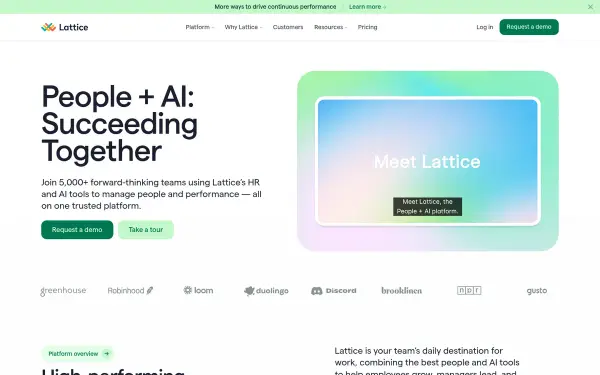
The most complete performance and compensation stack for mid-market firms that accept annual billing and a $4,000 floor.
Lattice sells talent management as separate per-seat modules rather than one bundled suite, and the pricing sheet is public. Engagement is $4 per seat per month, Goals and OKRs is $8, Performance is $10, Compensation is $6 and Grow is $4, all billed annually with a $4,000 annual minimum and no implementation fees. That structure suits a mid-market or larger firm that wants to start with reviews and add goals, engagement or compensation later, though the effective per-employee cost climbs quickly once you stack three or four modules.
The performance side is the reason most buyers arrive. Review cycles, calibration sessions, succession planning and talent reviews, performance improvement plans, one-on-ones and continuous feedback all sit in the same product, so a manager running a quarterly cycle does not juggle separate tools. Goals and OKRs tracking and engagement surveys are native, and native integrations with major HRIS platforms mean employee records stay where they already live.
The limit is that Lattice does not replace an HRIS. There is no payroll, no benefits administration and no core employee record system here, so a company without one still needs a system of record underneath. Annual billing with the $4,000 floor also rules out very small teams and anyone who wants to trial a cycle before committing.
Pick it when you have a defined review cadence, a compensation cycle to run and a mid-market or larger headcount. Skip it if you need payroll and records in the same contract, or if you want a monthly commitment with no minimum.
You run formal review and compensation cycles and want the modules priced in public before you talk to sales.
You need payroll and HR records in the same contract or cannot commit to annual billing.
Entry II of IX / Weekly feedback habit
Our verdict
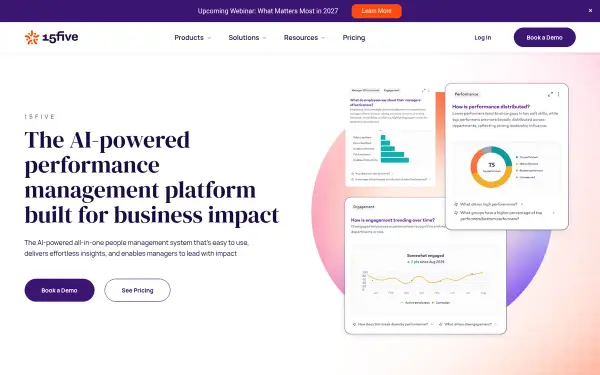
Best for building a weekly feedback habit quickly, with AI review drafting and a manager coach built into the flow.
15Five is built around a weekly rhythm. Check-ins, one-on-one agendas and peer recognition are the front door, and the platform layers engagement surveys, AI-assisted performance reviews, a nine-box talent matrix with calibration, and Kona, an AI manager coach, on top. Teams that already run weekly one-on-ones tend to adopt it fastest, because the product mirrors the habit instead of asking for a new one.
Pricing is the caveat. The Engage tier is listed at $4 per user per month billed annually, but figures for the higher tiers have not been reliably published, so a buyer should confirm the full cost on a quote. A free trial is offered and there is no free plan.
Depth is the second caveat. Reporting is thinner than what Lattice, Workday HCM or SAP SuccessFactors provide, and very large organizations with layered review committees, complex calibration rules and multi-country compensation cycles often outgrow it. Implementation, by contrast, is measured in weeks rather than months, which matters if you want a review cycle live this quarter.
Pick it if your managers need a structure for weekly conversations and you want AI help drafting reviews without adopting a heavy suite. Skip it if you are a 5,000-person employer with deep reporting requirements or a compensation program that needs its own module.
Managers need a repeatable weekly structure and you want review drafting assistance from day one.
You need heavy multi-country reporting or a dedicated compensation module.
Entry III of IX / HR plus reviews
Our verdict
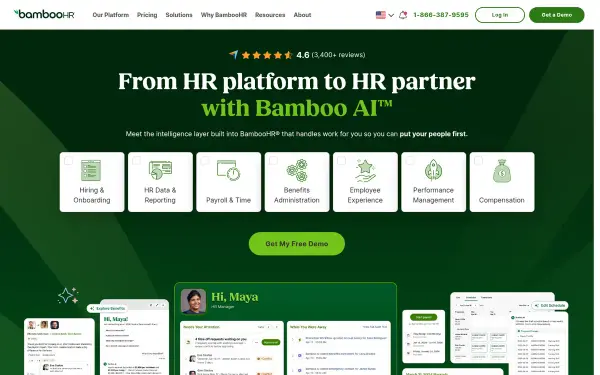
A clean single system for HR records, hiring and reviews, best under a few hundred employees.
BambooHR started as an HR records system and grew outward, which is exactly how it behaves in a talent management conversation. Core HR records, applicant tracking, onboarding workflows, time off and benefits administration sit in the same product as custom review cycles, 360 feedback, one-on-ones and goal tracking. For a company under a few hundred people, that means one login for hiring, onboarding and reviewing the same person.
The pricing page shows plan names (Core, Pro and Elite) without amounts, and Core is listed here at $10 per employee per month with volume discounts available. Amounts for the other plans are not published, so treat the $10 Core rate as a starting point for a quote. A free trial is offered. Compensation management is only available on the Elite tier, and the more complex review and calibration features concentrate on the higher plans rather than the entry level.
That tiering is where most of the debate sits. If you want simple annual reviews, manager one-on-ones and light goal tracking, Core plus Pro covers it and you avoid buying a second tool. If you run calibration sessions, nine-box talent reviews or structured compensation cycles, BambooHR will feel shallow next to Lattice or 15Five, and plenty of teams keep BambooHR for records while running performance elsewhere.
Pick it if you are a small or mid-size employer that wants HR, hiring and basic performance under one contract. Skip it if performance is the centerpiece of your people strategy or you need compensation management below the Elite tier.
You want HR records, hiring and simple review cycles handled by one vendor and one login.
You run calibration or compensation cycles that need specialist depth.
Entry IV of IX / Buy modules a la carte
Our verdict
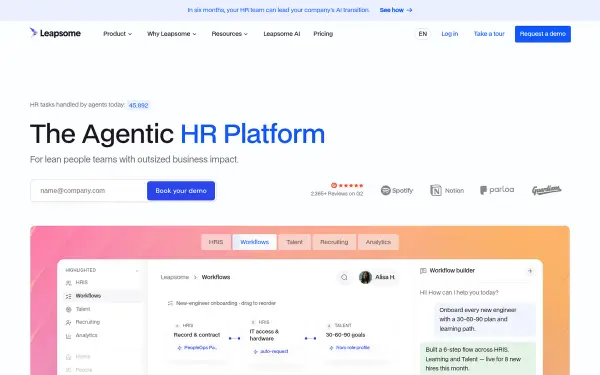
A modular European people platform where you buy only the talent modules you need, priced in euros.
Leapsome is a modular people platform built in Europe, and the module list reads like a menu: performance review cycles, goals and OKRs, engagement surveys, learning, compensation reviews, recruiting and an HRIS foundation. Buyers assemble the pieces they need rather than paying for a suite they will not use, and the vendor has offered an HRIS foundation free alongside any talent module through a promotion running to December 31.
That promotion is time limited, and currency is the complication for US buyers. Module prices are quoted in euros on a per-employee monthly basis, which means budget conversations need an exchange rate assumption and a finance team willing to revisit it. Module prices did not render cleanly in the capture behind this guide, so confirm numbers directly rather than lifting a comparison figure.
Operationally, the modular model cuts both ways. It keeps the entry point low and lets a company start with reviews, then add goals, surveys or compensation as the program matures. It also means more line items on the invoice and more decisions about scope each year. There are no setup fees, a 14-day free trial is available, and the vendor holds ISO 27001 and SOC 2 Type II certifications and states GDPR compliance, which carries weight for European employers and for US companies with EU staff.
Pick it if you want European data handling, a trial before commitment and the freedom to buy talent modules a la carte. Skip it if you need one published USD figure or if a fragmented module stack would create more admin than your team can absorb.
You want to start with reviews and add goals, surveys or learning one module at a time.
You need a single USD contract with one consolidated published price.
Entry V of IX / Survey benchmarks
Our verdict
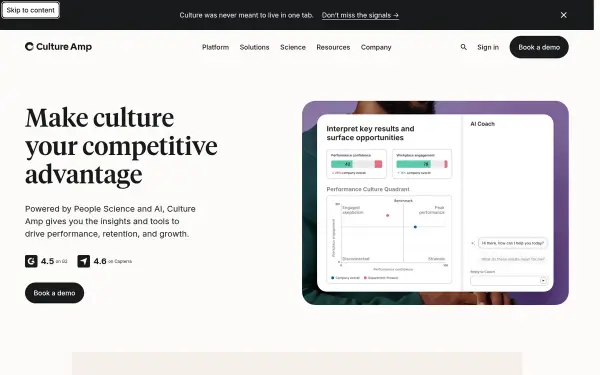
The strongest survey and benchmark engine here, with performance management as a useful second act.
Culture Amp is an employee experience platform, and it is honest about that. Engagement surveys, eNPS measurement, lifecycle and onboarding surveys, and industry benchmarks are the core, backed by a large employee dataset that gives the survey methodology more weight than a generic form builder. Performance reviews, development and growth tools, and people analytics dashboards sit around that center. The useful part is the connection: you can look at a team's engagement score and its review outcomes in the same place.
Pricing is quote-based only, with no free plan and no self-serve number. Quotes depend on employee count, product and service tier and are billed annually, which means a buyer cannot comparison-shop on a public figure. The platform is also engagement-first, so core HR records, payroll and benefits live in another system, and performance management is a secondary capability rather than the reason to buy.
For a people analytics or engagement lead, that trade is reasonable. Survey design, benchmark comparison and dashboarding are stronger than what generalist HR suites produce, and the performance module is good enough for many organizations that already keep records elsewhere. For a buyer whose main problem is running calibration, succession or compensation cycles, the depth is not there and a performance specialist will fit better.
Pick it if engagement measurement and benchmarking are the priority and you already have an HRIS. Skip it if you need talent management to cover records, payroll or deep compensation work.
You need credible engagement measurement and benchmarking on top of an existing HRIS.
Your priority is review calibration, succession planning or compensation cycles.
Entry VI of IX / One data model
Our verdict
One data model for HR, payroll, talent and finance, priced and implemented for large enterprises only.
Workday HCM is a full suite, not a talent module bolted onto something else. Core HR and records, talent and performance management, succession planning, learning, compensation, payroll and time tracking all run on one data model, which is the real argument for it. When an employee changes role, the reporting line, compensation, goals and review cycle all reflect the change because they read from the same source. Global employers get consistent processes across countries instead of a patchwork of local systems.
None of that comes cheaply or quickly. Pricing is enterprise quotes with no public starting figure, and implementations typically run several months, often longer. Buyers should plan for systems integrator costs, change management and a period where the old tools run in parallel. Organizations already running Workday for payroll and financials have the shortest path, because extending into talent management adds a module rather than a new vendor relationship.
The fit question is mostly about size. A 150-person company will pay for capability it never configures, and the configuration work itself assumes dedicated HRIS and IT resources. A 15,000-person company with operations in a dozen countries gets reporting and process consistency that smaller tools cannot match.
Pick it if you are a large enterprise that wants HR, payroll, talent and finance data in one governed system. Skip it if you need a review cycle live in a quarter, or if you do not have the internal team to run a multi-month deployment.
You are a global enterprise that wants talent, payroll and finance reporting from one governed source.
You are below enterprise scale or need something live within a single quarter.
Entry VII of IX / Compliance training depth
Our verdict
Learning and compliance training are the core strength, with performance and career tools riding alongside.
Cornerstone comes at talent management from learning, and that origin shows. Learning management, compliance training tracking, content libraries and skills development are the strongest parts of the platform, with career pathing, performance management, recruiting and onboarding attached around them. For a hospital, a bank or a manufacturer where annual training completion has to be evidenced to a regulator, that combination is the reason to shortlist it.
Pricing is quote-based with no public figure, so buyers should expect a scoped proposal rather than a published number. Deployments are sized like enterprise projects, and total cost depends heavily on content library choices, compliance requirements and which modules are in scope.
The trade is depth in the wrong places for some buyers. Performance management is functional but less refined than what a dedicated performance vendor offers; calibration workflows and continuous feedback feel like a supporting feature rather than the centerpiece. The broader suite can also feel heavy for a company that just wants annual reviews and one-on-ones, and configuration effort reflects that.
Pick it if learning, skills and compliance training are central to your talent strategy and you need them tied to performance and career paths. Skip it if performance reviews are the main purchase and you want a lighter, cheaper specialist tool.
Compliance training and skills development must be evidenced and tied to career paths.
Performance reviews are the whole purchase and you want a lighter specialist.
Entry VIII of IX / SAP integration
Our verdict
Deep global talent processes and succession planning, worth it mainly if SAP already runs your finance stack.
SAP SuccessFactors is the talent suite for employers that already think in SAP terms. Recruiting and onboarding, performance and goals, succession planning, learning, compensation, workforce planning and people analytics cover the full cycle, and succession and workforce planning are genuinely deep, with the kind of multi-level talent review structures that global employers build over years.
The integration story is the differentiator. Companies running SAP for ERP and finance get native links between headcount plans, labor costs and talent decisions, which is hard to replicate by stitching a specialist tool onto an SAP core. That advantage only exists if SAP is already the center of your systems landscape.
The costs are real. Pricing is quote-based with no public figure, and deployments are major projects that run for months, usually with a systems integrator involved. Configuration is extensive, the interface carries more complexity than mid-market buyers expect, and the skills needed to administer it are specialized. Smaller organizations routinely find the total cost of ownership hard to justify against a lighter tool.
Pick it if you are a global enterprise with complex, multi-country talent processes and SAP already runs your finance and ERP stack. Skip it if you are below enterprise scale, if your HR team has no dedicated systems support, or if you need a fast deployment.
You are a global employer already running SAP for ERP and finance and need deep succession planning.
You have no dedicated systems team or need a deployment measured in weeks.
Entry IX of IX / Recruiting to review
Our verdict
Recruiting and performance in one mid-market platform, now sold as ClearCo, with every bundle requiring a quote.
ClearCompany connects recruiting to performance, which is the combination mid-market employers most often ask for. Applicant tracking with AI-assisted sourcing, onboarding, performance management, goal alignment, learning, engagement and compensation are all available, and modular packaging means a buyer can start with hiring and add talent modules as the team grows.
The company now operates as ClearCo, a rebrand worth knowing when you search for documentation or ask for a quote. Pricing is not published for any package, and modular bundles make quotes genuinely hard to compare: two proposals can both say performance is included and mean different things about review cycles, calibration or reporting. Ask for a written module list and a per-employee figure before you shortlist.
Depth varies by module. Recruiting is the mature side, and performance is solid for standard review cycles and goal cascades, but a buyer with complex calibration or a global compensation program will find the ceiling sooner than they would with Lattice or Workday HCM. Conversely, a company that hires heavily and wants reviews in the same system gets a shorter vendor list and cleaner data flow from candidate to employee to review.
Pick it if recruiting volume is high and you want hiring and performance on one platform without enterprise overhead. Skip it if you need published pricing, best-in-class performance depth or a single global configuration.
You hire at volume and want the candidate record to flow straight into onboarding and reviews.
You need a published price list or best-in-class calibration and compensation work.
VBackground
Talent management software handles what happens to an employee after they are hired and before they leave: reviews, goals, feedback, engagement, skills, succession and pay decisions. It is not the same as core HR software, which keeps the record itself (name, address, contract, job title, salary, time off). Many vendors sell one and not the other, and the most common buying mistake is assuming a performance tool will also run payroll.
The categories overlap in specific places. A system of record like BambooHR or Workday HCM includes both records and talent modules. A specialist like Lattice or 15Five assumes records already live somewhere else and integrates with that system. An engagement platform like Culture Amp sits further out still, measuring how people feel and leaving the transactional work to others.
Practical differences show up in four areas:
Buyers also confuse talent management with learning. Cornerstone and SAP SuccessFactors carry deep learning modules; Lattice and 15Five do not. If compliance training is part of the requirement, that narrows the list quickly.
Finally, scale changes the answer. A 100-person company typically needs reviews, one-on-ones and light goals, and gets more value from a clean, cheap tool than from a suite. A 5,000-person company with offices in eight countries needs consistent process, multi-currency compensation and reporting that survives an audit, and that is a different purchase with a different implementation timeline.
This comparison sits in the software register. Further along the shore: baby tracking app and kennel software.
VIPricing
Pricing in this category falls into four models, and the model matters more than the headline number. Per-seat module pricing is the most transparent: you see a real rate and can model headcount growth yourself. Per-employee platform pricing bundles HR records with talent features and usually tiers the talent depth by plan. Quote-based pricing hides the number until sales scopes your headcount, module list and service tier, which makes comparison slow but not impossible if you ask every vendor for the same inputs.
| Model | How it bills | Typical fit | Example from this list |
|---|---|---|---|
| Per-seat module | Per seat per month, annual billing, module by module | Mid-market firms with a defined review cadence | Lattice at $4 per seat for Engagement and $10 for Performance |
| Per-employee platform | Per employee per month, tiered by plan | SMBs wanting records and reviews together | BambooHR Core at $10 per employee per month |
| Quote by headcount | Annual quote based on employees, products and service tier | Engagement and analytics buyers | Culture Amp, quoted on request |
| Enterprise contract | Multi-year agreement with services attached | Global enterprises with complex processes | Workday HCM, SAP SuccessFactors and Cornerstone, all quote-only |
Three things move the final number more than the list price. Headcount is the obvious one. Module count is the second: Lattice's modules run from $4 to $10 per seat per month, so a four-module stack costs several times the entry rate. Contract term is the third: annual billing with minimums is normal, and monthly flexibility usually costs more or is not offered at all.
Ask each vendor for total annual cost at your current headcount and at headcount plus 30 percent, with implementation, support and any content library fees itemized. That single comparison exposes most of the gap between a $4 headline rate and what an enterprise suite actually costs.
Each entry card shows the starting price as it appeared on the vendor's own pricing page on November 25, 2026. When a vendor shows no figure we could confirm, or only a promotional rate, the card says "See website" or gives the regular price instead of a guess. Usage, overage and add-on rates in the text change more often than plan prices, so confirm them on the vendor page before you set a budget. To test the numbers against your own volume, try the free User Research Budget Planner. The Event Break-Even Calculator is a second way to check the same decision.
VIIDecision
Map your record system. Decide whether HR records, payroll and benefits sit in this purchase or stay where they are. If they stay, you are buying a talent layer; if they move, the shortlist changes completely.
Size the headcount. Under 300 employees, BambooHR or 15Five usually beats an enterprise suite on cost and time to value. Above 2,000 with multiple countries, Workday HCM or SAP SuccessFactors start to make sense.
Name the one process you must fix. If it is calibration and compensation, weight Lattice and Workday HCM. If it is engagement measurement, weight Culture Amp. If it is compliance training, weight Cornerstone.
Get quotes on identical inputs. Ask every vendor for annual cost at current headcount plus 30 percent, with implementation, support and content fees itemized. Modular and quote-based vendors become comparable only when the inputs match.
Check the contract term. Annual billing with minimums is standard. Lattice carries a $4,000 annual floor and quote-based vendors bill annually by default, so confirm what happens at renewal and whether headcount bands adjust mid-term.
Run a live cycle, not a demo. Build one real review or survey in the trial or pilot with actual managers. Configuration friction and manager adoption surface in week two and stay invisible in a scripted demo.
VIIIPitfalls
Buying a suite for one feature. Enterprise suites are priced for the whole set of modules. If you only need review cycles and one-on-ones, a specialist tool costs less and goes live sooner.
Ignoring the annual minimum. Lattice's $4,000 floor and annual-only billing turn a $4 per-seat rate into a commitment. Model the minimum against your actual headcount before you sign.
Assuming performance comes with HR records. BambooHR places compensation management on Elite and concentrates deeper review features on higher tiers, so a Core quote rarely covers the talent work you planned.
Comparing list prices across models. A per-seat module rate and a per-employee platform rate are different units, and quote-only vendors publish nothing. Force every proposal into a total annual cost at your headcount.
Skipping the record system question. Talent tools like Lattice and 15Five assume an HRIS underneath. Buy one without checking and you will be running two projects and two budgets in the same quarter.
IXQuestions
It covers reviews, goals, feedback, engagement, skills, succession and pay decisions, while payroll and HR records stay in a system of record. The overlap varies: Workday HCM and BambooHR include both, Lattice and 15Five assume records live elsewhere and integrate with your HRIS, and Culture Amp focuses on surveys and analytics with performance as a secondary module.
Lattice at $4 per seat per month for Engagement and BambooHR at $10 per employee per month on Core are the clearest published figures. 15Five's Engage tier is listed at $4 per user per month but should be confirmed on a quote. Culture Amp, Workday HCM, Cornerstone, SAP SuccessFactors and ClearCo quote by headcount, modules and service tier, and Leapsome lists module pricing in euros.
Core HR software keeps the employment record: contract, job title, salary, time off and benefits. Talent management software acts on that record through reviews, goals, feedback, engagement surveys, succession slates and compensation cycles. Some vendors sell both, which is why tiering matters: BambooHR's compensation management only appears on the Elite plan, and Workday HCM bundles everything into one data model.
For simple annual reviews, one-on-ones and light goal tracking, BambooHR is enough and keeps everything in one system. It gets thin on calibration sessions, nine-box talent reviews and structured compensation cycles, and compensation management requires the Elite tier. Teams with those requirements often keep BambooHR for records and run performance in Lattice or 15Five instead.
Under a few hundred employees, BambooHR and 15Five are the practical picks, and 15Five's free trial lowers the risk. Mid-market firms running formal review and compensation cycles fit Lattice, Leapsome and ClearCo. Enterprise employers with multi-country processes fit Workday HCM, SAP SuccessFactors and Cornerstone, all quoted per contract.
It depends on the model. 15Five measures implementation in weeks, Lattice charges no implementation fees, and Leapsome offers a 14-day trial with no setup fees. Enterprise deployments run the other way: Workday HCM typically takes several months, and SAP SuccessFactors and Cornerstone are sized as major projects, usually with a systems integrator involved.
XFurther along the shore
Vendors can ask for a correction or apply for a Featured listing. Paid or not, the entry is scored on the same rubric and its limits stay in print. Partner with Umberlake.
Free tools
Our free browser tools turn the prices on this page into a figure for your own volume. Nothing you type leaves your device.