
Stripe Billing
See websitePay as you go, 0.7% of Billing volume, no monthly platform fee, annual subscription tiers from $620 per month
Best for startups already running payments through Stripe
- Free plan
- No
- Rubric
- 6.8 of 10
Nine subscription billing platforms compared on pricing model, tax handling, churn recovery and setup load, with prices checked on November 25, 2026 for teams choosing before year end.

IThe short answer
Stripe Billing is the best recurring billing software for teams already processing payments through Stripe, Chargebee is the best fit for growing SaaS mixing seat and usage pricing, and Recurly is the pick when involuntary churn is the problem. That ordering reflects fit for the buyer each entry describes, not a weighted total. Prices below were checked on November 25, 2026 against vendor pricing pages. Some tools publish a starting figure; others price as a percentage of volume or quote on request, so budget conversations start earlier than the marketing pages suggest.
9 tools compared from vendor pages on November 25, 2026. 5 publish a starting price we could read; the rest say "See website".
IITop three berths
Register order is editorial fit for the buyer each entry describes. Prices are the starting figures read on November 25, 2026.
See websitePay as you go, 0.7% of Billing volume, no monthly platform fee, annual subscription tiers from $620 per month
Best for startups already running payments through Stripe

FreeFlow, per month plus 0.80% of monthly invoicing volume, 100M usage events included
Best for growing SaaS mixing subscription, seat and usage pricing
$249Starter, per month plus 0.9% of billing volume, first $40K of billings included monthly
Best for subscription businesses fighting involuntary churn
How this page is paid for. All 9 tools here are unpaid editorial picks.
A paid listing's position can be part of what the vendor pays for. Every entry, paid or not, is scored on the same rubric and keeps its limits in print. Advertising disclosure.
IIIThe register
Starting prices as shown on each vendor's pricing page on November 25, 2026. "See website" means no figure we could confirm.
| No. | Tool | From | Free plan | Trial | Rubric | Actions |
|---|---|---|---|---|---|---|
| 01 | Stripe BillingStartups already running payments through Stripe | See websitePay as you go, 0.7% of Billing volume, no monthly platform fee, annual subscription tiers from $620 per monthRead on vendor page | No | See website | 6.8 | |
| 02 | ChargebeeGrowing SaaS mixing subscription, seat and usage pricing | FreeFlow, per month plus 0.80% of monthly invoicing volume, 100M usage events includedRead on vendor page | Yes | Free trial | 7.5 | |
| 03 | RecurlySubscription businesses fighting involuntary churn | $249Starter, per month plus 0.9% of billing volume, first $40K of billings included monthlyRead on vendor page | No | 90-day free trial | 7.1 | |
| 04 |  MaxioB2B SaaS where finance owns the billing decision | See websiteGrow, per month, for up to $100,000 in monthly billingsNot shown publicly | No | See website | 6.5 | |
| 05 | ZuoraLarge enterprises with complex global monetization | See websiteCustom quoted enterprise agreements, guided implementation, no self-serveNot shown publicly | No | Demo only | 6.5 | |
| 06 |  PaddleSaaS teams offloading global tax and compliance | See websitePay as you go, 5% + 50¢ per Checkout transaction, no monthly fee, custom pricing for high volumeRead on vendor page | No | See website | 6.9 | |
| 07 | Zoho BillingSmall businesses wanting capable billing on a budget | $50Standard, per organization per month, $39 per month if billed annually, up to 3 usersRead on vendor page | Yes | 14-day free trial | 6.9 | |
| 08 |  OrbUsage-based SaaS and AI infrastructure companies | See websiteCustom quoted pricing, no self-serve tierNot shown publicly | No | See website | 5.5 | |
| 09 |  BillingPlatformEnterprises whose billing models fit no standard product | See websiteQuote-only enterprise pricing, implementation required, no trialNot shown publicly | No | No | 5.9 |
Pinned:
IVMethod
How well the platform expresses the pricing structures a buyer is likely to run, from flat plans and seats to usage events and negotiated contracts.
How easy it is to forecast spend as billings grow, counting monthly minimums, percentage fees and plan step-ups.
Revenue recognition, tax handling and compliance scope, including whether the vendor carries tax liability or leaves it with you.
Dunning, retry scheduling and retention features that recover revenue from failed recurring payments.
Setup effort, self-serve access and how much configuration a team must absorb before the first invoice runs.
VMethod
Every tool on this list was scored against the same five criteria, weighted toward the decisions buyers actually face. Billing model fit carries 25% and asks how well the platform handles the pricing structures a buyer is likely to run, from flat plans to seats, usage and negotiated contracts. Pricing predictability carries another 25% and weighs how easy cost is to forecast as billings grow, including minimums and percentage fees. Revenue depth at 20% covers revenue recognition and, where applicable, sales tax and VAT liability. Recovery tooling at 15% looks at dunning, retry scheduling and retention features. Implementation load at 15% captures setup effort, self-serve access and configuration burden before the first invoice runs.
Prices, plan names and free tier facts come from vendor pricing pages checked on November 25, 2026. Where a vendor publishes no figure, the entry says so and no number is estimated. Percentage rates are quoted exactly as published, and applied to billing volumes only to show how the arithmetic behaves, not to project what any vendor would charge a specific company. Where a pricing page could not be reached during the November check, the item notes that the figure is unconfirmed rather than filling the gap with a guess.
The order is editorial: it reflects the best fit for the buyer each entry describes, plus a Featured position where one exists. A Featured position is a paid placement, and Featured entries are scored with the identical rubric and carry the same honest cons as every other entry. Scores reflect the criteria above and the published facts.
The full routine, from price reads to corrections, is on the methodology page. Paid listings follow the advertising disclosure.
Entry I of IX / Unified payments stack

Our verdict
Best for teams already on Stripe payments: one stack for billing and revenue recognition, with a percentage fee that scales with volume.
Stripe Billing turns a payments account into a subscription system. You build plans, run lifecycles, ingest usage events for metered pricing, and send quotes and invoices from the same dashboard that shows card settlements. A hosted customer self-service portal is included, and revenue recognition reporting sits inside the product instead of a spreadsheet. The API-first design comes with extensive developer documentation, which matters if engineering owns the integration.
Pricing is pay as you go at 0.7% of Billing volume with no monthly platform fee, so small billers pay close to nothing to start. Card processing is billed on top, and annual subscription tiers start at $620 per month for teams that prefer committed spend. The percentage is the catch at scale: at $1,000,000 in monthly billings the billing fee alone reaches $7,000 a month before a single card is processed.
The bigger structural point is that you remain merchant of record. Sales tax registration, VAT filing and chargeback exposure stay with your team, so Stripe Billing does not replace a tax engine or a merchant of record such as Paddle. Recurly lists dunning and smart retry scheduling, and buyers who need revenue recognition for complex contracts can compare Maxio or Zuora.
It fits startups and mid-market product teams already running Stripe payments, especially those with engineering capacity and simple tax exposure. If most revenue comes from a handful of enterprise contracts with negotiated terms, or you sell into dozens of tax jurisdictions, the in-house compliance work will outweigh the fast setup.
You already process payments on Stripe and want subscription billing live without a new vendor or a platform fee.
You sell into many tax jurisdictions or need dunning depth that matches Recurly's retry tooling.
Entry II of IX / Mixed pricing models

Our verdict
Best for growing SaaS that mixes seats, subscriptions and usage, with a free entry point that avoids a platform fee on day one.
Chargebee covers the awkward middle of subscription billing: plans that mix a base fee, seats and metered usage on the same invoice. Calendar billing and aligned billing periods handle customers who sign mid-month, and the gateway integrations mean you keep your existing processor rather than migrating card data. Revenue recognition is built in rather than sold as a separate reconciliation project, and dunning plus retention tooling covers recovery work that otherwise lands with support.
The entry point is unusual. The Flow plan runs at $0 base plus 0.80% of monthly invoicing volume with 100 million usage events included, so there is no platform fee to justify in month one, and a free trial is offered on top of that. For a mid-market platform, that is the easiest way to test configuration against real traffic before committing.
The jump is what to plan for. Paid Performance tiers sit around $599 per month plus overages, and revenue operations add-ons push cost higher again. Teams that outgrow the percentage model can compare the arithmetic against a flat platform fee elsewhere, and the answer changes as volume grows.
It fits SaaS companies with mixed pricing, a finance team that wants recognition done properly, and a billing owner who can handle configuration. Simple flat-rate products will find it heavier than necessary, and very large billers should price Maxio or Zuora before assuming the percentage stays cheaper.
Your invoices combine seats, subscriptions and metered usage and you want to start at 0.80% before committing to a platform fee.
You run a single flat plan, or if the step to a Performance tier at around $599 per month does not fit your budget this year.
Entry III of IX / Failed payment recovery

Our verdict
The pick when failed payments are leaking revenue: strong retry and dunning tooling, held back by a steep $249 monthly floor for small billers.
Recurly is built around the part of subscription billing that quietly costs the most: payments that fail and never get fixed. The dunning engine and smart retry scheduling chase failed cards, while lifecycle management and promotion handling cover the retention work that follows. Analytics center on subscriber retention and revenue recovery rather than general accounting, which tells you who the product is for.
Pricing starts at $249 per month plus 0.9% of billing volume, with the first $40,000 of monthly billings included. That structure is unforgiving at the low end: at $10,000 in monthly billing the fixed fee pushes the effective rate to about 3.4%. A 90-day free trial is long enough to run real recovery tests against live traffic before signing anything.
Where Recurly earns its fee is at volume, when involuntary churn is a material line in the revenue model and a fraction of a percentage point of recovered revenue exceeds the platform cost. Below that, the monthly minimum is hard to defend against Chargebee's percentage-only entry or Zoho Billing's $50 starting tier.
It fits subscription businesses with a high volume of small recurring transactions, particularly consumer and prosumer plans where card expiry and soft declines are constant. It fits less well for early-stage teams watching cash, for B2B contract billing with negotiated amendments, and for anyone who needs deep revenue recognition for audit.
Involuntary churn is a visible revenue line and you can use a 90-day trial to measure recovered payments against the fee.
You bill under roughly $40,000 a month, where the $249 minimum dominates the effective rate.
Entry IV of IX / Finance-grade recognition

Our verdict
Built for finance-led B2B SaaS: billing, ASC 606 revenue recognition, A/R and investor metrics in one quoted enterprise package.
Maxio comes from the merger of Chargify and SaaSOptics, and the shape of the product reflects it: a subscription billing engine wrapped in revenue recognition, accounts receivable management and SaaS metrics dashboards aimed at investors and boards. Amendments, renewals and negotiated terms are first-class objects rather than workarounds, and multi-entity billing plus audit and compliance controls support companies with real finance processes.
The Grow tier covers up to $100,000 in monthly billings and bundles revenue recognition and A/R with the billing engine, so finance runs one system instead of a billing tool plus a reconciliation spreadsheet. ASC 606 reporting is part of the platform, and the metrics dashboards give a controller the numbers a board deck needs without a separate export.
Maxio lists a Grow tier but no starting figure, and the entry point excludes early-stage companies. That is a deliberate positioning choice: Maxio is sold where a controller or CFO signs off on the billing decision and an implementation project is expected, so a self-serve signup would not match how the product gets bought.
It fits B2B SaaS with contract-led sales, annual invoicing, negotiated renewals and a finance function that owns the billing relationship. Product-led teams with self-serve card signups and no finance staff will find it heavy, and startups below the Grow threshold should look at Chargebee or Stripe Billing first.
A controller or CFO owns the billing decision and you need ASC 606 recognition, A/R and investor metrics in one place.
You run self-serve card signups with no finance team, or if you need a published price before you will take a call.
Entry V of IX / Order-to-revenue control

Our verdict
Enterprise order-to-revenue depth for complex global catalogs, at a cost and implementation timeline that rules out most companies below $10M.
Zuora is the enterprise option: an order-to-revenue system that handles hybrid subscription and usage models, a complex product catalog, multi-entity structures and global tax requirements in one place. More than 40 payment gateway integrations mean existing processing relationships usually survive the migration. Revenue workflows are built for audit, which is the point for public companies and pre-IPO finance teams.
Nothing about the buying process is self-serve. Zuora sells custom quoted enterprise agreements with guided implementation, and demos are the only way in. No price is published; agreements commonly reach six figures a year, and implementations run for months rather than weeks. Budget for both the platform and the people who will configure and maintain it.
That combination makes the fit narrow. Zuora earns its cost when billing complexity is genuinely structural: multiple legal entities, currencies, usage dimensions and revenue rules that no packaged product can express. Below roughly $10M in recurring revenue the implementation load and contract value rarely make sense, and a simpler platform plus a good accountant is usually cheaper.
It fits large enterprises and fast-scaling companies with cross-region monetization, complex catalogs and an internal team to run the system. It does not fit startups, small teams without dedicated billing administrators, or businesses that want to sign up and start invoicing this week.
You operate multiple legal entities and currencies with a catalog no packaged product can express, and you have a team to run it.
You are below roughly $10M in recurring revenue or need an invoice running before the quarter ends.
Entry VI of IX / Merchant of record

Our verdict
Merchant of record that carries global tax, VAT and chargeback risk, priced at 5% plus 50 cents per transaction with no monthly fee.
Paddle sells itself as the seller, not the software. It acts as merchant of record for global sales, which means it registers for sales tax and VAT, collects and remits it, handles chargebacks and absorbs compliance risk. Payments, billing and tax arrive through one integration, and subscription billing for software products is built in.
The pricing reflects that scope: 5% plus 50 cents per Checkout transaction with no monthly fee, and custom pricing at high volume. That is the highest headline transaction rate in this comparison, and it is worth running against your effective tax and compliance cost before deciding. For a domestic-only seller in one tax jurisdiction, the premium buys very little.
The rate makes sense when you sell software into dozens of countries and the alternative is registering, filing and remitting in each one. Removing tax registration from the roadmap is a real operational saving, and it is the main reason teams choose Paddle over a pure billing layer.
The trade-off is flexibility. Billing model support is narrower than Chargebee's or Orb's, so exotic pricing, deep usage dimensions and enterprise contract terms can hit a ceiling. It fits SaaS teams selling globally with simple to moderate pricing, no in-house tax function and an appetite for outsourcing compliance. It fits poorly if your billing logic is the product.
You sell software in many countries and would rather pay 5% plus 50 cents than register for VAT and sales tax yourself.
You sell mostly in one jurisdiction, or if your pricing model needs catalog flexibility Paddle does not offer.
Entry VII of IX / Low entry price
Our verdict
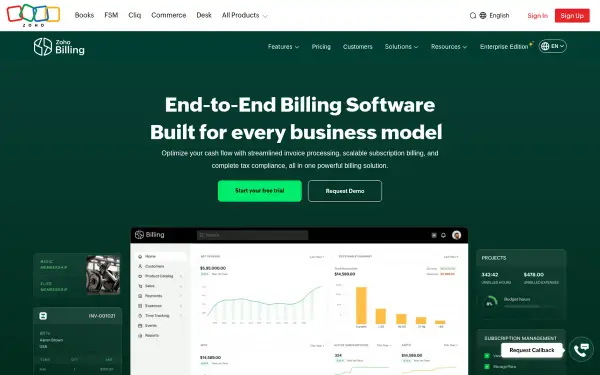
Cheapest credible entry at $50 per organization per month, with a free tier, a customer portal and a clean Zoho Books accounting loop.
Zoho Billing covers the basics competently for a small business: subscription management, hosted payment pages, a customer self-service portal, quotes and estimates, multi-currency support and basic dunning. The Standard plan starts at $50 per organization per month, or $39 per month if billed annually, and covers up to 3 users. A free tier handles very small subscriber bases, and a 14-day free trial is offered.
The strongest argument is the accounting loop. Billing connects to Zoho Books, so invoices, payments and reconciliation stay inside one suite instead of being exported between systems. For a business already running Zoho for accounting, both the marginal cost and the setup effort are low, which is unusual at this price.
Where it thins out is the specialist work. Dunning is simpler than Recurly's retry scheduling, usage billing does not reach Orb's event metering, and revenue recognition is basic compared with Maxio's ASC 606 reporting. Teams with mixed pricing or audit requirements will outgrow it, and the 3 user limit on the Standard plan caps who can work in the system.
It fits small businesses, agencies and early-stage SaaS with flat or simple tiered plans, three users or fewer on billing, and a preference for one vendor across accounting and billing. It does not fit usage-heavy products, companies preparing for audit, or subscription businesses where involuntary churn is a material revenue line.
You run a small operation with simple plans, already use Zoho Books, and want billing for $50 per organization per month.
You meter usage heavily, need audit-ready revenue recognition, or have more than 3 people working in billing.
Entry VIII of IX / Event metering

Our verdict
Event-first metering for AI and infrastructure pricing, sold on custom quotes with no self-serve entry and thin finance tooling.
Orb is built around events rather than subscriptions with a metering add-on. It ingests usage at high volume in real time, applies flexible rating and pricing rules, and turns the result into usage-based invoices. Metering for tokens, API calls and compute is the core use case, and pricing model configuration supports hybrid plans that blend a platform fee with consumption.
That event-first architecture is the differentiator. Products priced per token or per compute second generate event volumes that break systems designed around seat counts, and the operational requirement is being able to rerate a month of usage without rebuilding the pipeline from scratch. Orb is aimed squarely at that problem.
Buying is sales-led. Pricing is custom quoted with no self-serve tier, so evaluation starts with a conversation rather than a signup. The company was acquired by Adyen, which is worth tracking if vendor stability and roadmap ownership matter to your procurement process.
It fits usage-based SaaS and AI infrastructure companies whose revenue tracks consumption, and where billing accuracy is a product concern rather than a back-office one. It is excessive for flat-rate subscriptions, publishes no entry cost, and lacks the broad finance tooling that Maxio or Zuora bring. Teams needing seats and heavy metering together should weigh Chargebee's usage event allowance against Orb's dedicated pipeline.
You price per token, API call or compute second and your current billing system cannot rerate a month of events accurately.
You sell flat or seat-based plans, or if you need published pricing before starting an evaluation.
Entry IX of IX / Configurable rating
Our verdict
Configurable enterprise billing for models that fit no packaged product, quoted and implemented per engagement with no trial and no published price.
BillingPlatform targets the accounts where standard billing products run out of road. The product catalog is configurable, rating supports multiple dimensions, and billing workflows can be built to match processes that do not exist in any template. Revenue lifecycle management covers the span from order to recognized revenue, and unusual settlement scenarios are usually the reason buyers arrive.
There is no published pricing and no trial. Every engagement is quoted and implemented, which means evaluation is a sales process with a scoped deployment attached. That is consistent with how it is positioned against Zuora, where the competition is configurability rather than price, and where buyers expect a statement of work rather than a price list.
The trade-off is that you buy a platform plus a project. Configuration flexibility is only worth paying for if billing genuinely defies packaged rules; otherwise it converts a monthly software decision into an implementation project with consulting dependencies that can outlast the original billing requirement.
It fits enterprises with exotic rating and settlement requirements, internal engineering or professional services capacity, and a procurement cycle that expects a quote. It does not fit mid-market teams, self-serve products, or anyone who wants to evaluate before talking to sales.
Your rating and settlement rules defeat packaged billing products and you can staff an implementation project.
You want to trial software before buying, or if your billing fits a standard subscription catalog.
VIBackground
Recurring billing software is the system that turns a pricing model into invoices that repeat on schedule, collects payment, and accounts for the money correctly. A payment gateway moves funds. Billing software decides how much to charge, when, in which currency, and what happens when the card fails.
The category covers four jobs. First is plan and catalog management: defining flat, tiered, seat-based, usage-based and contract pricing, plus proration when a customer upgrades mid-cycle. Second is invoicing and collection, including hosted pages, customer portals and retry logic for failed charges. Third is revenue accounting, where recognized revenue differs from cash collected and ASC 606 reporting becomes an audit requirement rather than a nicety. Fourth is tax and compliance, which some vendors absorb and most leave with you.
Three distinctions decide which product you need:
A business outgrows spreadsheets when manual invoicing causes revenue leakage, when a second pricing model appears, or when a customer asks for a usage-based invoice finance cannot produce accurately. Before that point, a payment processor with a simple subscription add-on is usually enough.
The nine tools here span that range, from Zoho Billing at $50 per organization per month to quote-only platforms such as Zuora, Orb and BillingPlatform. The question is not which is most powerful but which matches the pricing complexity and tax exposure you will have in eighteen months, not the ones you have today.
This comparison sits in the software register. Further along the shore: baby tracking app and kennel software.
VIIPricing
Five pricing models cover every tool here, and the model matters more than the headline rate. Percentage-only pricing is cheapest at low volume and most expensive at scale. Base fee plus percentage punishes small billers. Flat subscriptions suit small teams. Merchant of record rates look steep until you price the tax work they replace.
| Model | How it bills | Typical fit | Example from this list |
|---|---|---|---|
| Percentage only | Share of billed volume, with no monthly platform fee | Early and fast-growing billers | Stripe Billing at 0.7%; Chargebee Flow at $0 base plus 0.80% |
| Base fee plus percentage | Monthly fee with a slice of volume included | Teams wanting a predictable base | Recurly Starter at $249 per month plus 0.9%, first $40K included |
| Flat subscription | Fixed monthly price per organization or tier | Small teams and simple plans | Zoho Billing Standard at $50 per organization per month, $39 if billed annually |
| Merchant of record | Per-transaction rate covering payments, tax and compliance | Global sellers without a tax function | Paddle at 5% plus 50 cents per transaction |
| Custom quote | Scoped enterprise agreement with implementation | Large or unusual billing models | Zuora, Orb and BillingPlatform |
The arithmetic changes fast with volume. Stripe's 0.7% costs very little at $10,000 in monthly billings and reaches $7,000 a month at $1,000,000, before card processing. Recurly's $249 minimum works out near 3.4% of a $10,000 base, then dilutes as volume grows because the first $40,000 of billings is included. Chargebee inverts the usual shape: the entry point is $0 base at 0.80% of invoicing volume, but paid Performance tiers sit around $599 per month plus overages, so the upgrade is a step rather than a slope.
Quote-only vendors make comparison harder. Maxio's Grow tier covers up to $100,000 in monthly billings but publishes no figure, and Zuora agreements commonly reach six figures a year. Ask each vendor for total first-year cost, implementation included, at your actual volume. Two proposals at the same volume tell you more than two price list.
Each entry card shows the starting price as it appeared on the vendor's own pricing page on November 25, 2026. When a vendor shows no figure we could confirm, or only a promotional rate, the card says "See website" or gives the regular price instead of a guess. Usage, overage and add-on rates in the text change more often than plan prices, so confirm them on the vendor page before you set a budget. To test the numbers against your own volume, try the free User Research Budget Planner. The Event Break-Even Calculator is a second way to check the same decision.
VIIIDecision
Work through these six steps in order, because the early answers eliminate most of the list before you ever see a demo.
Map your pricing models. List every way you charge today and plan to charge in 18 months: flat plans, seats, usage, contracts, multi-currency. A platform that cannot express next year's model becomes a migration project, not a billing tool.
Check who carries tax liability. If you sell into many countries and have no tax team, a merchant of record such as Paddle at 5% plus 50 cents per transaction may cost less than registering, filing and remitting yourself in each jurisdiction.
Run the fee math at your volume, not at zero. Recurly's $249 monthly minimum is about 3.4% of a $10,000 billing base, while Stripe's 0.7% reaches $7,000 a month at $1,000,000 in billings. Model both ends of your forecast.
Decide whether finance or engineering owns billing. Contract-led B2B sales with amendments and audit needs point to Maxio or Zuora. Self-serve card signups with an engineering team point to Stripe Billing or Chargebee. The owner should choose the tool.
Test recovery before you sign. Run the 90-day free trial Recurly offers, or push test declines through the dunning setup, and measure recovered revenue against the platform cost. Failed payments are where subscription revenue quietly leaks.
Price the implementation, not just the license. Quote-only platforms such as Zuora, Orb and BillingPlatform require a sales conversation, and Zuora deployments run for months. Ask for a scoped timeline and total first-year cost in writing.
IXPitfalls
Most failures here are buying mistakes rather than product defects, so check each of these before you sign.
XQuestions
It depends on volume. Percentage-only models cost almost nothing at low billings: Stripe Billing charges 0.7% with no monthly fee, and Chargebee's Flow plan is $0 base plus 0.80%. A base fee hurts early, since Recurly's $249 monthly minimum is about 3.4% of a $10,000 billing base. At high volume the percentage dominates, so model both ends of your forecast before signing.
Stripe Billing, unless tax or complex contracts push you elsewhere. It attaches subscription and usage billing to your existing Stripe account with no monthly platform fee, and revenue recognition shares the same stack. You stay merchant of record, so sales tax and chargebacks remain your problem. If you sell into many jurisdictions, compare Paddle's merchant of record rate before committing.
Two: Chargebee and Zoho Billing. Chargebee's Flow plan runs at $0 base plus 0.80% of monthly invoicing volume with 100 million usage events included, so the ceiling is billing volume rather than a user count. Zoho Billing offers a free tier for very small subscriber bases, with paid plans from $50 per organization per month for up to 3 users. Chargebee also offers a free trial.
When you sell software into several tax jurisdictions and have nobody to handle registration, filing and remittance. Paddle acts as the legal seller, collects and remits sales tax and VAT, and absorbs chargeback and compliance risk at 5% plus 50 cents per transaction with no monthly fee. Domestic-only sellers usually pay more than the risk is worth.
Orb for event-heavy consumption, Chargebee or Stripe Billing for mixed models. Orb meters tokens, API calls and compute in real time and rates them flexibly, on custom quoted pricing. Chargebee includes 100 million usage events on its Flow plan at 0.80% plus a $0 base. Stripe Billing ingests metered events at 0.7%. Zoho Billing's usage billing is simpler than all three.
Plan on several months for a mid-market move and longer for enterprise work: Zuora implementations run for months, and BillingPlatform requires an implementation, while Orb requires a sales conversation. Common failures are plan and coupon mapping, payment token portability and revenue schedules, so run a full billing cycle in parallel before switching off the old system.
XIFurther along the shore
Vendors can ask for a correction or apply for a Featured listing. Paid or not, the entry is scored on the same rubric and its limits stay in print. Partner with Umberlake.
Free tools
Our free browser tools turn the prices on this page into a figure for your own volume. Nothing you type leaves your device.