LabWare
See website
Best for enterprise QA/QC and regulated manufacturing labs
- Free plan
- No
- Rubric
- 7.2 of 10
Eight LIMS platforms compared on deployment, compliance evidence and instrument integration, with pricing checked on November 26, 2026 so you can shortlist before you talk to sales.

IThe short answer
The best LIMS software in November 2026 depends on your lab type more than your budget. LabWare suits enterprise QA/QC and regulated manufacturing, STARLIMS fits multi-industry labs that want one full informatics platform, and SciSure works for research labs combining ELN, LIMS and safety workflows. All three are quote-priced, so budget approval starts with a scoping call rather than a pricing page. The eight tools below cover regulated manufacturing, diagnostics, biotech R&D and small testing labs.
8 tools compared from vendor pages on November 25, 2026. 0 publish a starting price we could read; the rest say "See website".
IITop three berths
Register order is editorial fit for the buyer each entry describes. Prices are the starting figures read on November 25, 2026.
See website
Best for enterprise QA/QC and regulated manufacturing labs
See website
Best for multi-industry labs needing a full informatics platform
See website
Best for research labs unifying ELN, LIMS, and operations
How this page is paid for. All 8 tools here are unpaid editorial picks.
A paid listing's position can be part of what the vendor pays for. Every entry, paid or not, is scored on the same rubric and keeps its limits in print. Advertising disclosure.
IIIThe register
Starting prices as shown on each vendor's pricing page on November 25, 2026. "See website" means no figure we could confirm.
| No. | Tool | From | Free plan | Trial | Rubric | Actions |
|---|---|---|---|---|---|---|
| 01 | LabWareEnterprise QA/QC and regulated manufacturing labs | See websiteNot shown publicly | No | Demo only | 7.2 | |
| 02 | STARLIMSMulti-industry labs needing a full informatics platform | See websiteNot shown publicly | No | Demo only | 6.8 | |
| 03 | SciSureResearch labs unifying ELN, LIMS, and operations | See websiteNot shown publicly | No | Demo only | 6.7 | |
| 04 |  LabVantageAI-driven lab informatics on one platform | See websiteNot shown publicly | No | Demo only | 6.7 | |
| 05 |  BenchlingBiotech and pharma R&D teams | See websiteNot shown publicly | Yes | Demo only | 6.5 | |
| 06 | SciNoteAcademic, government, and startup labs | See websiteNot shown publicly | No | Demo only | 6.2 | |
| 07 | CloudLIMSSaaS LIMS for testing and clinical labs | See websiteNot shown publicly | No | No | 7.2 | |
| 08 | QBenchModern configurable LIMS for growing labs | See websiteNot shown publicly | No | Demo only | 6.7 |
Pinned:
IVMethod
Every tool here was assessed against the same five criteria: fit for a specific lab type, compliance coverage, instrument integration, implementation speed and pricing clarity. We started from the buyer's situation rather than a feature count, so a tool scores well when its center of gravity matches the lab it is sold to, and poorly when a buyer would have to bend a workflow around it.
Compliance coverage was judged on the standards each vendor states it supports: 21 CFR Part 11, GLP/GMP, ISO 17025, HIPAA and CLIA. Instrument integration considered how much connectivity is native and how much depends on custom driver work. Implementation speed weighed project length and whether a lab can configure the system without a consulting team. Pricing clarity rewarded published numbers and marked down quote-only models, not because a quote is bad, but because it slows a buyer's own comparison.
Prices, plans, trials and free-tier facts come from vendor pricing pages checked on November 26, 2026. Where a page was unavailable or failed to load, we say so in that entry rather than filling the gap with an estimate. Where a vendor publishes nothing, the entry says pricing is on the vendor site.
Featured placements are paid. A Featured vendor is scored with the same rubric as every other entry and carries the same honest cons. The order of this list is editorial: it reflects fit for the buyer each entry describes, plus any disclosed Featured position, not a weighted total.
The full routine, from price reads to corrections, is on the methodology page. Paid listings follow the advertising disclosure.
How closely the product's center of gravity matches the lab type it is sold to, rather than forcing a workflow bend.
Stated support for 21 CFR Part 11, GLP/GMP, ISO 17025, HIPAA and CLIA, plus the validation documentation behind those claims.
How much instrument connectivity is native and how much depends on custom driver work the buyer pays for.
Project length and whether a lab can configure the system without a long consulting engagement.
Whether a buyer can see a number before a sales call, and how much scoping stands between you and a budget.
Entry I of VIII / Single-platform LIMS and ELN
Our verdict
The most complete option for regulated manufacturing labs that can fund a long implementation and a trained in-house administrator.
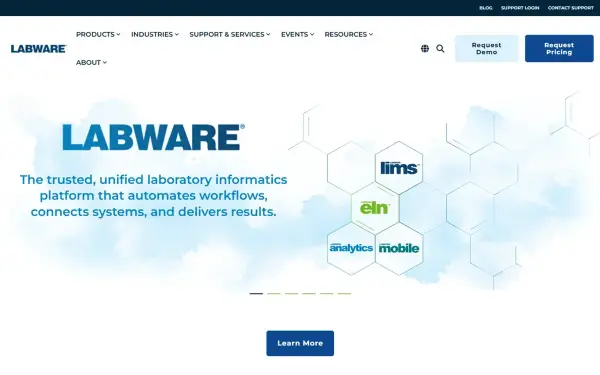
LabWare delivers LIMS and ELN on a single platform architecture, with direct instrument connectivity and configurable workflow automation. For pharma, food, environmental and other regulated manufacturing labs, that means the batch record, the instrument output and the audit trail live in one system rather than three. Compliance tooling covers FDA, GLP and ISO requirements, and the same installation can serve multiple sites.
The trade-off is effort. Deployments run for months rather than weeks, and the product is implemented as a project rather than trialled self-serve. Full value depends on trained in-house administrators who configure the workflows and keep them current. Labs without that bench strength tend to under-configure the system and then blame the software for the resulting rigidity.
Pricing is on the vendor site as a quote, with no published pricing sheet, so budget approval starts with a scoping conversation. LabWare reports installations in over 125 countries. We could not confirm pricing on November 26, 2026 because no pricing page was available to check.
It is the strongest pick here for a regulated manufacturer with a stable process and an IT function behind the lab. It is a poor fit for a small lab that wants to switch on a tool next week.
You run a multi-site regulated manufacturing, pharma, food or environmental lab and can staff an administrator.
You need a working system in weeks or have no internal owner for configuration.
Entry II of VIII / Full informatics suite
Our verdict
A broad, long-established informatics suite for multi-industry labs, held back by enterprise timelines and repeated ownership changes.
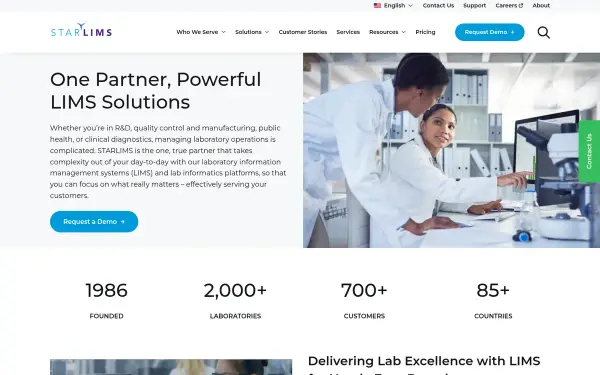
STARLIMS bundles LIMS, ELN, scientific data management and lab execution into one suite, then adds an analytics layer on top. That breadth is aimed at organizations running several kinds of lab: R&D, quality manufacturing and diagnostics under one vendor contract. Public health and clinical diagnostics workflows are a specific strength, and the 2023 Labstep acquisition added a cloud ELN for R&D teams.
The company has been in the LIMS market since 1986, and it reports more than 2,000 laboratories and 700-plus customers across 85 countries. Credentials in public health and manufacturing are deep. The caveat is ownership: the business moved from Abbott to Francisco Partners in 2021 and then to Turn/River Capital in January 2026. That churn does not break the product, but it does make the multi-year roadmap harder to read from outside.
Pricing is on the vendor site as a quote, and implementations are enterprise-scale projects with the timeline to match. Expect a scoping phase, a configuration phase and a validation phase before anyone calls the system live. We could not confirm pricing on November 26, 2026 because no pricing page was available to check.
Choose STARLIMS when you need one informatics platform across multiple lab types and you can absorb a long project. Look elsewhere if you want a narrow, fast-deploying LIMS for a single bench workflow.
Your organization runs R&D, manufacturing and diagnostics labs and wants one vendor contract across all of them.
You need a quick deployment or you want roadmap stability you can verify before a five-year commitment.
Entry III of VIII / ELN, LIMS and safety
Our verdict
A merged ELN, LIMS and safety platform that suits research organizations consolidating tools, not labs chasing raw sample throughput.
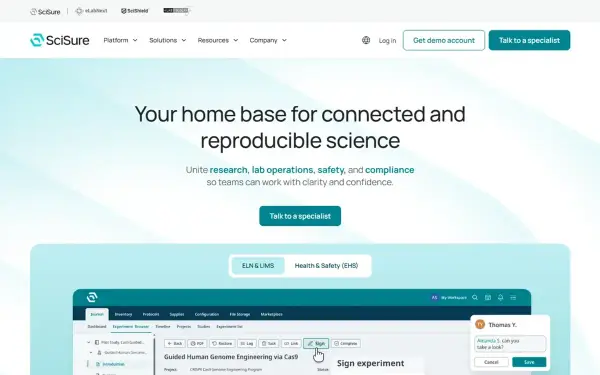
SciSure is the rebranded home of eLabNext and SciShield, combining ELN, LIMS, lab inventory and health and safety workflows in one platform. Protocol and sample management sit alongside chemical inventory tracking and safety documentation, so a research group keeps its methods, its samples and its risk assessments in the same place instead of three.
Compliance coverage is broad for a research-first product: ISO 27001, GDPR, 21 CFR Part 11, GxP and HIPAA. The vendor reports 550,000-plus scientists across 55,000-plus laboratories, a user base inherited from the two merged products.
The breadth is also the catch. SciSure is not a point LIMS, so a buyer cannot evaluate sample management in isolation. The platform spans enough surface area that a proper evaluation runs longer than a single demo, and stakeholders from safety, inventory and research all need a seat at the table. Pricing is quoted per engagement rather than published, so there is no public number to budget against. We could not confirm pricing on November 26, 2026 because no pricing page was available to check.
It fits research organizations consolidating several point tools behind one vendor, one login and one security posture. It fits less well if your core need is high-volume sample throughput with tight QA/QC release rules.
Your research institution is replacing separate notebook, inventory and safety tools with one vendor.
Sample-centric throughput is the core requirement and you want to evaluate a LIMS on its own.
Entry IV of VIII / Cloud or on-premise
Our verdict
One vendor for the full informatics stack with a genuine cloud or on-premise choice, though the AI layer needs a pilot.
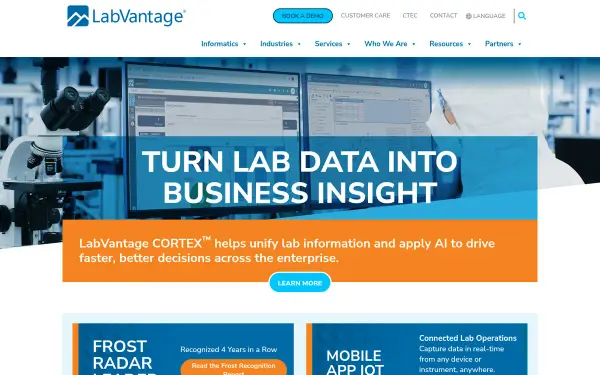
LabVantage puts LIMS, ELN, laboratory execution, scientific data management and analytics on one architecture, with a fully browser-based interface. Deployment is available as SaaS or on-premise, which matters for labs with data residency rules or an existing data center commitment. The vendor reports more than 1,500 customer sites across life sciences, pharma, food and beverage, forensics and oil and gas.
CORTEX is an AI layer positioned around AI-assisted decisions over platform data. Treat that as a claim to test rather than a reason to buy: ask for a pilot on your own data, with your own questions, before it influences the shortlist. The underlying platform has four decades of development behind it, and one vendor covering the full stack reduces integration work between modules.
Pricing is on the vendor site as a quote, and implementations need advance planning, so the evaluation should include an implementation partner and a realistic timeline rather than a feature checklist. We could not confirm pricing on November 26, 2026 because no pricing page was available to check.
Pick LabVantage when you want one vendor for the full informatics stack and you need a choice between cloud and on-premise. Skip it if you need a small, fast deployment with a published price.
You want a single vendor across LIMS, ELN, SDMS and analytics, and you need an on-premise option.
Your lab is small enough that a browser-based SaaS tool with a published price would cover the work.
Entry V of VIII / R&D notebook and design
Our verdict
The strongest R&D notebook and LIMS combination in this list, with a real free tier and little to offer a GMP quality unit.
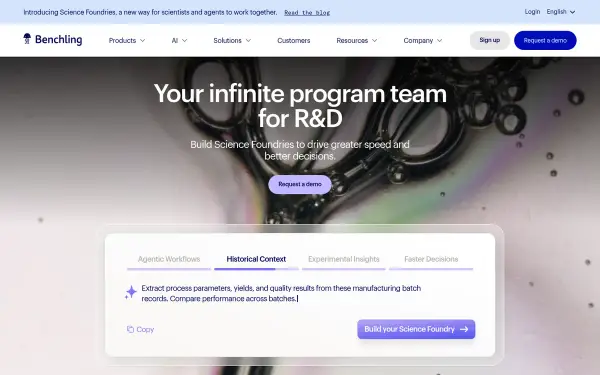
Benchling is a cloud ELN built for biotech R&D, with molecular biology design tools, bioregistration of biological entities and LIMS woven into research workflows rather than bolted on. The 2026 product story is Benchling AI, which applies copilots and predictive workflows to the structured R&D data the platform already holds. Founded in 2012 by MIT students, the company reports more than 200,000 scientists at 1,300-plus companies and 7,500 academic institutions.
The free tier for academic users is the only genuinely free plan in this list, and it is a real on-ramp for university labs that later convert to commercial terms. For commercial teams, pricing is on the vendor site and quote-based. We could not confirm pricing on November 26, 2026 because no pricing page was available to check.
The limit is scope. Benchling is optimized for discovery and development, not for QA/QC batch release in a regulated manufacturing environment. If your work is stability studies, method validation and certificate of analysis generation under GMP, the notebook-first design will feel like the wrong center of gravity. If your work is designing constructs, tracking strains and capturing experimental context, it is the strongest fit here.
Choose it when the lab's output is knowledge and candidate molecules. Do not choose it as the system of record for a production quality unit.
Your scientists design molecules, track biological entities and need a notebook that speaks the same language.
Your primary need is manufacturing quality control, batch release and GMP validation documentation.
Entry VI of VIII / Compliance out of the box
Our verdict
An adoptable, compliance-ready ELN for small labs, with sample management that stops short of full LIMS depth.
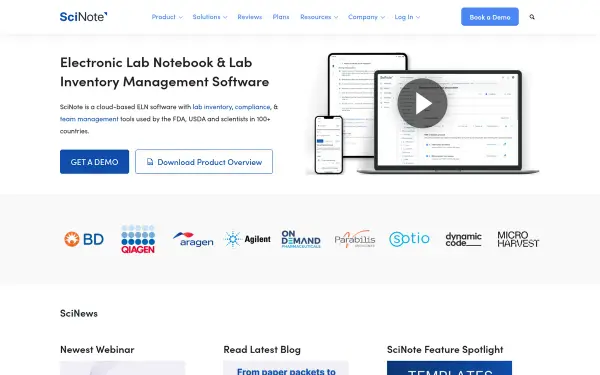
SciNote is a cloud ELN with inventory management, team management and the compliance basics built in: electronic signatures, audit trails, time stamps and access controls. A mobile app covers protocols and results at the bench, and industry plans ship with validated IQ/OQ documentation. The vendor states support for 21 CFR Part 11 and GLP/GMP environments, and reports use by the FDA along with more than 100,000 scientists in over 100 countries.
The appeal is adoptability. A lab without a dedicated IT team can run SciNote, and compliance tooling is included as standard rather than sold as an add-on module. Plans are structured by lab type, with industry editions that carry the validation paperwork.
The limit is depth. SciNote is ELN-first, so sample-centric capability is LIMS-adjacent rather than a full sample lifecycle engine. High-throughput QA/QC workflows, complex instrument integration and multi-site sample routing will expose that quickly. Pricing is on the vendor site but not published, and plans are demo-led, so you cannot self-serve a quote. We could not confirm pricing on November 26, 2026 because no pricing page was available to check.
Pick SciNote for academic, government or startup labs that need a compliant notebook and light inventory without a project team. Skip it if sample throughput and release testing are the core of your operation.
You run an academic, government or startup lab that needs a compliant notebook with light inventory tracking.
You need a sample lifecycle engine with release testing and heavy instrument integration.
Entry VII of VIII / Published per-user pricing
Our verdict
A vertical SaaS LIMS with vendor-supplied per-user pricing, best value for mid-size testing labs rather than tiny teams.
CloudLIMS is a SaaS LIMS covering the sample lifecycle, instrument integration, billing, patient and client portals, and a built-in quality management system. The differentiator is vertical editions: biobanking, cannabis, clinical diagnostics, environmental, food and beverage, genomics and water testing each get a configuration rather than a blank canvas. The 2026 release adds AI features including anomaly detection, demand forecasting and natural language queries.
It is also the only vendor here with vendor-supplied per-user pricing rather than a pure quote. The figures we recorded start at $310 per user per month for three users and fall to $42 per user per month at 100 users, with no upfront licence cost. We could not confirm those numbers on November 26, 2026 because the pricing page failed to load with an HTTP2 protocol error, so treat them as vendor-supplied and verify them directly before you budget.
There is no free trial, which makes the demo and a scoped pilot more important. Per-user pricing is also hardest on small teams: three users at the top rate is a meaningful monthly cost before you have proven fit. Configuration, migration, training and support are bundled into the subscription.
Choose CloudLIMS when you run a testing or clinical lab in one of its named verticals and you want published per-user numbers instead of a sales cycle. Skip it if you need a free trial or your team is very small.
You run a clinical, environmental, cannabis or biobanking lab and you want per-user numbers you can budget against.
You need to trial the software before buying or your team is small enough that per-user costs dominate.
Entry VIII of VIII / No-code configuration
Our verdict
A fast, no-code LIMS for growing labs, trading decades of track record for weeks-long configuration.
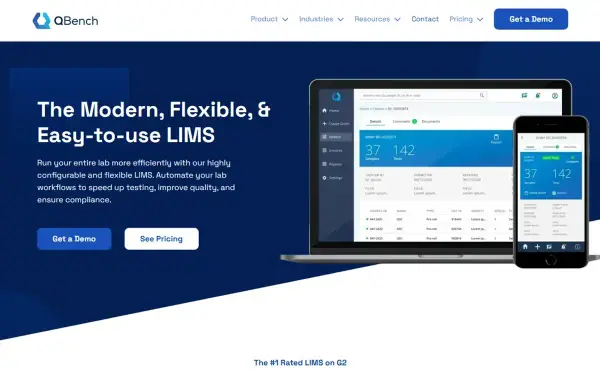
QBench is a cloud LIMS aimed at labs that want to configure their own workflows. No-code workflow configuration, sample tracking with custom fields and a no-code report template editor mean a lab analyst can change a form or a routing rule without a developer or a change request. A REST API covers the integrations the no-code layer cannot reach, and compliance support spans ISO 17025, HIPAA, 21 CFR Part 11 and CLIA.
The company was founded in 2015 and markets the product as a Lab Operating System. Implementation is positioned in weeks rather than quarters, which is the main contrast with the enterprise platforms at the top of this list. For a growing testing lab that has outgrown spreadsheets but cannot absorb a six-month project, that timeline is the selling point.
The trade-offs are track record and footprint. A 2015 founding date means a shorter history than vendors that have been in the market since the 1980s, and the market footprint is smaller than the long-established vendors. Pricing is on the vendor site but not published, so you will still go through a demo before you see a number. We could not confirm pricing on November 26, 2026 because no pricing page was available to check.
Pick QBench when speed of configuration and a modern API matter more than a decades-long reference list. Skip it if you need deep pre-built drivers for legacy analyzers or a heavily validated GMP release workflow out of the box.
You are a growing testing lab that wants to reshape workflows yourself without writing code.
You need a long reference history, deep legacy instrument drivers or a fully pre-validated GMP build.
VBackground
A LIMS tracks samples. It registers them, assigns tests, records results, links instruments, manages reagents and produces the report that leaves the lab. Its center of gravity is the sample lifecycle and the evidence trail around it: who ran what, on which instrument, with which lot of reagent, under which version of the method.
An ELN captures the experiment. It holds protocols, observations, calculations and signatures in a notebook structure that mirrors how scientists work. A clinical LIS is a third thing again: a laboratory information system built for patient specimens, orders and reporting in a diagnostic setting, with interfaces to hospital systems that a general LIMS does not carry.
In practice the categories overlap. LabWare, STARLIMS and LabVantage sell LIMS and ELN on one platform. SciSure and Benchling combine notebook capability with sample management. That means the real question is not LIMS or ELN, but which system should be the record of truth for your samples.
Three signals tell you it is time to buy:
If none of those is true yet, a compliant ELN may be enough, and you can defer the sample-centric platform until throughput or regulation forces the decision.
This comparison sits in the software register. Further along the shore: baby tracking app and kennel software.
VIPricing
Most LIMS vendors do not publish a price, and that is the first thing to plan around. Seven of the eight tools here put pricing on the vendor site as a quote, which means your budget conversation starts after scoping, not before. The one exception is CloudLIMS, which publishes per-user numbers, though the page would not load when we checked on November 26, 2026.
Four commercial models appear in this list.
| Model | How it bills | Typical fit | Example from this list |
|---|---|---|---|
| Quote-only enterprise licence | Priced per engagement after scoping, no published pricing sheet | Regulated manufacturing, multi-site pharma, public health | LabWare, STARLIMS, LabVantage |
| Per-user subscription | Monthly per named user, cost per seat falls as seat count rises | Testing and clinical labs that want published numbers | CloudLIMS, vendor-supplied from $310 per user per month at three users |
| Free academic tier | No cost for academic users, commercial terms quoted | University and nonprofit research | Benchling |
| Quote-based mid-market | Priced after a demo, no published pricing sheet | Research, academic and growing labs | SciSure, SciNote, QBench |
Two costs sit outside the licence and rarely appear in a demo. Instrument drivers for unsupported analyzers are custom work, and configuration depth on platforms like LabWare and LabVantage is only realized if someone is trained to do it. Add implementation, validation, training and administrator time to any number you are quoted.
Trials are just as thin. Benchling offers a free tier, the rest are demo only, and CloudLIMS has no free trial at all.
Each entry card shows the starting price as it appeared on the vendor's own pricing page on November 25, 2026. When a vendor shows no figure we could confirm, or only a promotional rate, the card says "See website" or gives the regular price instead of a guess. Usage, overage and add-on rates in the text change more often than plan prices, so confirm them on the vendor page before you set a budget. To test the numbers against your own volume, try the free User Research Budget Planner. The Event Break-Even Calculator is a second way to check the same decision.
VIIDecision
VIIIPitfalls
IXQuestions
A LIMS manages the sample lifecycle and its evidence trail; an ELN captures the experiment itself. A clinical LIS is built for patient specimens and hospital ordering, with interfaces a general LIMS does not carry. Vendors blur the lines: LabWare, STARLIMS and LabVantage sell LIMS and ELN on one platform, while Benchling and SciSure combine notebook and sample management tools.
Weeks for SaaS products positioned around fast configuration, months for enterprise platforms. QBench positions implementation in weeks rather than quarters. LabWare and STARLIMS run as enterprise-scale projects, and LabWare notes deployments run for months rather than weeks. Budget validation, instrument integration and administrator training inside the timeline, not after go-live.
There is no universal number; the trigger is usually manual rekeying and audit pressure rather than volume alone. If staff retype instrument output into spreadsheets, if assembling an audit trail takes days, or if a customer qualification asks for records you cannot produce quickly, the workaround already costs more than the licence. Sample counts just make the case easier to present.
Cloud suits most labs because the vendor handles infrastructure and upgrades. On-premise still wins where data residency rules, network isolation or an existing data center commitment apply. LabVantage offers both, CloudLIMS is SaaS and QBench is cloud. Let your validation and security obligations drive the choice, not the deployment label alone.
It depends on your lab, but the common set is 21 CFR Part 11 for electronic records and signatures, GLP and GMP for good practice, ISO 17025 for testing and calibration labs, and HIPAA plus CLIA for clinical work. QBench, SciNote and SciSure each state coverage of several of these, and CloudLIMS lists a built-in quality management system. Ask for the specific evidence, not the logo.
Check whether your exact instrument models are supported natively and who pays when a driver does not exist. LabWare lists direct instrument connectivity, and CloudLIMS lists instrument integration. Custom driver work is a recurring cost, so ask for a written list of supported models and a quote for anything missing before you sign.
XFurther along the shore
Vendors can ask for a correction or apply for a Featured listing. Paid or not, the entry is scored on the same rubric and its limits stay in print. Partner with Umberlake.
Free tools
Our free browser tools turn the prices on this page into a figure for your own volume. Nothing you type leaves your device.