
Icertis
See website
Best for global regulated contracting across subsidiaries and jurisdictions
- Free plan
- No
- Rubric
- 7.7 of 10
Eight enterprise CLM platforms compared on governance depth, post-signature intelligence, workflow adoption and rollout effort, with prices checked on November 26, 2026.

IThe short answer
The best enterprise contract management tools in November 2026 depend on where your contracting breaks. Icertis leads for global regulated contracting across subsidiaries and jurisdictions, Ironclad suits pre-signature workflow and adoption by legal and sales, and Sirion fits AI obligation tracking and supplier performance analysis. All eight platforms below quote custom pricing, so budget discovery matters as much as the feature demo.
8 tools compared from vendor pages on November 25, 2026. 0 publish a starting price we could read; the rest say "See website".
IITop three berths
Register order is editorial fit for the buyer each entry describes. Prices are the starting figures read on November 25, 2026.
See website
Best for global regulated contracting across subsidiaries and jurisdictions

See website
Best for pre-signature workflow and adoption by legal and sales
See website
Best for aI obligation tracking and supplier performance analysis
How this page is paid for. All 8 tools here are unpaid editorial picks.
A paid listing's position can be part of what the vendor pays for. Every entry, paid or not, is scored on the same rubric and keeps its limits in print. Advertising disclosure.
IIIThe register
Starting prices as shown on each vendor's pricing page on November 25, 2026. "See website" means no figure we could confirm.
| No. | Tool | From | Free plan | Trial | Rubric | Actions |
|---|---|---|---|---|---|---|
| 01 | IcertisGlobal regulated contracting across subsidiaries and jurisdictions | See websiteNot shown publicly | No | Demo only | 7.7 | |
| 02 | IroncladPre-signature workflow and adoption by legal and sales | See websiteNot shown publicly | No | Demo only | 7.3 | |
| 03 | SirionAI obligation tracking and supplier performance analysis | See websiteNot shown publicly | No | Demo only | 7.6 | |
| 04 |  DocuSign CLMEnterprises already standardized on DocuSign signature | See websiteNot shown publicly | No | Demo only | 7.1 | |
| 05 |  AgiloftNo-code configuration for complex or non-standard contracting | See websiteNot shown publicly | No | Demo only | 6.9 | |
| 06 | CongaSalesforce-native revenue contracting tied to CPQ data | See websiteNot shown publicly | No | Demo only | 6.6 | |
| 07 | LinkSquaresRepository search and post-signature contract analysis | See websiteNot shown publicly | No | Demo only | 7.0 | |
| 08 |  JuroFast browser-native contracting for standard high-volume agreements | See websiteNot shown publicly | No | Demo only | 6.8 |
Pinned:
IVMethod
We rank these eight platforms by fit for the buyer each entry describes, not by a single total. Every tool was scored against the same five criteria, weighted for enterprise buying: governance depth at 25 percent, post-signature intelligence at 20 percent, workflow adoption at 20 percent, integration fit at 20 percent and implementation effort at 15 percent. Scores are editorial judgments drawn from vendor materials, product documentation and the facts published with each listing.
Prices were checked on November 26, 2026. All eight vendors route buyers to custom quotes, so "See website" is an accurate description rather than a placeholder: none publishes a pricing sheet for enterprise scope. Ask each vendor to put scope, services and assumptions in writing.
We did not test these platforms hands-on in a live contracting environment, so treat the reviews as a shortlist tool. The real diligence is a pilot on your own contracts, your own templates and your own worst legacy documents, plus reference calls to customers running the entity structure you run.
The full routine, from price reads to corrections, is on the methodology page. Paid listings follow the advertising disclosure.
Clause and template control, entity structures, audit trails and approval rigor for regulated contracting.
Obligation tracking, renewal exposure and portfolio reporting after the contract is executed.
How quickly legal, sales and procurement teams actually use intake, routing and redlining.
Connection to Salesforce, SAP, Workday and signature tools so contract data stays attached to records.
Realistic time, partner dependency and admin load required to reach production.
Entry I of VIII / Global governance depth
Our verdict
The governance benchmark for multinational contracting, provided you can absorb a long, consulting-heavy implementation.
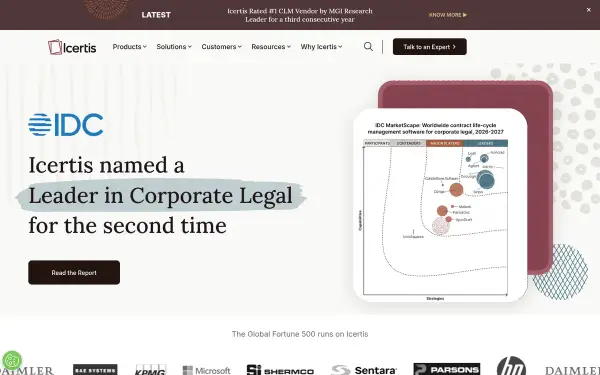
Icertis is built for contracting that spans many legal entities, currencies and regulators. The platform centers on clause and template governance, approval and workflow controls, and a global contract repository, with obligation tracking and contract analytics layered on top. Risk and exposure reporting is aimed at procurement and regulated contracting teams rather than at sales self-service, and the compliance automation is designed to travel across subsidiaries and jurisdictions.
Integrations with SAP, Salesforce, Workday and Microsoft matter here, because most buyers already run those systems and want contract data to stay attached to supplier, employee and customer records.
The limits show up during delivery rather than during the demo. Implementations run long and lean heavily on consulting involvement, and the platform assumes defined templates, clause libraries and entity structures, so readiness work comes first. The user experience is powerful rather than intuitive, which shifts training load onto administrators. Pricing is fully custom quoted at the premium end, and the depth can exceed what a mid-sized legal team needs.
Pick it when governance across entities is the buying problem. Verify current packaging, implementation scope and services with the vendor directly, because no pricing page content was captured when we checked on November 26, 2026.
Subsidiaries, regulators and delegated authority shape how you contract.
A single-entity legal team needs faster time to value on standard agreements.
Entry II of VIII / Pre-signature workflow

Our verdict
The strongest pick when legal and sales need one workflow they will actually use, not a governance monolith.
Ironclad focuses on pre-signature workflow, and that is where it earns its keep. Intake forms let sales and business requesters raise a contract request without emailing legal, drafting runs from approved clauses and templates, and automated approval routing moves the file toward signature. Negotiation and redlining workflows, a clause library and playbook controls keep legal's position visible during the back and forth.
The Salesforce integration places contract records next to the opportunity, which is why adoption among sales teams tends to be high. The repository, search and AI analysis are newer than the workflow core, so post-signature obligation and performance depth trails specialists such as Sirion.
Heavily customized global governance can strain the workflow-led design. Costs rise with users and AI modules, and pricing is custom quoted. Confirm current AI module and user pricing during diligence.
Pick it when cycle time and adoption are the main buying criteria, not when deep obligation management is the priority.
Slow approvals and low legal tool adoption are the problems you are solving.
Obligation tracking and supplier performance sit at the center of the purchase.
Entry III of VIII / Obligation intelligence
Our verdict
Best for what happens after signature, with AI obligation tracking that depends on clean, migrated contract data.
Sirion leans into what happens after signature. AI extraction pulls obligations, deadlines and commitments out of executed contracts, and the platform tracks them against supplier performance, with renewal and milestone alerts on top. Analytics on contract risk and performance sit alongside drafting assistance, a contract repository and search, and workflows for both buy-side and supplier contracting.
That makes it a strong match for procurement and supplier management teams who lose money to missed rebates, unnoticed auto-renewals and unenforced service levels. The AI-native focus is real, but results depend on the quality of migrated contract data, and legacy cleanup is genuine project work rather than a switch you flip.
Pricing is custom quoted with a premium enterprise sales motion. Buyers should validate fit with reference customers in their own industry. Brand recognition varies by region, so local references are worth asking for.
Pick it when obligation tracking and supplier performance are the reason you are buying. Test extraction accuracy on your own worst contracts before signing.
Missed obligations and supplier performance are costing you money today.
Your contracts live in a clean repository already and your gap is pre-signature speed.
Entry IV of VIII / Signature continuity
Our verdict
A sensible extension of an existing DocuSign signature estate, weaker as a standalone post-signature intelligence platform.
For organizations already standardized on DocuSign signature, DocuSign CLM keeps drafting, approvals, negotiation, signing and storage in one chain rather than bolting a separate CLM onto a signature tool. Templates and document generation, workflow automation for approvals, clause and template controls, and reporting on contract cycle status cover the standard enterprise requirements, and audit trails travel with the record.
The product sits under Intelligent Agreement Management, and its scope is modular, so contract volume and edition choices shape what you actually get. High-volume standard agreements are the sweet spot, particularly where the signature estate is already central to how the business operates.
The caveats are practical. Complex deployments carry implementation risk, obligation tracking and analytics trail the specialists, and licensing across the wider DocuSign estate needs careful counting before anyone signs. Pricing is custom quoted, and scope depends on edition entitlements and user or envelope assumptions. For organizations not on DocuSign signature, the main advantage shrinks fast.
Pick it when signature continuity is the point. Verify edition entitlements and envelope or user assumptions before committing.
DocuSign signature is already standard across the enterprise.
You run another signature provider and need deep obligation management.
Entry V of VIII / No-code configuration
Our verdict
Unmatched configuration freedom for genuinely unusual contracting, at the cost of admin time and interface polish.
Agiloft sells configuration rather than opinion. Legal operations teams can build workflows and data models without developers, wire up custom approval chains, and run mixed buy-side and sell-side contracting in one system. Audit trails, security controls, reporting and compliance dashboards give regulated teams the evidence trail they need, and template and clause management covers the basics well.
That flexibility is the whole argument. Organizations with genuinely non-standard contracting, unusual approval structures or contract types that fall outside sales and procurement get a system that bends instead of one that forces a redesign.
The trade-off is that configuration is a project. It needs skilled admin time, and implementation quality depends heavily on the partner or admin team assigned. Interface polish trails the more design-led workflow tools, and buyers with standard contracting often go live sooner elsewhere. Pricing is custom quoted, so ask for a written quote that separates subscription, implementation and admin effort.
Pick it when your process is the outlier. Weigh it carefully if a conventional approval chain and clause library would cover most of what you sign.
Your contracting process is genuinely non-standard and legal ops will own the build.
You want a conventional approval chain live in weeks.
Entry VI of VIII / Salesforce and CPQ
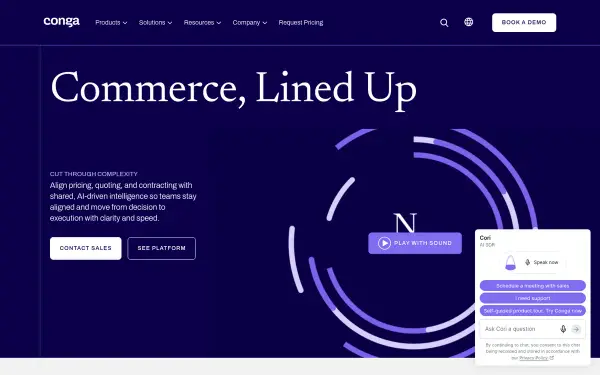
Our verdict
Excellent inside a Salesforce and CPQ motion, thin value once contracts leave the CRM estate.
Conga's contract capability is strongest when the quote already lives in Salesforce. Contract generation pulls from Salesforce and CPQ data, templates are data-driven, negotiation happens with CRM account data in view, and executed contracts store against the Salesforce record. Approval workflows, clause and template management, and reporting on revenue contracts round out the picture, inside a wider revenue lifecycle suite that includes CPQ and billing.
The practical benefit is not re-keying quote and account data, which is where contract errors and delay usually start. Document generation is a long-standing strength, and quote-to-contract revenue motions are the natural fit.
Outside the Salesforce estate the value drops quickly, because the integration is the product. Enterprise pricing is fully quoted, and packaging has changed through ownership transitions, so confirm current bundles, entitlements and renewal terms rather than relying on what a peer bought two years ago. Post-signature analytics are less deep than the intelligence-led platforms in this list.
Pick it when Salesforce is the system of record for revenue. Weigh it carefully if a meaningful share of your contracts never touches a quote.
Quotes, accounts and contracts all run through Salesforce and CPQ.
Supplier agreements and non-sales contracts dominate your volume.
Entry VII of VIII / Repository analysis
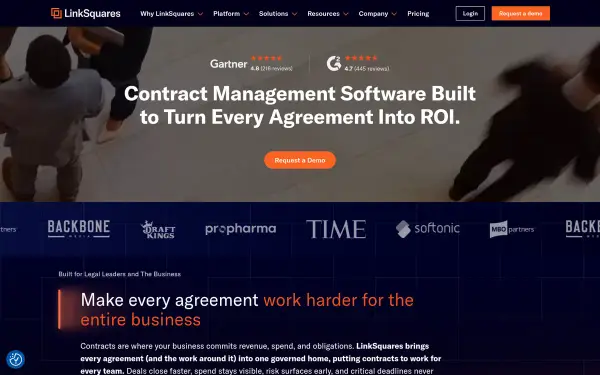
Our verdict
The fastest route from a messy legacy repository to answerable portfolio questions, with lighter governance depth.
LinkSquares starts with the mess most legal teams already have. AI ingestion reads legacy contracts, extracts clauses, dates and obligations, and puts them into a searchable repository, so questions like which agreements auto-renew next quarter or how many contracts carry a given clause become reportable rather than a research project. Portfolio reporting, renewal and obligation tracking, and collaboration tools for in-house teams sit on top.
Pre-signature drafting and workflow tools now round out the platform, but analysis is still the founding strength. For a legal team inheriting a shared drive full of PDFs, that focus is more useful than a drafting engine.
Complex global governance depth trails Icertis, and pricing is custom quoted, scaling with contract volume. The main diligence task is extraction quality on your own documents, so insist on a pilot that uses your ugliest contracts rather than clean samples. It also works well as an intelligence layer alongside a wider CLM estate rather than as a replacement for one.
Pick it when the repository is the problem. Test the AI on your own papers before you commit.
You cannot answer basic questions about the contracts you already signed.
Multi-entity governance and delegated authority are the core requirement.
Entry VIII of VIII / Browser-native workspace
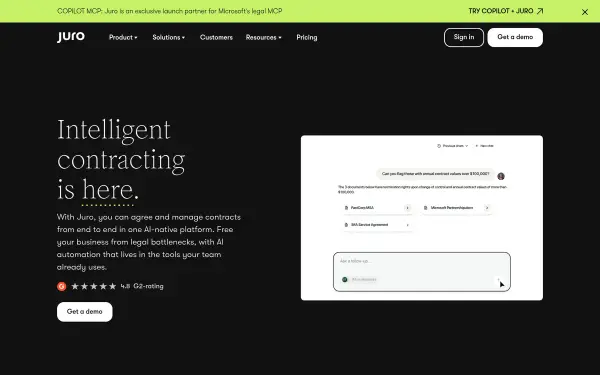
Our verdict
The adoption winner for high-volume standard agreements, not a global governance platform for regulated entities.
Juro puts contracts in the browser as live documents rather than email attachments. Counterparties and internal reviewers work in the same workspace, which reduces version chaos, and collaborative drafting and redlining, approval workflows, template automation, AI review, a repository and renewal reminders cover the standard high-volume needs.
The bigger differentiator is adoption. Business teams can raise and negotiate standard agreements without long training, and time to value on standard agreements is short. That matters when legal is a bottleneck on NDAs, sales contracts and vendor paperwork rather than on complex, negotiated deals.
Governance depth is where it stops. It trails Icertis and Agiloft on entity structures and heavily customized approval logic, and it sits at the top of the mid-market rather than at the core of a global enterprise estate. Very large organizations may outgrow it. Word-centric legal teams also face change management, because the workflow is not a Word add-in.
Pricing is custom quoted. Larger enterprises often pilot it for standard agreements alongside a heavier enterprise CLM, which is a sensible split rather than a compromise.
Legal is a bottleneck on high-volume standard agreements and adoption keeps failing.
Regulated multi-entity governance and complex approval logic are non-negotiable.
VBackground
Enterprise contract management software is the system that holds a contract from request to renewal: intake, drafting, approval, negotiation, signature, storage, obligation tracking and analytics. It differs from a signing tool because signature is one step inside a longer record that legal, procurement, sales and finance all depend on.
The category splits into two halves that buyers often blur. Pre-signature work covers intake forms, template drafting, redlining, approval routing and negotiation. Post-signature work covers the repository, obligation extraction, renewal exposure and supplier performance. Ironclad and Juro are strong on the first half; Sirion and LinkSquares are strong on the second. Icertis spans both because it was built for governance across entities.
Four things separate an enterprise platform from a mid-market one:
Everything in this list is quoted rather than listed, and none offers a free plan or a self-serve trial. Demos are the entry point. That makes the buyer's own preparation the limiting factor: the vendors that look slow in a demo are often doing the most governance work behind the screen.
This comparison sits in the software register. Further along the shore: baby tracking app and kennel software.
VIPricing
Every tool in this list quotes pricing on request, so there is no list price to compare. Budget conversations start with scope: users, contract volume, modules, implementation services and, for DocuSign CLM, the wider signature estate. None of the eight offers a free plan, and all offer a demo rather than a trial.
| Model | How it bills | Typical fit | Example from this list |
|---|---|---|---|
| Custom enterprise quote | Annual subscription plus implementation services | Multi-entity regulated contracting | Icertis |
| Workflow-led platform | Annual subscription scaled by users and AI modules | Legal and sales teams chasing cycle time | Ironclad |
| AI obligation layer | Annual subscription quoted on request | Buy-side and supplier performance teams | Sirion |
| Signature suite extension | Annual subscription with edition entitlements | Organizations already on DocuSign signature | DocuSign CLM |
| No-code configuration | Annual subscription plus admin or partner build time | Non-standard and mixed contracting | Agiloft |
| Salesforce-native suite | Annual subscription tied to the CRM and CPQ estate | Quote-to-contract revenue motions | Conga |
| Repository intelligence | Annual subscription scaled by contract volume | Legacy portfolio cleanup | LinkSquares |
| Browser-native workspace | Annual subscription quoted on request | High-volume standard agreements | Juro |
None of the eight publishes a list price. DocuSign CLM, Ironclad, Agiloft and the rest are custom quoted, so ask for a written quote based on the same scope, user count and contract volume.
Two costs sit outside the subscription. Implementation services, which for Icertis and Agiloft involve real partner or admin effort, and data migration, which decides how much value the Sirion or LinkSquares AI actually delivers. Ask for both separately in writing.
A useful test for 2026: give every shortlisted vendor the same scope, same user count, same contract volume, same modules, and ask for a written price. Custom-quote vendors answer vague questions with vague numbers.
Each entry card shows the starting price as it appeared on the vendor's own pricing page on November 25, 2026. When a vendor shows no figure we could confirm, or only a promotional rate, the card says "See website" or gives the regular price instead of a guess. Usage, overage and add-on rates in the text change more often than plan prices, so confirm them on the vendor page before you set a budget. To test the numbers against your own volume, try the free User Research Budget Planner. The Event Break-Even Calculator is a second way to check the same decision.
VIIDecision
Start with the failure, not the feature list. The best enterprise contract management tools in 2026 split by where contracting breaks: pre-signature cycle time, post-signature obligation risk, or governance across entities. Name the failure first, then shortlist two or three platforms and pilot them on your own contracts.
VIIIPitfalls
One mistake is buying governance depth you never configure. Icertis and Agiloft assume defined templates, clause libraries and entity structures, and without that readiness work the platform becomes an expensive shelf. The second is treating a scripted demo as evidence of a rollout. Both can show up early in a pilot.
IXQuestions
None of the eight publishes enterprise pricing. All quote custom pricing, so ask for a written quote that separates subscription, implementation services and any module or user assumptions. Implementation services can sit on top of the subscription.
Pre-signature covers intake, drafting, redlining, approvals and negotiation up to signature, where Ironclad and Juro are strongest. Post-signature covers the repository, obligations, renewals and performance analytics after execution, the ground Sirion and LinkSquares defend. Buyers may need both, but rarely in equal measure.
The facts here say little beyond long implementations with heavy consulting involvement for Icertis and configuration as a project for Agiloft, so treat published timelines with suspicion. Start with readiness work: defined templates, clause libraries and entity structures. A pilot on your own contracts is the fastest way to size real effort.
AI extracts clauses, dates and obligations and answers portfolio questions, which is the core of Sirion and LinkSquares. Drafting assistance and template automation appear in several tools here. Human review is still required because extraction quality depends on your migrated documents, so validate on your own legacy contracts and keep lawyers on anything unusual or high value.
When quote and account data already live in Salesforce, so contracts generate and store without re-keying. Conga is the clearest example, and Ironclad also connects contract records through Salesforce. If a meaningful share of your contracts never touches a quote or a CRM record, that integration advantage shrinks.
Match the platform to the contracting you actually do. If legal is a bottleneck on standard agreements, Juro's adoption strengths matter more than Icertis's entity governance. If subsidiaries and regulators shape the work, adoption-friendly tools will not hold. A governance core plus a fast lane can be a sensible split for some buyers.
XFurther along the shore
Vendors can ask for a correction or apply for a Featured listing. Paid or not, the entry is scored on the same rubric and its limits stay in print. Partner with Umberlake.
Free tools
Our free browser tools turn the prices on this page into a figure for your own volume. Nothing you type leaves your device.