
Lattice
$4Engagement module, per seat per month
Best for mid-size and larger firms tying feedback to performance
- Free plan
- No
- Rubric
- 8.0 of 10
We compared eight feedback and engagement platforms for buyers on survey depth, manager follow-through, recognition and pricing clarity in November 2026.

IThe short answer
Best Strong employee feedback tools for November 2026 include Lattice, Culture Amp and 15Five. Lattice fits mid-size and larger firms tying feedback to performance. Culture Amp suits large organizations running engagement surveys at scale. 15Five works for mid-market firms that want manager-friendly feedback with reviews. All three connect surveys or check-ins to action, but they differ in pricing clarity, implementation weight and how much support managers get after a survey closes.
8 tools compared from vendor pages on November 25, 2026. 5 publish a starting price we could read; the rest say "See website".
IITop three berths
Register order is editorial fit for the buyer each entry describes. Prices are the starting figures read on November 25, 2026.
$4Engagement module, per seat per month
Best for mid-size and larger firms tying feedback to performance

See websitecustom quote
Best for large organizations running engagement surveys at scale

$4Engage, per user per month, billed annually
Best for mid-market firms wanting manager-friendly feedback with reviews
How this page is paid for. All 8 tools here are unpaid editorial picks.
A paid listing's position can be part of what the vendor pays for. Every entry, paid or not, is scored on the same rubric and keeps its limits in print. Advertising disclosure.
IIIThe register
Starting prices as shown on each vendor's pricing page on November 25, 2026. "See website" means no figure we could confirm.
| No. | Tool | From | Free plan | Trial | Rubric | Actions |
|---|---|---|---|---|---|---|
| 01 | LatticeMid-size and larger firms tying feedback to performance | $4Engagement module, per seat per monthUpdated on vendor page | No | No | 8.0 | |
| 02 | Culture AmpLarge organizations running engagement surveys at scale | See websitecustom quoteQuote only | No | Demo only | 6.2 | |
| 03 | 15FiveMid-market firms wanting manager-friendly feedback with reviews | $4Engage, per user per month, billed annuallyRead on vendor page | No | Demo only | 8.0 | |
| 04 |  WorkleapCompanies whose managers need to act on feedback | $4,999Standard, billed annually, plus $32 per manager per monthUpdated on vendor page | No | Demo only | 7.6 | |
| 05 |  Quantum WorkplaceGrowing organizations wanting connected engagement and performance data | See websiteNot shown publicly | No | Demo only | 7.1 | |
| 06 |  TINYpulseTeams wanting frequent pulse surveys plus peer recognition | See websiteNot shown publicly | No | Demo only | 5.8 | |
| 07 |  BonuslyCompanies missing visible peer appreciation | $3Team without Bizy AI, per user per month, billed monthlyUpdated on vendor page | No | 30-day free trial | 4.6 | |
| 08 |  LeapsomeGrowing companies that want to add HR modules over time | $7Agentic HRIS Foundation, per employee per month, plus at least one Talent Suite moduleUpdated on vendor page | No | 14-day free trial | 7.0 |
Pinned:
IVMethod
Measures engagement and pulse survey design, reporting and anonymity controls.
Checks whether managers get prompts, plans and workflows that turn feedback into follow-through.
Reviews how well feedback connects to goals, reviews and development records.
Assesses peer appreciation, rewards and visibility of everyday work.
Scores published prices, plan detail and how easy it is to forecast total cost.
VMethod
We chose these eight tools by comparing what each product does for feedback and engagement, then scoring five criteria: survey depth, manager action, performance link, recognition and pricing clarity. Scores shape the write-ups but do not sort the list. The order is editorial: fit for the buyer each entry describes, plus any disclosed Featured position. No tool here is marked Featured. When a vendor buys Featured placement, it pays for that position; we still score it with the same rubric and list the same honest cons.
Prices and plan facts come from vendor pricing pages checked on November 25, 2026. We use the price exactly as published, in the vendor's currency, and do not convert it. Where a vendor publishes only a quote, we say so and avoid estimating a number. Where a page shows a starting price but total cost depends on modules or headcount, we explain the gap rather than treat the entry price as the full cost.
Weightings are 25 percent survey depth, 20 percent manager action, 20 percent performance link, 15 percent recognition and 20 percent pricing clarity. Survey depth matters because feedback software depends on trust and usable results. Manager action matters because feedback without follow-through becomes another dashboard. Pricing clarity matters because a quote-only platform can hide a large first-year cost, and recognition matters because visible appreciation changes how people experience feedback.
Each review names the buyer the product fits and the buyer who should skip it. We do not invent customer quotes, ratings or usage statistics. Vendor claims such as customer counts are attributed to the vendor and used as context, not proof of quality. The result is a shortlist, not a claim that one product wins for every team.
The full routine, from price reads to corrections, is on the methodology page. Paid listings follow the advertising disclosure.
Entry I of VIII / Connected performance workspace
Our verdict
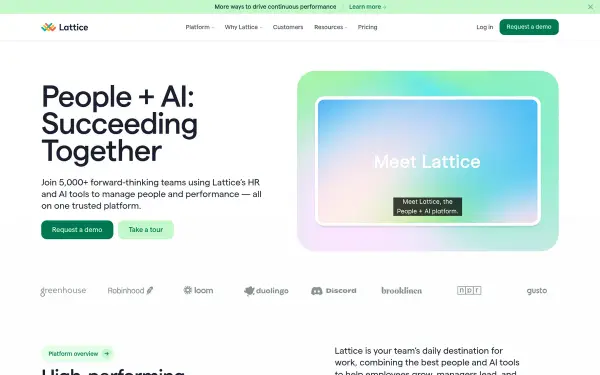
A strong fit for mid-size firms that want feedback, goals and reviews in one place, provided they can scope modules carefully.
Lattice puts continuous feedback, praise, one-on-one workflows, goals and OKRs, performance review cycles and company updates into one workspace. The AI agent surfaces insights and answers policy questions, while integrations cover Workday, Slack, Okta and other HRIS tools. For buyers trying to stop feedback from living in separate spreadsheets, chat threads and review forms, that shared workspace is the main draw, because a manager can move from a check-in note to a goal update or review comment without switching systems.
The product fits mid-size and larger firms tying feedback to performance. Managers can use one-on-ones and goals to make feedback part of routine work, while HR can run review cycles from the same system. The trade-off is scope. Lattice is a platform, not a single-purpose survey tool, so a small team may pay for modules it will not fully launch. Rollout requires planning across modules, with clear owners and a staged calendar rather than a single switch-on date.
Pricing needs care. The starting price is $4 per seat per month for the engagement module, and the vendor page now lists per-module seat prices from $4 to $13. That range is useful for rough budgeting, but the total depends on which modules you select and how many seats you buy. A complete platform quote for a given headcount is still not clear without contacting sales, so ask for a written breakdown by module, seat count and term.
Choose Lattice when feedback, goals and reviews need one connected system and you have HR capacity to run a staged rollout. It suits firms that want managers to see feedback beside goals and review cycles, not in a separate survey dashboard. Skip it when you only need pulse surveys or peer recognition, or when a small people team cannot support a multi-module implementation.
You want feedback, goals and reviews in one workspace and can phase the modules.
You need only pulse surveys or cannot support a multi-module rollout.
Entry II of VIII / Survey science at scale
Our verdict
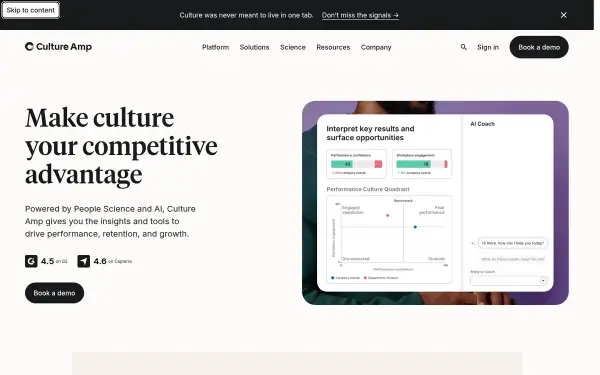
A strong choice for large survey programs that need people science and layered analytics, but not for buyers who need a published price.
Culture Amp centers on engagement and experience surveys, with AI analysis that turns results into recommendations. Separate views for leaders, managers, employees and HR let each audience see the slice it can act on, while analytics and data stories link engagement to business outcomes. People science guidance and benchmarks underpin survey design, and action planning support helps teams move from results to next steps.
That combination suits large organizations running engagement surveys at scale. The platform is built for HR teams with analytics capacity, not for a very small company that wants a simple weekly pulse. Buyers should expect a heavier setup than a lightweight survey tool, because survey design, audience segmentation, reporting permissions and action planning all need decisions before launch. AI-assisted analysis can speed the first read of results, but someone still needs to own the action plan.
Pricing is quote-only. The vendor does not publish a price list on the page provided, and the quote varies by headcount, product and service tier. That makes budgeting harder: a buyer cannot compare a per-seat rate against 15Five or Bonusly without a sales conversation. Ask for the full first-year cost, including implementation, support and any survey services, then model a renewal year at the same headcount.
Culture Amp states its platform is used by more than 6,000 companies. That scale does not prove fit, but it does signal that the vendor supports large survey programs and multiple audience groups. Choose it when engagement research, benchmarks and executive reporting matter more than fast self-serve setup. Skip it when you need a cheap pulse tool or a single system for reviews and recognition as well as surveys.
You run large engagement surveys and need people science plus audience-specific reporting.
You need published pricing, fast self-serve setup or built-in peer recognition.
Entry III of VIII / Manager feedback routine
Our verdict
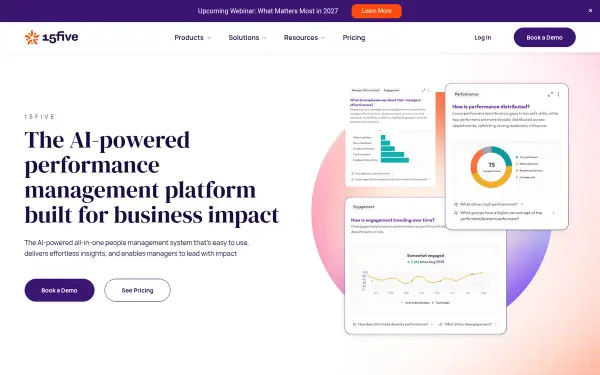
A practical mid-market choice with published tiers, manager-friendly check-ins and reviews, though add-ons push the total higher.
15Five combines engagement surveys with AI analytics, performance reviews, one-on-ones, weekly check-ins, OKRs, career development tools and compensation signals. Integrations cover HRIS, Jira and Salesforce. The mix is aimed at mid-market firms that want managers to run feedback routines, not just HR to collect survey data. A manager can hold a one-on-one, set a goal and prepare a review inside the same product. Weekly check-ins give managers a lightweight prompt between formal cycles.
Pricing is more transparent than most tools here. The Engage tier is $4 per user per month billed annually and covers surveys plus AI analytics. Perform is $11 per user per month and the full platform is $16 per user per month. Higher tiers add reviews, check-ins and goals. Coaching and compensation features are paid add-ons, so the entry price is not the whole budget for buyers that need those capabilities.
15Five is positioned at mid-market and enterprise buyers. Small teams can start on Engage, but they may find the full platform heavier than needed. Larger buyers get a broader manager workflow, yet they should map which add-ons are required before comparing against Lattice or Workleap. The top tier at $16 per user per month is still published, which makes headcount planning easier than a custom quote.
Choose 15Five when manager adoption matters and you want a clear path from surveys to reviews, check-ins and goals. The published tiers let you pilot with Engage and expand later. The product does not offer a free plan and trials are demo only, so evaluation depends on a guided walkthrough. Skip it when you need deep recognition, a pure survey research platform or a quote-only enterprise suite with heavy customization.
You want published tiers and a manager-led path from surveys to reviews.
You need a free trial, deep recognition or a pure survey research tool.
Entry IV of VIII / Manager follow-through
Our verdict
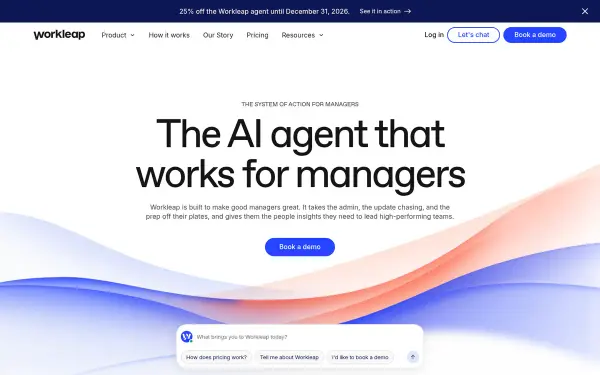
Built for manager follow-through, with AI review drafting and engagement prompts, but its pricing model needs a careful headcount check.
Workleap is designed around what managers do after feedback arrives. An AI agent drafts reviews in the manager's voice, engagement change detection flags shifts for teams, and manager action plans turn survey results into next steps. Recognition prompts encourage praise for noteworthy work, and employee experience surveys collect the underlying signal. Integrations cover Slack, Teams, Workday, BambooHR and other HR tools.
The product was formerly sold as Officevibe before the Workleap rebrand, and the vendor states more than 70,000 leaders use it. That manager-centric framing is the differentiator. HR buyers who want a deep research platform may find the survey side less central than Culture Amp's, while managers may appreciate prompts that fit into daily work rather than a quarterly report. That matters for buyers who care about manager adoption more than survey research depth. The brand is still settling after the transition, so buyers should confirm product naming and roadmap continuity.
Pricing is published on the vendor page in US dollars, despite older quote-only notes. The Standard plan is listed at $4,999 billed annually, plus $32 per manager per month. That split model means cost scales with manager count as well as the annual platform fee. A company with many managers would need to model both parts, not just the headline annual figure, and should confirm what is included in Standard.
Choose Workleap when manager action is the weak link and you want prompts, AI review drafts and engagement signals in one flow. It fits companies with a defined manager population and a budget for both the annual plan and per-manager fees. Skip it when you need a simple per-seat survey tool or when the Officevibe rebrand creates procurement concerns.
Your managers need prompts and action plans after feedback lands.
You want simple per-seat survey pricing or a research-heavy survey platform.
Entry V of VIII / Connected people data
Our verdict
A connected engagement and performance suite with hands-on implementation, best for buyers who will use several modules and can work through a quote.
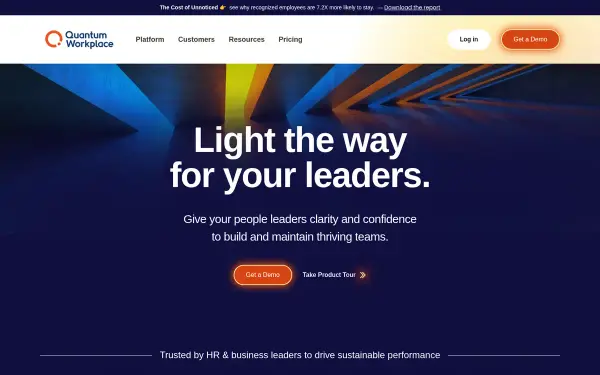
Quantum Workplace connects engagement surveys, action planning, performance reviews, recognition, development plans and succession planning. HRIS and single sign-on integrations support the employee record, and guided implementation helps buyers configure the modules they select. The pitch is a connected view of engagement and performance data, so HR can see whether survey results line up with review, development or recognition activity.
That scope suits growing organizations that want one vendor for several people processes. Module selection is flexible by organization size, which helps buyers avoid paying for every suite on day one. The trade-off is implementation effort. An all-in-one platform requires decisions about data ownership, review cycles, permissions and reporting, and a smaller HR team may need outside help to keep the project moving.
Pricing is only available as a custom quote. Cost depends on headcount and which suites are selected, so a sales conversation is needed for budgeting. Buyers should ask for a written breakdown by module, implementation service and support level, then compare the total against 15Five's published tiers or Culture Amp's quote. Without that breakdown, it is hard to tell whether Quantum Workplace is cheaper or more expensive for the same scope.
Quantum Workplace is lesser known than larger engagement platforms, which may matter in procurement. The upside is hands-on implementation and customer success support, plus a connected data model across engagement, performance, development and recognition. Choose it when you want those links and will use more than a survey tool. Skip it when you need a fast self-serve pulse product or a published price before you shortlist.
You want engagement, reviews, development and recognition connected with implementation help.
You need published pricing or a fast, single-purpose survey tool.
Entry VI of VIII / Anonymous pulse feedback
Our verdict
A focused pulse and peer recognition tool for candid feedback, but it is not a full performance management system.
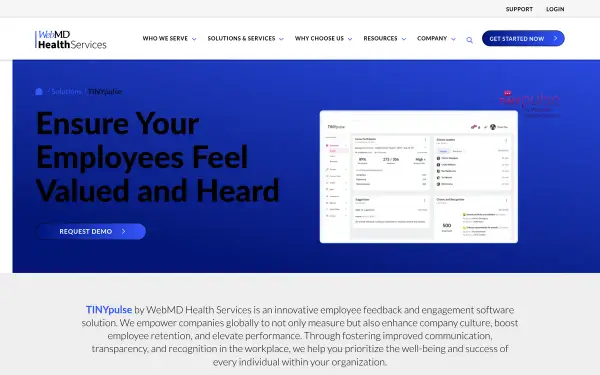
TINYpulse focuses on short pulse surveys, anonymous two-way feedback, Cheers for Peers recognition and engagement reporting. A dedicated customer success manager and weekday support around the clock are part of the service. The anonymous messaging is the core draw: employees can raise concerns without attaching a name, and managers get a structured channel for follow-up rather than an open inbox. Engagement reporting gives leaders a trend view, but it depends on consistent participation.
The product fits teams that want frequent pulse checks and visible peer recognition without a long survey cycle. It is narrower than all-in-one HR suites. It does not cover full performance reviews, so buyers should pair it with a separate performance management system. That makes TINYpulse a complement rather than a replacement for Lattice, 15Five or Quantum Workplace when reviews and goals matter.
Pricing is not published on the site. The vendor sits within WebMD Health Services, which may matter for procurement and support continuity. Buyers should ask how anonymous comments are stored, who can see raw text and what reporting thresholds apply to small teams. Those details affect trust more than the survey interface, especially in teams where a comment could be traced back to one person.
Choose TINYpulse when candid pulse feedback and peer recognition are the priority and you already have a performance system. The named success manager can help with adoption, and the weekday support coverage is useful for HR teams without a large operations staff. Skip it when you need reviews, goals, compensation or a single platform for the full employee lifecycle.
You want frequent anonymous pulses and peer recognition alongside a separate review system.
You need performance reviews, goals or a single HR platform.
Entry VII of VIII / Rewarded peer praise
Our verdict
A strong recognition layer with visible peer praise and rewards, but it is not an engagement survey platform.
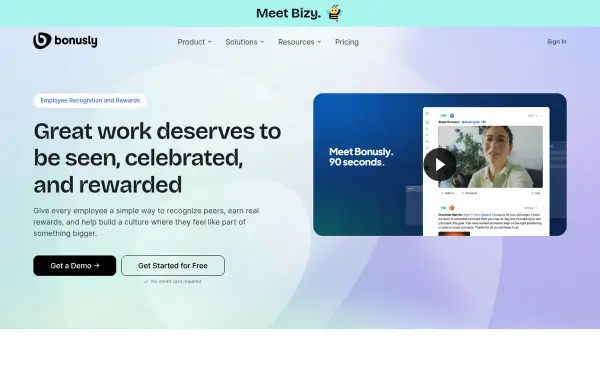
Bonusly centers on a public peer-to-peer recognition feed where employees give points that can be redeemed for real rewards. Recognition analytics show culture trends, and appreciation is visible across teams and locations. The product works with common workplace messaging tools, so praise can appear where people already talk. The reward element gives employees a tangible reason to participate, which is different from a survey that only collects sentiment.
The main limit is scope. Bonusly has no engagement survey capability, so it cannot replace Culture Amp, 15Five or TINYpulse for sentiment measurement. It is best treated as a complement to a survey or performance platform. The public feed also changes the tone of feedback: it rewards specific, visible appreciation, but it is not the place for anonymous concerns or confidential manager feedback.
Pricing is listed per user per month, billed monthly. Team without Bizy AI is $3 per user per month, and Team with Bizy AI is $5 per user per month. Budget for the reward pool on top of those fees, because points redeemed for rewards add spend beyond the subscription. Buyers should model participation rates and reward costs before assuming the per-user price is the whole program cost.
Choose Bonusly when peer appreciation is missing and you want recognition to be public, specific and rewarded. It fits teams that already have a survey or performance system and want to improve everyday culture visibility. A 30-day free trial makes it easy to test participation before a longer commitment. Skip it when you need engagement surveys, anonymous feedback, performance reviews or a single platform for people analytics.
You want visible peer appreciation with rewards and already have a survey platform.
You need engagement surveys, anonymity or performance reviews.
Entry VIII of VIII / Modular HR record
Our verdict
A modular HR suite for growing companies, with agentic admin and talent tools, but module pricing needs a careful quote.
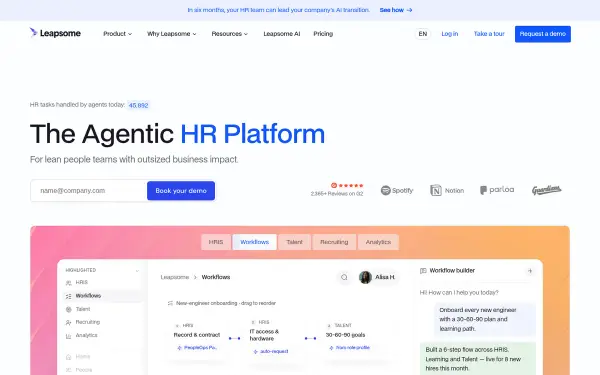
Leapsome combines performance reviews, goals and objectives, engagement surveys, learning modules, compensation management and AI agents for HR admin such as onboarding, absences and payroll preparation. The modules share one employee record, so review, goal, learning and compensation data can sit together rather than in separate systems. The AI agents are aimed at repetitive HR work, while the talent tools cover the feedback and performance side.
The product fits growing companies that want to add HR modules over time. Buyers pay for the modules in use, which is attractive for a lean people team that cannot adopt everything at once. The risk is the opposite: adopting every module at once can overwhelm a small HR team. The agentic features are new and still developing, so buyers should test them against current workflows rather than assume they remove admin work.
Pricing is not fully published. The listed starting price is $7 per employee per month for Agentic HRIS Foundation plus at least one Talent Suite module. The vendor also says the Foundation is free until Dec 31 when paired with a module, and individual module prices are not displayed. That makes the $7 starting point a guide, not a complete budget, so ask for a module-by-module quote.
Leapsome states around 2,000 companies use the platform. A phased module rollout is the safer path for lean HR teams, starting with reviews, goals or surveys, then adding learning or compensation. Choose Leapsome when you want one employee record and a modular path beyond feedback. Skip it when you need a standalone survey tool, a published all-in price or proven agentic automation today.
You want to add feedback, performance and HR modules on one employee record over time.
You need a standalone survey tool or a fully published all-in price.
VIBackground
Employee feedback software gives people a structured way to say what is working, what is not and what should change, then gives managers and HR a way to act on it. It covers engagement surveys, short pulse checks, anonymous comments, one-on-one notes, peer recognition, goal tracking and sometimes performance reviews. Buyers often meet three overlapping product types, and the labels do not always match the feature list.
Survey and pulse tools measure sentiment and track trends over time. Recognition tools make peer appreciation visible and may add rewards. Performance suites connect feedback to goals, reviews and development. A product can sit in more than one group: Lattice combines feedback, goals and reviews, while Bonusly is recognition-first and TINYpulse pairs pulses with peer praise. The category is broad because employee feedback is not one workflow.
Anonymity is the feature buyers should examine closely. Some tools offer fully anonymous comments, others keep feedback confidential to HR, and some attach every comment to a person. Ask who can read raw comments, how small groups are reported and what minimum group size prevents identification. A survey that promises anonymity but shows managers comments from a very small team will not earn trust, no matter how good the analytics look.
Integration and manager support matter as much as survey design. Feedback software often needs to read employee records from an HRIS, post prompts in Slack or Teams and send review data to other systems. Managers need action plans, reminders and clear next steps, because a dashboard does not change behavior on its own. Buyers should test a real manager workflow, not just the admin view.
Pricing adds another layer. Some products publish per-seat tiers, others sell modules or quote by headcount. A recognition tool may charge per user and require a reward pool, while a survey platform may include implementation services. The right shortlist depends on the job you need done, the anonymity rules you can support and the total budget you can forecast. Start with the workflow, then compare the price.
This comparison sits in the software register. Further along the shore: baby tracking app and kennel software.
VIIPricing
Pricing in this category falls into several models: per-seat subscriptions, module bundles, annual platform fees with manager charges, and custom quotes. Per-seat pricing is easiest to forecast, but the headline rate rarely covers every add-on. Module bundles let buyers start with surveys or reviews and add performance, learning or compensation later. Custom quotes are common for large survey programs and implementation-heavy suites.
Published per-seat pricing is the clearest. 15Five lists Engage at $4, Perform at $11 and the full platform at $16 per user per month, billed annually. Bonusly lists Team without Bizy AI at $3 per user per month, billed monthly, and Team with Bizy AI at $5. Lattice lists $4 per seat per month for the engagement module, with per-module seat prices up to $13.
| Model | How it bills | Typical fit | Example from this list |
|---|---|---|---|
| Per seat | Monthly or annual per user | Teams that can forecast headcount | 15Five Engage at $4 per user per month, billed annually |
| Per module | Seat price per module | Buyers adding workflows over time | Lattice engagement module at $4 per seat per month |
| Annual plus manager fee | Annual platform fee plus per-manager charge | Manager-heavy rollouts | Workleap Standard at $4,999 billed annually plus $32 per manager per month |
| Custom quote | Headcount, product and service tier | Large survey programs and suites | Culture Amp, Quantum Workplace and TINYpulse |
Module and split pricing needs more math. Workleap lists Standard at $4,999 billed annually plus $32 per manager per month. Leapsome lists $7 per employee per month for Agentic HRIS Foundation plus at least one Talent Suite module, though individual module prices are not displayed. Those structures can make a small team look affordable at the entry point and expensive once managers or modules are added.
Quote-only vendors make comparison harder. Culture Amp, Quantum Workplace and TINYpulse do not publish a price list, so buyers need a written quote that separates subscription, implementation, support and any services. Ask for first-year and renewal-year totals at your actual headcount.
Each entry card shows the starting price as it appeared on the vendor's own pricing page on November 25, 2026. When a vendor shows no figure we could confirm, or only a promotional rate, the card says "See website" or gives the regular price instead of a guess. Usage, overage and add-on rates in the text change more often than plan prices, so confirm them on the vendor page before you set a budget. To test the numbers against your own volume, try the free User Research Budget Planner. The Event Break-Even Calculator is a second way to check the same decision.
VIIIDecision
Define the job. Decide whether you need engagement surveys, continuous feedback, recognition, performance reviews or a combination. A recognition tool such as Bonusly will not replace a survey platform, and a survey tool may not run reviews.
Set anonymity rules early. Ask who can see raw comments, how confidential feedback is handled and what minimum group size triggers reporting. Small teams need thresholds that prevent a comment from being traced to one person.
Test the manager workflow. Walk through a survey close, a manager prompt and a follow-up action. Lattice ties feedback to goals and reviews, Workleap emphasizes manager follow-through, and Culture Amp leans on survey analytics and audience views.
Price the full scope. Add per-seat fees, module prices, manager fees, reward funding, implementation and add-ons. 15Five starts at $4 per user per month, but the top tier is $16 and coaching costs extra.
Match the platform to headcount. Small teams should avoid heavy suites and start with one workflow. Large organizations need analytics, permissions and support, which is why Culture Amp is built for survey programs at scale.
Plan a phased rollout. Pilot one module or team, then add goals, reviews, recognition or compensation. Leapsome and Lattice both work this way, but each needs clear owners and a calendar.
IXPitfalls
XQuestions
Small teams should start with a focused tool: 15Five's Engage tier at $4 per user per month covers surveys and AI analytics, and Bonusly at $3 adds peer recognition. Growing companies can phase Leapsome modules. Culture Amp fits large organizations running engagement surveys at scale, while Quantum Workplace suits growing organizations that want connected engagement and performance data.
Use the longer engagement survey for broad trends and the pulse check for fast follow-up. Culture Amp is built for engagement and experience surveys with audience-specific reporting, while TINYpulse focuses on short pulse surveys and anonymous two-way feedback. Run pulses between survey cycles, keep them short and close the loop on what changed. Do not repeat the same questions in both channels without a reason.
Ask for the exact anonymity model: fully anonymous, confidential to HR or attributed to the employee. Then ask who can read raw comments, how comments are grouped and what minimum group size triggers a report. TINYpulse offers anonymous two-way feedback, but every vendor should explain how small teams are protected. If a manager can infer the author from a very small team's report, the promise is weak.
No. Recognition software makes peer appreciation visible and may add rewards, but it does not measure engagement sentiment. Bonusly has no engagement survey capability, so it works best alongside a survey or performance platform. Use recognition to change everyday behavior and use surveys to track trends, then connect the two through manager action planning rather than expecting one tool to do both jobs.
Per-user pricing scales directly with headcount, and reward budgets sit on top. 15Five lists $4, $11 and $16 per user per month depending on tier. Bonusly lists $3 per user per month without Bizy AI and $5 with it, but redeemed rewards add spend. Workleap adds a per-manager fee on top of its annual plan, so manager count matters as much as total headcount.
Budget for implementation, add-ons, reward funding and module upgrades. 15Five charges separately for coaching and compensation features. Bonusly requires a reward pool beyond its per-user fee. Leapsome sells modules and does not display every module price. Quote-only suites may include implementation and support in the first year, so ask for a renewal-year total before you approve the subscription.
XIFurther along the shore
Vendors can ask for a correction or apply for a Featured listing. Paid or not, the entry is scored on the same rubric and its limits stay in print. Partner with Umberlake.
Free tools
Our free browser tools turn the prices on this page into a figure for your own volume. Nothing you type leaves your device.