Honeydue
See websiteFree, no paid tier
Best for couples wanting free shared budgeting with account-level sharing control
- Free plan
- Yes
- Rubric
- 7.9 of 10
Eight couples budgeting apps compared on cost, account sharing, free tiers and setup effort, with picks for envelope budgeters, zero-based planners and merged households.

IThe short answer
Honeydue suits couples starting out who want a free shared budget, because it costs nothing and lets each partner choose which accounts to share. Monarch Money suits couples who want budgets, bills, investments and net worth in one dashboard, at $8.33 per month billed annually at $99.99. YNAB fits couples ready to commit to zero-based budgeting together, at $9.08 per month billed annually at $109. All prices were checked on November 26, 2026: Best Couple Budget App.
8 tools compared from vendor pages on November 25, 2026. 3 publish a starting price we could read; the rest say "See website".
IITop three berths
Register order is editorial fit for the buyer each entry describes. Prices are the starting figures read on November 25, 2026.
See websiteFree, no paid tier
Best for couples wanting free shared budgeting with account-level sharing control
$8.33Core, per month, billed annually at $99.99
Best for couples wanting one shared dashboard for budgets, bills and net worth
$9.08Annual plan, per month, billed annually at $109
Best for couples ready to commit to strict zero-based budgeting together
How this page is paid for. All 8 tools here are unpaid editorial picks.
A paid listing's position can be part of what the vendor pays for. Every entry, paid or not, is scored on the same rubric and keeps its limits in print. Advertising disclosure.
IIIThe register
Starting prices as shown on each vendor's pricing page on November 25, 2026. "See website" means no figure we could confirm.
| No. | Tool | From | Free plan | Trial | Rubric | Actions |
|---|---|---|---|---|---|---|
| 01 | HoneydueCouples wanting free shared budgeting with account-level sharing control | See websiteFree, no paid tierNot shown publicly | Yes | No | 7.9 | |
| 02 | Monarch MoneyCouples wanting one shared dashboard for budgets, bills and net worth | $8.33Core, per month, billed annually at $99.99Read on vendor page | No | 7-day free trial | 7.5 | |
| 03 | YNABCouples ready to commit to strict zero-based budgeting together | $9.08Annual plan, per month, billed annually at $109Read on vendor page | No | 34-day free trial | 6.8 | |
| 04 |  GoodbudgetCouples who like envelope budgeting and manual entry | See websiteFree tier, 20 envelopes and syncing across two devicesNot shown publicly | Yes | No | 7.3 | |
| 05 | SimplifiHouseholds wanting a flexible spending plan with watchlists | $3.50Simplifi, per month, billed annually, 50% off first year from $6.99Updated on vendor page | No | Free trial | 7.2 | |
| 06 | CopilotApple-only couples who value design and fast syncing | See websitePer yearNot shown publicly | No | One month free trial | 6.6 | |
| 07 | EveryDollarCouples wanting a plain zero-based plan with manual entry | See websiteFree tier, manual budgeting onlyNot shown publicly | Yes | No | 6.6 | |
| 08 | PocketGuardCouples with merged finances wanting one safe-to-spend figure | See websitePlus tier, per yearNot shown publicly | Yes | No | 6.1 |
Pinned:
IVMethod
We scored each app against five criteria a couple can actually feel: cost and free tier at 25 percent, shared visibility at 25 percent, budgeting depth at 20 percent, setup effort at 15 percent, and household view at 15 percent. Shared visibility covers both sides of the same question, meaning whether both partners see the same numbers and whether one of them can keep an account or a purchase out of the shared view.
Prices and plan details come from vendor pricing pages checked on November 26, 2026. Where a page could not be fetched, the review says so and the plan detail comes from the research note rather than a live page. Every figure here is kept in the form the vendor shows it, with no currency conversion and no annualized guesses added on top.
The order is editorial. It reflects fit for the buyer described in each entry, not a weighted total, so a lower entry can still be the right pick for a specific household. A Featured placement is a paid slot and is labeled as Featured; it is scored against the same five criteria and carries the same kind of honest cons as every other entry.
Two things we did not do: invent trial lengths or prices, and treat a short trial as a free plan. If a tool has no free tier, the entry says so plainly.
The full routine, from price reads to corrections, is on the methodology page. Paid listings follow the advertising disclosure.
What a couple pays in year one and whether a usable no-cost option exists.
How well both partners see the same budget, and whether one can keep some accounts or purchases private.
Envelope, zero-based and flexible planning tools, plus goals and debt payoff support.
Time to connect accounts and reach a budget both partners trust and will maintain.
Whether investments, net worth and longer-term reporting sit alongside the monthly plan.
Entry I of VIII / Account-level sharing control
Our verdict
The default free pick for couples, with account-level sharing control and no paid tier to outgrow.
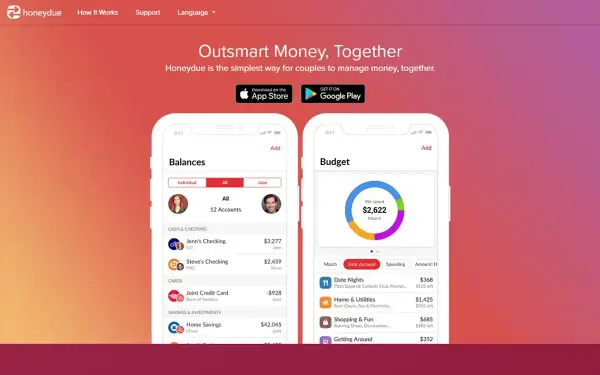
Honeydue is designed from scratch for two people rather than adapted from a solo tracker. Bills appear on a shared list with due date reminders, spending categories are visible to both partners, and each transaction carries a small chat thread so a question about a purchase stays attached to the purchase instead of moving to text messages.
The sharing control is the part that matters most. Each partner chooses which accounts and balances to share, so a joint account can sit alongside a personal one without everything being exposed. Accounts that cannot be linked can be entered manually, and linked balances sync automatically.
The limits are geographic and structural. Bank linking centers on US institutions, so couples banking elsewhere will lean on manual entry. Investment and net worth tracking is thin compared with Monarch Money or Copilot, and there is no desktop-first dashboard for a longer monthly review.
Pricing is simple: it is free, with no paid tier to graduate to. Pricing details are on the vendor site, and the plan note records a free product with no upgrade. Couples who used Zeta, which was acquired and closed in May 2025, are often pointed here or to Monarch Money.
You want a free shared budget where each partner controls what the other can see.
You need investment tracking, net worth reporting or a full desktop dashboard.
Entry II of VIII / Full household dashboard
Our verdict
The widest household view in this list, with separate logins and privacy flags on individual transactions.
Monarch Money gives a couple one dashboard covering budgets, bills, investments and net worth, and it does it without forcing a shared login. Each partner gets their own credentials, which matters for anyone who has been handed a partner's password to a bank-connected app.
The privacy flag is the feature worth paying attention to. Transactions can be marked shared or personal, so the household total stays accurate while a surprise purchase or a personal expense does not have to be explained. Bank, card and investment accounts sync into the same view, and goals plus household reporting sit on top.
The trade-offs are cost and setup. There is no free tier, only a 7-day free trial, and the Core plan runs $8.33 per month billed annually at $99.99. That is more than the free options here. Linking a full set of accounts also takes real time, and the effort scales with how many accounts a couple connects.
It fits couples who want the broadest household view in this list and are willing to pay for it. A couple who mainly needs a shared bill list will find Honeydue or Goodbudget enough.
You want budgets, bills, investments and net worth in one shared dashboard and will pay for it.
You need a free app or only want a simple shared bill list.
Entry III of VIII / Zero-based method

Our verdict
A method as much as an app, and a fit if both partners will commit to zero-based budgeting.
YNAB sells a method as much as an app: every dollar is assigned before it is spent, so a couple has to agree on priorities at the start of each month rather than argue about categories as spending lands.
One plan covers up to six people, which means both partners work from the same budget with the same categories. Debt payoff targets, loan tracking and savings goals with funding schedules are built in, and bank import is paired with manual reconciliation so the numbers stay honest. Web and mobile apps carry spending and net worth reports.
The cost is $9.08 per month billed annually at $109, with a 34-day free trial and no free tier. The 34 days are useful because the first weeks are the steepest: the method takes time to learn, and couples who treat the app as a passive tracker tend to abandon it. It rewards a regular weekly check-in from both partners.
It fits couples ready to commit to strict zero-based budgeting together. A couple who wants a light monthly glance at spending should look at Simplifi or Honeydue instead.
You both want a strict zero-based plan and will review it together every week.
Neither of you will maintain a weekly routine or you want a passive tracker.
Entry IV of VIII / Envelope budgeting
Our verdict
An envelope budgeting app for two, with a free tier many couples will never outgrow.
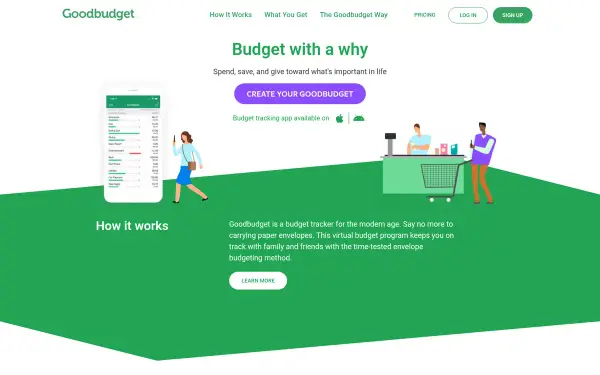
Goodbudget takes the cash envelope system and puts it on a shared screen. Each spending category gets an envelope, money moves between envelopes as it is spent, and both partners see the same balances. Debt tracking and envelope reports round it out.
The free tier is the reason to consider it. It includes 20 envelopes and syncing across two devices, which covers a couple with a phone each and a normal set of categories. A paid tier adds unlimited envelopes and more devices; pricing for it is on the vendor site, and the free tier details here come from the research note rather than a fetched page.
Manual entry is the core mechanic, and it cuts both ways. Entering each transaction keeps spending front of mind for both partners, but it only works if both keep doing it. Bank syncing is limited and paid features vary, so a couple who wants automatic account connections should check before committing. There is no investment or net worth tracking.
It fits couples who like envelope budgeting and do not mind typing in purchases. It is a poor match for a household that wants linked accounts to do the work.
You like envelope budgeting and one of you will enter purchases by hand.
You want automatic bank syncing or any investment tracking.
Entry V of VIII / Watchlists
Our verdict
A flexible spending plan with watchlists, good for households that want structure without zero-based rules.
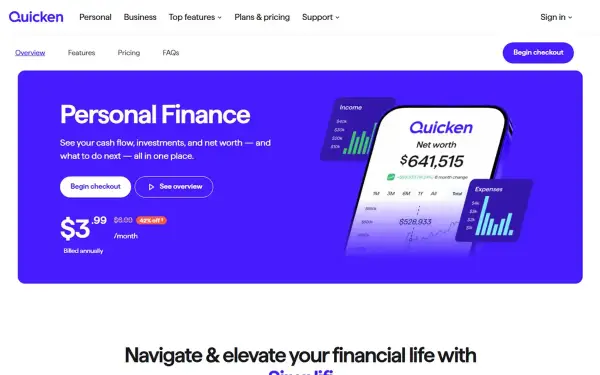
Simplifi is a Quicken product, and it shows in the breadth: connected bank, card and investment accounts in one view, customizable categories, bill and subscription tracking, and savings goals. The spending plan sets targets rather than enforcing categories, which suits a couple who wants structure without a lecture.
Watchlists let you track selected accounts and spending lines, so a short review covers the same ground every time, and custom reports support a periodic household sit-down.
The couple features are general rather than purpose-built. There is no dedicated partner privacy control, so a couple who wants to keep some spending private has to work around the design rather than use it. That is the main gap against Monarch Money and Honeydue.
Pricing needs confirming. The vendor page currently shows a promotional annual rate of $3.50 per month, which is 50% off the first year from a $6.99 regular rate. Rates have shifted before, so check the current plan on the vendor site before you commit. There is no free tier, and a free trial is offered. It fits households that want a flexible plan and watchlists without zero-based rules.
You want a flexible target-based plan and a repeatable monthly review.
You need per-partner privacy controls or a free tier.
Entry VI of VIII / Design and fast sync

Our verdict
A polished budgeting app, but only for households where everyone carries an Apple device.
Copilot is an Apple-first budgeting app with native builds for iPhone, iPad and Mac. The interface is the product: the monthly budget dashboard is clear enough that opening it becomes a habit, and account syncing after linking is fast, so balances stay current.
It covers more than a spending envelope. Investment and net worth views sit alongside budgets in one place, transaction categorization detects recurring charges, and a monthly spending review pulls the numbers into a short summary.
The platform limit is hard. There is no Android app, and the web experience does not match the native builds, so a household where one partner carries an Android phone is not a good fit. Couples also work from a shared login rather than separate partner controls, which means no per-transaction privacy layer.
Pricing is billed per year and the figure is shown on the vendor site, so confirm it there rather than assuming. A one month free trial lets a couple test the full app before paying. It fits design-conscious Apple households who want budgets and investments together.
Both of you use Apple devices and want budgets and net worth in one well-designed app.
Either partner uses Android or you want separate partner logins.
Entry VII of VIII / Simple manual plan

Our verdict
A very simple zero-based plan, free if you are willing to type in every transaction.
EveryDollar is the plainest option here. You plan income and spending for the month, then track transactions against the plan manually. The budget is shared at the household level, and the structure follows the Ramsey Baby Steps, so debt payoff guidance is built into how the app expects you to work.
The free tier is manual budgeting only, which is enough to run a zero-based plan if both partners will enter purchases. Bank syncing and connected accounts sit behind a paid Ramsey plan, and pricing for that is on the vendor site. There is no free trial because the free tier itself is the entry point.
The rigidity is deliberate and it limits the fit. Fixed categories and a prescribed order of operations leave little room for a household with irregular income or shared custody arrangements, and there is no investment or net worth view at all. What you get instead is a short learning curve and a method that does not require interpretation.
It fits couples who want a simple zero-based plan and are comfortable with manual entry. It is a weak match for anyone who wants linked accounts, investment tracking or flexible categories.
You want a plain zero-based plan and will enter spending by hand.
You want connected accounts, flexible categories or investment tracking.
Entry VIII of VIII / Safe-to-spend figure

Our verdict
One safe-to-spend number works well for merged finances, but it offers no real couples mode.
PocketGuard reduces the household budget to one number: what is safe to spend after bills, debt payments and savings are accounted for. For a couple with merged finances, that single figure is quick for both partners to check without opening a full budget.
The supporting tools are useful. Bill tracking with payment reminders keeps due dates from slipping, a debt payoff calculator supports planning, shared savings goals give both partners a target, and transactions can be categorized and tagged.
The couples story is the weak part. There is no dedicated couples mode, and one shared profile means full visibility of each other's transactions. A couple who wants any privacy has to rely on tags or separate categories rather than per-partner controls. A free tier exists, but the complete feature set requires the Plus tier, which bills per year with the figure on the vendor site.
It fits a merged-finance household that wants one leftover number and bill reminders. It is a poor match for couples who keep some money separate or want to grow into a fuller net worth picture.
Your money is fully merged and you want one safe-to-spend figure with bill reminders.
You want separate partner access or per-transaction privacy.
VBackground
Two people paying for one life need a budget both can see, and that is the whole category. A couple budget app is a shared set of numbers: income, recurring bills, spending categories, and usually goals or debt, with both partners looking at the same figures rather than keeping two separate spreadsheets.
What separates these tools from solo budgeting apps is access design. Some give each partner their own login. Some let each partner choose which accounts to share. Some assume full openness and rely on a single profile, which is fine for merged finances and awkward for anyone who wants a purchase to stay quiet.
There are four common shapes:
Most couples do not need the biggest tool. They need the one both partners will still open in week six. A free app that gets used beats a full dashboard that gets abandoned after the trial, and the reverse is also true when a household has investments, a mortgage and irregular income.
Decide first how much visibility you both want, then how much structure. The rest is price and platform.
This comparison sits in the software register. Further along the shore: baby tracking app and kennel software.
VIPricing
Pricing in this category runs on five models, and only one of them is genuinely free with no upgrade path. Most apps charge a single subscription that covers both partners, so the monthly figure is a household cost rather than a per-seat cost. The exceptions are the free tiers, which cap usage instead of charging.
| Model | How it bills | Typical fit | Example from this list |
|---|---|---|---|
| Free with no paid tier | No charge, no upgrade path | Couples testing shared budgeting | Honeydue |
| Free tier with paid upgrade | Free limits, paid unlocks more | Envelope budgeters | Goodbudget, 20 envelopes and two synced devices free |
| Annual subscription | Yearly charge shown as a monthly figure | Couples wanting a full dashboard | Monarch Money, $8.33 per month billed annually at $99.99 |
| Promotional first year | Discounted year one, regular rate after | Households wanting flexibility | Simplifi, $3.50 per month billed annually, 50% off first year from $6.99 |
| Per-year pricing on the vendor site | Yearly billing, figure published by vendor | Apple-only households | Copilot, billed per year |
Two habits save money here. First, check whether the advertised monthly figure requires annual billing, because the same app can look far cheaper per month than it is per charge. Second, use the trial to test whether both partners actually open the app. YNAB's 34 days and Monarch's 7 days are enough to find that out. All prices were checked on November 26, 2026, and promotional rates should be reconfirmed on the vendor site before you buy.
Each entry card shows the starting price as it appeared on the vendor's own pricing page on November 25, 2026. When a vendor shows no figure we could confirm, or only a promotional rate, the card says "See website" or gives the regular price instead of a guess. Usage, overage and add-on rates in the text change more often than plan prices, so confirm them on the vendor page before you set a budget. To test the numbers against your own volume, try the free User Research Budget Planner. The Event Break-Even Calculator is a second way to check the same decision.
VIIDecision
VIIIPitfalls
IXQuestions
Honeydue is the strongest zero-cost start because it is free with no paid tier and is built for two people. Goodbudget's free tier covers 20 envelopes and two synced devices, EveryDollar's free tier handles manual zero-based budgeting, and PocketGuard has a free tier but reserves the full feature set for Plus.
Yes, in two of these apps. Honeydue lets each partner choose which accounts and balances to share, so a personal account can stay out of the shared view. Monarch Money gives each partner separate credentials and flags transactions as shared or personal, which keeps household totals accurate. PocketGuard, by contrast, relies on one shared profile.
Honeydue is free outright with no upgrade path. Goodbudget's free tier allows 20 envelopes and syncing across two devices. EveryDollar's free tier is manual budgeting only, with bank syncing behind a paid Ramsey plan. PocketGuard has a free tier, but the full feature set requires the Plus plan, billed per year.
Zeta, an earlier couples finance app, was acquired and closed in May 2025. Its former users are often pointed to Honeydue for a free shared budget or to Monarch Money for a paid dashboard covering budgets, bills, investments and net worth. Both are built around two people rather than a solo account.
Safety here is mostly about how much each partner shares. Honeydue lets each person pick which accounts and balances to share, and Monarch Money flags individual transactions as shared or personal. Couples who would rather not link anything can use EveryDollar's free tier, which is manual budgeting only, or Goodbudget, which supports manual entry and has limited bank syncing.
Weekly for zero-based budgeting and monthly for everything else. YNAB works only with regular weekly check-ins from both partners, because every dollar is assigned at the start of the month. Simplifi's custom reports and Copilot's monthly spending review suit one longer session a month, while bill reminders handle due dates in between.
XFurther along the shore
Vendors can ask for a correction or apply for a Featured listing. Paid or not, the entry is scored on the same rubric and its limits stay in print. Partner with Umberlake.
Free tools
Our free browser tools turn the prices on this page into a figure for your own volume. Nothing you type leaves your device.