
Wiz
See website
Best for agentless Kubernetes risk visibility across multiple clouds
- Free plan
- No
- Rubric
- 7.0 of 10
Eight Kubernetes security platforms compared for agentless visibility, runtime defense, network segmentation and admission control, with pricing checked on November 26, 2026.

IThe short answer
The best Kubernetes security platforms for cloud in November 2026 lead with Wiz for agentless multi-cloud risk visibility, Aqua Security for full-lifecycle image-to-runtime protection, and Sysdig for deep runtime detection and forensics. We compared eight tools against vendor pricing pages checked on November 26, 2026, and ordered them by fit for the buyer each entry describes, with any Featured position treated as a paid placement.
8 tools compared from vendor pages on November 25, 2026. 0 publish a starting price we could read; the rest say "See website".
IITop three berths
Register order is editorial fit for the buyer each entry describes. Prices are the starting figures read on November 25, 2026.
See website
Best for agentless Kubernetes risk visibility across multiple clouds

See websitepricing based on number of code repositories or workloads
Best for full-lifecycle Kubernetes protection from image to runtime

See websitecustom quote
Best for deep runtime detection and forensics inside Kubernetes
How this page is paid for. All 8 tools here are unpaid editorial picks.
A paid listing's position can be part of what the vendor pays for. Every entry, paid or not, is scored on the same rubric and keeps its limits in print. Advertising disclosure.
IIIThe register
Starting prices as shown on each vendor's pricing page on November 25, 2026. "See website" means no figure we could confirm.
| No. | Tool | From | Free plan | Trial | Rubric | Actions |
|---|---|---|---|---|---|---|
| 01 | WizAgentless Kubernetes risk visibility across multiple clouds | See websiteNot shown publicly | No | Demo only | 7.0 | |
| 02 | Aqua SecurityFull-lifecycle Kubernetes protection from image to runtime | See websitepricing based on number of code repositories or workloadsNot shown publicly | Yes | Request a trial | 7.9 | |
| 03 | SysdigDeep runtime detection and forensics inside Kubernetes | See websitecustom quoteQuote only | Yes | Free tier available | 7.3 | |
| 04 |  Palo Alto Prisma CloudKubernetes policy inside a broad enterprise cloud security platform | See websiteNot shown publicly | No | Demo only | 7.4 | |
| 05 | TigeraKubernetes network security, segmentation and observability | See websiteNot shown publicly | Yes | Open-source Calico tier available | 6.4 | |
| 06 |  SnykCatching Kubernetes misconfigurations in the developer workflow | See websitecredit based platform, 1 credit = $1, small team flat rate not shownNot shown publicly | Yes | Free tier instead of a time-limited trial | 5.7 | |
| 07 | Red Hat Advanced Cluster SecurityKubernetes security on OpenShift and Red Hat platforms | See websiteNot shown publicly | No | Demo only | 7.1 | |
| 08 | NeuVectorContainer security inside SUSE and Rancher environments | See websiteNot shown publicly | Yes | Open-source core available for evaluation | 7.2 |
Pinned:
IVMethod
We built this list for operators buying Kubernetes security for cloud estates, not for teams collecting tools. Every entry was checked against the vendor's own product pages and pricing sheet where one was available on November 26, 2026. Where a vendor showed no figure, the entry says pricing is on the vendor site; we did not estimate a number. The rubric has five criteria: cluster coverage, runtime defense, policy enforcement, pricing clarity and operational fit. Weights reflect what changes a buying decision in this category, with cluster coverage and operational fit carrying the most weight. Each tool was scored 1 to 10 against that rubric, but the order is editorial: it follows fit for the buyer described in each entry, not a weighted total. A Featured position is a paid placement and is scored with the same rubric, including the same limits. We also noted free plans, open-source cores and trial paths only where the vendor facts provided them. Prices and plan terms change, so confirm licensing with the vendor before you sign.
The full routine, from price reads to corrections, is on the methodology page. Paid listings follow the advertising disclosure.
How well the platform finds risk across clusters, images, workloads and cloud context.
Depth of runtime threat detection, forensics and container behavior monitoring.
Strength of admission control, network policy and deploy-time guardrails.
Whether the vendor publishes usable pricing and how predictable billing is.
How well the product matches specific environments, teams and existing platforms.
Entry I of VIII / Agentless cloud scanning
Our verdict
Wiz gives fast, agentless Kubernetes risk visibility across clouds, with attack path context that ties cluster issues to real exposure.
Wiz starts with the cluster as a cloud resource. It scans through cloud provider APIs rather than deployed agents, so a team can connect accounts and see misconfigurations, vulnerabilities and internet-facing workloads across many clusters without waiting for a sensor rollout. That makes it a strong first call for multi-cloud estates where speed to first visibility matters more than deep host instrumentation.
The product also maps attack paths across cloud and Kubernetes, which is the part many buyers underestimate. A vulnerable image matters more when the workload is exposed to the internet and has a path to sensitive cloud identity. Wiz uses that context to prioritize, and its admission controller applies the same policies used in scans, so the team is not maintaining two rule sets. Runtime defense is the limit. It requires an additional sensor deployment, so Wiz is not a complete runtime forensics tool on its own. Network policy depth is also thinner than networking specialists such as Tigera or NeuVector.
Pricing is not published. The vendor pricing page shows a lead capture form with no figures, so budget talks start with a quote request. Wiz also carries a premium tier and an acquisition to track: Google announced an agreement to acquire Wiz in 2025, so roadmap and packaging should be re-checked before a long contract. It fits platform and cloud security teams that need fast multi-cloud posture, exposure mapping and admission policy, and it works best when paired with a runtime tool if live detection is in scope.
You need fast multi-cloud Kubernetes posture and exposure mapping without an in-cluster agent.
Deep runtime forensics or advanced network policy is the primary requirement.
Entry II of VIII / Full-lifecycle protection
Our verdict
Aqua Security covers image scanning, admission control and runtime defense in one Kubernetes-native platform, with more setup effort than agentless scanners.
Aqua Security is a full-lifecycle option in this list. It scans images and artifacts in CI pipelines, applies assurance policies at admission, detects runtime threats and prevents container drift. The policy model is Kubernetes-native, and admission control can run in audit mode so teams can preview blocks before enforcement. It also includes Kubernetes network policies and microsegmentation, compliance checks against CIS benchmarks and regulatory frameworks, and secrets detection in images and workloads. The open-source roots in Trivy and kube-bench give security teams familiar tooling to build on.
The trade-off is operational weight. Aqua is not a connect-and-read product; setup requires meaningful engineering effort, and the broad feature set needs dedicated staffing to run well. The console is dense for new users. Teams that want a single dashboard with no policy work will find it heavy. Teams that want one platform to cover the container lifecycle, from build to runtime, will find the coverage worth the effort.
Pricing is not listed. The vendor describes licensing based on the number of code repositories or workloads, which means cost scales with how much code and how many running services you protect. There is a free plan and a request-a-trial path, so evaluation can start before a commercial commitment. Aqua fits platform security teams with Kubernetes engineering support, especially those already using Trivy or kube-bench and those who want admission control and runtime defense from one vendor.
You want one platform for image scanning, admission control and runtime defense across the container lifecycle.
You need a lightweight scanner that a small team can run without dedicated platform staff.
Entry III of VIII / Runtime forensics
Our verdict
Sysdig focuses on runtime, with Falco-based detection and container forensics for pod-level incidents.
Sysdig is built around what happens after a container starts. Its runtime threat detection is based on Falco, the open-source project, and the product adds container forensics with capture files, process and network visibility, and detection rules aligned with Falco. For a pod-level incident, that detail matters: a security analyst can inspect what ran, what it touched and how it communicated, rather than only seeing that an image had a vulnerable package.
The platform also scans images and enforces results through an admission controller, and it includes Kubernetes and cloud compliance benchmarks. That makes it more than a runtime sensor. The center of gravity is still runtime, and posture management is lighter than CNAPP-first rivals such as Wiz or Prisma Cloud. The product is complex for smaller teams, the interface is information-dense, and pricing scales with the number of containers monitored, so scope planning is part of the buying process.
Sysdig does not publish prices. The vendor directs visitors to request a quote, and the commercial model is a custom quote tied to container count. A free tier is available, which gives teams a way to test the runtime model before a full rollout. Sysdig fits security operations and platform teams that need high-fidelity runtime detection and forensics in Kubernetes, and it pairs well with a shift-left scanner or a broader posture tool when the buyer wants full coverage.
Runtime threat detection and pod-level forensics are the core of your Kubernetes security requirement.
You mainly need posture management and a simple console for a small cluster fleet.
Entry IV of VIII / Broad CNAPP scope
Our verdict
Prisma Cloud puts Kubernetes policy inside a broad enterprise CNAPP, with strong compliance and code-to-cloud context but less Kubernetes depth than specialists.
Palo Alto Prisma Cloud is the enterprise platform option. Kubernetes posture management, admission control, runtime defense, CI pipeline checks and compliance reporting all sit inside a wider cloud security product. The same policies can be applied in the pipeline and at admission, and findings carry code-to-cloud context across cloud, host, container and infrastructure-as-code layers. For an organization already standardized on Palo Alto, that consolidation is the main appeal: one vendor relationship, one reporting model and one policy language across a large estate.
The cost of that breadth is complexity. Prisma Cloud is complex and costly for narrow Kubernetes needs, and Kubernetes depth is below focused specialists such as Sysdig for runtime or Tigera for network policy. Implementation takes staff time, and module-based packaging complicates scoping because the buyer has to map which modules cover which clusters and workloads. The platform is a better fit for a security organization that already runs Palo Alto controls and wants Kubernetes folded into a CNAPP than for a Kubernetes team buying a point tool.
Pricing is not confirmed. No official pricing page could be fetched, and the product is sold as an enterprise platform with scope and cost depending on the modules chosen. There is no free plan and the trial path is a demo. Prisma Cloud fits large enterprises that value compliance reporting, policy consistency from pipeline to admission, and a single vendor for cloud and container security, provided they can staff the implementation.
Kubernetes security must fit inside an enterprise CNAPP with compliance reporting and Palo Alto standardization.
You need a focused Kubernetes tool with simple scoping and lower operational overhead.
Entry V of VIII / Calico network policy
Our verdict
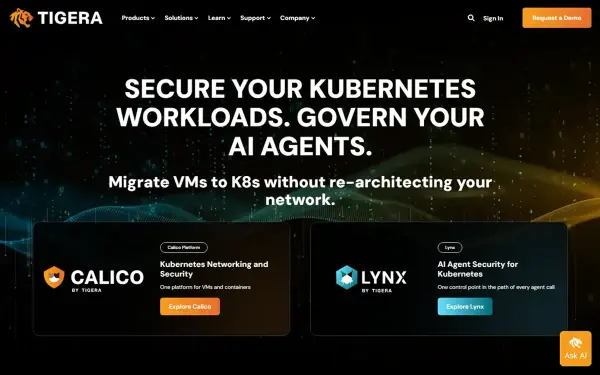
Tigera is the network policy and segmentation specialist, built on Calico and suited to large cluster fleets that need traffic control.
Tigera is the network-first entry. It builds on Project Calico and focuses on policy enforcement, microsegmentation across namespaces and clusters, flow logs, pod-to-pod encryption, an eBPF dataplane option and cluster mesh connectivity. The feature that matters most for cautious teams is staged rollout: policy changes can run in observe mode before enforcement, so the team can see what traffic would be blocked. At scale, that is safer than switching on a segmentation rule set and waiting for incidents.
The limit is scope. Tigera centers on networking rather than full CNAPP coverage. It does not try to be the image scanner, runtime forensics tool and compliance dashboard for the whole estate. The complete platform requires the commercial offering, and policy authoring carries operational complexity, so it fits teams with network and platform engineering depth. It is a smaller security suite than the broad platforms, but that is the point: buyers who need Kubernetes network policy, segmentation and observability get deeper controls than a general CNAPP provides.
Pricing is not confirmed. No official pricing page could be fetched, and the open-source Calico tier is available for evaluation. That open-source path lowers the cost of a proof of concept, but production features and support sit in the commercial product. Tigera fits platform networking teams, regulated environments that need pod-to-pod encryption and segmentation, and large cluster fleets where policy scale and traffic visibility matter more than a single-pane CNAPP.
Kubernetes network policy, segmentation and traffic observability are the main security gaps you need to close.
You want one platform to cover image scanning, runtime defense and compliance reporting.
Entry VI of VIII / Developer-first fixes
Our verdict
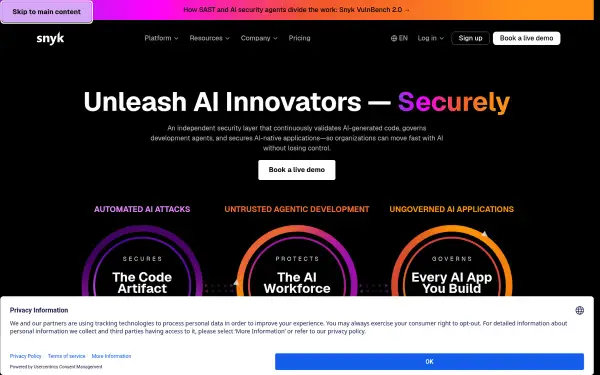
Snyk catches Kubernetes misconfigurations and image issues where developers work, but it is not a runtime or network security platform.
Snyk is the developer-workflow entry. It scans Kubernetes manifests and Helm charts, container images in CI, and infrastructure-as-code such as Terraform and YAML. It also checks open-source dependencies and licenses, and it puts fix guidance in pull requests, IDEs and the CLI. For a platform team trying to stop bad configurations before they reach a cluster, that placement matters. A developer sees the issue in the same place they review code, and automated fix pull requests reduce the backlog of manual tickets.
The limit is what Snyk does not do. Runtime protection is outside its scope, so it will not detect a live container compromise or provide pod-level forensics. Cluster runtime and network policy depth are also lighter than Aqua Security, Sysdig or Tigera. Findings still require triage discipline, because a scanner that produces a long list without ownership will stall. Snyk is a strong fit for shift-left programs, platform teams that want pull request checks and small teams that need a free starting point.
Pricing is credit based. The facts provided say 1 credit equals $1, but the small team flat rate is not shown, and enterprise pricing is contact sales. There is a free tier instead of a time-limited trial. Snyk fits development and platform teams that want Kubernetes misconfiguration and image scanning inside the developer workflow, and it should be paired with a runtime platform when live detection is required.
You want Kubernetes manifest, Helm and image checks inside pull requests and developer tools.
You need runtime threat detection, container forensics or deep network segmentation.
Entry VII of VIII / OpenShift integration
Our verdict
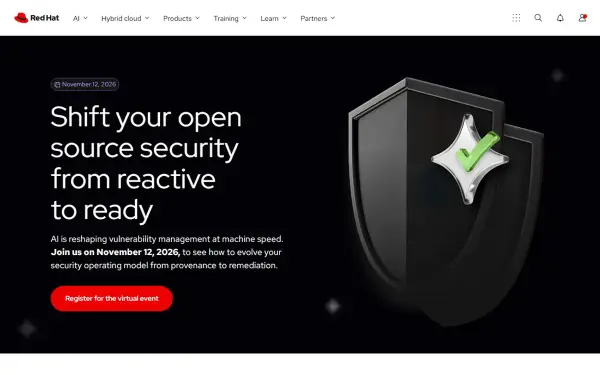
Red Hat Advanced Cluster Security is the OpenShift-native choice, with strong vulnerability and admission workflows and less value outside Red Hat estates.
Red Hat Advanced Cluster Security is built for Red Hat environments. It manages vulnerabilities for images and cluster nodes, ties admission control to OpenShift security context constraints, enforces runtime policies at deploy time and checks compliance against CIS, PCI and NIST-style standards. It can generate and simulate network policies, and it integrates with OpenShift and cluster management tooling. For an OpenShift shop, that integration is the reason to shortlist it: admission decisions respect the platform's own security model rather than sitting beside it.
Outside OpenShift, the case weakens. The product originated from the StackRox acquisition and is sold as a Red Hat product, with enterprise-level pricing and operational complexity that can be heavy for smaller teams. Its ecosystem is narrower outside Red Hat platforms. The vulnerability management workflow is strong, and runtime policies enforced at admission are a real control, but buyers should not assume the same depth of multi-cloud posture or developer experience as Wiz, Snyk or Prisma Cloud.
Pricing is not confirmed. No official pricing page could be fetched, and the listing shows no free plan and a demo-only trial. Red Hat Advanced Cluster Security fits organizations already standardized on OpenShift and Red Hat support, especially regulated teams that need vulnerability management, admission control and compliance checks in one supported product. It is less compelling for a mixed Kubernetes estate with no Red Hat commitment.
Your Kubernetes estate runs on OpenShift and you want admission control tied to Red Hat security context constraints.
You run a mixed, non-Red Hat estate and need broad multi-cloud posture from one tool.
Entry VIII of VIII / L3 to L7 visibility
Our verdict
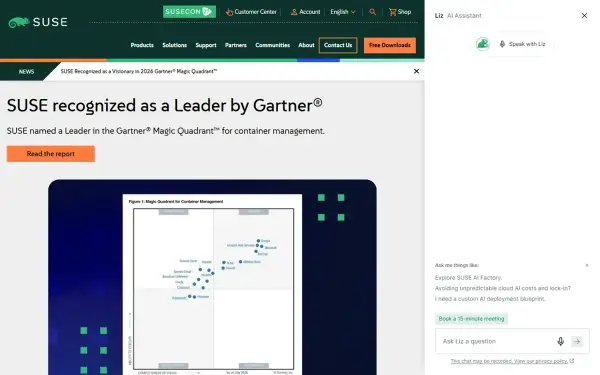
NeuVector combines container network visibility, segmentation and runtime defense for SUSE and Rancher environments, with an open-source core.
NeuVector is a container security platform with a networking core. It provides Layer 3 to Layer 7 visibility, microsegmentation and network policy enforcement, runtime threat detection based on process and file behavior, admission control for vulnerable or non-compliant workloads, registry and image scanning, compliance templates and data loss prevention scanning of traffic in transit. The enforcer runs without sidecar containers, which simplifies deployment in clusters where sidecar overhead is a concern. An open-source core lowers the cost of evaluation.
The fit is specific. NeuVector is part of SUSE following the 2021 acquisition, and it is tightly aligned with Rancher. The ecosystem is limited outside SUSE and Rancher, the brand is smaller than category leaders, and documentation is thinner in places. Advanced enterprise features are paid. Teams outside the SUSE world can still use it, but they should weigh the integration advantage against a broader CNAPP or a network specialist. Teams inside Rancher get a natural security layer that covers runtime and segmentation together.
Pricing is not confirmed. No official pricing page could be fetched, and the facts note that enterprise capabilities are commercial and priced per deployment. A free open-source core is available for evaluation. NeuVector fits SUSE and Rancher platform teams that want runtime protection, admission control and network segmentation in one tool, and it is a practical choice when sidecar-free enforcement and open-source evaluation matter.
You run SUSE or Rancher and want runtime defense, admission control and network segmentation in one container security tool.
You need a large independent ecosystem and the broadest CNAPP coverage from a single vendor.
VBackground
The best Kubernetes security platforms for cloud combine cluster visibility, image scanning, admission control and runtime detection, with enough context to separate real exposure from noise. They differ in whether they scan through cloud APIs or deploy sensors, and in how deeply they handle network policy, forensics and developer workflows.
Kubernetes security is not one job. A cluster exposes four separate surfaces: the images and manifests that enter it, the identity and admission rules that control what runs, the network paths between pods, and the runtime behavior of containers after they start. A platform that is strong on one surface can be weak on another. Wiz, for example, gets posture results by scanning through cloud provider APIs, which is fast to deploy across many clusters, but runtime defense needs an additional sensor. Sysdig goes the other way, with Falco-based runtime detection and container forensics as its center of gravity. Aqua Security spans both sides with image scanning, admission control and runtime protection, at the cost of setup effort. Network policy is a separate specialty. Tigera builds on Calico, and NeuVector combines Layer 3 to Layer 7 visibility with segmentation. Snyk sits earlier in the workflow, checking manifests, Helm charts and images in pull requests. Red Hat Advanced Cluster Security and Palo Alto Prisma Cloud are broader platform plays, with Kubernetes controls inside a larger security estate. The practical choice depends on whether you need an early warning system for developers, a deploy-time gate, a runtime sensor or a network segmentation layer. Many teams end up pairing a shift-left scanner with a runtime platform rather than forcing one product to cover every layer.
This comparison sits in the security register. Further along the shore: small business computer security software and AI patent tools with best reviews.
VIPricing
All eight Kubernetes security platforms here show See website as the starting price, so the cost question starts with scope rather than a sticker. Snyk adds a credit rate of $1 per credit but does not show the small team flat rate. Budget depends on clusters, workloads, containers, repositories or developers.
The table below keeps the billing model separate from the number, because vendors in this category rarely publish one. Use it to narrow which licensing conversation you need to have, then ask each vendor for a written quote against your cluster and workload counts.
| Model | How it bills | Typical fit | Example from this list |
|---|---|---|---|
| Agentless cloud API scanning | Quote on request, no published figures | Multi-cloud teams wanting fast visibility | Wiz |
| Repository or workload licensing | Based on number of code repositories or workloads | Full-lifecycle container protection | Aqua Security |
| Container-based quote | Custom quote, scales with containers monitored | Runtime-heavy teams | Sysdig |
| Enterprise platform modules | Module-based enterprise contract | Organizations standardizing on a broad CNAPP | Palo Alto Prisma Cloud |
| Open-source core plus commercial platform | Open-source tier available, commercial price not published | Network policy and segmentation at scale | Tigera |
| Credit based | 1 credit equals $1, small team flat rate not shown | Developer-first shift-left scanning | Snyk |
| Enterprise product | Enterprise-level pricing, no published figures | OpenShift environments | Red Hat Advanced Cluster Security |
| Open-source core plus paid enterprise | Open-source core available, enterprise features paid | SUSE and Rancher environments | NeuVector |
Wiz is the clearest example of an agentless model: the pricing page shows only a lead capture form, so the evaluation has to start with a scoping call. Aqua Security describes licensing by repositories or workloads, which maps to how many code streams and running services you protect. Sysdig uses a custom quote that scales with container count. Snyk publishes a credit rate of $1 per credit but not the small team flat rate, so you need to model credit consumption before comparing it with a fixed subscription. Red Hat Advanced Cluster Security is Red Hat-linked; NeuVector has an open-source core. Their enterprise terms are not public. For a fair comparison, ask for the same three inputs: cluster count, workload count and the number of users who will write policy.
Each entry card shows the starting price as it appeared on the vendor's own pricing page on November 25, 2026. When a vendor shows no figure we could confirm, or only a promotional rate, the card says "See website" or gives the regular price instead of a guess. Usage, overage and add-on rates in the text change more often than plan prices, so confirm them on the vendor page before you set a budget. To test the numbers against your own volume, try the free User Research Budget Planner. The Event Break-Even Calculator is a second way to check the same decision.
VIIDecision
Choose Wiz when multi-cloud visibility must arrive fast without agents, Aqua Security when one platform must cover image scanning, admission and runtime, and Sysdig when runtime forensics is the main requirement. For network policy, pick Tigera or NeuVector; for developer-first scanning, pick Snyk; for OpenShift, pick Red Hat ACS.
VIIIPitfalls
The common mistake is buying a scanner and calling it runtime security, or enforcing admission policies before the team has seen what they would block. Other failures include ignoring network policy, assuming a free tier covers production, and signing a quote without tying the billing unit to real cluster and workload counts.
IXQuestions
Wiz is the clearest fit in this list. It scans clusters through cloud provider APIs, so teams get posture, misconfiguration and exposure results without an in-cluster agent. Wiz still needs an additional sensor for runtime defense, so agentless scanning covers posture and vulnerability visibility, not live threat detection on its own.
Aqua Security, Sysdig, Tigera, Snyk and NeuVector list a free plan or open-source core in the facts provided. The free paths differ: Tigera and NeuVector point to open-source projects, while Snyk offers a free tier instead of a time-limited trial. Check which production features sit behind the paid edition.
Sysdig is the runtime specialist here, with Falco-based detection and container forensics. Aqua Security, Prisma Cloud, Red Hat ACS and NeuVector also include runtime defenses. Snyk is the shift-left option, checking manifests, Helm charts and images before deployment. Wiz scans through cloud APIs and needs an extra sensor for runtime defense.
Red Hat Advanced Cluster Security is the closest fit because it ties admission control to OpenShift security context constraints and comes with Red Hat support. It originated from StackRox and is sold as a Red Hat product. The value is highest on Red Hat platforms; outside that ecosystem, the integration advantage narrows.
Tigera and NeuVector are the network-focused entries. Tigera builds on Calico, with microsegmentation, flow logs, pod-to-pod encryption and an observe-before-enforce mode. NeuVector adds Layer 3 to Layer 7 visibility and runtime threat detection. Both go deeper on segmentation than the CNAPP-first platforms in this list.
Scanning finds issues before deployment; admission control enforces the decision at deploy time. Aqua Security, Prisma Cloud, Red Hat ACS and NeuVector can block non-compliant workloads, and Wiz has an admission controller that uses scan policies. Start in audit mode so you can see what would be blocked before enforcement.
XFurther along the shore
Vendors can ask for a correction or apply for a Featured listing. Paid or not, the entry is scored on the same rubric and its limits stay in print. Partner with Umberlake.
Free tools
Our free browser tools turn the prices on this page into a figure for your own volume. Nothing you type leaves your device.