Recorded Future
See websiteQuote-based enterprise pricing
Best for large teams needing broad intelligence coverage
- Free plan
- No
- Rubric
- 7.5 of 10
We compared nine threat intelligence platforms for November 2026 on coverage, operational fit, integrations, pricing clarity and time to value, with limits for each.

IThe short answer
The best cybersecurity threat intel software for November 2026 depends on where your team already works. Recorded Future suits large teams that need broad coverage, Google Threat Intelligence fits Google Cloud and SecOps teams, and CrowdStrike Falcon Adversary Intelligence works best for Falcon users tracking named adversaries. The rest of this list covers dark web specialists, feed operationalization, sharing, low-cost entry points and noise reduction.
9 tools compared from vendor pages on November 25, 2026. 0 publish a starting price we could read; the rest say "See website".
IITop three berths
Register order is editorial fit for the buyer each entry describes. Prices are the starting figures read on November 25, 2026.
See websiteQuote-based enterprise pricing
Best for large teams needing broad intelligence coverage
See websiteFlat annual Standard, Enterprise and Enterprise+ subscriptions with set API call volumes
Best for google Cloud and SecOps centered security teams
See websiteIntel module bundled into platform deals, not priced separately
Best for falcon platform users tracking named adversary groups
How this page is paid for. All 9 tools here are unpaid editorial picks.
A paid listing's position can be part of what the vendor pays for. Every entry, paid or not, is scored on the same rubric and keeps its limits in print. Advertising disclosure.
IIIThe register
Starting prices as shown on each vendor's pricing page on November 25, 2026. "See website" means no figure we could confirm.
| No. | Tool | From | Free plan | Trial | Rubric | Actions |
|---|---|---|---|---|---|---|
| 01 | Recorded FutureLarge teams needing broad intelligence coverage | See websiteQuote-based enterprise pricingNot shown publicly | No | See website | 7.5 | |
| 02 | Google Threat IntelligenceGoogle Cloud and SecOps centered security teams | See websiteFlat annual Standard, Enterprise and Enterprise+ subscriptions with set API call volumesNot shown publicly | No | No | 7.0 | |
| 03 | CrowdStrike Falcon Adversary IntelligenceFalcon platform users tracking named adversary groups | See websiteIntel module bundled into platform deals, not priced separatelyNot shown publicly | No | Free trial of the Falcon platform | 6.6 | |
| 04 | FlashpointDark web, fraud and vulnerability intelligence programs | See websiteQuote-based enterprise pricingNot shown publicly | No | Demo only | 6.4 | |
| 05 | AnomaliSOCs operationalizing multiple threat feeds | See websiteEnterprise quote-based pricingNot shown publicly | No | Demo only | 6.9 | |
| 06 | CybleDark web monitoring plus brand protection in one stack | See websiteQuote-based pricingNot shown publicly | No | Demo only | 6.2 | |
| 07 | CywareIntelligence sharing across teams and trusted communities | See websiteEnterprise quote-based pricingNot shown publicly | No | Demo only | 6.6 | |
| 08 |  SOCRadarBudget-limited teams building a first intel capability | See websiteAsset-based licensing on the paid platformNot shown publicly | Yes | Free tools available | 6.6 | |
| 09 | GreyNoiseSOCs overwhelmed by internet scanning noise | See websitePaid tiers quoted per deploymentNot shown publicly | Yes | Free community tier | 6.4 |
Pinned:
IVMethod
We assessed each platform against five criteria: coverage and source depth, operational fit for the buyer described, integration reach, pricing clarity and time to value. Scores reflect how well each tool serves that specific buyer, not a single universal winner. The order is editorial, based on fit for the buyer each entry describes, with the Featured position disclosed. A Featured listing is a paid placement, and we scored it with the same rubric and included the same kind of cons as every other entry.
Prices were checked on November 26, 2026 from vendor pricing pages. Where a vendor did not publish a price, we say pricing is on the vendor site and do not guess a number. We also used the plan notes supplied for each tool: quote-based enterprise pricing, flat annual subscriptions, bundled modules, asset-based licensing and free community tiers. We looked at whether the product feeds existing tools, how much analyst work it assumes, and whether a team can evaluate it through a trial, demo, free tool or platform trial.
We did not invent customer counts, quotes or ratings. Product facts, strengths and limits come from the supplied vendor data and plan notes. A tool can score well for one buyer and poorly for another, so use the pick and skip lines as much as the scores.
The full routine, from price reads to corrections, is on the methodology page. Paid listings follow the advertising disclosure.
How broad and deep the collection is across open web, dark web, malware, vulnerability and adversary sources.
How well the platform matches the buyer it is best for, including analyst workload and workflow.
How easily intelligence reaches SIEM, EDR, firewall and ticketing tools through native integrations or APIs.
How easy it is to understand the commercial model before a sales conversation.
How quickly a team can evaluate the product and turn intelligence into action.
Entry I of IX / Intelligence Graph
Our verdict
The broadest collection and human research on this list, but it demands analyst time and a quote-based sales cycle.
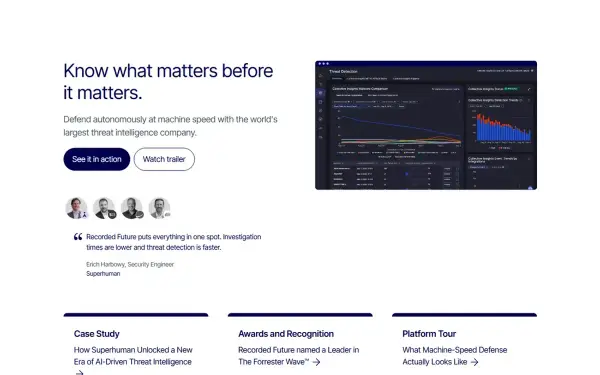
Recorded Future centers on its Intelligence Graph, which correlates technical sources, dark web sources and open web sources into one body of intelligence. It continuously tracks threat actors, campaigns and vulnerabilities, then adds Insikt Group analyst research on top of machine-collected data. The product is organized into four modules: cyber operations, digital risk protection, third-party risk and payment fraud. More than 100 native integrations push indicator and actor context into existing security tools, so analysts can use intelligence inside the consoles they already run.
The main strength is breadth. Collection spans technical feeds, underground sources and the open web, and human analyst reporting gives context that automated feeds often lack. For a large team with dedicated analysts, that combination can support hunting, vulnerability prioritization and third-party risk work. The integration catalogue also makes it easier to fit the platform into an existing stack.
The limits are real. Pricing is quote-based, with no public number in the facts we checked, and onboarding runs as a project rather than a quick setup. Data volume can overwhelm teams without analysts to tune it and turn it into action. Buyers should treat analyst capacity as part of the cost.
You have a mature security team and need broad intelligence coverage across technical, open web and underground sources.
You need a fast self-serve setup or cannot dedicate analysts to tuning and using the data.
Entry II of IX / Gemini query agent
Our verdict
A strong fit for Google Cloud and SecOps teams that want Mandiant research, VirusTotal data and Gemini-assisted querying in flat annual tiers.
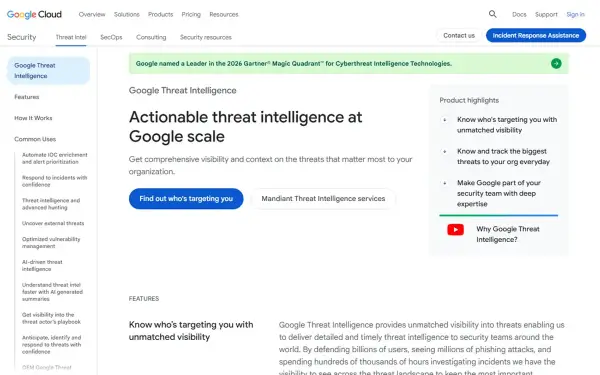
Google Threat Intelligence combines Mandiant incident response research, VirusTotal community data and Google telemetry into one corpus. A Gemini-powered agent lets analysts query that corpus conversationally, which reduces the need to write complex queries. The threat workbench supports malware analysis, hunting and collaboration. Subscription tiers are Standard, Enterprise and Enterprise+, each with a defined API call volume, though the amounts are not public.
The best fit is a security team already standardized on Google Cloud or Google SecOps. Native integration with Google SecOps puts intelligence close to detection and response workflows, while API access supports teams running on other clouds. That combination of frontline research, community malware data and global telemetry is unusual, and the flat annual structure is easier to budget than a fully custom quote.
The limits start with ecosystem fit. The value proposition is strongest inside Google Cloud, and teams on other platforms may find the integration path less natural. Pricing is on the vendor site but no figure is public in the facts we checked, so budgeting starts with sales. No free trial is advertised, which makes hands-on evaluation harder.
Your team runs Google Cloud or Google SecOps and wants frontline research, community malware data and conversational querying in one corpus.
You are standardized on another cloud or need a published price and a free trial before shortlisting.
Entry III of IX / Falcon-native intel
Our verdict
Best for existing Falcon users who want adversary context attached to detections, not a standalone feed purchase.
CrowdStrike Falcon Adversary Intelligence gives Falcon users profiles of named adversary groups that target their industry, with technique mapping to MITRE ATT&CK. Adversary context is attached to detections and hunting workflows, and alerts can show the actor behind an indicator. The intelligence draws on telemetry from intrusions the vendor investigates, so it reflects activity seen in real environments rather than only feed collection.
The product works best as part of the Falcon platform. Analysts consume it inside Falcon EDR and threat hunting, where context appears next to the detection that matters. That tight coupling is the appeal: a team can move from an alert to actor context without switching consoles. A free trial of the Falcon platform supports hands-on evaluation.
The limits follow from that design. Full value depends on running Falcon, and the intel module is bundled into platform deals rather than priced separately. Pricing is not public, so buyers cannot compare it as a standalone line item. For a non-Falcon shop, it is a weak fit as a standalone purchase. Evaluate it through the platform trial, not as a separate intelligence product.
You already run CrowdStrike Falcon and want named adversary context attached to detections and hunting workflows.
You need a vendor-neutral intelligence platform that you can buy and use without the Falcon stack.
Entry IV of IX / Dark web depth
Our verdict
A deep dark web and fraud intelligence option for converged security teams, sold through demos and enterprise quotes.
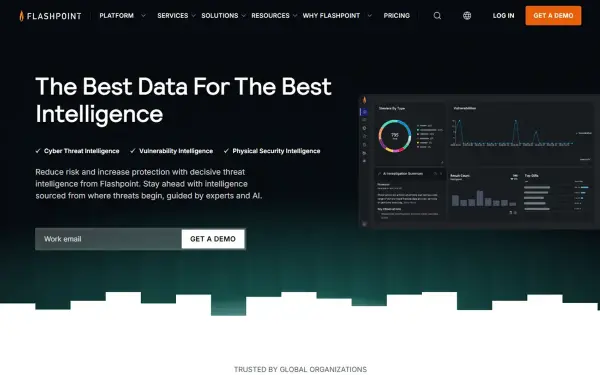
Flashpoint collects primary-source data from illicit forums, chat groups and marketplaces, where stolen credential sales and ransomware chatter appear. Human analysts filter collected data against customer priorities, and AI-assisted analysis sits on top of the collected content. The platform also covers vulnerability intelligence, physical security intelligence for converged teams and fraud scheme monitoring. The vendor describes data volume in petabytes drawn from closed adversary spaces.
That collection depth is the reason to consider it. Automated scrapers cannot reach many of these closed spaces, so Flashpoint can surface credential exposure, ransomware discussion and fraud schemes that outside-in tools miss. Analyst support tuned to organizational priorities helps a team focus on the actors and assets that matter. The combination of cyber, vulnerability and physical security coverage also suits enterprises with converged security functions.
The trade-offs are enterprise-shaped. Pricing is quote-based and not public in the facts we checked, and evaluation runs through a demo rather than self-serve signup. Collection breadth can exceed what a smaller team needs, and a buyer without analysts may struggle to use the volume well. It fits a program with clear intelligence requirements, not a quick add-on.
You need primary-source dark web, fraud and vulnerability intelligence and have analysts to turn collection into priorities.
You need self-serve signup, public pricing or a narrow tool for a single small SOC.
Entry V of IX / Feed operationalization
Our verdict
A feed operationalization specialist with a long ThreatStream heritage, now repositioned around an agentic SOC platform.
Anomali built its reputation on ThreatStream, a platform for ingesting multiple threat feeds, deduplicating and enriching indicators, and pushing them to enforcement points. The current product adds investigation agents for triage and analysis, a unified data layer across intelligence sources and governed response actions. More than 80 integrations connect the platform to existing security tools.
The strongest use case is a SOC that already subscribes to multiple feeds and needs to operationalize them. Anomali can normalize and deduplicate those sources, enrich indicators and automate pushes to enforcement points. Agentic AI is applied to triage and investigation, which can reduce manual work if the underlying data is clean. The company reports more than 400 enterprise customers across finance, critical infrastructure and government.
Buyers should note the repositioning. Anomali has shifted from a pure threat intelligence platform toward an agentic SOC platform, which can confuse teams that only want a TIP. The enterprise sales motion has no self-serve path, and pricing is quote-based with no public figure in the facts we checked. During evaluation, confirm the depth of TIP features you need rather than assuming the broader SOC story covers them.
Your SOC already runs multiple threat feeds and needs deduplication, enrichment and automated pushes to enforcement points.
You want a pure intelligence platform with a clear standalone TIP story and a self-serve buying path.
Entry VI of IX / AI-native platform
Our verdict
An AI-native option that combines dark web monitoring, attack surface management and takedowns, though it is a younger vendor.
Cyble correlates open, deep and dark web sources continuously and packages the result in its Cyble Vision threat intelligence platform. The platform includes dark web monitoring, attack surface management and takedown services. An agentic AI analyst hunts and acts within policy guardrails, which is a more AI-native design than adding a chatbot to a legacy stack.
The appeal is breadth in one stack. A team can monitor dark web exposure, see exposed attack surface and request takedowns without buying three separate products. That fits organizations that want brand protection and threat intelligence from one platform. Cyble is newer to the market than Recorded Future or Flashpoint, so peer references carry extra weight during evaluation.
Pricing is quote-based, with no public figure in the facts we checked, and evaluation is demo only. The shorter track record is the main caution: established peers have longer histories and larger reference bases. Ask for references in your sector and test a concrete use case, such as credential exposure or brand impersonation. The AI-native architecture is interesting, but the buyer should confirm analyst support and workflow depth, not just the agent narrative.
You want dark web monitoring, attack surface management and takedowns in one AI-native stack and can validate the vendor through references.
You need a long established track record or a public price before starting a sales conversation.
Entry VII of IX / Community sharing
Our verdict
A sharing-first intelligence platform for ISACs, subsidiaries and teams that want collective defense rather than a standalone feed.
Cyware centers on Intel Exchange, a threat intelligence platform for ingesting, normalizing and operationalizing intelligence. Its differentiator is real-time indicator and context sharing with trusted communities, plus collaboration features for multi-team and subsidiary structures. The platform lists more than 400 integrations and agentic AI supporting detection-to-response workflows. The vendor claims more than 30,000 organizations on the platform.
The sharing model is the reason to shortlist it. An ISAC, an industry group or an enterprise with subsidiaries can multiply the value of each feed by sharing context across trusted parties. Collaboration features support that structure, and the broad integration catalogue helps connect intelligence to existing controls. Agentic AI is positioned around detection-to-response workflows rather than collection alone.
The trade-offs are evaluation effort and sales process. Cyware sells through enterprise quotes and demos rather than trials, so buyers need a structured proof of value. Platform breadth takes time to assess, and a single small SOC may find a simpler tool sufficient. Pricing is quote-based with no public figure in the facts we checked. Confirm which sharing communities you can join and how sightings flow back before committing.
You run an ISAC, an industry group or a multi-subsidiary enterprise and want intelligence sharing built into the platform.
You are a single small SOC that needs a simple feed or lookup tool rather than a broad sharing platform.
Entry VIII of IX / Free entry tools
Our verdict
A practical budget-oriented entry point, with free dark web and IOC tools and asset-based paid licensing for growing teams.
SOCRadar offers free tools that are usable on their own: a dark web report that scans underground sources for a domain, IOC radar for domains, IPs and hashes, and a country threat report. The paid platform adds automation, API integrations and analyst support. Licensing is asset-based, tied to what you monitor, which keeps cost aligned with coverage.
The main appeal is a low-friction start. A small team can run a domain report or look up an indicator without a sales cycle, then move to the paid platform when it needs automation and integrations. Setup is measured in hours rather than weeks. Asset-based licensing also makes the commercial model easier to understand than a fully custom enterprise quote.
The limits are depth and commercial gravity. Collection depth sits below top-tier intelligence vendors, so a large SOC with advanced requirements should not treat it as a direct replacement for Recorded Future or Flashpoint. The free tools naturally funnel users toward the paid platform. Paid pricing is on the vendor site but no figure is public in the facts we checked, so confirm asset counts and included features before budgeting.
You need a fast, low-friction first intelligence capability and want free tools plus asset-based paid licensing.
You need top-tier collection depth or advanced intelligence work for a large, mature SOC.
Entry IX of IX / Scanning noise filter
Our verdict
A focused noise-reduction tool for SOCs drowning in internet scanning, best paired with a broader intelligence platform.
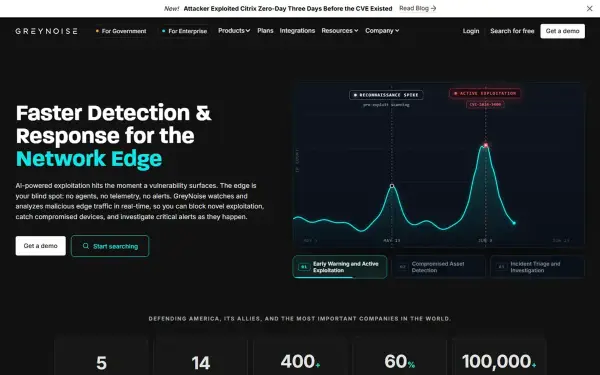
GreyNoise runs a global sensor network that observes internet-wide scanning, then tags activity in real time by CVE, tooling and campaign. The core job is separation: it helps analysts distinguish targeted attacks from background scanning traffic that fills SIEM queues. The free community tier covers basic IP lookups. Paid plans add blocklists, SIEM integrations and deeper investigation features.
That focus makes it useful in a busy SOC. If analysts spend hours closing alerts from scanners and crawlers, GreyNoise can cut false positives and speed triage. Real-time exploit and tooling tagging adds context without requiring a full intelligence platform. It is a specialized instrument, not a complete threat intelligence platform, and it works best alongside a broader TIP.
The limits are scope and pricing transparency. It is network-focused, so it does not cover dark web collection, brand protection or third-party risk. Paid tiers are quoted per deployment, with no public figure in the facts we checked. The community tier is useful for basic lookups but not a substitute for paid blocklists and integrations. Buy it to solve noise, not to replace an enterprise intelligence program.
Your SOC is buried in internet scanning alerts and you need a focused way to separate background noise from targeted activity.
You need a complete intelligence platform for dark web collection, brand protection or third-party risk.
VBackground
The best cybersecurity threat intel software collects, enriches and prioritizes threat data so security teams can act before an attack spreads. It differs from a raw feed because it adds context, scoring, actor tracking and integrations, then pushes usable indicators into tools such as a SIEM, EDR or firewall.
A feed is a stream of indicators: IP addresses, domains, hashes or vulnerabilities. A platform such as Recorded Future or Google Threat Intelligence adds source correlation, adversary context and workflow integrations. That matters because a list of indicators without context creates alerts without priority. The platform tells an analyst whether an IP belongs to a known scanning cluster, a ransomware affiliate or a one-off researcher.
Operationalization is the dividing line. Anomali and Cyware focus on ingesting many feeds, removing duplicates, enriching indicators and pushing them to enforcement points. Flashpoint and Cyble lean toward closed sources such as illicit forums, chat groups and marketplaces, where stolen credentials and ransomware chatter appear. GreyNoise takes a narrower approach by labeling internet-wide scanning so analysts can ignore background noise.
A short buying checklist:
This comparison sits in the security register. Further along the shore: small business computer security software and AI patent tools with best reviews.
VIPricing
Paid threat intelligence is worth it when the platform changes what your team does, not when it adds another dashboard. In 2026 several serious platforms on this list are quote-based enterprise purchases, while a few offer free tools or community tiers for basic lookups. Budget for analyst time and integration work, not just the subscription.
Recorded Future, Flashpoint, Anomali and Cyware are quote-based, so the first step is a sales conversation rather than a public price. Google Threat Intelligence uses flat annual Standard, Enterprise and Enterprise+ subscriptions with defined API call volumes, though the amounts are not public. CrowdStrike bundles its intel module into platform deals, so the cost appears as part of a Falcon agreement. SOCRadar uses asset-based licensing on the paid platform, and GreyNoise quotes paid tiers per deployment while offering a community tier.
| Model | How it bills | Typical fit | Example from this list |
|---|---|---|---|
| Quote-based enterprise | Vendor quote after sales process; no public number | Large teams needing broad collection or analyst support | Recorded Future, Flashpoint, Anomali, Cyware |
| Flat annual subscription | Standard, Enterprise and Enterprise+ tiers with set API call volumes | Google Cloud and SecOps centered teams | Google Threat Intelligence |
| Bundled platform module | Intel module included in platform agreements, not priced separately | Existing Falcon users | CrowdStrike Falcon Adversary Intelligence |
| Asset-based paid licensing | Paid platform bills on monitored assets | Budget-limited teams building a first capability | SOCRadar |
| Free community tier plus quoted paid tiers | Basic lookups free; paid tiers quoted per deployment | SOCs reducing internet scanning noise | GreyNoise |
Ask vendors what the quote includes: API call volume, seats, modules, analyst support and onboarding. A lower subscription can cost more over a year if it needs extra staff to tune feeds or build integrations. Time to value also varies. A free tool or community tier can prove basic value in hours, while an enterprise platform with broad collection often runs as an onboarding project. Match the buying model to how your team works.
Each entry card shows the starting price as it appeared on the vendor's own pricing page on November 25, 2026. When a vendor shows no figure we could confirm, or only a promotional rate, the card says "See website" or gives the regular price instead of a guess. Usage, overage and add-on rates in the text change more often than plan prices, so confirm them on the vendor page before you set a budget. To test the numbers against your own volume, try the free User Research Budget Planner. The Event Break-Even Calculator is a second way to check the same decision.
VIIDecision
Choose Recorded Future when you need the broadest collection and can staff analysts to use it. Choose Google Threat Intelligence when your team already runs Google Cloud or Google SecOps and wants Mandiant research, VirusTotal data and Gemini-assisted querying. For Falcon users, CrowdStrike is the lower-friction choice because the intel sits inside existing detection workflows.
VIIIPitfalls
The biggest mistake is buying collection volume without a workflow to use it. A platform that adds thousands of indicators but no context or integration will slow your SOC down. Other common errors include ignoring analyst time, treating free tools as a full platform and skipping the evaluation of how indicators reach existing tools.
IXQuestions
A threat feed is a stream of indicators such as IPs, domains, hashes or vulnerabilities. A platform adds collection from multiple sources, enrichment, adversary context, scoring and integrations, then pushes usable intelligence into tools like a SIEM, EDR or firewall. The platform turns raw data into something analysts can prioritize.
A small business needs one when it has recurring exposure it cannot see with existing tools, such as stolen credentials, brand impersonation or dark web chatter. Start with free tools like SOCRadar or GreyNoise community lookups. Move to a paid platform when you need automation, API integrations, analyst support or broader collection.
Platforms push enriched indicators to SIEM, EDR and firewall enforcement points through native integrations or APIs. Sightings, meaning matches your tools observe, can flow back so the platform learns what is relevant to your environment. Ask each vendor to show both directions, not just a one-way feed export.
No, free tools cover narrow jobs well. SOCRadar offers a dark web domain report, IOC lookups and a country threat report. GreyNoise has a community tier for basic IP lookups. Neither provides the full collection, analyst support, automation and integration depth of an enterprise platform, but both are useful for proving a first use case.
A free tool or community tier can show basic value in hours, because setup is light and the first lookup is immediate. A quote-based enterprise platform such as Recorded Future or Flashpoint often runs as an onboarding project with integrations, tuning and analyst training. Plan for an onboarding project before the full workflow proves value.
XFurther along the shore
Vendors can ask for a correction or apply for a Featured listing. Paid or not, the entry is scored on the same rubric and its limits stay in print. Partner with Umberlake.
Free tools
Our free browser tools turn the prices on this page into a figure for your own volume. Nothing you type leaves your device.