
Klaviyo
$20Email plan, per month, 500 active profiles, 5,000 emails per month
Best for stores wanting email and SMS in one platform
- Free plan
- Yes, free plan up to 250 active profiles and 500 emails per month
- Rubric
- 7.7 of 10
Eight ecommerce SMS platforms ranked for November 2026, with pricing, consent handling, and when a texting specialist beats the SMS add-on inside your email suite.

IThe short answer
Klaviyo is the best SMS marketing platform for ecommerce stores that want email and SMS on one customer profile, and it leads this list for November 2026. Postscript suits Shopify brands that treat texting as a primary revenue channel, with two-way conversational flows and no profile fees. Attentive fits mid-market and enterprise teams running high-volume programs across SMS, RCS, email, and push, priced by custom quote after a demo. Every price below was checked on November 25, 2026: Best Sms Marketing Platforms For Ecommerce.
8 tools compared from vendor pages on November 25, 2026. 7 publish a starting price we could read; the rest say "See website".
IITop three berths
Register order is editorial fit for the buyer each entry describes. Prices are the starting figures read on November 25, 2026.
$20Email plan, per month, 500 active profiles, 5,000 emails per month
Best for stores wanting email and SMS in one platform

See websitecustom quote
Best for mid-market and enterprise brands with high-revenue SMS programs

FreeStarter, per month plus $49 monthly minimum spend and per-message fees
Best for shopify brands making SMS a primary revenue channel
How this page is paid for. All 8 tools here are unpaid editorial picks.
A paid listing's position can be part of what the vendor pays for. Every entry, paid or not, is scored on the same rubric and keeps its limits in print. Advertising disclosure.
IIIThe register
Starting prices as shown on each vendor's pricing page on November 25, 2026. "See website" means no figure we could confirm.
| No. | Tool | From | Free plan | Trial | Rubric | Actions |
|---|---|---|---|---|---|---|
| 01 | KlaviyoStores wanting email and SMS in one platform | $20Email plan, per month, 500 active profiles, 5,000 emails per monthUpdated on vendor page | Yes | See website | 7.7 | |
| 02 | AttentiveMid-market and enterprise brands with high-revenue SMS programs | See websitecustom quoteQuote only | No | Free trial | 7.7 | |
| 03 | PostscriptShopify brands making SMS a primary revenue channel | FreeStarter, per month plus $49 monthly minimum spend and per-message feesUpdated on vendor page | No | Free trial with $100 credit for 30 days | 8.9 | |
| 04 |  OmnisendSmall and mid-size stores seeking email plus SMS value | $11.20Standard, per month, 30% off first 3 months paid upfront, then billed monthlyUpdated on vendor page | Yes | See website | 7.8 | |
| 05 |  SlickTextBusinesses wanting straightforward SMS marketing with clear pricing | $29500 credits per month, per month, billed monthlyUpdated on vendor page | No | Free trial, no credit card | 7.5 | |
| 06 |  SimpleTextingSmall businesses wanting easy texting with human support | $39.00500 credits plus local number, per month, billed monthlyUpdated on vendor page | No | Free trial, no credit card | 7.0 | |
| 07 |  RecartShopify brands focused on list growth and welcome revenue | $200List Growth, per month, quarterly commitmentUpdated on vendor page | No | See website | 6.7 | |
| 08 |  EZ TextingSmall businesses sending easy mass SMS and MMS campaigns | $20Launch, per month, billed annually, up to 500 contacts, 6k yearly creditsUpdated on vendor page | No | Free trial | 6.4 |
Pinned:
IVMethod
How well the platform uses store data such as catalogs, cart events, order sync, and revenue attribution.
Conversational tools, personalization, send-time optimization, RCS support, and how far automation reaches past a welcome text.
Published rates, transparent message pricing, and absence of profile fees versus a quote-only sales process.
Opt-in capture, opt-out handling, and multi-country compliance support built into the platform.
Migration help, prebuilt flows, and how quickly a store can send a first campaign.
VMethod
Every platform here was scored against the same five criteria, weighted for an ecommerce buyer rather than a general business texter. Ecommerce fit (30%) asks whether the platform understands store data: product catalogs, cart events, revenue attribution, and Shopify or BigCommerce order sync. Channel depth (25%) covers conversational tools, personalization, send-time optimization, RCS, and how far automation goes beyond a welcome message. Pricing clarity (20%) rewards published rates, transparent message pricing, and no profile fees over a quote-only process. Consent tooling (15%) weighs opt-in capture, opt-out handling, and multi-country compliance support. Setup effort (10%) considers migration help, prebuilt flows, and how fast a store can send its first campaign.
Scores inform the write-up but do not set the order. The sequence is editorial: each position reflects how well a platform fits the buyer described in that entry, plus a disclosed Featured position where one applies. When a listing carries the Featured label, that placement is paid; it is scored with the same rubric and gets the same honest cons as every other tool.
Prices, plan names, free tiers, and trial terms come from vendor pricing pages checked on November 25, 2026. Where a vendor quotes after a demo, we say pricing is on the vendor site and do not estimate a figure. Where a plan carries a promotional rate or an annual commitment, we note it in the entry. Volume-based costs move, so treat every figure as a starting point and confirm it against your own contact count and send volume before you sign.
The full routine, from price reads to corrections, is on the methodology page. Paid listings follow the advertising disclosure.
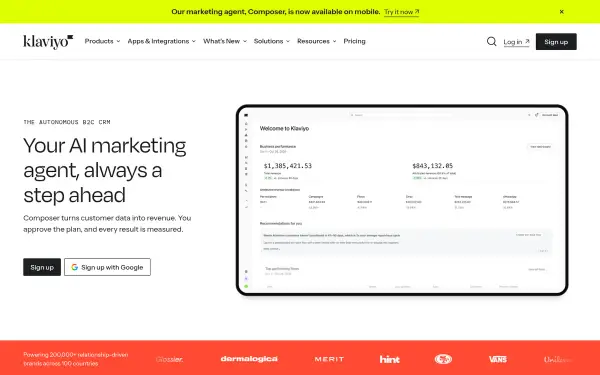
Entry I of VIII / Unified customer profile
Our verdict
The default choice for Shopify stores that want one customer profile driving both email and SMS campaigns.
Klaviyo puts email and SMS on one customer profile, which is the reason most Shopify stores end up here. Segmentation applies to both channels, so a text can target the same group an email just missed. The journey builder runs cross-channel sequences, and abandoned-cart flows can open with an email, follow with a text after a set delay, and stop when the order lands. Campaign sending covers both channels, and the Shopify integration is included.
Pricing starts at $20 per month for the email plan covering 500 active profiles and 5,000 emails per month. A free plan covers up to 250 active profiles and 500 emails per month, enough to test a welcome flow before committing budget. No trial is stated on the pricing page, so the free tier is the practical way to evaluate. SMS runs on top of the email plan by message volume, and the profile count sets the floor for what you pay.
The honest limit is that this is an email product with texting attached, not a texting product. Conversational tooling, two-way inboxes, and message-level personalization run thinner than on SMS specialists. Costs rise with contact count and send volume together, so a fast-growing list increases spend on both sides. Stores that send mostly texts will find the SMS half capable but not deep, and they will pay for email capacity they rarely use.
Pick it if you want one platform, one profile, and one set of segments across email and SMS, and you expect email to stay the bigger channel.
You want email and SMS sharing one profile, one segment list, and one journey builder.
Texting is your main channel and you need deep conversational or two-way tooling.
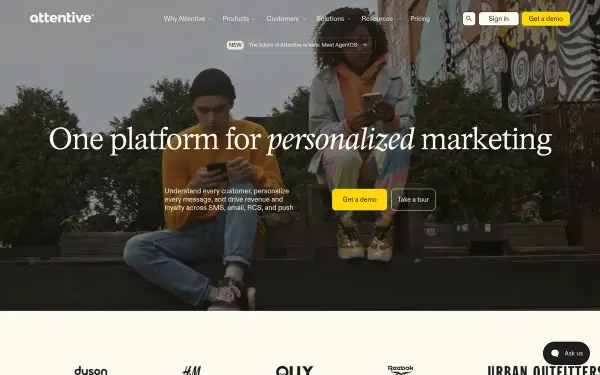
Entry II of VIII / AI multi-channel messaging
Our verdict
Best for large teams running multi-channel messaging at volume, with AI targeting and multi-country compliance, at enterprise pricing.
Attentive runs SMS, email, RCS, and push from a single platform, with AI handling personalization and send timing. Identity resolution ties a phone number and an email address to the same person, so a text campaign can follow an email without double messaging the same shopper. AI copy generation produces message variants, and send-time optimization picks the window per subscriber rather than per campaign. Deliverability engineering is aimed at peak events, which matters when a Black Friday send goes to a list built over a year. Compliance tooling covers more than 20 countries, useful for stores selling across borders.
Pricing is on the vendor site. Contracts are custom quoted after a demo, and the platform confirms free trials exist. Expect a sales process: nobody signs up with a card and sends a campaign the same afternoon. That model fits buyers who know their volume and want negotiated rates, not small stores testing whether texting works for them.
The capability level is the trade. Attentive brings more messaging surface than most stores can operate, rewarding a team with a dedicated retention marketer, a testing calendar, and someone watching deliverability and consent records. Smaller stores pay for depth they will not use, and there is no published free plan to soften that entry. In 2025 the vendor took on SMS customers from Yotpo after that service shut down, which says something about the scale of program it is built to serve.
Pick it if you run a high-revenue program across several channels and want AI, deliverability support, and multi-country compliance in one place.
You have a team and a budget for a large multi-channel messaging program.
You are a small store that wants a published price and a self-serve start.
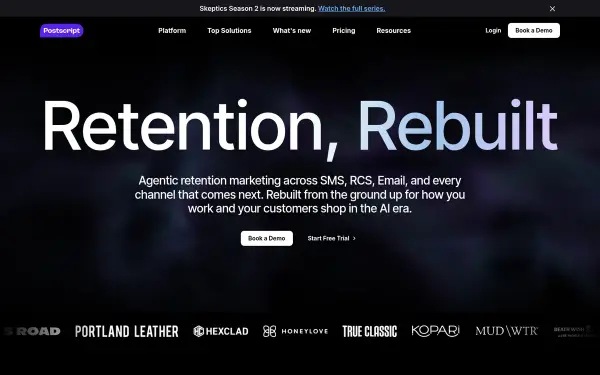
Entry III of VIII / Conversational commerce threads
Our verdict
A Shopify-first texting platform built around conversations and purchases inside the thread, priced by messages sent.
Postscript is built for stores where the text message is the revenue channel, not a companion to email. Subscribers can reply, and the thread becomes a place to buy: conversational commerce runs two ways, with purchases completed inside the message thread. An AI context layer keeps subscriber-level detail that shapes personalization at send time. SMS, RCS, and email sit in one platform, so a shopper who ignores a text can still receive email without adding a second tool.
Pricing uses a usage model. The Starter plan carries no platform fee but comes with a $49 monthly minimum spend plus per-message fees, and the vendor states there are no profile fees. That structure favors stores with a tight, engaged list over stores with a large dormant one: you pay for messages sent, not contacts stored. A free trial runs 30 days with $100 credit. No free plan is listed.
The build is Shopify-focused, which is a strength on Shopify and a limitation anywhere else. Stores on BigCommerce or a custom stack get much less from the Shopify-focused setup. Email sits second to SMS here, so a business whose revenue is mostly email will find the SMS-first framing mismatched to how it actually operates. Costs move with volume, and a heavy send month produces a heavier invoice.
Pick it if you are a Shopify brand making SMS a primary channel and you want two-way conversations plus clear per-message pricing.
You are on Shopify and want SMS-first conversational selling with per-message pricing.
Shopify is not your platform or email is your main revenue channel.
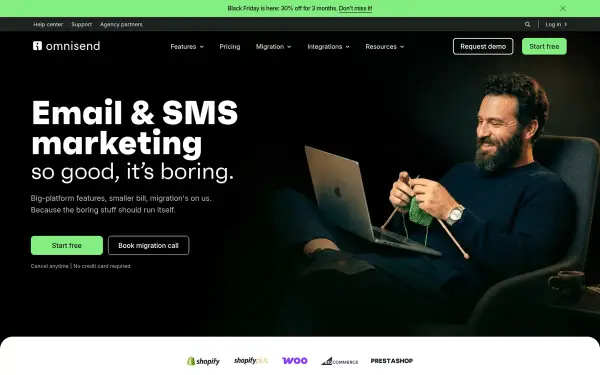
Entry IV of VIII / Prebuilt ecommerce flows
Our verdict
A low-cost way to run email, SMS, and push together with prebuilt ecommerce flows and a free migration service.
Omnisend covers email, SMS, and push in one account, aimed at small and mid-size stores that want the basics working without a long build. Welcome, cart, and post-purchase automations come prebuilt, so a new store can switch on a cart recovery sequence in an afternoon. AI-assisted copy drafts message text, send-time optimization picks delivery windows, and segmentation splits the list by behavior. Push messages add another channel alongside email and SMS. A five-day migration service moves data from another platform at no charge.
The Standard plan starts at $11.20 per month, a promotional rate that takes 30% off for the first three months when paid upfront, then bills monthly at the regular rate. A free plan covers 250 contacts and 500 emails per month, enough to run a first campaign and see whether the editor and flows fit. No trial beyond the free plan is stated. The vendor positions its pricing as lower than Klaviyo for comparable use, though profile and send limits decide the real cost.
Depth is where it trails. Enterprise SMS specialists go further on personalization and journey complexity, and Attentive in particular outruns Omnisend on AI-driven targeting. Stores sending high volumes of texts will feel the ceiling and start looking at per-message specialists. For a small or mid-size store, the included automations, the push channel, and the migration offer usually outweigh that gap.
Pick it if you want email, SMS, and push in one place at a low entry price and you value prebuilt flows over deep customization.
You want a low-cost suite with prebuilt ecommerce automations and a free migration offer.
You send very high volumes or need advanced AI personalization.
Entry V of VIII / Ungated feature access
Our verdict
Full feature access on every plan and a strong list-growth toolkit, with less ecommerce automation than a suite.
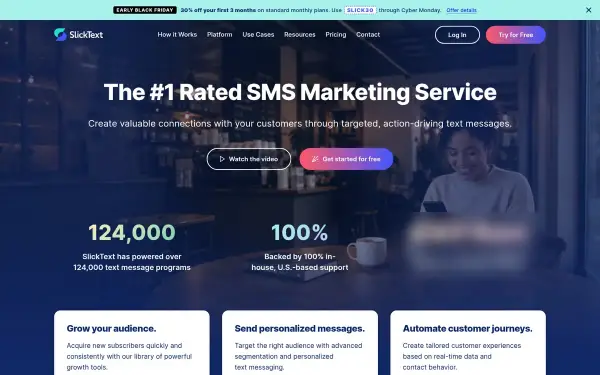
SlickText sells texting with a simple promise: every plan includes the full feature set, and you pay for message volume instead of unlocking tools. List growth gets real attention, with popups, keyword opt-ins, tap-to-join links, QR codes, and web forms all built in. A drag-and-drop workflow builder handles automated sequences, and integrations cover Shopify, HubSpot, and Salesforce.
The lowest paid plan is $29 per month for 500 credits, billed monthly. MMS costs extra on top of that, so picture messages need their own line in the budget. A free trial requires no credit card, which lets you send a test campaign before committing. There is no free plan. Pricing by volume rather than by feature tier makes cost predictable when sending is steady and higher when a promotion pushes volume.
For ecommerce specifically, the automation layer is shallower than what a suite like Klaviyo or a Shopify specialist like Postscript provides. Ecommerce automation is shallower than a commerce suite, so stores that need deep automation will find the toolkit thinner. SlickText is a good texting tool that integrates with a store, not a retention platform built around one. Support has a strong reputation, and businesses that want a person on the line rather than a documentation portal tend to land here.
Pick it if you want straightforward SMS marketing with the whole feature set on every plan and integrations that reach beyond Shopify.
You want clear per-credit pricing with every feature included on the entry plan.
You need deep cart recovery and revenue attribution out of the box.
Entry VI of VIII / Two-way team inbox
Our verdict
Easy texting with a two-way inbox and a no-card trial, though cart flows and revenue attribution are thin.
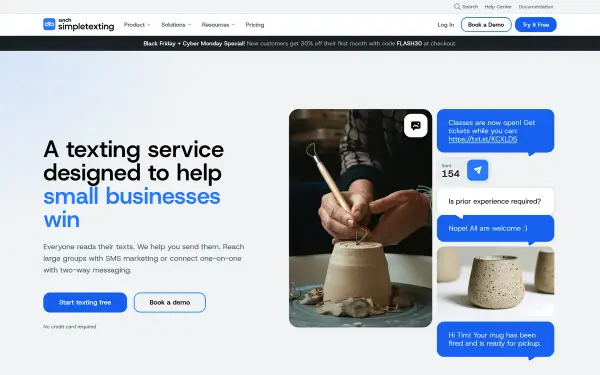
SimpleTexting is a general texting tool that ecommerce stores use because it is easy to start. Contacts import in bulk, list growth runs through popups and keyword opt-ins, and bulk sends go out from a single screen. A two-way team inbox lets staff answer replies, turning a broadcast into a conversation without leaving the platform. No-code automations cover simple sequences, and compliance handling is built in so opt-out language and registration steps are not something you assemble yourself.
The listed price is $39.00 per month for 500 credits plus a local number, billed monthly. That figure combines a $29 credit plan with a $10 number charge. A free trial requires no credit card, and the vendor suggests texting your own number during the trial to see delivery and formatting firsthand. No free plan is listed.
The gap is ecommerce depth. Cart flows, product feeds, and revenue attribution are thinner than on commerce suites, and automation does not go as deep as what Klaviyo or Omnisend ship. A Shopify integration exists, so basic order and customer data moves across, but the platform is not organized around store revenue the way a specialist is. Teams that want a flow to open with a browse-abandon text and close on a discount code will end up building it by hand or doing without.
The product has been marketed for more than ten years, and the ease of use reflects that history: fewer screens, less configuration, a shorter path from signup to first send.
Pick it if you want simple texting with a two-way inbox and human support, and your ecommerce needs are light.
You want quick, uncomplicated texting with a shared team inbox.
You need store-triggered flows and order-level revenue reporting.
Entry VII of VIII / One-tap list growth
Our verdict
One-tap signup and DTC flow templates for Shopify stores where list growth is the bottleneck, from $200 per month.
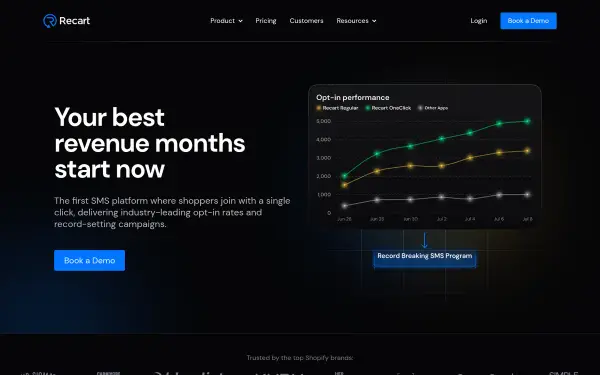
Recart focuses on one job: growing a Shopify list and turning new subscribers into first orders. OneClick popups let a shopper sign up with a single tap instead of typing a phone number, which reduces friction on mobile. From there, DTC flow templates cover the sequences most stores need: welcome, abandoned cart, browse abandonment, and replenishment. Each template is a starting point rather than a blank canvas, so setup takes less planning than building flows from zero.
The List Growth plan starts at $200 per month on a quarterly commitment, and the SMS bundle starts at $500 per month. Account build-out and an SMS audit come at no charge, which is how the vendor gets a new store's flows and list setup running. No free plan and no trial are stated, so evaluation happens through the sales conversation rather than a self-serve test. That entry price is higher than credit-based texting tools, and the quarterly commitment means you live with the decision for a while.
The scope is deliberately narrow. Recart works only with Shopify, and it is not an email platform or a general texting tool: if you need a full messaging suite, you will keep another vendor alongside it. Stores on BigCommerce or WooCommerce cannot use it at all. For the stores it does serve, the focus means popups and flow templates are tuned to DTC patterns rather than generic business texting, and the math only works if list growth is a real bottleneck and the flows convert.
Pick it if you are on Shopify and list growth plus welcome revenue is the specific problem you are solving.
You are on Shopify and need more subscribers plus stronger welcome flows.
You are not on Shopify or you need a full email and SMS suite.
Entry VIII of VIII / Built-in MMS editor
Our verdict
Simple mass SMS and MMS with text-to-pay links, better for promotions than for deep ecommerce automation.
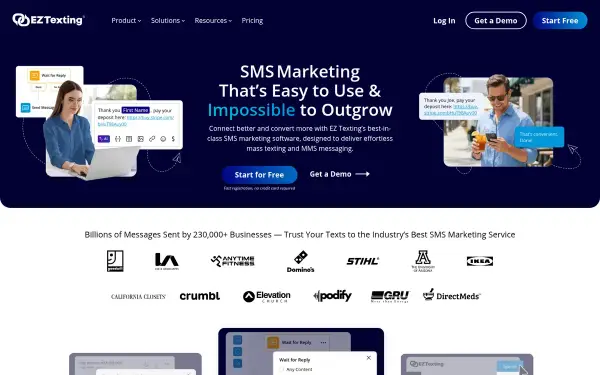
EZ Texting is mass texting with a low learning curve. Bulk SMS campaigns go out from a straightforward interface, MMS support includes a built-in image editor so a promotion can carry a picture without a separate design tool, and two-way texting handles replies. Automated workflows cover simple sequences, opt-in tools collect numbers, and text-to-pay payment links let a recipient pay from the message. Multilingual messaging and preloaded compliance defaults reduce setup work for a small team.
The Launch plan is $20 per month billed annually, covering up to 500 contacts and 6,000 credits per year. Annual-first pricing means the monthly figure assumes a yearly commitment, so the cash outlay is larger than the headline suggests. A free trial is available. No free plan is listed.
Ecommerce automation is the weak point. Ecommerce automation is less deep, and the integration ecosystem is smaller. A store can send campaigns, but the flows will not match a commerce suite's depth. This is a generalist product that works for stores running promotions to a list.
For a small business sending weekly offers with an occasional picture message, that is enough, and the text-to-pay links add a useful way to collect payment on the spot. For a store that wants texting to run recovery sequences by itself, it is not. The preloaded compliance defaults can also reduce setup work.
Pick it if you want simple mass SMS and MMS campaigns with text-to-pay and you do not need deep ecommerce automation.
You want quick mass texting, picture messages, and built-in payment links.
You need store-triggered flows or a wide integration catalog.
VIBackground
Ecommerce SMS marketing software collects phone numbers, records consent, and sends promotional and automated texts tied to a store's order and customer data. It is not a chat widget, though good platforms include a two-way inbox so replies reach a person. Stores buy it because a text reaches a phone in seconds and does not depend on an inbox filter the way email does. The category covers four jobs: list growth through popups, keywords, QR codes, and tap-to-join links; campaign sending to a segment; automated flows triggered by store events; and reporting that ties revenue back to messages.
The pieces that matter for a store:
Consent is the dividing line between a marketing tool and a liability. In the US, texts need prior express written consent collected with clear disclosure, and opt-outs must be honored immediately. Registration and toll-free verification are part of setup. Platforms that preload compliance defaults save real work, and platforms that record when and how each number opted in give you something to show if a complaint arrives.
Built-in SMS versus a specialist is the second decision. If email already runs retention, the SMS add-on inside that suite shares segments and profiles and usually wins on simplicity. If texting is a primary revenue channel, a specialist with conversational selling and per-message pricing fits better.
RCS is the newer layer. It adds branded sender identity, rich cards, carousels, and read receipts where carriers support it, and falls back to SMS elsewhere. Attentive and Postscript both list it. Treat RCS as upside for now: coverage varies by carrier and country, so SMS stays the baseline you plan around.
This comparison sits in the marketing register. Further along the shore: email and SMS marketing software and ecommerce live chat software.
VIIPricing
Four billing models cover this list, and the model matters more than the headline number. A low entry price with per-message fees and a monthly minimum can cost more than a higher platform fee once volume grows, and an annual plan can look cheap per month while requiring the full year upfront.
| Model | How it bills | Typical fit | Example from this list |
|---|---|---|---|
| Platform fee plus contact tiers | Monthly fee scales with active profiles and email sends; SMS billed on top | Stores running email and SMS together | Klaviyo, $20 per month for 500 active profiles and 5,000 emails |
| Usage-based with a minimum | No platform fee on entry, but a monthly minimum spend plus per-message fees | Shopify brands where texting leads | Postscript, $49 monthly minimum on Starter |
| Custom quote | Priced on usage and negotiated after a demo | Mid-market and enterprise programs | Attentive, pricing on the vendor site |
| Message credits | A credit allowance per month with the full feature set on every plan | Predictable texting budgets | SlickText, $29 for 500 credits; SimpleTexting, $39 with a local number |
| Annual credit plan | Billed annually with a contact cap and yearly credits | Small businesses sending mass campaigns | EZ Texting, $20 per month billed annually, 500 contacts |
Three costs sit under every row. The platform or credit fee is what the vendor quotes. Message rates are what you pay per text or MMS, and MMS usually costs more than SMS; SlickText bills it separately. Carrier fees cover delivery and registration. Ask each vendor how those fees appear on the invoice, because a rate that looks low per message can carry handling charges that change the effective price.
Free tiers and trials are not the same thing. Klaviyo and Omnisend both have free plans with 250 profiles or contacts, enough to test a welcome flow. SlickText and SimpleTexting offer trials without a credit card, which suits a buyer who wants to check delivery before signing. Postscript runs a 30-day trial with $100 credit. Recart states no trial and starts at $200 per month on a quarterly commitment, so evaluation happens through a sales conversation.
Each entry card shows the starting price as it appeared on the vendor's own pricing page on November 25, 2026. When a vendor shows no figure we could confirm, or only a promotional rate, the card says "See website" or gives the regular price instead of a guess. Usage, overage and add-on rates in the text change more often than plan prices, so confirm them on the vendor page before you set a budget. To test the numbers against your own volume, try the free User Research Budget Planner. The Event Break-Even Calculator is a second way to check the same decision.
VIIIDecision
Name the job. Decide whether texting is a primary revenue channel or a companion to email. That single answer removes half the list: suites win the companion case, specialists win the primary case.
Check the platform fit. Shopify stores get the most from Postscript and Recart. Recart will not run elsewhere, and Postscript's setup is Shopify-focused. Confirm the integration works before you look at pricing.
Size your volume. Count contacts, monthly texts, and expected MMS. Compare that against credit allowances and minimum spends: a $49 monthly minimum is cheap at high volume and expensive at low volume.
Test delivery yourself. Use a free plan or a no-card trial, send to your own phone, and check formatting, link behavior, and opt-out text. SlickText and SimpleTexting both allow this without a card.
Read the consent setup. Confirm the platform handles opt-in capture, opt-out honoring, and registration for the countries you sell in. Attentive lists compliance tooling for more than 20 countries.
Price the second year. Promotional rates expire: Omnisend's $11.20 is 30% off for three months, and EZ Texting's $20 assumes annual billing. Model the regular rate before signing.
IXPitfalls
Buying on the headline price. A low entry price with a monthly minimum and per-message fees can outrun a $200 plan for a heavy sender. Model total spend at your real volume first.
Skipping the consent audit. Collecting numbers without a recorded opt-in, or missing toll-free verification, can stall a campaign at launch. Confirm what the platform captures and stores.
Assuming every plan includes MMS. SlickText bills MMS separately, so budget for picture messages. Budget for the format you actually send.
Choosing a Shopify-only tool without Shopify. Recart works only with Shopify, and Postscript is Shopify-focused. Stores on other platforms lose most of the benefit and still pay the fee.
Treating the free tier as a long-term home. Klaviyo's free plan caps at 250 active profiles and Omnisend's at 250 contacts. Useful for testing, not for a list that grows past a few hundred.
XQuestions
It includes four things: list growth tools that capture a phone number with a consent record, segmentation and campaign sending, automated flows triggered by store events such as cart abandonment, and reporting that ties revenue to messages. Some platforms add a two-way inbox for replies. A few, including Attentive and Postscript, also send RCS and email.
They stack. The platform fee or credit allowance is the vendor's charge, message rates apply per text or MMS, and carrier fees cover delivery and registration. Klaviyo charges $20 per month for email on 500 active profiles and bills SMS on top. Postscript charges no platform fee on Starter but requires a $49 monthly minimum plus per-message fees. Ask how carrier fees appear on the invoice.
In the US you need prior express written consent with clear disclosure, an opt-out in every message, and immediate honoring of stop requests. Toll-free and short-code registration are part of setup. Rules differ by country, which is why Attentive lists compliance tooling for more than 20 countries. Pick a platform that records when and how each number opted in.
Built-in SMS is enough when email runs your retention program and texts supplement it. Klaviyo and Omnisend both cover email and SMS, so a text can follow an email without a second tool. Choose a specialist like Postscript when texting is a primary revenue channel and you need conversational threads and per-message pricing.
RCS adds branded sender identity, rich cards and carousels, suggested replies, and read receipts where carriers support it, and it falls back to SMS elsewhere. For ecommerce that means product images and buttons inside the message rather than a bare link. Attentive and Postscript both list RCS. Coverage varies, so treat RCS as upside and SMS as the baseline.
Klaviyo has a free plan up to 250 active profiles and 500 emails per month, and Omnisend has a free plan with 250 contacts and 500 emails per month. SlickText and SimpleTexting offer free trials without a credit card, Attentive confirms free trials exist, and Postscript runs a 30-day trial with $100 credit. Recart states neither.
XIFurther along the shore
Vendors can ask for a correction or apply for a Featured listing. Paid or not, the entry is scored on the same rubric and its limits stay in print. Partner with Umberlake.
Free tools
Our free browser tools turn the prices on this page into a figure for your own volume. Nothing you type leaves your device.