
Stessa
FreeEssentials free tier included, Manage $12 per month billed annually, Pro $28
Best for free rental accounting for new landlords
- Free plan
- Yes, Essentials plan
- Rubric
- 7.9 of 10
We compared ten rental accounting tools on property reporting, free plans, pricing and fit for landlords, from solo schedules to fifty unit portfolios.

IThe short answer
As of November 2026, the best accounting software for landlords depends on whether you need free bookkeeping, banking, or property management. Stessa suits new landlords who want free rental accounting and tax-ready reports. Baselane suits landlords who want banking and bookkeeping in one place. Innago suits landlords who want free property management with basic accounting attached. Landlord Studio and REI Hub are stronger fits for mobile expense capture and short-term rental payouts. The ten tools below range from $0 entry plans to suites with fifty unit minimums.
10 tools compared from vendor pages on November 25, 2026. 9 publish a starting price we could read; the rest say "See website".
IITop three berths
Register order is editorial fit for the buyer each entry describes. Prices are the starting figures read on November 25, 2026.
FreeEssentials free tier included, Manage $12 per month billed annually, Pro $28
Best for free rental accounting for new landlords

FreeCore plan free, Smart $20 per month on an annual plan
Best for landlords who want banking and bookkeeping combined

FreeNo setup fee, no monthly fee, no contract, core features free for landlords
Best for landlords who want free property management plus accounting
How this page is paid for. All 10 tools here are unpaid editorial picks.
A paid listing's position can be part of what the vendor pays for. Every entry, paid or not, is scored on the same rubric and keeps its limits in print. Advertising disclosure.
IIIThe register
Starting prices as shown on each vendor's pricing page on November 25, 2026. "See website" means no figure we could confirm.
| No. | Tool | From | Free plan | Trial | Rubric | Actions |
|---|---|---|---|---|---|---|
| 01 | StessaFree rental accounting for new landlords | FreeEssentials free tier included, Manage $12 per month billed annually, Pro $28Read on vendor page | Yes | No | 7.9 | |
| 02 | BaselaneLandlords who want banking and bookkeeping combined | FreeCore plan free, Smart $20 per month on an annual planRead on vendor page | Yes | 30-day free trial | 7.9 | |
| 03 | InnagoLandlords who want free property management plus accounting | FreeNo setup fee, no monthly fee, no contract, core features free for landlordsRead on vendor page | Yes | No | 7.4 | |
| 04 |  Landlord StudioSmall portfolios and bookkeeping done from a phone | FreeGo free for 3 units, Pro $12 per month billed annually, 3 units includedRead on vendor page | Yes | 14-day free trial | 7.7 | |
| 05 | REI HubShort-term and mixed rental portfolios | See websiteNot shown publicly | Yes | No | 7.6 | |
| 06 |  TenantCloudBudget landlords who also need rent collection | $12.42Essentials plan, per month, free plan includedUpdated on vendor page | Yes | 14-day free trial | 6.8 | |
| 07 | QuickBooks OnlineLandlords who need general accounting with workarounds | $38Simple Start, per month, 1 user, promo $11.40 per month for 3 monthsRead on vendor page | Yes | 30-day free trial | 6.0 | |
| 08 |  BuildiumGrowing portfolios that need full property accounting | $65Essential plan, per monthUpdated on vendor page | No | 14-day free trial | 8.2 | |
| 09 |  DoorLoopAll-in-one management with strong built-in accounting | $2.50DoorLoop One, per unit per month, minimum spend and unit minimums applyUpdated on vendor page | No | Demo only | 7.8 | |
| 10 |  AppFolioLarge portfolios and management companies | $1.49Core, per unit per month, 50 unit minimum and minimum spend applyRead on vendor page | No | Demo only | 8.4 |
Pinned:
IVMethod
Tracks income, expenses, cash flow and tax reports at the property or unit level.
Covers reconciliation, ledgers, deposits and owner or investor reporting without spreadsheets.
Offers a clear entry price, free plan or trial that matches small and growing portfolios.
Handles rent collection, leases, maintenance or short-term payouts alongside the books.
Adds units, users, automation and controls as the portfolio grows beyond a few doors.
VMethod
We scored each tool against five criteria: property reporting, accounting depth, pricing value, rental workflow and portfolio scalability. Property reporting carries the most weight because a landlord needs income, expenses, cash flow and tax reports split by property or unit. Accounting depth covers reconciliation, ledgers, deposits and owner reporting that would otherwise live in spreadsheets. Pricing value rewards clear entry prices, free plans and trials that fit small portfolios. Rental workflow looks at rent collection, leases, maintenance and short-term payout handling. Portfolio scalability covers extra units, users and automation.
Prices, plan terms and trial details come from vendor pricing pages checked on November 25, 2026. We used the starting price and plan note supplied for each tool, kept currencies as listed and did not convert or estimate. Where pricing is quoted per unit or requires a sales conversation, we say so. Where a pricing page could not be fetched, the entry says pricing is on the vendor site.
We also read the limits that affect real use: unit minimums, per-unit charges, paid tiers for reporting and the gap between a free plan and a usable paid plan. The list order is editorial and reflects fit for the buyer each entry describes, not a weighted total score. When a paid placement appears, it is scored with the same rubric as every other entry, including honest cons.
The full routine, from price reads to corrections, is on the methodology page. Paid listings follow the advertising disclosure.
Entry I of X / Free rental books
Our verdict
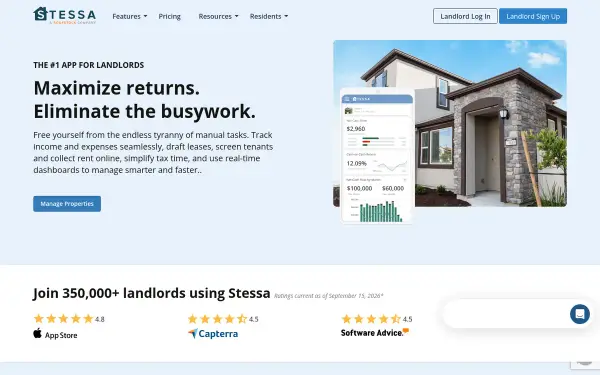
Stessa is a strong free starting point for new landlords who need rental bookkeeping and tax-ready reports before they need rent collection.
Stessa answers the first landlord accounting question: can I track rental income and expenses without buying a full management suite? The free Essentials plan does that with automatic bank transaction import, rental-specific income and expense categories, and per-property dashboards for cash flow, net operating income and equity. Schedule E tax-ready reports package the books for an accountant. For a new landlord with one to a few properties, that is a substantial free tier rather than a demo.
Paid tiers move into operations. Manage is $12 per month billed annually and Pro is $28 per month. Those tiers add rent collection and tenant screening, and Pro adds portfolio-level analytics. The bookkeeping remains the core strength. Rent collection is weaker than at dedicated property management tools, so landlords who need leases, maintenance and tenant communication may outgrow Stessa. Support is also thinner than at paid competitors, which matters when tax season creates questions.
The trade-off is focus. Stessa does rental accounting well, and the paid add-ons are useful only if you want them. A landlord with a small portfolio and an accountant can stay on Essentials and ignore the upsell. A landlord managing dozens of doors, short-term stays or on-site staff should compare a full suite.
Paid tiers add features many small landlords never use, so start on Essentials and upgrade only when a specific need appears. The free plan still requires setup: connect accounts, review categories and correct misclassified transactions before trusting reports. That review is the difference between clean books and a tidy dashboard built on bad categories. The vendor page confirms free Essentials and Manage at $12 per month on annual billing; Pro is listed at $28 per month.
You want free rental bookkeeping with bank import and Schedule E reports.
You need strong rent collection, leases and maintenance in the same tool.
Entry II of X / Banking plus books

Our verdict
Baselane fits landlords who will move banking into the platform so deposits, rent collection and bookkeeping sit in one workflow.
Baselane answers a specific landlord problem: deposits and bookkeeping live in different systems, so every rent payment needs manual matching. Its Core plan is free and includes landlord bank accounts, rent collection into those accounts, automated transaction categorization, built-in bookkeeping and reconciliation, plus mortgage and expense payment tracking. Because deposits land inside the platform, the software can categorize them without waiting for a bank feed to catch up.
The Smart tier is $20 per month on an annual plan and adds advanced automation and reporting. A 30-day free trial lowers the risk of moving banking. The catch is that the benefits depend on moving banking into its ecosystem. Landlords with strong bank relationships, multiple entities or treasury rules may find that lock-in too high. Deeper reporting also sits behind the paid plan, so the free Core plan is best for simple portfolios.
Baselane is a younger company than the established suites, which matters for anyone who wants a long operating history. It is not the right first choice for a landlord who only needs tax reports and wants to keep existing accounts. It is a strong fit for a hands-on landlord with a few units who wants rent collection and books to meet in one place and is willing to change banks.
Start with Core, connect one property and one account, and test reconciliation before moving the whole portfolio. The free plan covers banking, rent collection and basic books, so the evaluation can be real rather than a demo. Check current terms on the vendor site before switching deposit accounts.
You will move rent deposits and operating accounts into its banking platform.
You need to keep existing bank relationships or want advanced reporting on the free plan.
Entry III of X / Free management core

Our verdict
Innago suits landlords who want free rent collection, leases and maintenance, with basic accounting as part of the package rather than the main event.
Innago answers the budget question directly: landlords can run core property management without a monthly software fee. Its free platform includes rent collection, online leases, tenant screening, maintenance requests, basic income and expense tracking, usable financial reports, and a tenant-facing portal and app. There is no setup fee, no monthly fee and no contract for the core features listed. For a landlord who needs operations more than deep bookkeeping, that is a practical package.
The accounting is lighter than dedicated bookkeeping tools. It tracks income and expenses and produces usable reports, but landlords with multiple entities, short-term rentals or complicated owner reporting should not expect a full general ledger. Revenue comes from optional tenant-paid services such as credit reporting, so the landlord's free access is real but not charity. Fewer integrations than paid suites may matter if accounting or banking tools must connect.
Innago fits small landlords who want one login for rent, leases and maintenance, and who can keep the books simple. It also suits landlords who already have an accountant and only need a clean transaction record. It does not fit portfolios that need trust accounting, 1099 e-filing or advanced property reporting. For a small portfolio, that trade-off is often acceptable.
Treat Innago as property management that includes accounting, not as an accounting-first tool. Test the financial reports against your tax needs before a full year of data is inside. The free model means the main cost is setup and training, not subscription budget. Confirm current tenant fees on the vendor site, since those optional services fund the product.
You want free rent collection, leases and maintenance with simple books attached.
You need double-entry accounting, trust accounting or deep owner reporting.
Entry IV of X / Mobile receipt capture
Our verdict
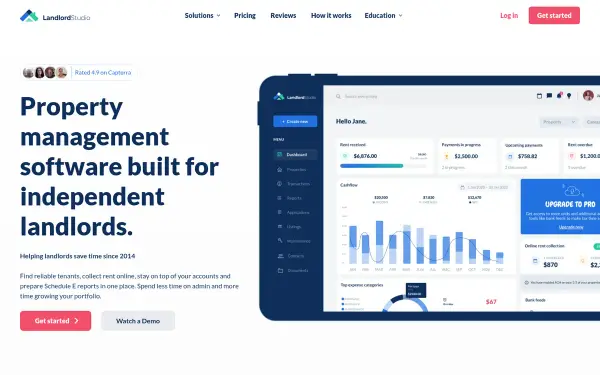
Landlord Studio is a good fit for small portfolios and landlords who capture receipts and mileage from a phone between showings.
Landlord Studio answers the mobile bookkeeping problem: receipts pile up in a truck console, and mileage gets reconstructed at tax time. Its mobile app captures receipts and files them against the right property, tracks mileage, logs expenses and sends rent reminders. Bank connections bring transactions in, and Schedule E reports are built for US filing. The Go plan is free for up to three units, which covers a small portfolio before any subscription.
Pro is $12 per month billed annually with three units included, and a 14-day free trial is offered. Extra units add roughly a dollar per unit past three, so the price scales with the portfolio. That is reasonable for a growing landlord but worth modeling before adding doors. Rent collection is basic, and the desktop experience trails the mobile app, so landlords who manage from a laptop may find the workflow less comfortable.
The fit is a small portfolio or a hands-on landlord who is often in the field. The app reduces the paper bag of receipts at year end and keeps expenses tied to properties. The free Go plan is enough to test the workflow, but the paid Pro plan is where the unit allowance and per-unit scaling matter.
Landlord Studio is not a full management suite. It does not replace lease automation, maintenance workflows or owner reporting at the level of Buildium or AppFolio. It is a bookkeeping-first tool with enough rent reminders to keep small operations moving. Start on Go, capture a month of real expenses, then decide whether Pro's extra units and features earn the subscription.
You manage a small portfolio and want strong mobile receipt and mileage capture.
You need full rent collection, desktop-heavy workflows or advanced owner reporting.
Entry V of X / Short-term payout import
Our verdict
REI Hub is worth a look for short-term and mixed portfolios because it imports Airbnb and VRBO payouts and keeps property-based books.
REI Hub answers the mixed portfolio problem: a landlord may run long-term rentals and short-term stays under the same ownership, and generic rental bookkeeping struggles when payouts arrive from Airbnb and VRBO. REI Hub imports those platform payouts, keeps property-based accounting and handles portfolios that mix short-term and long-term units. It also provides investor-oriented Schedule E reporting and a free tier for testing on a live portfolio.
Pricing is on the vendor site, so this list does not guess at a monthly number. A free tier is available, and paid tiers vary with portfolio size. No trial is listed, but the free tier lets you test on a live portfolio. The specialty is valuable only if short-term stays are part of the mix; pure long-term landlords get little from the payout import. The user community is smaller than the big names, and paid plan details need checking against current pricing before committing.
For a landlord with a few Airbnb units and a few long-term doors, the alternative is manual splitting of platform fees and two sets of reports. REI Hub's property-based structure is meant to avoid that. For a landlord with only long-term leases, a bookkeeping-first tool with Schedule E reports and bank feeds is usually simpler and cheaper, especially if the portfolio is small.
Test it with one short-term unit and one long-term unit, then check that the reports match how the accountant wants fees and payouts split. The free tier makes that test possible without a subscription. Confirm pricing on the vendor site before budgeting, because portfolio size changes the paid tier. REI Hub is a specialist, not a default choice.
Airbnb or VRBO payouts and mixed rental strategies are central to your portfolio.
You only own long-term rentals and want simple, predictable subscription pricing.
Entry VI of X / Affordable rent collection
Our verdict
TenantCloud suits budget landlords who need rent collection, listings and basic accounting in one affordable place, and can tolerate a dated interface.
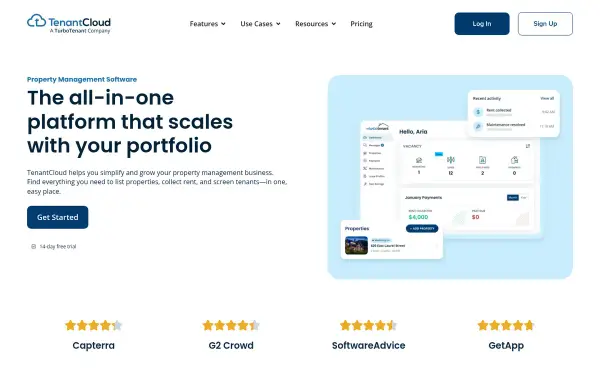
TenantCloud answers the budget landlord's need for one system that collects rent and keeps basic books. The free plan covers small-portfolio basics, and the Essentials paid plan is $12.42 per month. Features include rent collection, basic accounting, rental listings, maintenance tracking, tenant communication and paid tiers that raise portfolio limits. A 14-day free trial is offered. It sits between free apps and full management suites, with a broader operations set than a bookkeeping-only tool.
The accounting is basic, so landlords with multiple entities, short-term rentals or detailed owner reporting will hit limits. The free plan limits are tighter than Innago's, and support can be slow on lower tiers. The interface feels dated next to newer apps, which affects tenant adoption and staff training. Paid plans stay affordable as the portfolio grows, which is the main reason to consider it.
TenantCloud fits a small landlord who needs rent collection, listings and maintenance more than advanced bookkeeping. It also fits a landlord who wants a free plan to start and a low paid tier when the portfolio grows. It does not fit a landlord who needs trust accounting, 1099 e-filing or deep property reporting. For a small portfolio, that trade-off can still work.
The current lowest paid tier is Essentials at $12.42 per month, so older $15 expectations should be updated. Compare the free plan limits against Innago before choosing, since both charge the landlord little or nothing at entry. Test the tenant experience during the trial, because a dated portal can cost more in support time than the subscription saves.
You want a free start and a low paid tier for rent collection and basic books.
You need deep accounting, modern design or fast support on a low tier.
Entry VII of X / General ledger depth
Our verdict
QuickBooks Online fits landlords who need general accounting and can build property reporting with class tracking, not a rental-native workflow.
QuickBooks Online answers a different question: what if the landlord needs general accounting rather than a rental-specific tool? It provides a double-entry general ledger, class tracking that can report profit by property, profit and loss and balance sheet reports, bank feed reconciliation, invoicing and a large third-party integration ecosystem. Accountants already know its reports, which matters when an outside bookkeeper or tax preparer is part of the workflow.
The rental gap is the product's weakness. QuickBooks has no native property, unit or tenant concepts, so per-property reporting requires manual class setup on every transaction. That setup is easy to postpone and painful to fix later. Simple Start is $38 per month for one user, with a promotional rate of $11.40 per month for three months. Payroll and other extras cost more, and a 30-day free trial is offered for the paid product.
QuickBooks Online fits landlords who already run other businesses under the same books, or whose accountant requires it. It also fits landlords with complex financing, multiple entities or inventory-like operations. It does not fit a landlord who wants property dashboards, rent collection and Schedule E categories out of the box, because those require workarounds or add-ons.
If you choose QuickBooks, decide the class structure before importing a year of transactions. Use one class per property or per ownership entity, and make the rule mandatory for every bank feed item. A 30-day trial is offered, and the paid Simple Start tier is the practical entry point for a landlord with real books to keep.
Your accountant requires QuickBooks or you need general accounting for several businesses.
You want property-level reports and Schedule E categories without manual class setup.
Entry VIII of X / Trust accounting
Our verdict
Buildium fits growing portfolios that need trust accounting, owner reporting and 1099 e-filing, and can absorb a $65 monthly starting price.
Buildium answers the growing portfolio's need for property management accounting, not just bookkeeping. The Essential plan is $65 per month and includes a general ledger, bank reconciliation, owner distributions, vendor bills, 1099 e-filing, trust accounting, owner and resident portals, and API access on the Premium tier. A 14-day free trial is offered, and there is no free plan. For a landlord with enough units to need trust accounting and owner reporting, the feature set is serious.
The price is steep for portfolios under ten units. Buildium's notes list Growth at $192 and Premium at $400 per month, and advanced automation sits on higher tiers. Implementation and data import take real setup time, so the first month is a project rather than an afternoon. The product scales from small managers to large firms, which is its strength and the reason small landlords should not buy it early.
Buildium fits landlords who manage other people's properties, need trust accounting, file 1099s and produce owner statements. It also fits a growing portfolio that has outgrown free tools and wants one system for accounting, leasing and maintenance. It does not fit a landlord with four units who mainly needs Schedule E reports and a clean bank feed.
Use the 14-day trial to test the reports your owners or accountant need, not just the dashboard. Import a small set of real transactions and reconcile one bank account before committing. The Essential plan at $65 per month is the entry point, but model Growth and Premium if automation and API access matter. Buildium is a management platform with accounting at its core.
You manage other owners' properties and need trust accounting and 1099 e-filing.
You have fewer than ten units or only need simple rental bookkeeping.
Entry IX of X / Modern all-in-one
Our verdict
DoorLoop suits landlords who want modern property management and accounting behind one login, but only after a demo confirms the per-unit cost.
DoorLoop answers the all-in-one question for landlords who want accounting, rent collection and operations behind one modern login. The DoorLoop One plan is $2.50 per unit per month, with minimum spend and unit minimums applying. Features include an accounting module, rent collection, tenant screening and basic reporting, with team management, vendor portals and third-party integrations on higher tiers. The interface is easier for staff to learn than older suites.
There is no free tier and no trial, so evaluation runs through a demo. The Starter tier is $69 per month billed annually for up to ten units, according to the pricing notes, and the current pricing has moved to per unit. That makes the entry cost manageable for a small portfolio, but costs climb as unit counts push the account up tiers. Arrive at the demo with real workflows, including a rent cycle and a month-end close.
DoorLoop fits a landlord or small manager who wants a modern system with accounting and operations together, and who will use the demo properly. It also fits a portfolio that has outgrown free bookkeeping but does not need trust accounting or 1099 e-filing at Buildium's level. It does not fit a landlord who refuses to evaluate without a trial or who only needs tax reports.
Compare the per-unit cost against flat plans at your current unit count and at the next twelve months of growth. A ten unit portfolio and a thirty unit portfolio can land in different tiers even when the per-unit rate looks low. Ask about minimum spend during the demo, since the published starting price does not show the full bill for every account.
You want modern all-in-one management and will test the workflows in a demo.
You need a free trial, a free plan or simple bookkeeping without operations.
Entry X of X / Large portfolio automation
Our verdict
AppFolio fits management companies with hundreds of units, not small landlords, because the 50 unit minimum and $298 floor set the entry bar.
AppFolio answers the large portfolio and management company question. Its Core plan is $1.49 per unit per month, with a 50 unit minimum and a minimum spend that the pricing notes put at $298 per month. Features include AI-assisted leasing workflows, bulk operations, advanced owner reporting, maintenance automation, mobile apps for field staff and residents, and accounting for managed portfolios. The automation is built for companies managing hundreds of units, not for a landlord with a few doors.
Pricing is quote-only, so budgeting needs a sales conversation and a clear module list. Implementation is a substantial project, and the 50 unit minimum excludes most small landlords before the first demo. The product's strength is depth: leasing, maintenance and owner reporting connect to accounting in one system. The weakness is the entry bar, which is deliberate. AppFolio is not a tool to buy for a duplex and grow into.
AppFolio fits management companies and large landlords who need field staff mobile tools, bulk operations and advanced owner reporting. It also fits a portfolio with enough maintenance volume to justify automation. It does not fit small landlords, house hackers or anyone below the 50 unit minimum, even if the per-unit rate looks attractive.
Before the demo, calculate the true monthly floor with the $298 minimum and the 50 unit minimum. Then list the modules that are actually included, because quote-only pricing can hide costs. Ask how data import works and who owns the implementation project. AppFolio is powerful when the portfolio supports the overhead, and expensive when it does not.
You manage hundreds of units and need mobile operations and advanced owner reporting.
You are below the 50 unit minimum or need a low-cost, self-serve tool.
VIBackground
Landlord accounting software is rental bookkeeping built around properties and units. It imports bank transactions, sorts income and expenses by property, tracks cash flow and produces reports you can hand to a tax preparer. The category differs from general small business accounting because property, unit, tenant and lease records sit at the center, rather than being added as tags or classes after the fact.
The core job is simple: know what each property earns and costs. A useful tool connects to bank accounts, remembers rental categories such as rent, repairs, mortgage interest and insurance, and keeps receipts attached to the right property. Reports should show net operating income, cash flow and Schedule E categories. Schedule E is the US tax form for supplemental rental income and expenses; the software does not file it for you, but it maps transactions into the lines an accountant or tax preparer needs.
Rent collection, tenant screening, leases and maintenance sit around the accounting core. Some tools are accounting first; others are property management systems with books attached. Security deposits need care: they are liabilities, not rental income, so the books should keep them separate and flag movements rather than counting deposits as revenue. Full management suites add trust accounting for client funds.
Short-term rentals add another wrinkle. Airbnb and VRBO payouts arrive net of platform fees, so software that imports those payouts and splits fees saves manual work. Pure long-term landlords can ignore that feature.
A spreadsheet usually stops working when you have several accounts, multiple properties, paper receipts or a tax deadline. That is the point where a spreadsheet becomes a second job. At that point, bank feeds, property-level reports and a clean Schedule E export matter more than extra features. Software organizes the books; it does not replace an accountant for tax positions, depreciation or entity questions.
This comparison sits in the finance register. Further along the shore: lease accounting software and ecommerce live chat software.
VIIPricing
Landlords pay for accounting software through free plans, flat subscriptions, per-unit pricing or quote-based suites. The right model depends on door count and whether rent collection or banking sits inside the product. The table below uses starting prices and plan terms checked on November 25, 2026.
| Model | How it bills | Typical fit | Example from this list |
|---|---|---|---|
| Free plan | $0 entry with optional paid tiers | New landlords or small portfolios testing rental books | Stessa Essentials is free; Innago lists no monthly fee for core features |
| Flat subscription | Monthly fee, often lower on annual billing | Solo landlords and small teams that need reports and support | Landlord Studio Pro is $12 per month billed annually for three units; Buildium Essential is $65 per month |
| Per unit | Monthly fee for each unit, with minimums on larger suites | Portfolios where cost should track door count | DoorLoop One is $2.50 per unit per month; AppFolio Core is $1.49 per unit per month with a 50 unit minimum |
| Free plus paid upgrade | Core free, advanced reporting or automation paid | Landlords who want banking or automation later | Baselane Core is free and Smart is $20 per month on an annual plan; TenantCloud Essentials is $12.42 per month |
Stessa also lists Manage at $12 per month billed annually and Pro at $28 per month. QuickBooks Online Simple Start is $38 per month for one user, with a promotional rate of $11.40 per month for three months. REI Hub pricing is on the vendor site, so do not budget from a guess. Buildium's notes list Growth at $192 and Premium at $400 per month.
Trial access changes the cost of evaluating. Baselane offers a 30-day free trial, TenantCloud and Buildium offer 14-day trials, QuickBooks Online offers a 30-day trial, and Landlord Studio offers a 14-day trial. Stessa and Innago list no trial, while DoorLoop and AppFolio list demos only. Free plans still require setup time: connect accounts, fix categories and test the report your accountant needs before you commit.
Each entry card shows the starting price as it appeared on the vendor's own pricing page on November 25, 2026. When a vendor shows no figure we could confirm, or only a promotional rate, the card says "See website" or gives the regular price instead of a guess. Usage, overage and add-on rates in the text change more often than plan prices, so confirm them on the vendor page before you set a budget. To test the numbers against your own volume, try the free Lease Liability Calculator. The Event Break-Even Calculator is a second way to check the same decision.
VIIIDecision
IXPitfalls
XQuestions
A spreadsheet stops being enough when you have several bank accounts, multiple properties, receipts to match or a tax deadline. At that point manual entry creates errors and per-property reporting takes too long. Rental software adds bank imports, property-level categories and reports such as Schedule E summaries, so the books stay current without a monthly rebuild.
Schedule E is the US tax form for supplemental rental income and expenses. Rental accounting software maps bank transactions to categories such as rent, repairs, insurance and mortgage interest, then produces a report organized for those lines. It does not replace a tax preparer, but it reduces the year-end sorting. Stessa, Landlord Studio and REI Hub list Schedule E reporting.
Security deposits should be tracked as liabilities, not rental income, because the money may be refunded. The books should separate deposit received, interest if required, and refund or deduction. Escrow rules vary by state and lease, so confirm local requirements. Full property management suites add trust accounting, while bookkeeping-first tools may need a separate liability account.
Record the gross rent and the platform fee as separate lines, then match the net deposit to both. That keeps revenue and expenses honest. Software that imports Airbnb and VRBO payouts saves manual splitting; REI Hub lists this feature and handles portfolios that mix short-term and long-term units. For long-term rentals only, the feature adds little.
A full suite usually pays off when rent collection, maintenance, owner reporting and accounting together cost more time than the software fee. Small landlords can start free or near free. Buildium starts at $65 per month, DoorLoop uses per-unit pricing, and AppFolio has a 50 unit minimum and $298 monthly floor, so the math favors larger portfolios.
Yes, most landlords still need an accountant or tax preparer for depreciation, entity questions, state rules and tax positions. Software organizes transactions and produces reports, but it does not decide how to treat a renovation or a mixed-use property. Use the software to make the accountant's work cleaner, not to replace professional review.
XIFurther along the shore
Vendors can ask for a correction or apply for a Featured listing. Paid or not, the entry is scored on the same rubric and its limits stay in print. Partner with Umberlake.
Free tools
Our free browser tools turn the prices on this page into a figure for your own volume. Nothing you type leaves your device.