Diligent Boards
See website
Best for large enterprises and regulated financial institutions
- Free plan
- No
- Rubric
- 7.8 of 10
Nine board management platforms ranked for fit, from enterprise governance suites with audit trails to per-user portals small nonprofits can afford.

IThe short answer
Diligent Boards is the first pick for large enterprises and regulated financial institutions that need audit trails, granular permissions and board evaluations in one governance suite. OnBoard suits mid-market boards that want a portal directors will actually open, and BoardEffect fits nonprofit, education and healthcare boards. That order is editorial, based on fit for the buyer each entry describes. Prices were checked on November 25, 2026, and seven of the nine vendors publish no starting figure at all: Top Board Management Software.
9 tools compared from vendor pages on November 25, 2026. 2 publish a starting price we could read; the rest say "See website".
IITop three berths
Register order is editorial fit for the buyer each entry describes. Prices are the starting figures read on November 25, 2026.
See website
Best for large enterprises and regulated financial institutions

See website
Best for mid-market boards seeking an easy-to-adopt portal
See website
Best for nonprofit, education and healthcare boards
How this page is paid for. All 9 tools here are unpaid editorial picks.
A paid listing's position can be part of what the vendor pays for. Every entry, paid or not, is scored on the same rubric and keeps its limits in print. Advertising disclosure.
IIIThe register
Starting prices as shown on each vendor's pricing page on November 25, 2026. "See website" means no figure we could confirm.
| No. | Tool | From | Free plan | Trial | Rubric | Actions |
|---|---|---|---|---|---|---|
| 01 | Diligent BoardsLarge enterprises and regulated financial institutions | See websiteNot shown publicly | No | No | 7.8 | |
| 02 | OnBoardMid-market boards seeking an easy-to-adopt portal | See websiteNot shown publicly | No | No | 7.0 | |
| 03 | BoardEffectNonprofit, education and healthcare boards | See websiteNot shown publicly | No | No | 6.5 | |
| 04 |  Nasdaq BoardvantagePublic companies and large listed enterprises | See websiteNot shown publicly | No | Demo only | 7.3 | |
| 05 |  ConveneGovernment, finance and highly regulated boards | See websiteNot shown publicly | No | No | 7.0 | |
| 06 |  BoardableSmall nonprofits and associations with tight budgets | $20.99Essentials, per user per month, billed annually, first year pricingRead on vendor page | No | 14-day free trial, no credit card | 7.9 | |
| 07 |  BoardProSMEs and nonprofits wanting flat per-board pricing | $1,650Essentials, per board, billed annually, unlimited usersRead on vendor page | No | Free 30-day trial, no credit card | 7.7 | |
| 08 |  GovendaCorporations needing governance workflow automation | See websiteNot shown publicly | No | No | 6.7 | |
| 09 |  AprioSmall boards wanting a simple all-in-one portal | See websiteNot shown publicly | No | Demo only | 6.3 |
Pinned:
IVMethod
How quickly a director finds the agenda, the paper behind each item and the vote without training.
Voting, approvals, minutes, evaluations and audit evidence included in the base product.
Whether a starting price and plan limits are published, and how the model scales with board size.
Permissions, encryption, audit trails and certifications a regulated board has to evidence.
Onboarding effort and support measured against the board size the vendor actually targets.
VMethod
Every vendor in this list was scored against the same five criteria: board experience (25 percent), governance depth (25 percent), pricing clarity (20 percent), security and compliance (20 percent), and implementation fit (10 percent). Board experience asks how quickly a director finds the agenda, the paper behind it and the vote without training. Governance depth covers voting, approvals, minutes, evaluations and the audit evidence an examiner may ask for. Pricing clarity rewards a published starting price and penalizes a quote-only wall. Security and compliance looks at permissions, encryption, audit trails and certifications. Implementation fit weighs onboarding and support against the board size the vendor targets.
Prices were checked on November 25, 2026 against vendor pricing pages. Where a vendor publishes a rate, the review uses it exactly as listed, including the billing term and plan name. Where no pricing page could be captured, the entry reads See website and the review says so rather than estimating a figure.
The order is editorial. It reflects fit for the buyer each entry describes rather than a weighted total,
Two facts shaped several entries. Diligent owns OnBoard and BoardEffect, so all three carry an ownership question to raise before signing. And seven of the nine vendors here publish no starting price, which makes written scoping and side-by-side quotes more useful than any headline number.
The full routine, from price reads to corrections, is on the methodology page. Paid listings follow the advertising disclosure.
Entry I of IX / Audit-grade governance
Our verdict
The deepest governance toolkit here, built for large regulated boards that need audit evidence, voting and evaluations in one place.
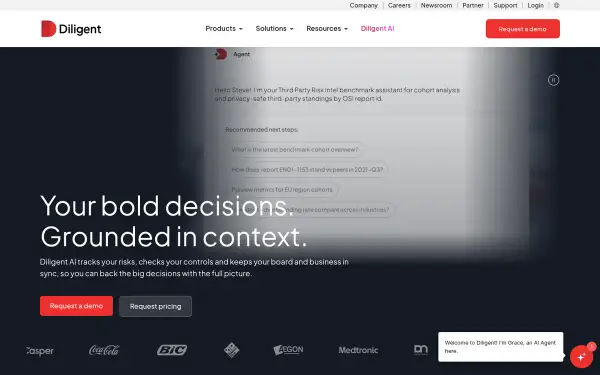
Diligent Boards is the governance suite most large, regulated boards end up comparing everything else against. The core is a secure board book, with granular permissions deciding which director sees which committee paper, and audit trails recording who opened what and when. Voting, e-signatures, board evaluations and board analytics sit inside the same product rather than in separate modules you buy later, which matters if your general counsel wants one place to point at during an examination.
The fit is narrow on purpose. Large enterprises and regulated financial institutions get the most from it, because the controls, evaluations and analytics match the evidence a compliance team has to produce. Smaller organizations tend to pay for depth they never open, and the setup is a project: permissions have to be mapped, historic documents migrated and directors trained before the first live meeting.
Pricing is custom. Diligent does not publish a starting figure, and our check on November 25, 2026 found no pricing page to record. Pricing is quoted per buyer, so ask for a written scope covering entity count, modules and users. Budget for a sales cycle and for professional services alongside the subscription.
One ownership note matters. Diligent now owns OnBoard and BoardEffect, so a buyer weighing all three should ask directly how each roadmap is funded and which features will be shared. Skip Diligent if you run a small board and your governance needs are agendas, papers and minutes, because the depth is real but so is the bill.
Your board answers to a regulator and must produce audit evidence on request.
You run a small private board that mainly needs papers, agendas and minutes.
Entry II of IX / Director adoption

Our verdict
The easiest portal to get directors using, with an agenda builder and analytics that suit mid-market boards rather than enterprise compliance teams.
OnBoard is the mid-market portal in the Diligent family, and its argument is adoption. Directors who resist new software tend to open it, because the agenda builder assembles a meeting in a logical order, documents attach to the line item they belong to, and read tracking shows a chair who has actually prepared. Voting tools, secure messaging, document management and board analytics cover the routine work of a mid-size board without a governance module for every edge case.
Where it trails Diligent Boards is advanced governance trail: the heavier audit, evaluation and entity level controls that regulated boards need to evidence. Buyers who need those should treat OnBoard as a step below the enterprise suite rather than a substitute for it. Support has a good reputation, which matters more than feature counts when directors hit a problem ten minutes before a meeting.
There is no published price. OnBoard is quote-based, and our check on November 25, 2026 returned no page content to confirm a figure, so treat any number you hear as specific to your seat count and modules. The product sits between budget portals at the low end and Diligent Boards at the top, which usually means a mid-market board with a staff administrator.
The ownership question is the one to ask in the room. OnBoard is part of Diligent, so ask how the roadmap is funded and which features will be shared across the portfolio. Skip OnBoard if you need deep compliance evidence or if you cannot get a written quote with a renewal cap.
You need a portal your directors will actually open and your compliance demands are moderate.
You need enterprise-grade audit and evaluation evidence, or a price you can see before the call.
Entry III of IX / Nonprofit workflows
Our verdict
Purpose-built for nonprofit, education and healthcare governance, with a drag-and-drop agenda builder and surveys, though pricing stays quote-only.
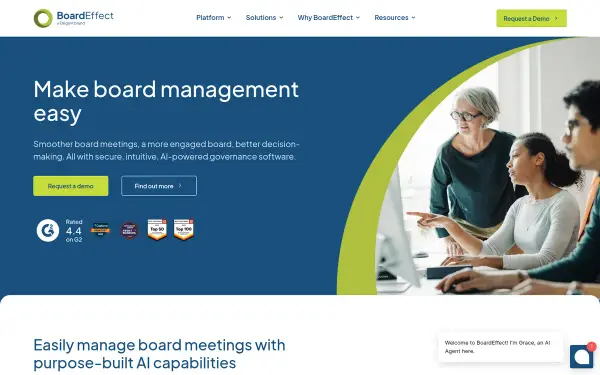
BoardEffect is aimed squarely at nonprofit, education and healthcare boards, and the workflow shows it. The drag-and-drop agenda builder lets an executive director or board secretary assemble a meeting without a manual, secure document libraries keep committee papers in the right place, and surveys, voting and minutes cover the business a mission-driven board actually conducts. The minutes trail is the kind of thing this product was designed around.
The interface is functional rather than modern. Directors who live in consumer apps will notice it, though the trade is a layout that has been stable for years and rarely confuses a first-time user. Document and survey tools are the strongest part of the package. Advanced analytics and enterprise governance depth sit with other products in the Diligent portfolio.
Pricing is custom. Our check on November 25, 2026 found no pricing page text to verify a figure. Current rates are quote-based and move with board size and module mix. Nonprofits should ask for the nonprofit rate explicitly, ask what the renewal uplift looks like, and get the multi-year figure in writing rather than the first-year number.
BoardEffect is part of Diligent, which is worth knowing before you compare it against OnBoard and Diligent Boards, because all three are sold by the same company. The practical risk is not quality, it is leverage at renewal. Skip BoardEffect if your board is small, meets quarterly and mainly needs papers distributed securely, since a general-purpose portal will cost less.
Your board is a nonprofit, school or health system that wants governance features built for its routines.
You are a small volunteer board that needs secure papers and nothing more.
Entry IV of IX / Offline board books

Our verdict
A listed-company board book with strong offline reading for traveling directors, sold through a sales-led process at custom pricing.
Nasdaq Boardvantage is a board book product for listed companies, and it behaves like one. Secure board books are the core, with offline access for directors reading on a plane, annotations that survive the sync back, voting and approvals, and board book tools that make a large pack navigable. The security pedigree that comes with the Nasdaq name is the reason many general counsels put it on the shortlist without much debate.
Offline access is the feature that gets mentioned most by people who travel to meetings, and it is executed well enough that directors stop asking for printed packs. Annotations are solid. Where the product feels narrower is the surrounding governance work: evaluations, entity management and the workflow automation a corporate secretary might want sit elsewhere or need a conversation with sales.
Pricing is custom and the process is sales-led. Our check on November 25, 2026 captured no pricing page, so no starting figure could be confirmed. Demos are available, and a demo is the realistic first step for most buyers here. Expect scoping questions about board size, committee structure and listed-company obligations before anyone quotes a number.
Small boards should look elsewhere. The value shows up when you have a full board book, several committees, disclosure obligations and directors who travel, and the cost reflects that. Skip Boardvantage if you run a small private board that needs agendas, papers and minutes, because you will pay for listed-company machinery you never use.
You are a listed company whose directors read packs on planes and tablets.
You are a small private board with simple agenda and minutes needs.
Entry V of IX / Compliance evidence
Our verdict
Security-first meeting software from Azeus that fits government and regulated boards, with real-time collaboration and almost no public pricing.
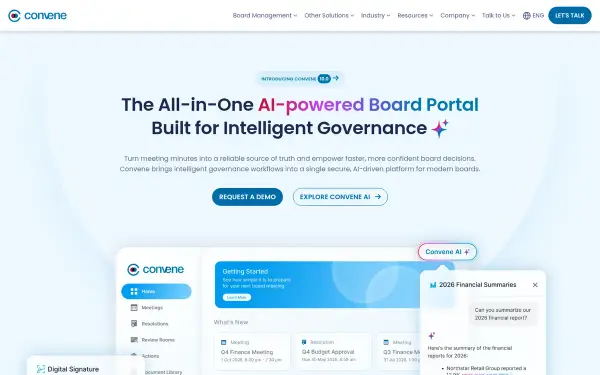
Convene comes from Azeus Systems and leads with security rather than with usability marketing. Encrypted board meetings, real-time document collaboration, annotations, voting and audit trails sit on top of a compliance certification set that procurement teams in government and finance tend to ask about by name. If your board answers to a regulator, the paperwork around the product is part of what you are buying.
Real-time collaboration is the strongest daily feature. Directors can annotate the same document during a meeting and see each other's marks, which shortens the gap between discussion and a recorded decision. Audit trails record the meeting activity a compliance officer will later ask for. The trade-off is weight: the product is built for formal, high-stakes meetings rather than for a small board that meets quarterly and wants something a volunteer can administer.
Pricing is quote-based. Our check on November 25, 2026 returned no page content, so no starting price could be confirmed. The real figure depends on users, modules and support terms. Government buyers should ask early about procurement vehicles and hosting options.
The brand has a smaller US footprint than Diligent or Nasdaq, which matters if you want a large local partner network. Buyers in government should also ask whether the vendor's certifications cover the hosting region they need. Skip Convene if your board is small, informal and price-sensitive, because the compliance depth is the product and you will pay for all of it.
Your board is in government or finance and procurement will ask for certifications by name.
You run a small board that needs plain paper distribution at a low price.
Entry VI of IX / Published per-user pricing
Our verdict
Published per-user pricing from $20.99 and a no-card trial make this the easiest small-nonprofit portal to budget for.
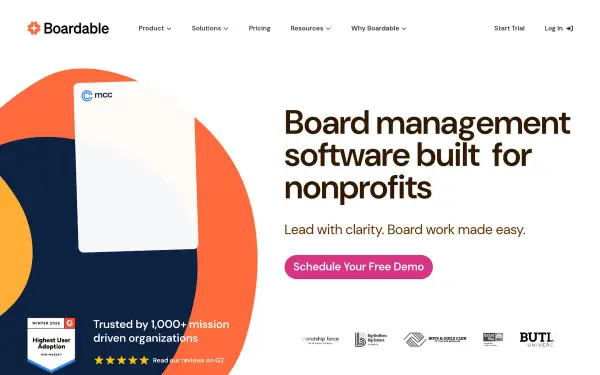
Boardable is the pricing-transparent option in this list, and that alone changes the buying conversation. The Essentials plan is $20.99 per user per month, billed annually at first-year pricing, with Professional at $29.99 and Professional+ at $35.99 on the same per-user basis. A 14-day free trial with no credit card means a small board can test the document center, agenda builder, meeting scheduler and board packets before committing budget.
The per-user model is the catch. A board of eight with two administrators costs far less than a board of twenty with committee chairs, and the bill grows every time a director joins or a committee member needs access. Storage limits on Essentials push active boards toward Professional, which is where AI-generated meeting summaries and transcripts live. Advanced governance tooling, the kind that produces defensible evaluation and entity records, sits with enterprise portals rather than here.
For small nonprofits and associations, the fit is good. Documents, agendas, packets and e-signatures are the daily work of a volunteer board, and the product is built to be learned in an afternoon by a director who logs in four times a year. The trial terms are unusually generous: no credit card, two weeks, real meetings.
Skip Boardable if your board is large, if your committee structure means most members need paid seats, or if your governance obligations require audit-grade evidence. In those cases the per-user arithmetic stops favoring you and an enterprise suite starts to look reasonable.
You run a small nonprofit or association and want a price you can see before you call.
Your board is large or your committee members all need paid seats.
Entry VII of IX / Flat per-board pricing
Our verdict
Flat per-board pricing of $1,650 a year with unlimited users makes BoardPro the predictable choice for SMEs and nonprofits.
BoardPro sells predictability: $1,650 per board per year on Essentials, with unlimited users, which works out to $165 a month. Premium is $275 and Ultimate is $440 per board per month on the same per-board basis. For a board of twelve that is a simple calculation, and for a board of twenty it does not change, which is the point. The vendor says unlimited users carry no extra cost and claims costs can run 5 to 10 times lower than enterprise alternatives.
The build is aimed at SMEs and nonprofits. A one-click board pack compiles the agenda, documents and reports into something directors can read on a tablet, AI-assisted minutes cut the secretariat's drafting time, e-signatures close resolutions, and flying minutes handle decisions taken between meetings. An annual work plan keeps the governance calendar in one place. These are the tasks that consume a small board's administrator, and the product targets them rather than entity management.
$165 a month is still real money for a very small board that meets four times a year, and the software is priced per board, so a nonprofit running several subsidiary boards pays several times. The US presence is thinner than the larger competitors, which matters if you want a local implementation partner or same-time-zone support. Enterprise governance depth, the audit and evaluation machinery Diligent sells, is not what BoardPro is built for.
Skip BoardPro if you run many boards under one parent, if you need regulated-grade evidence trails, or if your budget cannot clear $1,650 a year for governance software.
You want one predictable annual fee and a board that grows or rotates members.
You administer several boards under one parent organization.
Entry VIII of IX / Entity management
Our verdict
Built for corporate secretaries who need entity management, compliance calendars and governance dashboards, sold through custom quotes.
Govenda targets the corporate secretary rather than the director, and the feature list reflects that. Entity management tracks subsidiaries and their officers, compliance calendars keep filing and meeting deadlines in view, governance dashboards roll the picture up, and reporting turns it into something a board or a regulator can read. Board meeting tools handle the meeting itself, but the surrounding governance workflow is the differentiator.
That makes it a fit for corporations with a complicated structure: several entities, a small legal or secretarial team, and a need to prove that deadlines were tracked. Customizable workflows let a secretariat model approvals the way the company actually runs them rather than the way a template assumes. Board meeting tools cover papers, annotations and minutes for day-to-day meetings. Reporting turns board meeting activity into a record the secretariat can hand to auditors.
Pricing is custom. Our check on November 25, 2026 returned no pricing page text, so no starting figure could be confirmed. Expect scoping around entity count, users and the modules you need. Implementation needs planning: entity records have to be built and calendars configured before the dashboards mean anything, so budget staff time in the first quarter alongside the license fee.
The market visibility is lower than Diligent, Nasdaq or OnBoard, which is a practical consideration rather than a quality judgment. Fewer public references make reference checks more important, and buyers should ask for customers of a similar size and structure. Skip Govenda if your board only needs papers and minutes, because entity management is the reason to pay for it.
A corporate secretary must track entities, deadlines and approvals in one place.
Your board only needs papers, agendas and minutes.
Entry IX of IX / One clear package
Our verdict
A simple all-in-one portal with 12 user licenses and unlimited committees included, best for small boards that want one package.
Aprio is a small-board portal sold as one package rather than a menu. The subscription includes 12 user licenses and unlimited committees, along with unlimited training and supported onboarding, which removes the two questions small boards ask first: how many seats do we get, and who teaches us to use it. The document library, agenda builder, minutes builder, annotations, audit reports and decision tracking cover the routine work of a volunteer board.
The design is deliberately simple. Directors who found enterprise portals confusing tend to get through Aprio without a manual, and the agenda and minutes builders follow the order a meeting actually runs in. The cost of that simplicity is depth: advanced governance features are simplified by design, so a board that needs entity management, granular committee permissions or evaluation analytics should look at the heavier products in this list.
Pricing is not published. Our check on November 25, 2026 captured no pricing page, so no starting figure could be confirmed, and a demo is the route to a quote, which means you will not see the product live without a sales conversation. Buyers should confirm what happens above 12 users, since the included license count is the number that makes the package work for a small board, and should ask whether onboarding support is time-limited or runs for the life of the contract.
Aprio is a smaller vendor with less visibility than the enterprise names, so ask for references from boards of a similar size and check how long the company has supported the product. Skip Aprio if you need enterprise governance depth, or if your board plus committees already exceeds the included licenses and the per-seat add-on cost is unclear.
You are a small board that wants seats, committees and onboarding bundled into one package.
You need entity management, granular permissions or evaluation analytics.
VIBackground
Board management software is the system a board uses to run its meetings and keep its records. It replaces the emailed PDF pack with a portal where directors find the agenda, the papers behind each item, the minutes of the last meeting and any resolutions that need a signature. The point is not paperless for its own sake. The point is that one version of the truth exists, access is controlled, and there is a record of who read what.
Most products in this category share a core. A board book or document library stores papers by meeting and committee. An agenda builder assembles the running order and attaches the right document to the right item. Voting, approvals and e-signatures let the board act during and between meetings. Minutes tools record decisions, and audit trails log activity for later review. Above that core, products diverge. Some add board evaluations, governance dashboards, entity management for subsidiaries, or AI-assisted minutes.
What separates the tiers is depth and evidence. A small nonprofit needs directors to open the pack and find page 40 without calling the office. A bank needs to show an examiner who had access to a credit committee paper, when they opened it, and whether a resolution was properly recorded. Those are the same broad features at very different levels of rigor, and the price follows the rigor rather than the feature list.
Implementation is the part buyers underestimate. A small board can be live in days: import the member list, upload the current pack, run one training session. An enterprise with entities, committees and legacy archives is a project measured in weeks or months, usually with professional services attached. Ask any vendor what a realistic go-live looks like for a board your size, and ask who does the work.
This comparison sits in the software register. Further along the shore: baby tracking app and kennel software.
VIIPricing
Three models show up in this list, and they behave very differently as a board grows. Per-user pricing multiplies a rate by the number of people who need a login, which is cheap for a small board and expensive once committees, advisors and the executive team get accounts. Flat per-board pricing charges one fee regardless of seats, so the arithmetic flips as membership grows. Custom quotes hide the model behind a sales process and usually bundle modules, entities and support into one number.
| Model | How it bills | Typical fit | Example from this list |
|---|---|---|---|
| Per user per month | Seat count times rate, billed annually | Small to mid-size boards with steady membership | Boardable Essentials at $20.99 per user per month, billed annually |
| Flat per board | One annual fee, unlimited users | Boards that grow or rotate members often | BoardPro Essentials at $1,650 per board per year, unlimited users |
| Custom quote | Sales-led proposal based on modules and users | Enterprises and regulated bodies with procurement | Diligent Boards, OnBoard, BoardEffect, Nasdaq Boardvantage, Convene, Govenda and Aprio |
Run the arithmetic before the demo. If you are choosing between Boardable at $20.99 per user and BoardPro at $1,650 per board, the crossover depends on how many seats you actually need, and committee members often need seats. Ask each vendor what counts as a user: directors only, or directors plus executives, advisors, auditors and legal counsel.
Then ask what is not in the price. Storage limits, onboarding, training, data migration, premium support and extra modules all sit outside the headline rate for some vendors. For the seven vendors here that do not publish a starting price, the first quote is a negotiating position rather than a list price, so ask for the same scope in writing from two or three suppliers before you compare.
Each entry card shows the starting price as it appeared on the vendor's own pricing page on November 25, 2026. When a vendor shows no figure we could confirm, or only a promotional rate, the card says "See website" or gives the regular price instead of a guess. Usage, overage and add-on rates in the text change more often than plan prices, so confirm them on the vendor page before you set a budget. To test the numbers against your own volume, try the free User Research Budget Planner. The Event Break-Even Calculator is a second way to check the same decision.
VIIIDecision
IXPitfalls
XQuestions
A board book and document library, an agenda builder, minutes tools, voting or approvals, e-signatures on most products, permissions and audit trails. The standard core is meeting papers and decisions. Above that, products add evaluations, analytics, entity management, AI-assisted minutes or compliance dashboards, and the price reflects which of those you need.
Per-user pricing multiplies a rate by seats, flat per-board pricing charges one annual fee whatever the headcount, and custom quotes bundle modules and users into a sales-led number. Boardable uses per-user pricing from $20.99 per user per month, BoardPro charges $1,650 per board per year on Essentials, and seven vendors in this list publish nothing at all.
Start with Boardable at $20.99 per user per month and its 14-day no-card trial, then price BoardPro at $1,650 per board per year if you have enough members that a flat fee beats per-user costs. BoardEffect is built for nonprofit workflows but is quote-based, so ask for a nonprofit rate and a multi-year figure in writing.
Yes on mobile for most products, and offline access is a specific strength of Nasdaq Boardvantage, where directors can read board books without a connection and annotations sync back later. If your directors travel, make offline reading a scored requirement in the demo rather than a footnote, and test it on the devices they carry.
Days for a small board: import members, upload the current pack, train once. Weeks or months for an enterprise with entities, committees, legacy archives and permissions to map, often with professional services attached. Ask each vendor what go-live looks like for a board your size and who does the migration work, because that answer changes the total cost.
Check granular permissions by committee, audit trails that record access and downloads, encryption in transit and at rest, e-signature records, and whatever certifications your regulator expects. Ask the vendor to show the audit report rather than describe it. Convene and Diligent lean hardest on compliance evidence, so regulated buyers should make that a scored criterion rather than a checkbox.
XIFurther along the shore
Vendors can ask for a correction or apply for a Featured listing. Paid or not, the entry is scored on the same rubric and its limits stay in print. Partner with Umberlake.
Free tools
Our free browser tools turn the prices on this page into a figure for your own volume. Nothing you type leaves your device.