
Showpad
See websitecustom quote
Best for field sales teams presenting in person
- Free plan
- No
- Rubric
- 7.1 of 10
We compared eight sales enablement platforms on content delivery, coaching depth, implementation speed and price transparency, so you can match the tool to your team.

IThe short answer
Showpad is the best fit for field sales teams that present in person, Allego leads on video coaching for large distributed teams, and Mindtickle handles onboarding, certification and role play at scale. That is the short answer as of November 2026, when we checked pricing on each vendor site. None of the three publishes a starting price, so budget talks start with a quote. Below them, SalesHood, Spekit, Dock, Guru and Paperflite cover narrower jobs at lower cost, and two of those offer a free plan: Seismic Alternatives.
8 tools compared from vendor pages on November 25, 2026. 2 publish a starting price we could read; the rest say "See website".
IITop three berths
Register order is editorial fit for the buyer each entry describes. Prices are the starting figures read on November 25, 2026.
See websitecustom quote
Best for field sales teams presenting in person

See websitecustom quote
Best for video coaching for large distributed teams

See website
Best for onboarding, certification and role play at scale
How this page is paid for. All 8 tools here are unpaid editorial picks.
A paid listing's position can be part of what the vendor pays for. Every entry, paid or not, is scored on the same rubric and keeps its limits in print. Advertising disclosure.
IIIThe register
Starting prices as shown on each vendor's pricing page on November 25, 2026. "See website" means no figure we could confirm.
| No. | Tool | From | Free plan | Trial | Rubric | Actions |
|---|---|---|---|---|---|---|
| 01 | ShowpadField sales teams presenting in person | See websitecustom quoteQuote only | No | See website | 7.1 | |
| 02 | AllegoVideo coaching for large distributed teams | See websitecustom quoteQuote only | No | See website | 7.3 | |
| 03 | MindtickleOnboarding, certification and role play at scale | See websiteNot shown publicly | No | See website | 6.5 | |
| 04 |  SalesHoodMid-market teams wanting broad content and learning coverage | $45Essential, per user per monthRead on vendor page | No | See website | 7.5 | |
| 05 |  SpekitGuidance inside Salesforce and daily tools | See websitecustom quoteQuote only | No | See website | 6.3 | |
| 06 |  DockMid-market deal rooms and fast onboarding | FreeFree tier, Standard $350 per month for 5 users, Premium $1,000 per month billed annually for 10 usersRead on vendor page | Yes | See website | 7.6 | |
| 07 |  GuruContextual knowledge delivery inside existing tools | See websitecustom quoteQuote only | Yes | See website | 5.5 | |
| 08 |  PaperfliteBudget content delivery for smaller teams | See websiteNot shown publicly | No | See website | 5.5 |
Pinned:
IVMethod
How well the right asset reaches a buyer, whether on mobile, in a deal room or inside the tools a rep already uses.
Video coaching, role play, certification and onboarding depth, scored against how often buyers name that job.
Reported time from contract to live, from days for self-serve tools to three months for enterprise rollouts.
Whether a buyer can see a number before a sales call, and whether published plans or a free tier exist.
Whether the tool serves a mid-market team without enterprise overhead, or holds up across a large distributed organization.
VMethod
We ranked these eight tools by fit for the buyer each entry describes, not by a single composite number. Price was checked on vendor pricing pages on November 25, 2026, and where a vendor publishes nothing we say so rather than estimating. Every tool was scored on the same five criteria, and the criteria carry the weights below because these are the questions that decide a deal.
Content delivery, 25 percent, covers how the right asset reaches a buyer, whether that is a mobile app, a deal room or a prompt inside Salesforce. Coaching and readiness, 25 percent, covers video coaching, role play, certification and onboarding depth. Implementation speed, 20 percent, uses the timelines reported for each vendor. Pricing clarity, 15 percent, rewards a published number and penalizes a page that only offers a quote. Fit and scale, 15 percent, asks whether the tool serves a mid-market team or a large distributed field organization.
A Featured listing is a paid placement. It is scored with the same rubric as every other entry, it can lose points on the same criteria, and it carries the same honest cons. Placement affects position on the page, not the score.
We did not test these products hands on. Timelines and pricing ranges are described in each entry, and vendor pages change without notice, so confirm seats, term and modules in writing before you sign.
The full routine, from price reads to corrections, is on the methodology page. Paid listings follow the advertising disclosure.
Entry I of VIII / Mobile field content
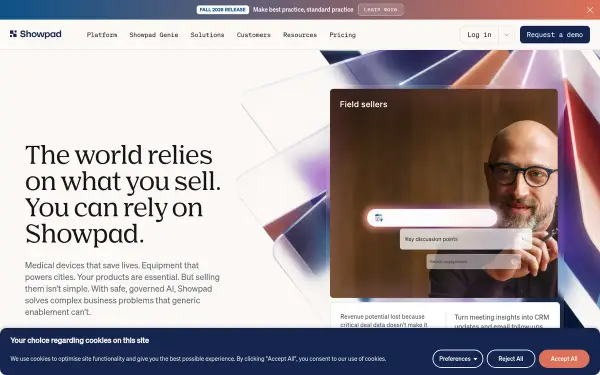
Our verdict
The strongest field content platform here, held back by quote-only pricing and a 2025 merger that raises roadmap questions.
Showpad is built for the rep who walks into a room, opens a tablet and needs the right deck, case study and one-pager without hunting through folders. Mobile content delivery, buyer engagement tools and micro-learning modules live in the same app, and the vendor positions the product for in-person selling. Teams of 100 to 500 reps are the sweet spot: big enough to need governed content, small enough that one enablement lead can run the whole instance.
Pricing is the hard part. Every plan on the vendor site shows Request a quote, with no public figures, so you cannot benchmark before the first call. A median enterprise figure of $219,000 per year and per-user pricing of about $37 to $48 are planning references. Treat those as planning ranges rather than quotes, then ask for a written breakdown by seat, module and contract term.
The October 2025 merger with Bigtincan under the Showpad name is the most important fact for a 2026 buyer. Two content libraries, two admin models and two roadmaps have to become one. Ask which capabilities come from the Bigtincan side, how existing contracts convert, and whether renewal dates are being consolidated across the combined base. Get those answers in writing before a multiyear signature.
Implementation is reported at 6 to 10 weeks in one account and 6 to 9 weeks in another, so plan a quarter where field time is limited. Training and micro-learning support exists, but the center of gravity is content and presentation. If your real gap is video coaching for a distributed team, Allego fits better; if it is certification at scale, Mindtickle does. Showpad wins when the field needs governed content in hand.
Your field team presents in person and needs governed content on a tablet, with coaching as a bonus.
You need a published price before the first call or a certification program at cohort scale.
Entry II of VIII / Video coaching depth
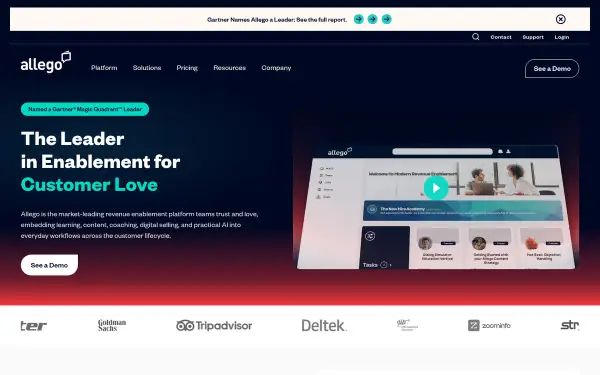
Our verdict
Best video coaching in the list for distributed teams, with compliance-grade delivery and enterprise pricing to match.
Allego pairs enablement with video coaching, which is a different center of gravity from a pure content platform. Reps record calls or role play, managers leave feedback, and AI coaching and role play absorb some of the repetition a manager cannot scale. Compliance-grade content delivery matters in regulated industries, where a wrong version of a document in front of a buyer is a real problem rather than an inconvenience.
Pricing is per user and quote based, usually on a multiyear term. Annual totals of $40,000 to $80,000 and a per-user range of about $30 to $100 depending on seats and modules are planning references. That is enterprise-shaped pricing. A smaller team comparing Allego against a mid-market tool with a published price will usually find it expensive per head, even when the coaching depth is the better match.
Implementation is reported at 6 to 8 weeks, which is reasonable for a platform that touches both content workflows and coaching routines. Coaching depth is the selling point and also the limit: some teams find the content side thinner than expected, particularly if they need heavy content governance, detailed asset analytics or a large library migration from an older system.
Pick Allego when the problem is manager bandwidth and ramp speed across a distributed field force, and when compliance rules mean every rep must see approved content. Skip it when you are buying a content library with light coaching, or when the budget sits nearer SalesHood's $45 per user per month. Get multiyear terms, usage metering for AI coaching and renewal uplift in writing before signature.
Manager bandwidth is the bottleneck and you need video coaching plus compliance-grade content delivery.
You are buying a content library with light coaching or your budget is mid-market per seat.
Entry III of VIII / Readiness analytics
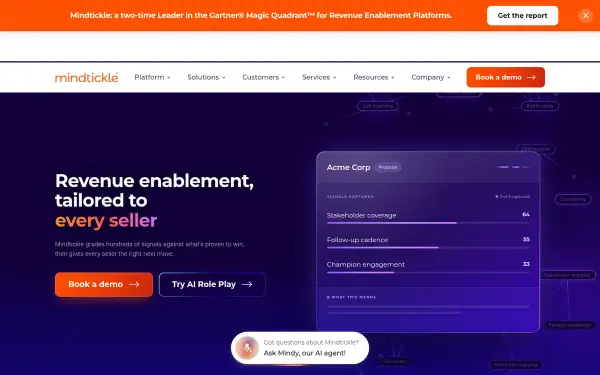
Our verdict
A readiness platform for onboarding and certification at scale, priced by quote and slow to stand up.
Mindtickle is a readiness platform first. Onboarding programs, certification and AI role play are the core, and the Ideal Rep Profile analytics try to show which behaviors separate your best reps from the rest. For a company hiring in cohorts, that combination is more useful than a content library, because the job is getting new reps to a quota number on a predictable schedule rather than handing them a folder of decks.
Pricing is quote only, and no list price appeared on the vendor page used for this list. An average annual figure of about $92,000 suggests the buyer is usually an enterprise with a training budget rather than a manager with a credit card. Expect seats, modules and term to move the number substantially, and ask how AI role play usage is metered before you pilot it widely.
Implementation estimates range from 8 to 12 weeks in one account to 2 to 4 months in another. Either way, plan a quarter before the first cohort runs live. Content governance is secondary here: the platform assumes you already have somewhere to store approved assets and want to train, test and certify reps against them.
Mindtickle fits large training cohorts, distributed onboarding, and any team that must show evidence a rep completed certification. It fits less well when the daily gap is content delivery in front of a buyer, which is Showpad's territory, or when you want a cheap knowledge layer inside Salesforce, which is Spekit's. Ask for a pilot with one cohort and a readiness metric agreed in advance, so the renewal conversation is about evidence.
You hire in cohorts and need onboarding, certification and AI role play with evidence behind it.
Your daily gap is content delivery in front of a buyer or you need a price you can see today.
Entry IV of VIII / CMS plus LMS
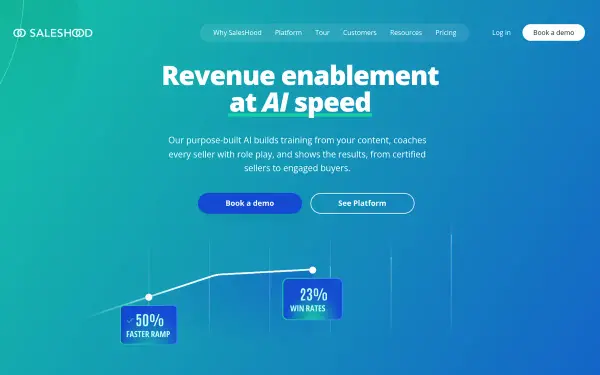
Our verdict
Broad content and learning coverage with a published $45 per seat, best for mid-market teams without enterprise governance needs.
SalesHood covers content management and learning management in one product, which is why mid-market teams shortlist it: one system for the library and the training program, without the enterprise overhead of a Showpad or Allego deployment. The pitch is breadth rather than depth, and for a mid-market team that trade is usually the right one, because two half-used systems are worse than one used system.
Pricing is the clearest in this list. The Essential plan is $45 per user per month, which you can multiply by headcount without a sales call. Confirm what Essential includes before you build a budget on the number; per-user pricing across the base runs about $30 to $80, with a median annual figure of about $38,000. That median is the useful planning number for a mid-market team.
Implementation is reported at 4 to 6 weeks, among the faster timelines here for a product with both a content and a learning side. The brand is smaller than the enterprise names and enterprise depth trails them, so a regulated buyer with complex permission needs should look harder at Showpad or Allego.
SalesHood fits a mid-market team that wants content and training under one contract, a published per-seat price and a rollout inside two months. Skip it if you need compliance-grade delivery, deep coaching or an enterprise permission model, and skip it if the buying committee will not accept a smaller vendor regardless of fit.
You want content and learning under one contract with a $45 per user per month reference price.
You need compliance-grade delivery, deep coaching or complex enterprise permissions.
Entry V of VIII / In-Salesforce guidance
Our verdict
A fast, cheap guidance layer inside Salesforce, not a full enablement platform and not trying to be.
Spekit is guidance, not a full enablement suite. It places contextual answers and in-app digital adoption content inside Salesforce and the other tools reps already use, so a rep sees the definition, the talk track or the next step without leaving the record. Implementation is reported at 2 to 4 weeks, which is fast for anything in this category and short enough to run inside a single quarter.
Pricing is quoted by package and seat count. Typical pricing is reported at $10 to $25 per user per month, well below the enterprise platforms here and easy to justify for a mid-market team. Position it as a knowledge and adoption purchase rather than a content platform replacement, because the budget usually comes from sales operations or revenue operations rather than from marketing content.
The limit is scope. One report describes Spekit as a knowledge tool rather than a full enablement platform and notes no coaching, no AI content suggestions, no rep training and no digital sales rooms. If reps cannot find the right answer inside the CRM, that gap matters more than coaching. If reps cannot present a coherent story to a buyer, Spekit will not fix it.
Spekit fits teams whose enablement problem is adoption: a new process, new fields, new messaging that nobody uses after the launch call, or a CRM rollout that stalled. Skip it if you need deal rooms, certification or manager-led coaching, and look at Dock, SalesHood or Allego instead. Ask how seat-based scaling works when you add a second team.
Reps work inside Salesforce all day and cannot find the right answer at the right moment.
You need deal rooms, video coaching or a certification program.
Entry VI of VIII / Deal rooms and learning
Our verdict
Deal rooms, onboarding and learning with a free tier and list prices, lighter on governance than enterprise rivals.
Dock bundles deal rooms, onboarding workflows, content management and learning into a single platform and sells to mid-market teams that want to move quickly. Setup is self-serve in days to 4 weeks, the shortest reported timeline in this list, and that speed is the main reason small teams put it on a shortlist next to much larger vendors.
It is the only full platform here with a free tier, and the limits on that tier will show up quickly once you have a real library and more than a handful of reps. Paid Standard is $350 per month for 5 users, and Premium is $1,000 per month billed annually for 10 users. Those are list figures, so you can model cost before a call, which is rare in this category.
The trade-off is governance. Enterprise governance is lighter than Showpad or Allego, the brand is smaller, and the platform has a shorter track record. If you need compliance-grade delivery, complicated permission trees across business units or deep coaching analytics, Dock will feel thin, and the low price will not compensate for the rework.
Dock fits a mid-market sales team that wants deal rooms and onboarding running quickly and will trade some depth for speed and a published price. Skip it if procurement requires a long vendor history, or if the enablement program is really a certification program. Ask what the free tier caps and what migration looks like if you outgrow the platform.
You want deal rooms and onboarding live in weeks with a published price and a free tier to test.
Procurement needs a long vendor track record or you require compliance-grade governance.
Entry VII of VIII / In-tool answers
Our verdict
Knowledge findability inside existing tools with a free plan, but no coaching and no deal rooms.
Guru is a knowledge delivery tool. It surfaces contextual answers inside the tools a team already uses, and its strength is findability: a rep asks a question and gets an answer rather than a link to a stale document in a shared drive. If your reps lose time on every call hunting for a policy, a price or a spec, that is the problem Guru addresses.
There is a free plan, which makes it easy to test with one team. Paid plans were reported from $10 per user per month in one report, and pricing is otherwise scoped with sales, with no public figures listed on the vendor page used here. Confirm what the free plan caps and who owns content maintenance before you scale past a pilot.
The scope limit matters. Guru is a knowledge management tool, not a full enablement platform, and one comparison notes it lacks coaching and digital sales rooms. Content delivery is secondary. Teams that need to present, coach and certify will end up buying a second product, and two tools with overlapping content is a maintenance problem nobody budgets for.
Guru fits support and sales teams that need fast, trustworthy answers inside their existing tools, and buyers who want a free start. Skip it if the requirement is deal rooms, video coaching or certification. Compare it with Spekit on Salesforce depth and on how much content authoring each team is realistically willing to do every week.
The problem is finding trusted answers inside tools you already use, and you want a free start.
You need coaching, digital sales rooms or a full certification workflow.
Entry VIII of VIII / Budget content delivery
Our verdict
Budget content delivery that covers sharing and library basics, with pricing you will have to request.
Paperflite is content delivery with a budget reputation. Reps organize the library and share assets with buyers, which covers the core loop many mid-market teams need without the coaching, certification and readiness machinery of an enterprise platform. Treat claims that it delivers most of the value at a fraction of the cost as something to test rather than accept.
Pricing is not published in the sources used for this list, so it appears here as See website and you should not plan a budget from a number you found elsewhere. Paperflite sits in an under $25,000 per year budget band, which is the useful signal: this is a tool bought by a sales or marketing lead, not by a procurement committee with a large line item.
The limits are scope and depth. Coaching and readiness are secondary, the brand is smaller, and enterprise governance is lighter, so a regulated buyer with permission complexity will outgrow it. Content sharing and library organization are solid, but if the problem is that reps cannot present or managers cannot coach, Paperflite will not solve it.
Paperflite fits a smaller team that needs to stop sharing decks over email and start sharing assets with buyers, at a price that does not require a business case. Skip it if you need certification, role play or deep analytics. Ask directly for a pricing sheet with seats and term, because the public site does not give you one.
You need content sharing on a small budget and can live without coaching.
You need published pricing up front, certification or enterprise governance.
VIBackground
Sales enablement software gives a sales team one place to store what it sells and one way to teach reps how to sell it. In practice that splits into a few jobs vendors combine differently:
Most products here do two of those well and one badly. Showpad is strongest on content delivery and field presentation. Allego is strongest on video coaching and compliance-grade delivery. Mindtickle is strongest on onboarding, certification and role play. Spekit and Guru barely do content delivery at all: they put answers where work happens, which is a different purchase with a different budget owner.
If you started from Seismic, the question is rarely whether the category is right. It is which slice of the category you need, and whether you can buy that slice without paying for the rest. A small team that needs deal rooms and onboarding should not be evaluating a certification platform, and a distributed field force with weak manager coverage should not buy a content library and hope coaching follows.
One more framing point: these tools sit next to learning management systems, knowledge bases and sales content platforms, and buyers often arrive with two overlapping budgets. Before you shortlist, work out whether the budget belongs to training, marketing content or sales operations. That determines who signs the contract and which of the eight tools here is actually in scope.
This comparison sits in the software register. Further along the shore: baby tracking app and kennel software.
VIIPricing
Sales enablement pricing comes in four shapes, and only three of them let you see a number before you talk to a rep. Per-user pricing is the easiest to model, tiered plans give a small team a fixed bill, free tiers let you test, and custom quotes hide the figure behind seats, modules and term length. The table maps each shape to the tools in this list that use it.
| Model | How it bills | Typical fit | Example from this list |
|---|---|---|---|
| Free tier | No charge, with feature and user limits | Small teams testing a workflow | Dock and Guru both offer a free plan |
| Per user per month | Charge for each seat, monthly or annual | Mid-market teams with stable headcount | SalesHood at $45 per user per month on Essential |
| Tiered platform plan | Flat monthly fee for a set bundle of users | Teams that want a predictable bill | Dock Standard at $350 per month for 5 users; Premium at $1,000 per month billed annually for 10 users |
| Custom quote | Scoped by seats, modules and contract term, often multiyear | Enterprise and regulated teams | Showpad, Allego, Mindtickle and Spekit, all listed as See website |
Why does so much of the category quote instead of publishing? Because the sale is rarely seats alone. A field team that needs mobile presentation support, a regulated team that needs compliance-grade delivery and a training team that needs certification each pull a different bundle, and vendors price the bundle. Allego is per-user and quote based, usually multiyear, with annual totals of $40,000 to $80,000. Mindtickle is quote only, with an average annual figure of about $92,000. Showpad carries a median enterprise figure of $219,000 per year.
The practical move is to request a written breakdown covering seats, modules, term, implementation and renewal uplift, then compare it with the published anchors: SalesHood at $45 per user per month, Dock at $350 per month for 5 users, Spekit at $10 to $25 per user per month and Guru from $10 per user per month. Paperflite and Guru published no paid pricing on the pages used here, so ask for a pricing sheet rather than a range.
Each entry card shows the starting price as it appeared on the vendor's own pricing page on November 25, 2026. When a vendor shows no figure we could confirm, or only a promotional rate, the card says "See website" or gives the regular price instead of a guess. Usage, overage and add-on rates in the text change more often than plan prices, so confirm them on the vendor page before you set a budget. To test the numbers against your own volume, try the free User Research Budget Planner. The Event Break-Even Calculator is a second way to check the same decision.
VIIIDecision
IXPitfalls
XQuestions
Showpad is the better fit when reps present in person, because mobile content delivery and buyer engagement tools are the core of the product. Allego is the better fit when the problem is video coaching across a large distributed team, since coaching, AI role play and compliance-grade delivery are its strengths. Showpad merged with Bigtincan in October 2025, so add merger questions to your evaluation.
Dock and Guru both offer a free plan. Dock is the only full platform here with a free tier, and its paid Standard plan starts at $350 per month for 5 users. Guru's free plan covers knowledge delivery, with paid plans reported from $10 per user per month. Neither free plan replaces a paid rollout for a real team, so treat them as a test rather than a destination.
Because the bill is driven by modules and term as much as by seats. A field team needing mobile presentation support, a regulated team needing compliance-grade delivery and a training team needing certification each pull a different bundle, and vendors price the bundle. Annual totals vary widely: $40,000 to $80,000 for Allego, about $92,000 for Mindtickle and a median of $219,000 for Showpad.
It changes what you are buying. The two products merged under the Showpad name in October 2025, so a November 2026 evaluation should ask which capabilities come from the Bigtincan side, how existing contracts convert and whether renewal dates are being consolidated. The merger does not disqualify Showpad, but it makes written answers about product direction more important than a polished demo.
You need enterprise governance when approved content must be provably delivered, when permissions differ across regions or business units, and when someone has to show an auditor that every rep saw the current version. That pushes you toward Showpad, Allego or Mindtickle. Mid-market tools like Dock, SalesHood and Paperflite carry lighter governance, which is usually fine below a few hundred reps.
Plan for days to 4 weeks with Dock, 2 to 4 weeks with Spekit, 4 to 6 weeks with SalesHood, 6 to 8 weeks with Allego, 6 to 10 weeks with Showpad and 8 to 12 weeks with Mindtickle, based on the timelines described here. Paperflite and Guru had no timeline in the sources used, so ask both vendors directly and get the answer in the contract.
XIFurther along the shore
Vendors can ask for a correction or apply for a Featured listing. Paid or not, the entry is scored on the same rubric and its limits stay in print. Partner with Umberlake.
Free tools
Our free browser tools turn the prices on this page into a figure for your own volume. Nothing you type leaves your device.