Oracle NetSuite
See websiteCustom quote built from modules, user counts and subsidiary structure, no public list price
Best for growing companies needing a full cloud ERP
- Free plan
- No
- Rubric
- 6.7 of 10
Eight tools that pick up where QuickBooks Enterprise stops, from quote-only ERP platforms to cheap cloud accounting, matched to the buyer each one actually fits.

IThe short answer
Oracle NetSuite is the broadest move up from QuickBooks Enterprise, Sage Intacct suits finance teams wrestling multi-entity consolidation, and Microsoft Dynamics 365 Business Central is the practical pick for Microsoft 365 shops. Prices were checked on 25 November 2026 across eight tools: NetSuite, Sage Intacct, Business Central, Odoo, SAP Business One, Acumatica, Xero and QuickBooks Online. Only Business Central, Odoo and QuickBooks Online publish a usable starting price, so most budget talks here begin with a quote rather than a number: Quickbooks Enterprise Alternatives.
8 tools compared from vendor pages on November 25, 2026. 3 publish a starting price we could read; the rest say "See website".
IITop three berths
Register order is editorial fit for the buyer each entry describes. Prices are the starting figures read on November 25, 2026.
See websiteCustom quote built from modules, user counts and subsidiary structure, no public list price
Best for growing companies needing a full cloud ERP

See websitecustom quote
Best for finance-led firms with multi-entity accounting complexity

$80Essentials, per user per month, billed yearly
Best for eRP for teams already standardized on Microsoft
How this page is paid for. All 8 tools here are unpaid editorial picks.
A paid listing's position can be part of what the vendor pays for. Every entry, paid or not, is scored on the same rubric and keeps its limits in print. Advertising disclosure.
IIIThe register
Starting prices as shown on each vendor's pricing page on November 25, 2026. "See website" means no figure we could confirm.
| No. | Tool | From | Free plan | Trial | Rubric | Actions |
|---|---|---|---|---|---|---|
| 01 | Oracle NetSuitegrowing companies needing a full cloud ERP | See websiteCustom quote built from modules, user counts and subsidiary structure, no public list priceNot shown publicly | No | No | 6.7 | |
| 02 | Sage Intacctfinance-led firms with multi-entity accounting complexity | See websitecustom quoteQuote only | No | No | 6.5 | |
| 03 | Microsoft Dynamics 365 Business CentralERP for teams already standardized on Microsoft | $80Essentials, per user per month, billed yearlyRead on vendor page | No | Free 30-day trial | 7.6 | |
| 04 | Odoomodular ERP for budget-conscious growing businesses | $7.25Standard, per user per month, billed yearly, all apps includedUpdated on vendor page | Yes | Free trial | 7.0 | |
| 05 | SAP Business Onesmaller distributors and manufacturers wanting SAP depth | See websiteQuote based, sold exclusively through SAP partners, total cost includes licences, implementation and supportNot shown publicly | No | No | 6.1 | |
| 06 | Acumaticadistributors, manufacturers and field service operations | See websitecustom quoteQuote only | No | No | 6.3 | |
| 07 |  Xerosmall firms that mainly need cloud accounting | See websiteEntry plan, per month, after an introductory periodNot shown publicly | No | 30 day free trial | 6.5 | |
| 08 | QuickBooks Onlinefirms staying in the QuickBooks cloud ecosystem | $38Simple Start, per month, 1 user, 70% off for 3 months promoUpdated on vendor page | Yes | Free 30-day trial | 6.8 |
Pinned:
IVMethod
Whether inventory, production, procurement and consolidation run inside the same system as the ledger.
Strength of the general ledger, consolidation, revenue recognition and financial reporting before any operational module.
How much of the cost a buyer can see and budget for before speaking to a salesperson or partner.
How much partner time, configuration work and internal effort a live rollout typically demands.
Breadth of integrations, add-ons and partner extensions that extend the core product over time.
VMethod
We ranked these eight tools on the job a QuickBooks Enterprise buyer is actually trying to do, not on how big the vendor is. Five criteria carried the scoring, and each one is weighted in the rubric above.
ERP depth got the largest weight at 25 percent because most people leaving Enterprise are chasing inventory, production or multi-entity depth they could not get in desktop accounting. Accounting fit at 20 percent asks whether the general ledger, consolidation and reporting are strong before any operations modules. Pricing clarity and implementation load each take 20 percent, reflecting how often quote-only deals and partner-led rollouts blow past a finance team's first budget. Ecosystem and integrations take the last 15 percent.
Every price in this list was read from the vendor's own pricing page on 25 November 2026. Where a vendor publishes no list price, we say pricing is on the vendor site and start from the quote model described in its plan notes rather than estimating a figure. We do not convert currencies or project totals. We also checked whether each tool can carry growth over time without forcing a second migration.
The Featured placement in this list is a paid position and is scored with the same rubric as every other entry, cons included. Position order is editorial: it reflects fit for the buyer described in each entry plus the disclosed Featured slot, not a calculated total.
The full routine, from price reads to corrections, is on the methodology page. Paid listings follow the advertising disclosure.
Entry I of VIII / One database ERP
Our verdict
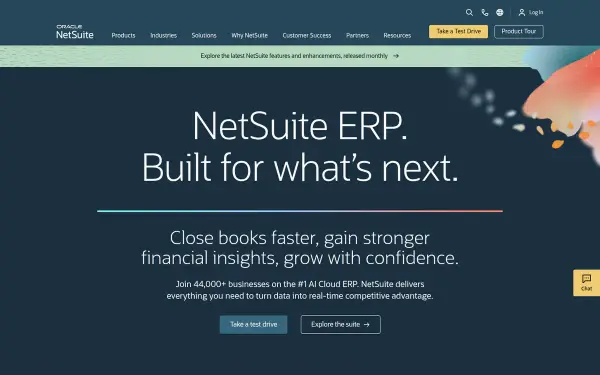
The broadest step up here, with financials, inventory, CRM and procurement sharing one database, priced only by quote.
Oracle NetSuite is the widest step up on this list: financials, inventory, order management, procurement and CRM share one database, so a sales order and its revenue recognition rule live in the same place as the ledger entry. Multi-subsidiary consolidation and multi-currency handling are native rather than bolted on, which matters once a company opens a second entity or sells across borders.
The case for it is growth. A distributor that outgrows desktop accounting usually ends up juggling an accounting package, a separate inventory tool and a CRM. NetSuite removes those joins. Revenue recognition rules and ecommerce connectors are listed features, and the system scales from mid-market to large organizations.
The case against it is cost visibility. NetSuite quotes per deal from modules, user counts and subsidiary structure, and there is no public list price and no trial. Implementation typically runs through a partner over several months, so the total spans licences plus services for setup, data migration and training. Ask for the licence line, the services line and the annual support line as three separate numbers before comparing it to anything else.
Treat NetSuite as the answer for a growing company that needs a full cloud ERP and can fund a partner-led rollout, not as a drop-in replacement for a desktop file. The weak spots are pricing clarity and rollout effort, not capability. It is the broadest platform here and also the least predictable to budget.
You need a single cloud ERP covering inventory, CRM and multi-entity consolidation and can fund a partner rollout.
You need a published price and a self-serve setup this quarter.
Entry II of VIII / Dimensional ledger
Our verdict
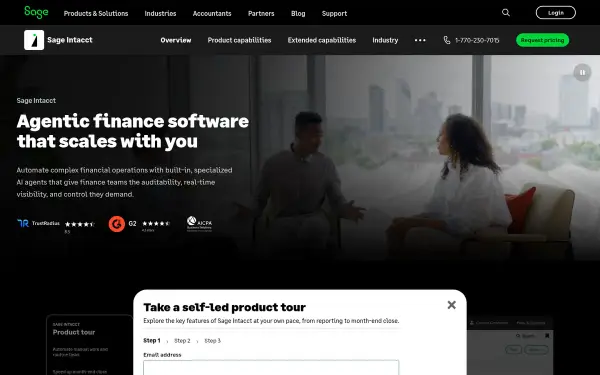
A finance team's ERP, built around a dimensional ledger and clean consolidation, sold only through a scoped quote.
Sage Intacct is built around a dimensional general ledger. Instead of adding accounts to the chart every time finance wants a new cut, teams tag transactions with dimensions (commonly up to 10, per vendor descriptions) and report by department and project from the same ledger. For a firm with several entities, that is a materially different way of working from QuickBooks Enterprise.
Multi-entity consolidation and intercompany transactions are the features that pull finance teams in. Consolidated reporting arrives without a spreadsheet bridge, and audit-ready reporting is a first-class output rather than an export exercise. Nonprofits get fund accounting, and project-driven firms get reporting by project and department without standing up a second system.
Pricing is quote only. The vendor page offers a request pricing form and nothing else: no list price, no free plan, no trial. Annual cost depends on configuration, so a quote should separate licences, implementation and support rather than arriving as one figure. Implementation is also heavier than a QuickBooks migration, which is the honest trade for a ledger this structured.
Where it does not fit is inventory and shop floor control. If the core problem is stock accuracy or production scheduling, an operations-first platform will serve better. Sage Intacct suits finance-led firms with multi-entity accounting complexity, particularly SaaS, nonprofit and professional services teams whose reporting burden grows faster than their headcount.
Consolidation, intercompany work and dimensional reporting are the reasons you are leaving QuickBooks Enterprise.
Stock control or production scheduling is the problem you need solved.
Entry III of VIII / Microsoft 365 native
Our verdict
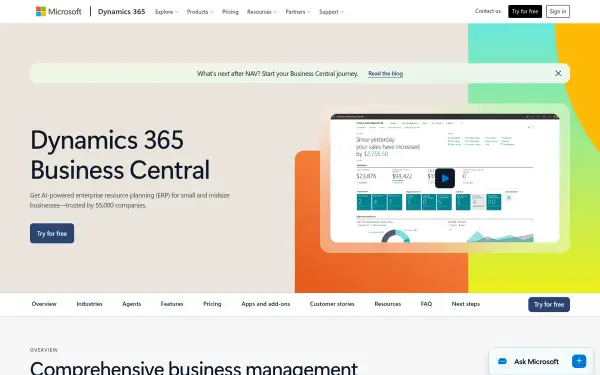
The ERP for Microsoft 365 shops, and one of the few ERP options here that publishes a per user starting rate.
Microsoft Dynamics 365 Business Central is the ERP for teams that already live in Microsoft 365. Financial management, inventory management and job and project costing sit in one system, and the identity and collaboration layer is the one your staff already sign into, which shortens adoption more than any training course.
It is also one of the few ERP options here with a published starting rate. Essentials lists at $80 per user per month on a yearly commitment, and Premium at $110 per user per month. That makes early budgeting possible before a partner conversation, though the per user model means a larger company should do the multiplication carefully, especially when some staff only touch the system occasionally. Yearly billing is the listed commitment, so ask for the annual figure rather than the monthly one.
Multi-company support is included, and partner add-ons cover manufacturing and warehousing depth the base product does not carry. That is the honest limit: complex manufacturing, warehousing or multi-company rollouts usually need a partner to configure, and the Premium tier costs more per user. Teams wanting a fully guided, no-partner rollout will not get one here.
There is a free 30-day trial, no free plan, and Essentials remains the sensible entry point for most mid-market buyers. Choose Business Central when the Microsoft stack is already the backbone of the business: Microsoft identity, Teams and a familiar interface all reduce friction. Choose something else if your operation is shop-floor heavy from day one or if you cannot support a partner relationship.
Your team works in Microsoft 365 daily and you want a priced, per user route into ERP.
You need shop floor depth at go-live with no partner involved.
Entry IV of VIII / All apps included
Our verdict
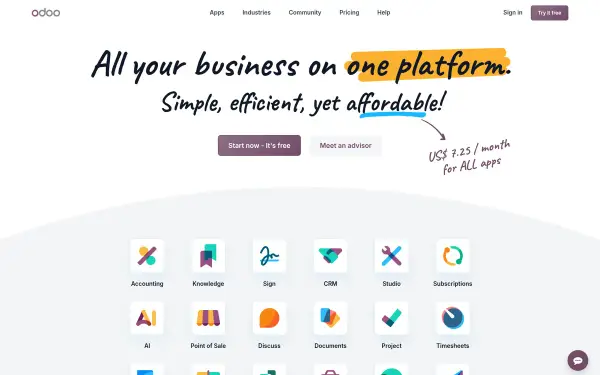
The modular ERP with a published per user rate and every app included, at the cost of real configuration work.
Odoo is modular ERP sold on a simple premise: one per user price covers every app. Standard lists at $7.25 per user per month billed yearly, with all apps included, and there is a free trial plus a free plan that covers one app. The Community edition is open source, which is why small teams can start at almost nothing and add accounting, inventory, sales, CRM, manufacturing, project management or ecommerce as they grow.
The strength is switching things on. A company can begin with invoicing and inventory, then add CRM or manufacturing without negotiating a new module price. Enterprise licensing avoids the module by module stacking that makes some ERP quotes hard to read, and the free plan covering one app gives a genuine evaluation path before any spend.
The weakness is configuration effort. Odoo gives you a toolkit, not a finished process, and quality varies between modules and between implementation partners. Projects sprawl when scoping is loose, and a team without an internal owner will spend months deciding how to map its own workflows. Budget for a partner or a capable internal administrator.
Pricing clarity is why it scores well here: $7.25 per user per month on Standard is a number you can put in a spreadsheet next to Business Central and QuickBooks Online. Whether that number holds depends on how many people need access and how much customisation you accept. It suits budget-conscious growing businesses that want ERP shape without ERP entry pricing.
You want a published per user price and are willing to invest in configuration discipline.
Nobody on your team can own scoping and system administration.
Entry V of VIII / Distribution depth
Our verdict
SAP operational depth for smaller distributors and manufacturers, available only through partners at quote-based prices.
SAP Business One is the small-company end of SAP: financials, sales, purchasing, inventory, production and CRM in one system, sold exclusively through partners. It brings SAP-grade operational control to firms up to a few hundred staff without pushing them onto S/4HANA, which is the tier above it in the portfolio.
The operational depth is the draw. Distributors get purchasing, stock and sales in one chain. Manufacturers get production alongside the ledger. Auditability controls and a recognized vendor name reassure auditors and larger customers, which is a real consideration for firms bidding for enterprise contracts where the software stack gets reviewed.
The cost is not published. There is no vendor pricing page, no free plan and no trial, and total cost spans licences, implementation and support through a partner. That makes early side-by-side comparison hard: two partners can quote the same product at very different totals depending on scope, licence counts and support terms. Confirm all three before you sign, and get the scope in writing rather than in a slide.
It suits smaller distributors and manufacturers that want SAP depth and are ready to work through a partner relationship over months rather than weeks. It is a poor fit for a small team that wants a self-serve rollout, a published rate or a low-friction switch from desktop accounting with minimal outside help.
You are a distributor or manufacturer that wants SAP depth and will invest in a partner relationship.
You need a published price and a short, self-managed rollout.
Entry VI of VIII / Resource based pricing
Our verdict
A cloud native ERP priced on resources rather than seats, suited to operations-heavy teams with many occasional users.
Acumatica is a cloud native ERP with separate editions for distribution, manufacturing, construction and field service. Financials are the core, and inventory and warehouse operations sit inside the same system rather than in a bolt-on that has to be reconciled back to the books.
Its distinguishing feature is resource based pricing. Instead of charging a full seat for every warehouse or shop floor user, the licence is built around resources, so occasional users do not each need a full named seat. For operations-heavy firms with many people who touch the system lightly, that changes the arithmetic substantially compared with per user competitors.
Sales and implementation run through partners, and pricing is a custom quote. The vendor page explains the resource based model and asks buyers to request a pricing review, which means no headline number to compare against Business Central at $80 or Odoo at $7.25. Ask each partner for a defined scope, references from similar operations and a fixed implementation estimate. Without that, two quotes can look identical and behave very differently six months in.
It fits distributors, manufacturers and field service operations that need industry edition depth and have a mixed population of heavy and occasional users. It is a weaker choice when the buyer wants a direct purchase, a short self-serve setup or a simple accounting replacement for a small team with no operational complexity to solve.
Many of your users only need occasional access and you want industry edition depth.
You cannot pin a partner to a fixed scope and budget.
Entry VII of VIII / Bank reconciliation
Our verdict
Clean cloud accounting with unlimited users on plans, but not the answer to an inventory or consolidation problem.
Xero is cloud accounting, not ERP. Invoicing, bill management, bank reconciliation and financial reporting are the core, and unlimited users on plans means the whole team can see the books without buying seats. The bank reconciliation workflow is one of its strengths for clients moving off desktop software.
The ecosystem is the second reason. Payroll integrations and an app marketplace extend the core product, and inventory add-ons are available. A small firm can assemble a workable stack without paying for modules it will never open, and the 30-day free trial gives a real test before committing.
The limits are clear at the top. Inventory depth is thin, multi-entity consolidation is not what the product is built for, and advanced capabilities sit on higher plans. Pricing is on the vendor site, and the entry plan runs per month after an introductory period, with no free plan. Check the current rate on the vendor page rather than relying on last year's renewal quote.
It fits small firms that mainly need cloud accounting and a bookkeeper-friendly workflow, especially where several people need read access without extra seats. It does not fit a distributor that needs stock depth, a group that consolidates entities or a manufacturer. If you are leaving QuickBooks Enterprise because of inventory or consolidation pressure, Xero moves you sideways rather than forward.
Your books are simple and several people need access without buying seats.
Stock depth or entity consolidation is why you are leaving Enterprise.
Entry VIII of VIII / Desktop migration path
Our verdict
The lowest friction move for existing Enterprise users, with a hard ceiling on inventory and consolidation.
QuickBooks Online is the lowest friction move for an existing Enterprise user. Cloud accounting, multi-user collaboration, automatic product updates and the same terminology, charts and reports mean less retraining than switching to an unfamiliar ledger, and the reporting habits your team already has carry over.
Simple Start lists at $38 per month for one user, currently shown with a temporary promo rate and a 70 percent off for three months offer. There is a free QuickBooks Free plan and a free 30-day trial. Migration paths from Desktop Enterprise exist, and the app ecosystem extends payroll, payments and inventory through third party connectors.
The caps matter more than the headline price. Lower tiers limit users and features, so a larger finance team ends up on a higher plan quickly. Advanced inventory, multi-company reporting and consolidation trail what a full ERP does, and long term cost climbs as add-ons accumulate. Check user limits and add-on costs before assuming the cloud version covers everything Enterprise covered on the desktop.
It fits firms that want to stay in the QuickBooks cloud ecosystem and can live inside its ceiling, particularly service businesses with light stock. It does not fit a distributor with real stock control needs or a group consolidating several entities. For those buyers, Odoo, Business Central or NetSuite is the honest next step, and the quote conversation is worth starting early.
You want the shortest switch and your stock and entity needs are simple.
You need real inventory control or multi-entity consolidation.
VIBackground
QuickBooks Enterprise alternatives are accounting and ERP systems that can take over the general ledger plus at least some of the operational work around it: inventory, purchasing, projects, production or multi-entity consolidation. The category splits into two halves, and knowing which half you need answers most of the buying question.
The first half is cloud accounting. Xero and QuickBooks Online keep the books, reconcile bank feeds and invoice customers, and both connect to payroll through integrations and app marketplaces. They are cheap, fast to start and easy to hand to a bookkeeper. What they do not do is hold real inventory depth, consolidate several legal entities cleanly or run a shop floor.
The second half is ERP. Oracle NetSuite, Sage Intacct, Microsoft Dynamics 365 Business Central, SAP Business One, Acumatica and Odoo all assume the ledger is one module among many. Inventory, purchasing, production and reporting share the same records, which is why a stock adjustment shows up in the accounts without a manual journal.
Signals that you have crossed into ERP territory:
Signals that cloud accounting is still enough: one entity, simple stock, no production and a bookkeeper who owns the ledger. Buying ERP for that profile adds cost and implementation time without adding control over anything that was previously out of control.
The line is not permanent. Odoo and Business Central both start narrow and expand, which is why their published per user pricing gets attention from firms that expect to grow into more modules later rather than buying everything on day one.
This comparison sits in the software register. Further along the shore: baby tracking app and kennel software.
VIIPricing
Pricing in this category follows one of a few models, and the model tells you as much about fit as the number does. Per user pricing is transparent and scales with headcount. Resource based pricing scales with how often people use the system. Plan tiers scale with features. Quote pricing scales with configuration, which is exactly why it is hard to budget.
| Model | How it bills | Typical fit | Example from this list |
|---|---|---|---|
| Per user | Per user per month on a yearly commitment | Teams needing a number before a sales call | Microsoft Dynamics 365 Business Central at $80 on Essentials |
| Per user, all apps | Per user per month billed yearly | Growing firms that add modules over time | Odoo at $7.25 on Standard |
| Plan tiers | Monthly per company, with user caps on lower tiers | Small firms with straightforward books | QuickBooks Online at $38 on Simple Start, 1 user |
| Resource based | Quote built from resources and editions | Operations-heavy firms with many occasional users | Acumatica |
| Module and entity quote | Custom quote from modules, users and subsidiaries | Multi-entity mid-market and larger | Oracle NetSuite |
| Partner quote | Licences plus implementation plus support | Distributors and manufacturers buying through a partner | SAP Business One, Sage Intacct |
Four of the eight vendors here publish no list price at all. That is not evasion; a NetSuite or Acumatica deal genuinely changes shape with module count, user mix and entity structure. The practical response is to demand components: licence, implementation and support as three separate lines, with scope in writing.
Watch the difference between a rate and a total. Business Central at $80 per user per month is a rate, and a larger company pays a different total than a small finance department. Xero prices on the vendor site with an entry plan after an introductory period. Budget the total, not the rate.
Each entry card shows the starting price as it appeared on the vendor's own pricing page on November 25, 2026. When a vendor shows no figure we could confirm, or only a promotional rate, the card says "See website" or gives the regular price instead of a guess. Usage, overage and add-on rates in the text change more often than plan prices, so confirm them on the vendor page before you set a budget. To test the numbers against your own volume, try the free User Research Budget Planner. The Event Break-Even Calculator is a second way to check the same decision.
VIIIDecision
IXPitfalls
XQuestions
Oracle NetSuite brings financials, inventory, order management, procurement, CRM, multi-subsidiary consolidation and revenue recognition together in one database. Acumatica and SAP Business One add operational depth for distributors and manufacturers, and Business Central covers financials, inventory and job costing. Breadth is not free. NetSuite quotes per deal and typically needs a partner-led rollout over several months.
Cloud accounting is enough when you run one entity, simple stock, no production and a bookkeeper who owns the ledger. Xero and QuickBooks Online handle that profile well and cost far less to start. Move to ERP when you keep a second system for inventory or jobs, when month end needs a spreadsheet to consolidate entities, or when role-limited access to operational records becomes necessary.
Because their price depends on configuration. NetSuite, Sage Intacct, SAP Business One and Acumatica build quotes from modules, user or resource counts, entity structure and partner services, so one list price would mislead more than it helps. The practical consequence is that comparison starts with a scoped quote covering licences, implementation and support as separate lines.
Odoo lists $7.25 per user per month on Standard with all apps included, and QuickBooks Online lists Simple Start at $38 per month for one user. Xero prices on the vendor site with an entry plan after an introductory period. QuickBooks Online and Xero are accounting tools, so they do not carry the inventory, consolidation or production depth that pushed you off QuickBooks Enterprise. Odoo lists $7.25 per user per month on Standard and includes inventory and manufacturing apps.
Accounting data migration covers chart of accounts, open balances, customers and vendors. A full ERP rollout also covers inventory records, open orders, production routings and reporting, all of which need mapping and testing. NetSuite, Sage Intacct, SAP Business One and Acumatica typically run through a partner, so the partner's queue and your internal availability matter as much as the software.
Sage Intacct is the finance-led pick, with a dimensional ledger, intercompany transactions and consolidation that arrive without a spreadsheet bridge. Oracle NetSuite handles multi-subsidiary consolidation natively and suits larger groups that also need inventory and CRM depth. Business Central supports multi-company work. Xero and QuickBooks Online are not built for consolidation and should not be shortlisted for it.
XIFurther along the shore
Vendors can ask for a correction or apply for a Featured listing. Paid or not, the entry is scored on the same rubric and its limits stay in print. Partner with Umberlake.
Free tools
Our free browser tools turn the prices on this page into a figure for your own volume. Nothing you type leaves your device.