People Data Labs
$98Pro, per month, starting at 350 credits, monthly or annual
Best for person and company data APIs at scale
- Free plan
- Free, up to 100 credits per month
- Rubric
- 7.5 of 10
Seven tools that replace a Coresignal subscription, from API-first data suppliers to sales prospecting platforms and email finders, with prices checked on November 25, 2026.

IThe short answer
People Data Labs is the closest Coresignal alternative for teams that need an API-first supply of person and company records, starting at $98 per month on the Pro plan. Apollo.io suits sales teams that want search, sequences and CRM sync in one tool from $49 per seat per month, billed annually. RocketReach fits individual contact lookups at $27 per month on annual billing. Prices were checked on November 25, 2026, and the remaining four entries cover reveal tools, email verification, European mobile data and in-house web collection: Coresignal Alternatives.
7 tools compared from vendor pages on November 25, 2026. 5 publish a starting price we could read; the rest say "See website".
IITop three berths
Register order is editorial fit for the buyer each entry describes. Prices are the starting figures read on November 25, 2026.
$98Pro, per month, starting at 350 credits, monthly or annual
Best for person and company data APIs at scale

$49Basic, per seat per month, billed annually, 30,000 credits
Best for sales prospecting with workflow, search, sequences and CRM sync

$27Essentials, per month, billed annually at $329 per year, 1,200 exports per year
Best for contact lookup and filtered search
How this page is paid for. All 7 tools here are unpaid editorial picks.
A paid listing's position can be part of what the vendor pays for. Every entry, paid or not, is scored on the same rubric and keeps its limits in print. Advertising disclosure.
IIIThe register
Starting prices as shown on each vendor's pricing page on November 25, 2026. "See website" means no figure we could confirm.
| No. | Tool | From | Free plan | Trial | Rubric | Actions |
|---|---|---|---|---|---|---|
| 01 | People Data LabsPerson and company data APIs at scale | $98Pro, per month, starting at 350 credits, monthly or annualRead on vendor page | Yes | Free test credits | 7.5 | |
| 02 | Apollo.ioSales prospecting with workflow, search, sequences and CRM sync | $49Basic, per seat per month, billed annually, 30,000 creditsRead on vendor page | Yes | 14-day free trial | 7.3 | |
| 03 | RocketReachContact lookup and filtered search | $27Essentials, per month, billed annually at $329 per year, 1,200 exports per yearUpdated on vendor page | Yes | Free allowance | 6.5 | |
| 04 |  LushaOne click contact reveals for sales reps | $37.45Starter, per month, billed yearly, 4,800 credits per year, 1 seat includedUpdated on vendor page | Yes | Free tier with limited credits | 6.5 | |
| 05 |  HunterEmail finding and verification | $34Starter, per month, billed yearly at $408 per year, 24,000 credits per yearRead on vendor page | Yes | Free plan available | 7.1 | |
| 06 |  CognismEuropean contacts with verified mobile numbers | See websitecustom quoteQuote only | No | No | 6.0 | |
| 07 |  Bright DataCollecting public web data in house | See websiteusage based per unit pricing, e.g. $1 per 1k requests, free tier includedNot shown publicly | Yes | Free trial available | 6.6 |
Pinned:
IVMethod
How many person and company records a tool reaches, and how often those records refresh.
Whether the tool supports programmatic access and embedding records in your own product.
How easy it is to work out a real monthly cost from the published plans and limits.
Lawful basis, do-not-call screening and documentation support for regulated contact data.
How quickly a non-technical team can get value without engineering help.
VMethod
We scored each tool on five criteria: data coverage, API fit, pricing clarity, compliance support and ease of use. Coverage carries the most weight because a contact database is only useful if it reaches your market, and API fit matters almost as much for buyers leaving Coresignal. Pricing clarity asks how much work it takes to reach a real monthly figure. Compliance support covers lawful basis, screening and documentation. Ease of use covers how fast a non-technical team gets value.
Every price in this list comes from the vendor's own pricing sheet or product page, checked on November 25, 2026. Where a vendor publishes no figure, the entry says pricing is on the vendor site and gives no number. We did not convert currencies, and we did not infer a monthly rate from an annual contract where the vendor did not state one.
The list order is editorial. It reflects fit for the buyer each entry describes, not a weighted total. A Featured placement, where one exists, is a paid position scored with the same rubric and given the same honest cons; no entry in this list carries a Featured placement. Strengths and weaknesses come from the published plan limits, the feature set and the licensing terms rather than vendor marketing claims. Where a vendor's own numbers disagree between a plan page and a footnote, we used the plan page and said so in the entry.
The full routine, from price reads to corrections, is on the methodology page. Paid listings follow the advertising disclosure.
Entry I of VII / Per-match API billing
Our verdict
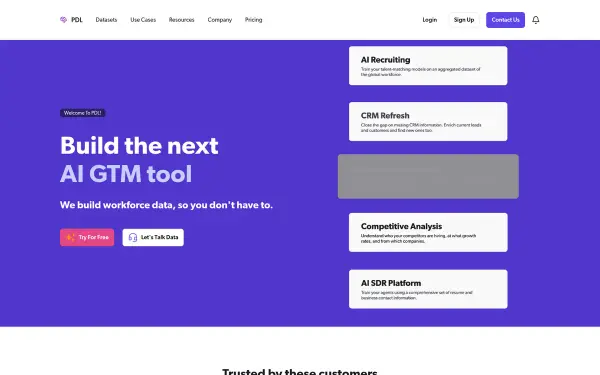
The closest API-first Coresignal replacement, priced per successful match, with no interface for non-technical teams.
People Data Labs is the closest match to Coresignal in this list: a data supplier you call through an API rather than a tool your sales team logs into. The product covers person enrichment, company enrichment, search and identity resolution, and it bills per successful match, so a request that returns nothing does not spend credits. There is no user interface, and that is the point. You wire the endpoints into your own application, enrichment job or scoring model and treat the record set as a component.
Pricing starts at $98 per month on the Pro plan for 350 credits, available monthly or annual. A free tier covers up to 100 credits per month, and free test credits let you measure match rates against your own sample before you buy. Records refresh monthly rather than in real time. Licensing for product use, where the data sits inside something you sell, is available on enterprise terms.
The trade-offs are practical. Without an interface, a non-technical team cannot browse or export records, so you need someone who can work with JSON and pagination. Bulk requests consume credits quickly, which makes a small dry run worth the time. Contact fields sit on higher tiers or enterprise terms, so budget above the entry price if email and phone matter. Customers carry the lawful basis and deletion requests themselves.
It fits data and platform teams that want a supplier contract and a predictable per-match cost, not a seat-based prospecting seat. If you need a human working in a browser tab, look further down this list.
You are building enrichment into an application or warehouse and want a per-match contract.
Your team needs a browser interface or live refresh.
Entry II of VII / Workflow plus data
Our verdict
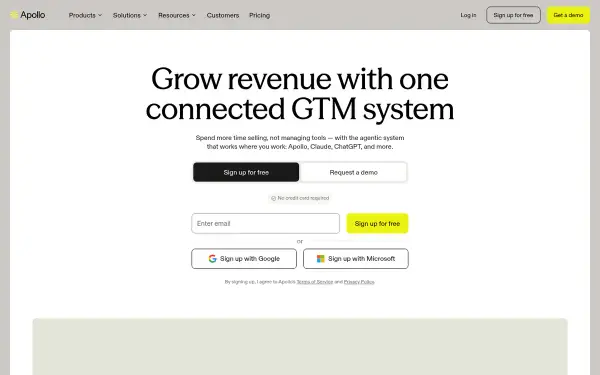
A full prospecting workflow on top of a large contact database, best value for sales teams rather than data teams.
Apollo.io is the opposite end of the market from People Data Labs: a sales platform with a large contact database attached, not a raw data feed. Search runs without credit use, which means reps can filter and build lists without spending the 30,000 credits that come with a paid seat. Those credits go on reveals, enrichment and exports. Email sequences, a dialler and CRM sync sit in the same product, so a team can move from list to outreach without a second subscription.
Pricing starts at $49 per seat per month on the Basic plan, billed annually. A free plan covers 900 credits per month, and there is a 14-day free trial. The product includes a large B2B contact database. For a small sales team the arithmetic is easy and the cost is predictable.
The limits matter if you were hoping for a data supplier. Records are licensed for use inside Apollo, not for building your own data product, so anything that resells or embeds the data is out. Full API access sits on custom plans, so an engineering team that wants programmatic enrichment has to negotiate rather than self-serve. Accuracy varies.
It fits a sales or revenue team that wants one tool for search, outreach and CRM hygiene without engineering help. It does not fit a product team that needs records inside an application or a warehouse, and per-seat pricing gets expensive when the buyers are analysts rather than reps.
A sales team needs search, outreach and CRM sync in one subscription.
You need records for embedding in a product or a bulk export contract.
Entry III of VII / Quick contact lookup
Our verdict
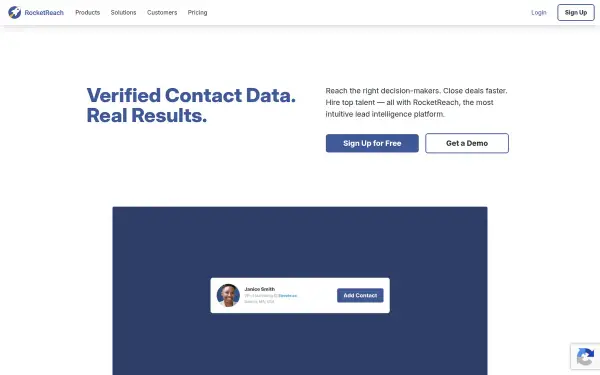
Fast, affordable contact lookup for recruiters and individual sellers, though it trails API-first suppliers on company depth.
RocketReach is a lookup tool rather than a data platform. You search by name, company, role or skill, reveal an email or phone number, and move on. The browser extension works over profiles you already have open, which is why recruiters and individual sellers keep it around. There is an API for lookup workflows and bulk export, though bulk export sits on annual tiers only.
Pricing starts at $27 per month on the Essentials plan, billed annually at $329 per year for 1,200 exports per year. A free account includes 3 free lookups, enough to see whether coverage reaches your market before you pay. The annual commitment is what keeps the monthly figure low, so month-to-month buyers should expect different terms.
Where it falls short against Coresignal is depth. Employment history and company intelligence are thinner, and the record structure is built for a single lookup rather than a bulk feed into a warehouse. API plan details require a conversation with sales, which slows a technical evaluation. Phone accuracy varies by region, and the export allowance is small for teams that work at volume, so a small team will use 1,200 exports quickly.
It fits an individual recruiter or seller who needs a handful of verified contacts a day and wants a browser extension rather than a pipeline. It does not fit a data team that needs tens of thousands of records with company attributes attached, or a product team that needs licensing for embedded use. Treat it as a lookup layer that sits beside a supplier, not as the supplier itself.
You need a few hundred contact lookups a year and want a browser extension.
You need bulk records, deep company data or self-serve API terms.
Entry IV of VII / Rep-friendly reveals
Our verdict
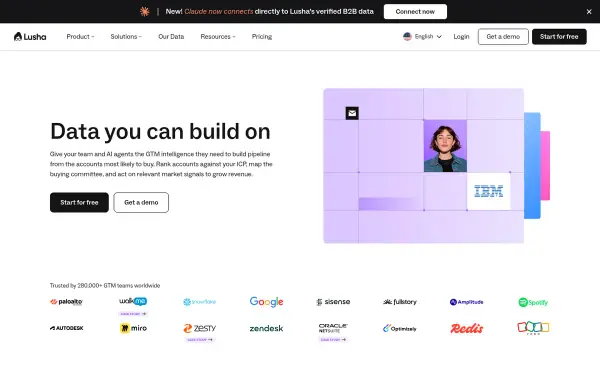
Simple one-click reveals that sales reps can use on day one, with shallow data depth and credit waste risk.
Lusha is built for speed over depth. A rep installs the extension, opens a profile or a search, and clicks to reveal an email or a direct dial. The data is partly community sourced, which means coverage grows as users contribute and decay shows up in the same way. Filters and lists cover basic prospecting, and API access opens from the Pro tier for teams that want enrichment inside another tool.
Pricing starts at $37.45 per month on the Starter plan, billed yearly, with 4,800 credits per year and one seat included. A free plan gives 40 credits per month on a single seat, enough for a trial without a sales call. Credits are consumed on reveals, so a wrong number costs the same as a right one. That is the main budget risk for small teams, and it is worth sampling mobile coverage in your target countries before committing to a year.
Against Coresignal, the gaps are about scale and reuse. There are no bulk datasets, no deep employment history, and the licensing does not support building a data product, so a buyer who wants to enrich an application eventually needs a supplier contract elsewhere. Mobile coverage is uneven outside major markets.
It fits a small sales team that wants one-click reveals with almost no setup and a free tier to test the water. It does not fit a data team, a product team or anyone who needs phone coverage across many regions or records they can legally embed in software.
A small sales team wants reveals inside a browser with almost no onboarding.
You need bulk records, deep history or global mobile coverage.
Entry V of VII / Email verification
Our verdict
A focused email finder and verifier with API access on every tier, and no phone numbers at all.
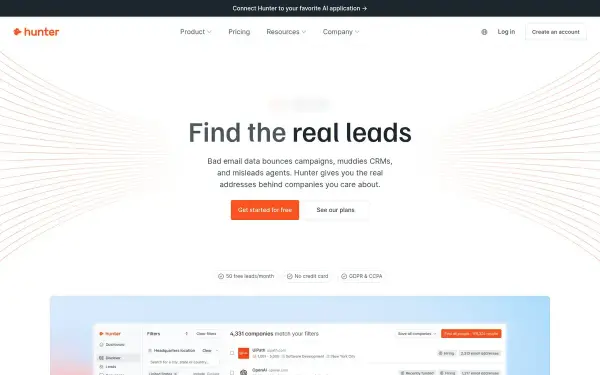
Hunter does two jobs and does them well: find an email for a domain or a named person, then verify that the address will accept mail. Domain search finds emails for a company, the finder resolves a specific person, and the verifier flags risky addresses before they reach a sequence. Deliverability checks are the practical part of the product, especially when you are cleaning a list you already own.
Pricing starts at $34 per month on the Starter plan, billed yearly at $408 per year for 24,000 credits per year. A free plan covers 50 credits per month. API access is included on every tier, including free, which is unusual in this list and useful for anyone who wants to test a workflow before paying. For a team already buying records elsewhere, that combination is cheap insurance against bounced email.
It is not a Coresignal replacement on its own. There are no phone numbers, no employment history and no firmographic depth beyond the basics. Coverage is limited to addresses that are publicly findable, so a contact who has never published an address will not appear. Search and verification credits are metered separately, so a verification-heavy workflow runs through its allowance faster than the headline number suggests.
It fits a team that already has a contact source and needs the email layer cleaned, or a developer who wants a cheap verifier behind an API. It does not fit anyone who needs phone data, company attributes or a single supplier for contact records. It works best as one part of a stack rather than the whole of it.
Your contact source needs an email finder and verifier behind a cheap API.
You need phone data or company firmographics in the same contract.
Entry VI of VII / European mobiles
Our verdict
European mobile coverage with compliance screening built in, sold on quotes that put it out of reach for small teams.
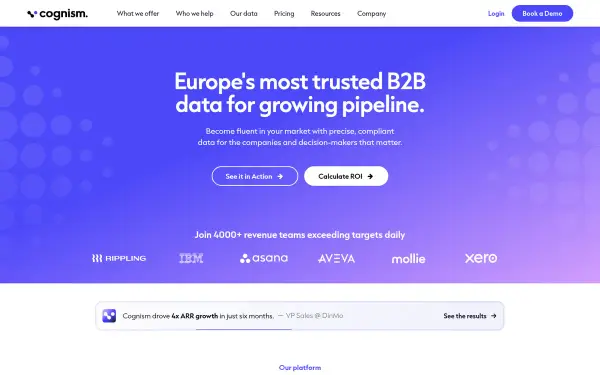
Cognism is the European specialist in this list. The database is built around business contacts with a strong emphasis on European coverage, and the Diamond layer covers phone-verified mobile numbers with screening against do-not-call registers. GDPR documentation is part of the offer, which matters to buyers who need a paper trail for a data protection review.
Pricing is quote only. The vendor site lists Standard and Pro tiers by seats included but shows no figures, so pricing is on the vendor site and budget conversations start with seat count and contract length rather than a published monthly rate. There is no free plan and no trial, which means the evaluation happens through a sales process and a demo rather than a self-serve test.
The trade-offs are scope and cost. Quote-only pricing puts it out of reach for small teams, and the contract structure suits companies with a procurement function rather than a founder with a card. Coverage is Europe-focused, so a global account list will need a second supplier. It is also not a raw dataset supplier: the data is meant for outreach inside the platform, not for building a data product or feeding a warehouse.
It fits a mid-market or enterprise sales team selling into Europe that needs verified mobiles and a defensible compliance story. It does not fit a startup that wants to test the water this week, a product team that needs records for embedding, or anyone whose buyers sit mostly outside Europe.
You sell into Europe and need verified mobiles plus a documented compliance position.
You need a published price, a self-serve test or global coverage from one vendor.
Entry VII of VII / In-house collection
Our verdict
In-house collection of public web data for engineering teams, with costs and legal review scoped per project.
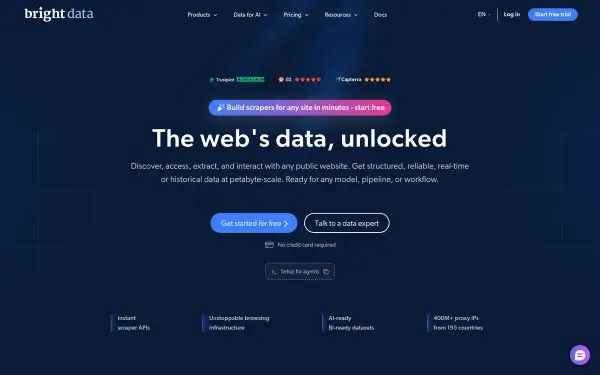
Bright Data sells the ability to collect public web data rather than a finished contact database. Proxy networks, scraping tools and ready-made datasets sit in one product, and you can point collection at public professional and company pages with custom refresh schedules. For a team that wants to own its sources and its provenance story, that is a different proposition from buying records from a supplier and taking the supplier's word for where they came from.
Pricing is usage based, with per-unit rates across products such as $1 per 1k requests, a free tier on several products and a free trial. There is no single monthly starting price on the pricing page, so budgeting means estimating request volume and refresh frequency before you commit. Small tests are cheap; a production pipeline is a volume line item that grows with coverage targets.
What you pay for that control is engineering time. Collection pipelines need building and ongoing maintenance, and costs scale with volume in a way that is hard to forecast in month one. Legal review is required for public data collection in several jurisdictions, and the compliance story rests on what you choose to collect and how you document it, not on the vendor's database.
It fits an engineering team with a clear collection target, a legal review process and a reason to own the pipeline rather than rent a record set. It does not fit a sales team that wants a list by Friday, or a buyer who wants a fixed monthly figure and no maintenance work. Treat it as infrastructure, not as a Coresignal substitute for finished contact records.
You want to own public web collection and can staff the pipelines.
You need finished contact records with no engineering work.
VIBackground
These tools sell access to B2B contact and company records, but they sell it in three different ways, and the differences decide which one you can use.
The first model is a raw data supply. You send a request through an API and get back structured person or company records, billed per successful match. People Data Labs works this way. The data is meant to sit inside your application, your warehouse or your scoring model, and the contract is with your engineering team. Licensing for product use is a separate negotiation.
The second model is a sales platform with data attached. Apollo.io, Lusha, RocketReach and Cognism bundle a database with search, lists, sequences or a dialler, and the license covers use inside that tool. You pay per seat. The data feels cheaper because the workflow is included, but you cannot take the records with you and embed them in software.
The third model is collection tooling. Bright Data sells proxies, scrapers and datasets, and you decide what to collect from public pages. You own the pipeline, the provenance story and the maintenance burden.
Three things separate the tools inside each model:
If you are leaving Coresignal because you were pulling records programmatically rather than clicking through a list, you likely want the first model. If your reason for leaving is price or a stalled API contract, the second model will feel like a downgrade in flexibility even when it looks cheaper per seat. If your reason is control over sources, the third model is the honest match.
Whatever the model, the legal duties do not move. You are the controller of the contact data you process, so lawful basis, objection handling, deletion requests and do-not-call screening stay with your team even when the supplier provides documentation.
This comparison sits in the software register. Further along the shore: baby tracking app and kennel software.
VIIPricing
Pricing in this category is not one number, and the headline figure rarely matches the invoice. There are four billing shapes, plus a quote-only tier at the top.
Per-seat subscriptions bundle a credit allowance into a monthly or annual user price. Apollo.io at $49 per seat per month billed annually and Lusha at $37.45 per month billed yearly fit here, and cost scales with headcount rather than data volume.
Per-match API billing charges only when a request returns a record. People Data Labs at $98 per month for 350 credits is the example, and the advantage is that a failed match does not spend budget. The catch is that bulk jobs with poor match rates still consume engineering time.
Annual export allowances suit predictable individual use. RocketReach at $27 per month billed annually at $329 per year for 1,200 exports and Hunter at $34 per month billed yearly at $408 per year for 24,000 credits both trade commitment for a lower rate.
Usage-based pricing charges per unit of collection. Bright Data publishes rates such as $1 per 1k requests, which is cheap at small scale and hard to forecast at large scale.
| Model | How it bills | Typical fit | Example from this list |
|---|---|---|---|
| Per seat | Monthly or annual per user, credits included | Sales teams working in the tool daily | Apollo.io at $49 per seat per month, billed annually |
| Per match | Credits consumed on successful matches | Engineering teams enriching records | People Data Labs at $98 per month for 350 credits |
| Annual exports | Yearly commitment with a set export allowance | Individual lookup and recruiting | RocketReach at $27 per month, billed annually at $329 per year |
| Credit bundle | Monthly or yearly credits metered per reveal | Small sales teams and list cleaning | Hunter at $34 per month billed yearly |
| Usage based | Per unit rate on requests or records | In-house collection at volume | Bright Data at $1 per 1k requests |
| Quote only | Negotiated contract by seats included | Enterprise and regulated buyers | Cognism, no published figures |
Two rules make comparison honest. First, convert everything to a cost per usable record using your own sample. Second, check whether unused credits roll over, because several plans reset monthly or annually and the effective price rises when they do.
Each entry card shows the starting price as it appeared on the vendor's own pricing page on November 25, 2026. When a vendor shows no figure we could confirm, or only a promotional rate, the card says "See website" or gives the regular price instead of a guess. Usage, overage and add-on rates in the text change more often than plan prices, so confirm them on the vendor page before you set a budget. To test the numbers against your own volume, try the free User Research Budget Planner. The Event Break-Even Calculator is a second way to check the same decision.
VIIIDecision
Name the job in one sentence. Decide whether you need records inside software, a list for outreach, an email cleanup layer, or your own collection pipeline. The answer removes most of this list immediately and stops you paying for a workflow you will not use.
Check the license before the price. Confirm whether records can be embedded in a product, stored in a warehouse or only used inside the vendor tool. Ask for the clause in writing, because a rep saying yes is not a license term you can rely on later.
Sample coverage on your own list. Send 200 to 500 records where you know the correct answers. Measure match rate, email bounce rate and phone connect rate separately, since a tool strong on email may be thin on direct dials in your regions.
Model the real monthly cost. Convert every option to a cost per usable record, including unused credits and seat minimums. A $27 plan with 1,200 exports a year and a $98 plan billing per match land in very different places at volume.
Review the compliance paperwork. Ask what documentation the vendor supplies for lawful basis, objection handling and do-not-call screening, and who handles deletion requests. The controller duties stay with your team in every model on this list.
Run a short pilot with one owner. Give a named person 30 days, a fixed sample and a decision date. Pilots without an owner drift into a permanent subscription that nobody reviews.
IXPitfalls
XQuestions
People Data Labs is the closest. It sells person and company enrichment, search and identity resolution through APIs, bills per successful match, and starts at $98 per month on the Pro plan for 350 credits. There is no user interface, so it suits engineering teams. Bright Data is the other API-led option, but it sells collection tooling rather than finished contact records.
Coverage and refresh are not the same thing. Apollo.io includes a large B2B contact database inside its platform, while People Data Labs refreshes monthly and sells the record set. Cognism concentrates on Europe with phone-verified mobiles, and Hunter covers only publicly findable email addresses. Ask each vendor for a match-rate test on your own list before comparing database sizes.
You carry the lawful basis. Suppliers provide documentation, screening and provenance, but controller duties stay with you: a lawful basis for processing, honoring objections and deletion requests, and respecting do-not-call registers where they apply. Cognism builds do-not-call screening and GDPR documentation into its European offer. With Bright Data you also need legal review of what you collect and where.
Convert both to a cost per usable record. A per-seat plan bundles credits you may not spend, and an API plan charges per successful match, so the useful figure is what you pay for records that match your list. Run the same 500-record sample through each vendor and divide the invoice by the matches your team can use.
Only when the license says so. Apollo.io licenses data for use inside Apollo, and Lusha's terms do not support building a data product. People Data Labs offers licensing for product use on enterprise terms. Bright Data lets you collect public data yourself, which puts provenance and legal review in your hands. Read the license before the pricing page.
Send a sample of 200 to 500 records where you already know the answers. People Data Labs provides free test credits, Hunter has a free plan with 50 credits per month, Apollo.io has a 14-day free trial and a free plan with 900 credits per month, and RocketReach gives 3 free lookups. Measure match rate, bounce rate and phone connect rate separately, and ask whether unused credits roll over.
XIFurther along the shore
Vendors can ask for a correction or apply for a Featured listing. Paid or not, the entry is scored on the same rubric and its limits stay in print. Partner with Umberlake.
Free tools
Our free browser tools turn the prices on this page into a figure for your own volume. Nothing you type leaves your device.