
SonarQube
$34SonarQube Team plan, monthly, up to 100k LOC
Best for enterprise rule depth and compliance-focused static analysis
- Free plan
- Free tier, up to 50k LOC
- Rubric
- 7.7 of 10
A practical comparison of eight Code Climate alternatives, ranked by fit for quality, security, migration, and budget, with prices checked on November 25, 2026.

IThe short answer
As of November 2026, the best Code Climate alternatives depend on what you need replaced. SonarQube suits enterprises that want deep rule coverage and compliance-focused static analysis. Codacy suits teams that want the closest all-in-one replacement for quality, security, secrets, and coverage. Qlty suits teams migrating from Code Climate with minimal model change. The list below covers eight tools, including AI review and budget options, with prices checked on November 25, 2026.
8 tools compared from vendor pages on November 25, 2026. 8 publish a starting price we could read; the rest say "See website".
IITop three berths
Register order is editorial fit for the buyer each entry describes. Prices are the starting figures read on November 25, 2026.
$34SonarQube Team plan, monthly, up to 100k LOC
Best for enterprise rule depth and compliance-focused static analysis

$18Team plan, per dev per month, starting price
Best for all-in-one quality and security replacement for Code Climate

$24Team, per user per month, billed yearly
Best for low false positives with automated fixes
How this page is paid for. All 8 tools here are unpaid editorial picks.
A paid listing's position can be part of what the vendor pays for. Every entry, paid or not, is scored on the same rubric and keeps its limits in print. Advertising disclosure.
IIIThe register
Starting prices as shown on each vendor's pricing page on November 25, 2026. "See website" means no figure we could confirm.
| No. | Tool | From | Free plan | Trial | Rubric | Actions |
|---|---|---|---|---|---|---|
| 01 | SonarQubeEnterprise rule depth and compliance-focused static analysis | $34SonarQube Team plan, monthly, up to 100k LOCUpdated on vendor page | Yes | 14-day free trial | 7.7 | |
| 02 | CodacyAll-in-one quality and security replacement for Code Climate | $18Team plan, per dev per month, starting priceUpdated on vendor page | No | 14-day free trial | 8.2 | |
| 03 | DeepSourceLow false positives with automated fixes | $24Team, per user per month, billed yearlyUpdated on vendor page | Yes | 14-day free trial | 7.4 | |
| 04 |  CodeRabbitAI-powered pull request review alongside quality tools | $24Essentials, per user per month, billed annuallyRead on vendor page | Yes | 14-day free trial | 5.9 | |
| 05 |  QltyTeams migrating from Code Climate with minimal model change | $20Pro, per contributor per monthUpdated on vendor page | Yes | Free plan available | 7.0 | |
| 06 |  CodeSceneTechnical debt prioritization by delivery impact | €18Standard, billed yearly, on-prem or cloudUpdated on vendor page | Yes | Free trial | 6.1 | |
| 07 |  QodanaBudget analysis for small teams and JetBrains users | $5.00Ultimate, per active contributor per month, billed annually, minimum 3 contributorsUpdated on vendor page | No | 30-day free trial | 7.1 | |
| 08 |  SemgrepCustom security rules and organization-specific patterns | $30Teams, per contributor per month, starting priceUpdated on vendor page | Yes | Free plan available | 6.3 |
Pinned:
IVMethod
How deep the rule set, maintainability model, quality gates, and reporting go for everyday code review.
How well the tool covers SAST, SCA, secrets detection, DAST availability, and custom security rules.
How directly the tool can replace Code Climate workflows with minimal model or process change.
How predictable and accessible the entry price, free tier, trial, seat minimum, and scaling model are.
How well repository connections, pull request review, IDE integration, and setup effort match daily engineering work.
VMethod
We compared eight tools for teams that need a Code Climate alternative, using five criteria that reflect how buyers actually evaluate code quality and security platforms. Rule depth and maintainability look at static analysis coverage, quality gates, grading models, and reporting. Security coverage covers SAST, SCA, secrets detection, DAST availability, and custom rule support. Code Climate fit weighs migration effort, the maintainability model, and whether the tool can replace quality and coverage workflows. Pricing fit considers entry price, free tiers, trials, seat minimums, and lines-of-code scaling. Workflow fit covers repository connections, pull request review, IDE integration, and the amount of setup required.
We score each tool from 1 to 10 on every criterion, then use those scores as a structured input, not as the order. The order is editorial: it reflects fit for the buyer each entry describes, plus any disclosed Featured position. A Featured listing, where present, is a paid placement and is scored with the same rubric as every other tool. We do not treat placement as a quality signal.
Prices come from vendor pricing pages checked on November 25, 2026. We use the starting price and plan note supplied by each vendor, keep the currency as published, and avoid converting currencies. Where a vendor publishes a range or a custom quote, we say so and point readers to the vendor site. Free plans and trials are listed only when the vendor states them. Features and limits in each review come from the vendor's published product information.
The full routine, from price reads to corrections, is on the methodology page. Paid listings follow the advertising disclosure.
Entry I of VIII / Rule depth
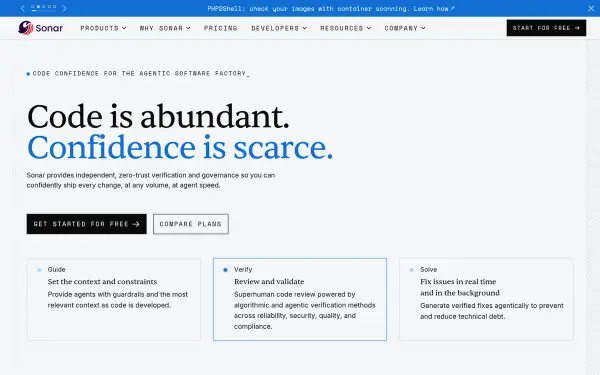
Our verdict
Best for enterprises that need deep static analysis, legacy language support, and enforceable quality gates across large codebases.
SonarQube is for organizations that treat static analysis as a control, not a checkbox. It pairs 6,500+ rules across 35+ languages with quality gates that can block merges, so teams can enforce thresholds before code reaches production. Self-hosted deployment and a free open source Community Build make it viable for regulated environments and internal projects. That makes it a better fit for platform teams than for small product groups.
Where it stands apart is rule depth and legacy coverage. It supports COBOL, ABAP, and PL/SQL, which matters if your portfolio includes systems that cloud-only tools ignore. The quality gate model is mature and gives engineering leaders a consistent way to define what good enough means before code ships. A cloud option through SonarCloud adds a managed path for teams that do not want to run servers.
Pricing is tied to codebase size. The Team plan starts at $34 per month for up to 100k LOC, and the free tier covers up to 50k LOC. The Community Build is free, open source, and has no contributor cap. Large codebases can face lines-of-code pricing, and enterprise tiers are expensive, so budget review matters before a wide rollout. That model rewards smaller codebases and penalizes sprawling monoliths.
Setup is heavier than cloud-only tools, and teams without platform support may feel the operational load. A 14-day free trial and a cloud option through SonarCloud lower the testing barrier. Pick SonarQube when rule depth, compliance-focused analysis, and self-hosting matter more than fast onboarding or a low entry price. For Code Climate users, it is less a straight swap and more a platform migration.
You need deep rules, legacy language support, and self-hosted quality gates.
You want a lightweight cloud-only replacement with minimal setup.
Entry II of VIII / All-in-one coverage
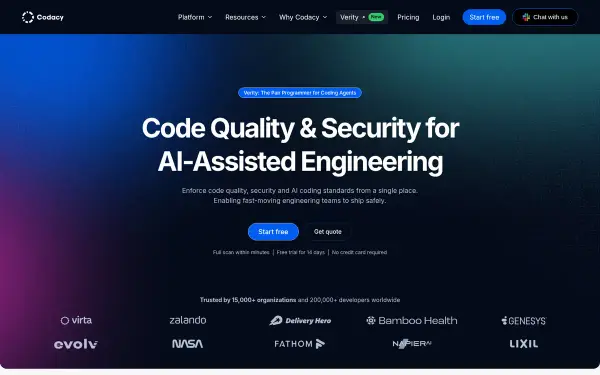
Our verdict
Best all-in-one Code Climate replacement for teams that want quality, security, secrets detection, and coverage in one platform.
Codacy is the closest all-in-one replacement for Code Climate in this list. It combines code quality analysis, SAST, SCA, secrets detection, coverage tracking, and AI review features in one platform. Setup is pipeline-less and works across 49 languages, so teams can connect repositories without rebuilding CI steps. That breadth is the main reason to shortlist it.
The value is consolidation. A team can standardize quality, security, secrets, and coverage checks in one workflow instead of stitching three vendors. AI Guardrails and AI Reviewer add review support, though the AI review is less deep than dedicated AI review tools. DAST is limited to the Business plan, so security buyers should check that boundary before committing. That matters for teams that want a single view of risk.
Pricing starts at $18 per developer per month on the Team plan, with a Developer plan that is free forever and a 14-day free trial. That entry price is lower than DeepSource, which helps mid-sized teams add coverage gradually. Rule depth still trails SonarQube, so highly regulated teams may need a second tool for deep compliance rules. The lower entry price does not remove the need to test rule coverage on your own code.
Codacy fits teams that want one dashboard for quality and security without a heavy self-hosted rollout. It is less suited to buyers who need advanced DAST at every tier or the deepest possible rule library. For Code Climate users, the migration is mostly about repository connections and policy tuning, not new infrastructure. Start with the free Developer plan and use the trial to compare findings on a representative repository.
You want one platform for quality, security, secrets, and coverage.
You need the deepest rule library or DAST on every plan.
Entry III of VIII / Low false positives
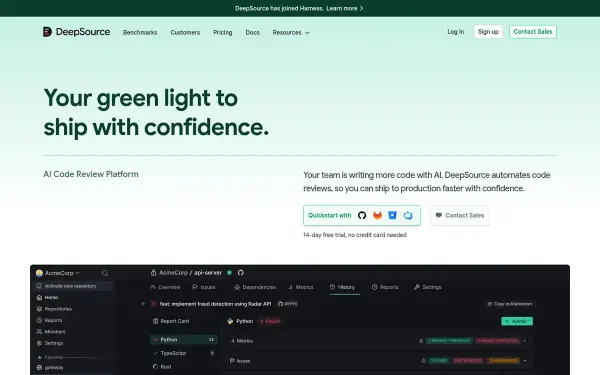
Our verdict
Best for teams that want low false positives, pull request report cards, and automated fixes without CI configuration work.
DeepSource focuses on low-noise review. It offers 5,000+ analysis rules and a sub-5 percent false positive rate, then adds five-dimension pull request report cards so reviewers see where a change stands. AI-powered Autofix proposes fixes, and the platform covers SAST, SCA, secrets detection, and infrastructure-as-code review. The promise is fewer noisy comments and more actionable pull requests.
Setup is quick because it connects to GitHub, GitLab, Bitbucket, and Azure DevOps without CI configuration. That makes it practical for teams that want signal in pull requests without platform work. The tradeoff is language breadth: 16 languages are generally available, which is narrower than SonarQube or Qodana and may matter for mixed stacks. The pull request report cards are the feature most likely to win over reviewers.
Pricing starts at $24 per user per month on the Team plan, billed yearly, with a 14-day free trial and free use for open source. Published pricing ranges from $12 to $30 per user per month depending on plan and whether AI review is included. At the top end, $30 per user per month is steep for large teams. The gap between the low and high published figures makes a quote check essential.
DeepSource suits teams that value low false positives and automated fixes over the broadest language list. It is a strong fit for product engineering groups that already work in pull requests and want security checks in the same flow. Teams needing a full compliance platform or very wide legacy coverage should compare SonarQube first. Use the trial on a noisy repository to see whether the false positive claim holds for your code.
Low-noise pull request feedback and automated fixes matter most.
You need the broadest language coverage or a fully predictable price.
Entry IV of VIII / Contextual AI review
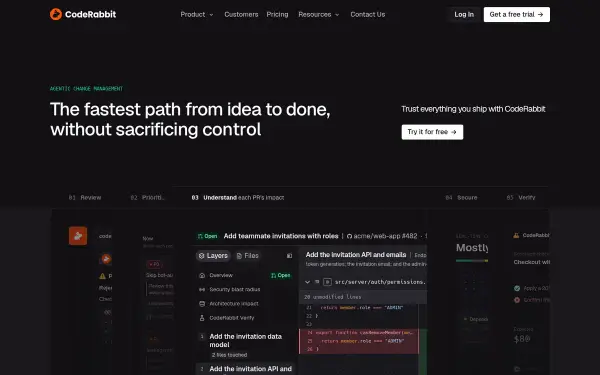
Our verdict
Best as an AI pull request review companion for teams that already run a quality and security platform.
CodeRabbit is not a full Code Climate replacement. It is an AI pull request reviewer that uses codebase context to comment on changes, catch logic and edge-case issues, and flag style problems across 30+ languages. Teams use it alongside a quality platform, not instead of one. The product is built for review time, where context matters more than a rule list. It does not try to be a system of record.
The appeal is contextual feedback at review time. CodeRabbit reads beyond the diff and explains issues in the pull request, which can shorten review cycles for teams that already review every change in pull requests. It has a free tier with unlimited repositories and a 14-day free trial. Those free limits make it easy to test on real pull requests before buying seats.
What it lacks is the platform layer. There are no quality gates, no maintainability metrics, and no replacement for SAST, SCA, secrets detection, or coverage tracking. Essentials starts at $24 per user per month, billed annually. That price buys review help, not governance. Buyers who need to block merges on quality thresholds will still need a tool such as SonarQube or Codacy.
Pick CodeRabbit when your static analysis stack is already in place and reviewers need a second set of eyes on logic. Skip it if you need to replace Code Climate's quality gates, metrics, or security checks. It works best as a companion to SonarQube, Codacy, or DeepSource, where policy and coverage stay in the platform. The free tier makes that companion role easy to evaluate without a procurement request.
You already have quality gates and want sharper pull request comments.
You need a full replacement for Code Climate quality and security checks.
Entry V of VIII / Code Climate model
Our verdict
Best for Code Climate migrants who want a familiar A-F maintainability model and a free commercial CLI.
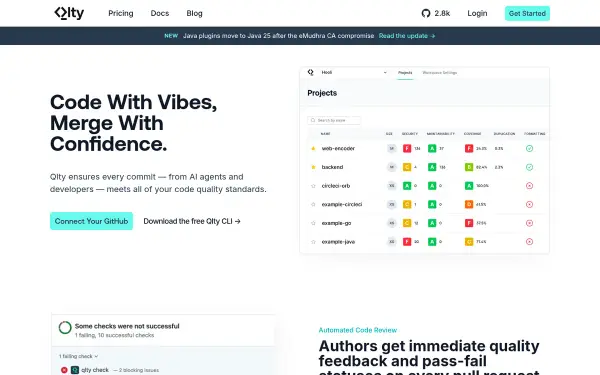
Qlty is the most natural migration path for teams that used Code Climate and want the same mental model. It was created by members of the Code Climate founding team. The platform provides A-F maintainability grading, technical debt quantification, test coverage tracking, and 70+ embedded plugins across 40+ languages. The A-F grade is the familiar anchor for teams that already report maintainability to stakeholders.
The A-F model is familiar, so teams can move without rewriting dashboards from scratch. Qlty also ships a free CLI licensed for commercial use, which lets engineers run checks locally and in CI before adopting the cloud service. The cloud platform adds centralized reporting, but pricing is per contributor. That split between a free CLI and paid cloud reporting is useful for gradual adoption.
Pro is $20 per contributor per month, and there is a free plan with unlimited contributors. That free plan makes it easy to test the model with a small group before rolling it out. As a newer vendor, Qlty has a smaller community than SonarQube, and its rule depth and security coverage are not as broad as the largest platforms. The lower community size may matter if you depend on forums and third-party integrations.
Qlty fits teams that care about maintainability trends and a low-friction Code Climate migration. It is less compelling for buyers who need deep SAST, SCA, secrets detection, and compliance reporting in one purchase. Those teams should pair Qlty with a security tool or choose Codacy or SonarQube instead. Start with the free plan, then use Pro when the A-F grades and debt views become part of your release process.
You want the closest Code Climate style maintainability model.
You need deep security scanning in the same purchase.
Entry VI of VIII / Delivery impact view
Our verdict
Best for leaders who want to prioritize technical debt by delivery impact instead of rule count alone.
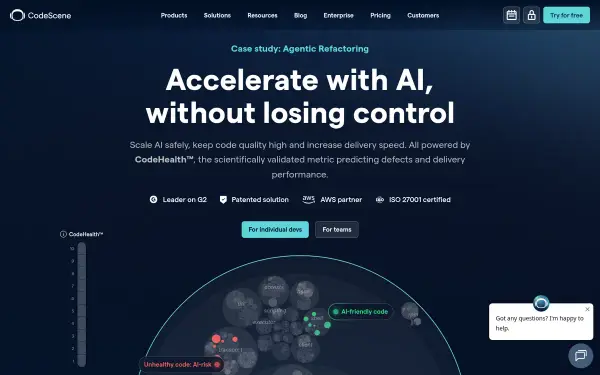
CodeScene approaches code quality from behavior rather than rules alone. It analyzes how code changes over time and combines that with team behavior, then prioritizes technical debt by delivery impact. That gives engineering leaders a view of where debt slows work, not just where a rule fired. The delivery impact view is the reason to consider it over a conventional linter.
The product is strongest for teams that already have rule-based linting and want a prioritization layer. It covers 20+ languages and offers a free tier for open source projects. The behavioral model differs from rule-based tools, so it is not a direct replacement for quality gates or security scanning. That difference is a feature for some buyers and a barrier for others. Teams that need a rule-based gate should not expect CodeScene to provide one.
Pricing starts at €18 on the Standard plan, billed yearly, with on-prem or cloud deployment. The price is published in euros, so buyers outside the eurozone should plan for currency and procurement overhead. A free trial is available. CodeScene has less language breadth than SonarQube or Qodana, which matters for polyglot estates. Euro pricing also makes direct comparison with dollar-priced tools harder.
Pick CodeScene when technical debt prioritization by delivery impact is the main problem and your team can adopt a different model. Skip it if you need deep security coverage, a large rule set, or a simple per-seat replacement for Code Climate. It works well as a management layer alongside a static analysis platform. The free open source tier lets maintainers test the behavioral model on a real repository before a paid rollout.
Technical debt prioritization by delivery impact is your main problem.
You need a rule-based quality gate or broad security scanning.
Entry VII of VIII / Low entry price
Our verdict
Best budget entry for small teams and JetBrains users who need static analysis across many languages.
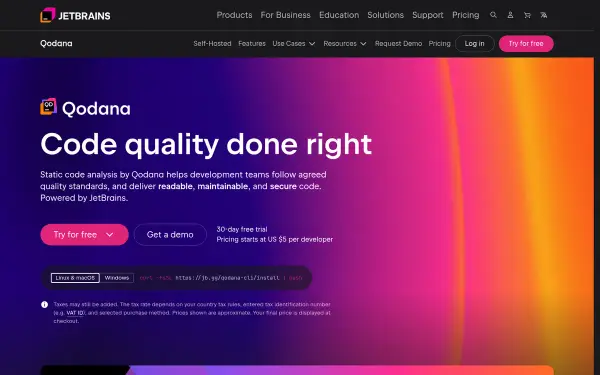
Qodana is the budget option in this comparison. Built by JetBrains, it provides static analysis across 60+ languages with a free Community plan and a paid Ultimate plan. The lowest paid entry is $5.00 per active contributor per month, billed annually, with a minimum of 3 contributors. That price makes it easy for a small team to start without a long procurement cycle.
The JetBrains IDE integration is the main differentiator. Teams that already use JetBrains tools can get feedback before commits, which shortens the loop between local work and CI. The paid entry is low enough for small teams to add analysis without a procurement cycle, and a 30-day free trial lowers the test barrier. Feedback before commits is the practical benefit, not a larger rule library.
The tradeoff is enterprise depth. Qodana has less brand recognition in quality platforms and fewer enterprise features than SonarQube or Codacy. The experience is JetBrains-centric, so teams on VS Code or other editors may not get the same value from the integration. Language coverage is strong, but security and governance features are not as broad. Buyers should test the active contributor definition before assuming the entry price applies to every seat.
Qodana fits small teams, JetBrains shops, and buyers who need a low-cost first step into static analysis. It is less suited to organizations that need mature quality gates, compliance reporting, and a wide security suite. Confirm current pricing and limits on the vendor site, especially how active contributors are counted. Use the 30-day trial on a representative project before choosing it as a Code Climate replacement.
You want the lowest paid entry and work in JetBrains tools.
You need mature quality gates and enterprise governance.
Entry VIII of VIII / Custom security rules
Our verdict
Best for security teams that need custom rules and organization-specific patterns across their repositories.
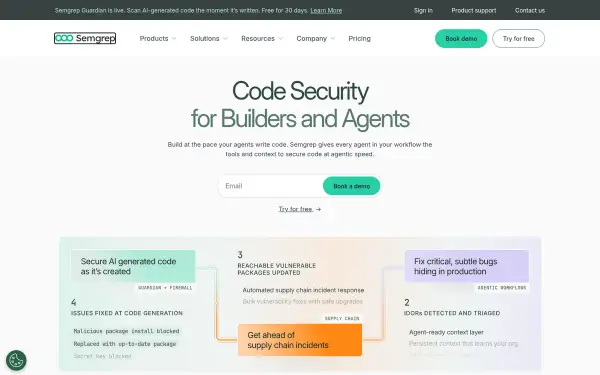
Semgrep is a security-first platform built around an open-source SAST engine. It offers 10,000+ community rules and custom rule authoring for organization-specific patterns. Teams use it to encode their own security standards, not just consume vendor defaults. The free edition supports up to 10 contributors, which gives small teams a real path to evaluate the rule model.
The custom rule model is the reason to choose it. Security engineers can write rules for internal frameworks, APIs, and risky patterns, then run them consistently across repositories. That flexibility requires setup effort and rule maintenance, so it suits teams with security engineering capacity. A team without rule ownership may get less value than a team that treats rules as code. That is a meaningful operational commitment.
Pricing starts at $30 per contributor per month on the Teams plan. Semgrep Pro is $35 per contributor per month. The focus is security, not maintainability metrics or quality gates. Teams that need a Code Climate replacement for quality trends, coverage, and debt tracking should pair Semgrep with another tool. The free plan is useful for a pilot, but the paid platform is where organization-wide policy enforcement lives. Budget for rule upkeep, not just seats.
Semgrep fits organizations that need custom security rules and can invest in rule ownership. It is less suited to teams that want a single platform for quality, coverage, and security with minimal configuration. For a Code Climate migration, Semgrep is a security companion, not a full successor. Use the free edition to test custom rules on a few repositories, then move to Teams when the rule library becomes shared infrastructure.
Custom security rules are central to your review process.
You need maintainability metrics and quality gates in one tool.
VIBackground
Code quality and security analysis tools inspect source code and pull requests for defects, risky patterns, and maintainability problems before release. They sit between your repository and your deployment pipeline, then return findings that developers can act on. The category covers static analysis, software composition analysis, secrets detection, coverage tracking, and AI review, though most vendors specialize in a subset rather than all of it.
Static analysis parses code without running it and flags bugs, code smells, duplication, complexity, and style problems. Quality gates turn those findings into policy, so a merge can be blocked when thresholds are missed. SAST looks for security flaws in first-party code. SCA checks third-party dependencies for known risk. Secrets detection scans for committed keys and tokens. Coverage tracking shows which lines tests exercise. AI review adds contextual comments on pull requests, but it usually complements rule-based checks rather than replacing them.
Code Climate users often arrive with a specific mix: maintainability grades, test coverage, and pull request checks. Some also expect security scanning, which is where the category splits. A full platform such as SonarQube or Codacy can replace more of that workflow. A specialized tool such as Semgrep goes deeper on custom security rules but leaves quality metrics to another product. Qlty keeps the maintainability model close to Code Climate, while CodeRabbit adds AI review on top of an existing stack.
The practical questions are:
Answer those before comparing feature lists. A tool that fits your repository workflow and pricing model will outperform a broader platform that nobody configures.
This comparison sits in the software register. Further along the shore: baby tracking app and kennel software.
VIIPricing
Pricing in this category usually follows four models: per developer or contributor, lines of code, active contributor with a minimum, or a free tier that expands into paid seats. The model matters more than the headline number because codebase size, commit volume, and seat count can push costs in different directions.
| Model | How it bills | Typical fit | Example from this list |
|---|---|---|---|
| Per developer | Monthly or annual seat price per developer | Teams that add reviewers gradually | Codacy at $18 per developer per month on Team; DeepSource at $24 per user per month billed yearly |
| Lines of code | Monthly tiers based on codebase size | Large codebases with stable teams | SonarQube Team at $34 per month up to 100k LOC |
| Per contributor | Monthly or annual price per contributor | Small teams with mixed commit volume | Qlty Pro at $20 per contributor per month; Semgrep Teams at $30 per contributor per month |
| Active contributor minimum | Annual contract with minimum seats | JetBrains shops and small teams | Qodana Ultimate at $5.00 per active contributor per month, minimum 3 contributors |
| Free tier or open source | No charge within stated limits | Open source projects, pilots, and small teams | SonarQube free up to 50k LOC; Semgrep Free Edition up to 10 contributors |
CodeRabbit charges $24 per user per month on Essentials, billed annually, which buys AI review rather than a full quality platform. CodeScene starts at €18 on Standard, billed yearly, with on-prem or cloud deployment; the euro price means buyers should handle currency in procurement. Free tiers vary widely. Some are permanent plans, such as Codacy Developer, Qlty free, and Qodana Community. Others are trials, such as SonarQube's 14-day free trial or Qodana's 30-day free trial.
Ask for a pricing sheet when seat counts or codebase size are uncertain. Confirm whether a plan counts active contributors, developers, users, or lines of code, because those definitions change the renewal.
Each entry card shows the starting price as it appeared on the vendor's own pricing page on November 25, 2026. When a vendor shows no figure we could confirm, or only a promotional rate, the card says "See website" or gives the regular price instead of a guess. Usage, overage and add-on rates in the text change more often than plan prices, so confirm them on the vendor page before you set a budget. To test the numbers against your own volume, try the free User Research Budget Planner. The Event Break-Even Calculator is a second way to check the same decision.
VIIIDecision
IXPitfalls
The biggest risk is replacing one kind of tool with another and calling it a migration.
XQuestions
Code Climate pricing is on the vendor site, and this comparison does not assume a number for it. Teams often look for alternatives because they want quality analysis, SAST, SCA, secrets detection, and coverage in one platform. Codacy and SonarQube are the broadest options here for that combined quality and security need.
Codacy is the closest all-in-one replacement in this list. It combines code quality analysis, SAST, SCA, secrets detection, coverage tracking, and AI review features in one platform, and setup is pipeline-less across 49 languages. It starts at $18 per developer per month on the Team plan, with a free Developer plan and a 14-day free trial.
Qlty is the most natural successor for teams that want minimal model change. It was created by members of the Code Climate founding team and keeps an A-F maintainability model, technical debt quantification, and test coverage tracking. Pro is $20 per contributor per month, and there is a free plan with unlimited contributors. Its rule depth and security coverage trail larger platforms.
SonarQube has the deepest rule coverage in this comparison. It provides 6,500+ rules across 35+ languages, quality gates that can block merges, and legacy support for COBOL, ABAP, and PL/SQL. It starts at $34 per month on the Team plan for up to 100k LOC, and the free tier covers up to 50k LOC. Rule depth comes with heavier setup.
Choose a rule-based platform first if you need quality gates, maintainability metrics, coverage, and security checks. SonarQube, Codacy, DeepSource, and Qlty provide that platform layer. Add AI pull request review such as CodeRabbit when reviewers need contextual feedback on logic and edge cases. CodeRabbit has no quality gates or maintainability metrics, so it works best alongside another tool.
Qodana has the lowest paid entry at $5.00 per active contributor per month, billed annually with a minimum of 3 contributors. Free tiers include SonarQube up to 50k LOC, Codacy Developer free forever, Qlty free with unlimited contributors, Semgrep Free Edition up to 10 contributors, and Qodana Community. Trials range from 14 days to 30 days depending on the vendor.
XIFurther along the shore
Vendors can ask for a correction or apply for a Featured listing. Paid or not, the entry is scored on the same rubric and its limits stay in print. Partner with Umberlake.
Free tools
Our free browser tools turn the prices on this page into a figure for your own volume. Nothing you type leaves your device.