
Vagaro
See website
Best for small spas wanting the most features for the lowest spend
- Free plan
- No
- Rubric
- 7.4 of 10
Eight spa booking platforms compared on price, booking speed, memberships and marketplace reach, with honest limits for solo therapists, growing teams and multi location groups.

IThe short answer
Vagaro is the best spa booking software for small spas that want the widest feature set for the least spend, and its 30 day trial covers the full product. Mangomint suits growing teams that will pay $120 per location plus $10 per user for speed, automation and free migration. GlossGenius fits solo professionals and small teams that want a polished brand at $24 per month billed annually. Prices were checked on 25 November 2026, and five of the eight tools still list no confirmed price.
8 tools compared from vendor pages on November 25, 2026. 3 publish a starting price we could read; the rest say "See website".
IITop three berths
Register order is editorial fit for the buyer each entry describes. Prices are the starting figures read on November 25, 2026.
See website
Best for small spas wanting the most features for the lowest spend
$120Per location per month, plus $10 per user per month
Best for growing teams that prioritise speed and automation

$24Standard, per month, billed annually
Best for solo professionals and small teams wanting a polished brand
How this page is paid for. All 8 tools here are unpaid editorial picks.
A paid listing's position can be part of what the vendor pays for. Every entry, paid or not, is scored on the same rubric and keeps its limits in print. Advertising disclosure.
IIIThe register
Starting prices as shown on each vendor's pricing page on November 25, 2026. "See website" means no figure we could confirm.
| No. | Tool | From | Free plan | Trial | Rubric | Actions |
|---|---|---|---|---|---|---|
| 01 | VagaroSmall spas wanting the most features for the lowest spend | See websiteNot shown publicly | No | 30-day free trial | 7.4 | |
| 02 | MangomintGrowing teams that prioritise speed and automation | $120Per location per month, plus $10 per user per monthUpdated on vendor page | No | Free trial | 7.8 | |
| 03 | GlossGeniusSolo professionals and small teams wanting a polished brand | $24Standard, per month, billed annuallyRead on vendor page | No | 14-day free trial | 7.4 | |
| 04 |  Square AppointmentsSolo operators who want no software cost | FreeSquare Free, per location, paid Plus tier is $49 per month per locationRead on vendor page | Yes | 30-day free trial | 7.7 | |
| 05 |  FreshaSpas in competitive markets that need discovery | See websiteNot shown publicly | No | 14-day free trial | 6.7 | |
| 06 |  BoulevardLuxury day spas, medspas and multi location groups | See websiteNot shown publicly | No | Demo only | 7.5 | |
| 07 |  MindbodyWellness businesses mixing services, classes and memberships | See websiteNot shown publicly | No | No | 6.4 | |
| 08 | ZenotiLarge spa chains and franchise groups | See websiteNot shown publicly | No | No | 7.4 |
Pinned:
IVMethod
Whether booking, treatment notes, memberships, inventory and marketing run in one product without another subscription.
How few steps a client takes to confirm, whether an account is required, and how fast a receptionist can move a full day.
The published entry rate, what sits behind add ons, and how the monthly total changes as a team grows.
The gap between a tool that tops out at three chairs and one that runs dozens of locations from a central dashboard.
Migration help, contract terms, data return on exit, and whether support answers inside your working hours.
VMethod
We ranked these eight tools on five criteria. Feature depth asks whether a spa can run booking, treatment records, memberships, inventory and marketing without bolting on another subscription. Booking experience covers how few steps a client takes to confirm, whether an account is required, and how quickly a receptionist can move a full day. Price and value looks at the published entry rate, what sits behind add ons, and how the number changes as a team grows. Scaling headroom separates tools built for a single site from those that run dozens of locations. Onboarding and support covers migration, contracts, data return and whether help arrives in your working hours. The weights are in the rubric above.
Every price here comes from the vendor's own pricing page, checked on 25 November 2026. Where a page would not load or the vendor publishes no price list, the entry says pricing is on the vendor site and we did not estimate a figure. Nothing was converted between currencies and no plan name was inferred. Where a note conflicted with an older published figure, we used what the page showed on the day.
Order is editorial. Each position reflects fit for the buyer described in that entry, not a weighted total, and we list the same honest cons for every product, including any listing marked Featured. A Featured placement is paid and is disclosed as such.
Two things we could not test at a distance: how each system behaves on a busy Saturday, and how fast support answers. Ask for a reference spa of your own size before you sign.
The full routine, from price reads to corrections, is on the methodology page. Paid listings follow the advertising disclosure.
Entry I of VIII / SOAP notes included
Our verdict
The widest feature set at the lowest entry point, held back by an older interface and a mandatory client account.
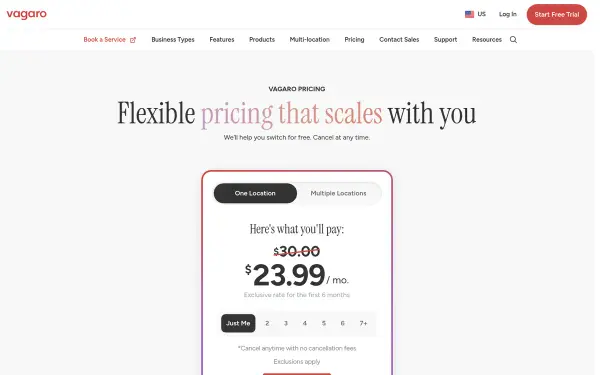
Vagaro covers a lot of a small spa's daily work in one product, from a single login. Online booking runs through Vagaro's own marketplace plus Instagram, Facebook and Apple Maps, so a request that starts on a social profile lands in the same calendar as a repeat client's rebooking. Treatment records use SOAP notes, memberships and packages bill on a recurring schedule, and inventory tracking sits alongside both rather than in a separate tool.
The practical argument for Vagaro is consolidation. A spa that would otherwise pay for a booking system, a forms app, a membership biller and a stock spreadsheet gets all four in one product, and the marketplace listing adds a discovery channel at no extra line item. The 30 day trial covers the full product rather than a cut down tier, which is enough time to move a real week of bookings across and see where the workflow rubs.
That friction shows up in two places. Clients have to create a Vagaro account before they can book, and the interface looks older than newer competitors. Neither is a dealbreaker for a spa whose clients are already regulars, and both matter more to a business spending money to win new faces.
Pricing sits on the vendor site, and we could not load a price list on 25 November 2026, so treat any figure you have seen quoted as unconfirmed until Vagaro sends it in writing. Ask for the per seat rate, the marketplace terms and the card processing rate together, because the software fee is only part of the monthly cost.
You run a small spa that wants booking, treatment notes, memberships and inventory in one place without stacking subscriptions.
A low friction first booking matters more than breadth of features, or if your team dislikes an older interface.
Entry II of VIII / Fastest booking flow
Our verdict
Fast, modern and well supported, with a price that only makes sense once a team has several chairs booked.
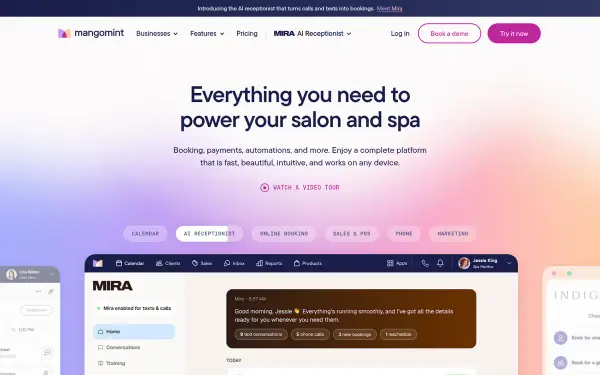
Mangomint has a very fast interface, and speed is the whole pitch. Booking, rescheduling and checkout are quick, Express Booking speeds up a repeat visit, and automated reminders, waitlists and follow ups run without anyone watching the calendar. For a spa where the front desk is also the treatment room, that saved time is the product.
Pricing is $120 per location per month plus $10 per user per month, which replaced an earlier flat $130 single user rate on the vendor page. Add ons stack on top: extra phone lines are $70 each, marketing starts at $30 and payroll is $50 plus $8 per worker. A team with a phone line and marketing will land well above the entry figure, so build the real number before comparing it with a bundle like Vagaro.
What you get in exchange is onboarding rather than a login. Free onboarding includes data transfer, there is no long term contract, and your data comes back if you leave. Teams of two or more get a dedicated specialist, and support is US based, which matters if your quiet hours are late evening.
The limit is shape as much as price. Mangomint is a strong fit for a growing service business with staff, rooms and a receptionist, and an awkward one for a solo practitioner who mainly needs a booking page with reminders attached. It also asks you to buy carefully: the base rate is only the start once phone, marketing and payroll modules appear on the quote.
You have a team, several rooms and enough daily volume that a faster calendar pays for itself.
You work alone, or if the add ons you need push the monthly total past your budget.
Entry III of VIII / Polished client booking
Our verdict
A polished client booking experience, priced low for solo professionals and light on enterprise depth.
GlossGenius sells a look as much as a booking engine, and for a solo aesthetician or a small studio the look is the point. The client facing flow is polished, and clients can book without creating an account, which removes a common drop off point in online booking. Card on file and tap to pay are built in, and processing runs at a flat 2.6% with no separate tap to pay or card on file fees on top.
Beyond booking, the product covers small business jobs that usually live in several other subscriptions. Email marketing sits alongside a custom website builder and inventory management, so a one person spa can run a booking page, a mailing list and stock counts from one login.
Pricing is $24 per month on the Standard plan when billed annually, and a 14 day trial lets you test the booking flow before committing. Annual billing is the catch: the headline rate depends on paying for a year up front, so work out the monthly equivalent if you prefer to stay flexible, and confirm what the rate becomes on monthly terms.
The honest limit is depth. GlossGenius handles the client experience well, but it has fewer enterprise capabilities than Mangomint or Zenoti, so a larger operation will outgrow it. Payment processing is charged on volume, so a high ticket medspa should model that 2.6% against a negotiated rate before signing.
You are a solo professional or small team and the booking page is the first impression you want to control.
You need multi location controls, deep resource rules or reporting built for a group.
Entry IV of VIII / Free for solo
Our verdict
Free for one person and fast to set up, with the useful team features sitting behind a paid tier.
Square Appointments has a free tier, and for a solo operator the software cost is zero. The free tier covers online booking, a calendar and automated reminders for one person, and payments run inside Square without a separate processor or gateway contract. If you already use Square, setup fits an existing payments account.
The paid Plus tier is $49 per month per location, and Premium sits above it; the pack we worked from listed no figure for Premium, so ask the vendor directly. Moving up buys the pieces a team needs: memberships, advanced marketing and room management. A 30 day trial applies as well, which is long enough to run a live week rather than a demo.
The trade is scope. Square Appointments is built around payments and scheduling, and memberships, advanced marketing and room management need paid tiers, with no built in marketplace to bring new clients in. If growth depends on discovery rather than repeat visits, that gap matters more than the price.
It fits the practitioner who wants one system for money and calendar and refuses to pay twice for the same function. It fits a spa with rooms, rotating staff and membership revenue less well, because the paid tiers arrive and the missing depth starts to show. Read the processing rate alongside the subscription, since the free tier is only free if the payment economics work for your average ticket.
You work alone, take card payments already, and want booking and reminders at no software cost.
You need memberships, multiple rooms or a discovery channel on the entry plan.
Entry V of VIII / Marketplace discovery
Our verdict
A discovery engine first, with marketplace commission that pays off only when your weekday slots sit empty.
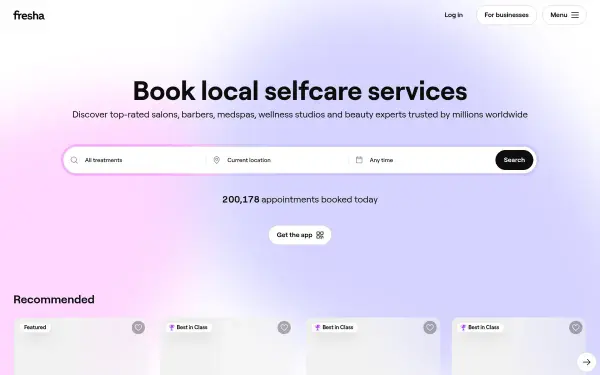
Fresha's argument is discovery. Its consumer marketplace puts your open slots in front of people searching for a treatment nearby, which is a different job from managing the clients you already have. Online booking, team member management and a modern interface cover the day to day, and the product is aimed at independent operators rather than at groups.
The pricing model is the part to model carefully. Fresha charges a subscription plus a per team member fee, and it takes a commission on bookings that arrive through the marketplace. That commission is the trade: you pay for the clients the marketplace brings, and you pay nothing extra on a client who found you directly and booked. For a spa in a competitive neighborhood with quiet Tuesdays, the maths can work. For a spa with a full book and a loyal base, the marketplace adds cost without adding much.
No public price list was visible when we checked on 25 November 2026, so confirm the subscription and the per team member rate with the vendor, and get the commission percentage in writing. A 14 day trial is available, and it is worth spending part of it watching which bookings actually arrive through the marketplace.
Depth is the other limit. Fresha is comfortable for a single site with a handful of staff and thinner for complex multi location operations that need central reporting and layered permissions. If you run several sites with shared clients, test the reporting before you commit, and check what happens to marketplace clients if you ever leave.
You trade in a crowded market with empty weekday slots and want new client volume more than control.
Your book is already full, or if you run several sites needing central reporting.
Entry VI of VIII / Luxury spa workflows
Our verdict
Premium software for premium spas, sold through a demo with no published price to budget from.
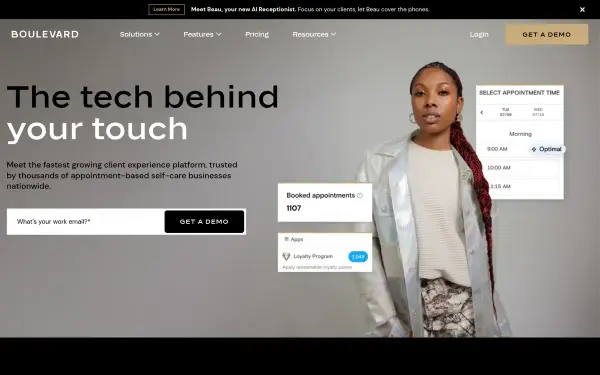
Boulevard sits at the premium end of spa software, and it is priced and shaped for luxury day spas, medspas and multi location groups rather than for a single therapist. Online booking, client management, point of sale and marketing run in one system, and the workflows are built around premium service. For a medspa selling courses of treatment, that sequence is where the revenue lives.
Multi location control is the other differentiator. The product includes multi location operational controls for groups running more than one site. The client facing booking experience is refined, and it looks like the brand the spa is trying to present rather than like software.
Pricing is not published. The entry point is a demo, after which Boulevard quotes, so you cannot budget from the website and the conversation will cover contract length and implementation. That model is standard at this level, but it means the number arrives late, once you have described rooms, staff and locations in detail. Treat the demo as the start of a sales process rather than an evaluation.
For a single small spa the product is more than needed, and the cost reflects capacity you will not use. If you run one site with a handful of rooms, a spa specific tool with a published rate will serve you better and cost less, and you will know the number before you commit.
You run a premium day spa or medspa group and the client experience carries your pricing power.
You need a published rate before budgeting, or you run one small site.
Entry VII of VIII / Class and membership billing
Our verdict
A strong choice for businesses mixing classes and appointments, and heavy machinery for a pure spa.
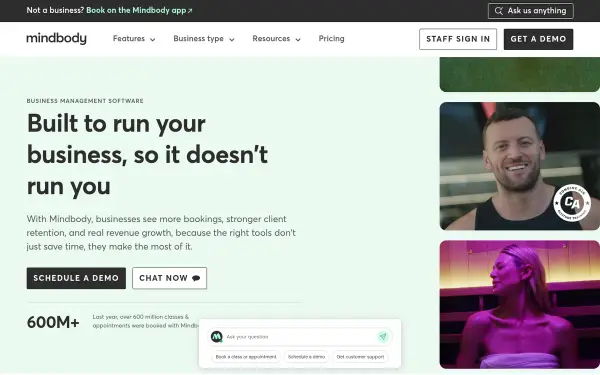
Mindbody has a broad feature set and is built for wellness businesses that mix services with classes. It handles class scheduling, membership and package billing, appointment booking and a large consumer marketplace, which makes it the natural choice for a wellness business that sells classes alongside treatments, or that lives on recurring membership revenue rather than individual appointments.
The strength is the blend. A studio running classes, a membership base and a handful of one to one appointments keeps all three in one system, with recurring billing for memberships and packages. The marketplace is large, and it sits alongside the booking calendar rather than replacing it.
The cost of that breadth is complexity and price. Mindbody's entry pricing runs higher than spa focused tools, the interface carries the weight of features a pure spa never touches, and no plan prices appear on the vendor site, so you will be quoting rather than comparing. No free trial is listed either, which makes evaluation harder than it should be for a product this large.
For a spa selling treatments, packages and a loyalty membership, the extra machinery is overhead and the training time is real. For one that also runs classes or a strong recurring membership, Mindbody is built for that blend. Be clear which business you are before you shortlist it, and ask what implementation support is included.
You sell classes, memberships and appointments together and want them in a single system.
You run a pure treatment spa with no recurring membership revenue.
Entry VIII of VIII / Multi location control

Our verdict
Enterprise control for chains and franchise groups, with custom quoting and an implementation that suits large teams.
Zenoti is built for operators running many locations, and it shows in everything from the navigation to the sales process. Multi location management, franchise controls, marketing automation, membership billing and deep analytics sit in one platform, with centralised control and local flexibility. Enterprise grade reliability and support are part of the pitch, and at this scale they matter more than interface polish.
Franchise controls are the distinguishing feature. A group running franchises needs central control across sites, and a spa tool built for one location cannot provide that. Zenoti runs the group as one system with many faces, which is the difference between a chain and a collection of spas that happen to share a name.
There is no public pricing. Everything is custom quoted per deal, so you need a quote from the vendor. Implementation effort is real, and it suits an organisation with someone who owns the rollout rather than a single owner squeezing it in between treatments. Budget for training as a line item, not an afterthought.
For a single site spa, the product sits outside the target market and the cost will not make sense. Compare it with Boulevard if you are choosing between premium systems at group scale, and with Mindbody if classes sit inside the business. Ask for a reference group of similar size and a clear view of what the quote includes.
You operate a chain or franchise group and need central control with local flexibility.
You run one or two sites, or you need a price you can see before a sales call.
VIBackground
A booking page is the smallest part of it. Spa booking software holds the calendar, the client record, the treatment history and the money in one place, so the person giving a massage is not also reconciling a paper diary at 9pm. The category splits into three rough shapes: tools built for appointments and treatment notes, tools built for memberships and recurring revenue, and enterprise systems built for groups of locations. Most single site spas need the first, and the second if they sell packages.
The core jobs in this category usually include:
What separates the products is where they stop. Square Appointments stops at booking and payments and leaves memberships to paid tiers. Vagaro adds inventory and marketing, while Mangomint adds phone, marketing and payroll options. Zenoti goes further into franchise controls and deep analytics.
Two features deserve separate thought because they change the economics. A consumer marketplace, offered by Vagaro, Fresha and Mindbody, puts your open slots in front of people who are not yet clients. It can fill a quiet Tuesday, and it can also deliver a one time visitor who never rebooks. Card on file and deposits are the more reliable no show defence, and they are worth more than any reminder text.
What it is not: spa booking software is not a full clinical record system, and it is not a marketing strategy on its own. It is the operational spine that everything else attaches to, which is why the choice of spine matters more than the length of the feature list.
This comparison sits in the software register. Further along the shore: baby tracking app and kennel software.
VIIPricing
Most spa booking software bills monthly, but what the monthly fee covers varies more than the number itself. Five charging models appear in this list.
| Model | How it bills | Typical fit | Example from this list |
|---|---|---|---|
| Flat subscription | One monthly fee, often cheaper billed annually | Solo operators and small teams | GlossGenius at $24 per month billed annually |
| Base plus seats | Per location per month plus a fee for each user | Growing teams with front desk staff | Mangomint at $120 per location plus $10 per user |
| Free software, paid payments | $0 for the software, revenue from card processing | Solo operators | Square Appointments free tier |
| Subscription plus commission | Monthly fee plus a commission on marketplace bookings | Spas buying new client discovery | Fresha |
| Quote only | Custom proposal from the vendor | Groups and mixed service businesses | Boulevard, Mindbody and Zenoti |
The headline rate is rarely the monthly total. Add ons are where budgets move: Mangomint charges $70 per extra phone line, marketing starts at $30 and payroll is $50 plus $8 per worker. Square Appointments is free for one person, but the Plus tier is $49 per month per location, and Premium sits above it with no figure in the pack we worked from. GlossGenius bundles a website builder and email marketing into its Standard plan, which removes subscriptions a solo operator would otherwise carry.
Annual billing shows up as a discount and as a commitment. GlossGenius reaches $24 per month on annual billing, so the monthly equivalent on flexible terms will be higher. Ask what cancellation looks like on both.
Payment processing is the second bill and often the larger one. GlossGenius charges a flat 2.6%, and Square earns from processing on its free tier. A spa with a high monthly card volume should model processing before celebrating a low software fee. Five of the eight tools here publish no confirmed price, so those conversations start with a quote rather than a page.
Each entry card shows the starting price as it appeared on the vendor's own pricing page on November 25, 2026. When a vendor shows no figure we could confirm, or only a promotional rate, the card says "See website" or gives the regular price instead of a guess. Usage, overage and add-on rates in the text change more often than plan prices, so confirm them on the vendor page before you set a budget. To test the numbers against your own volume, try the free User Research Budget Planner. The Event Break-Even Calculator is a second way to check the same decision.
VIIIDecision
IXPitfalls
XQuestions
Vagaro packs the widest set into one product. Online booking, SOAP treatment notes, membership and package billing, inventory tracking and marketing all sit in the base product, so a small spa avoids buying separate tools. Pricing is on the vendor site and we could not load a price list on 25 November 2026, so confirm the current rate with the vendor before comparing it against Mangomint or GlossGenius, both of which publish more detail about how they bill.
Entry points run from free to well over a hundred dollars a month. Square Appointments is free for solo operators, with a paid Plus tier at $49 per month per location. GlossGenius starts at $24 per month on Standard billed annually, and Mangomint is $120 per location plus $10 per user per month. Vagaro, Fresha, Boulevard, Mindbody and Zenoti list no confirmed price.
GlossGenius lets clients book without an account. For Square Appointments, ask the vendor whether clients need a Square account. Vagaro is the clear opposite: every client must create a Vagaro account before a first booking, which is a real cost on a first visit. Ask each vendor to show you the live client flow for your own location rather than a rehearsed demo.
Reminders do most of the work, and card on file does the rest. Automated texts and emails arrive before the appointment, and a stored card or deposit makes a late cancellation cost the client something. GlossGenius includes card on file and tap to pay with a flat 2.6% processing rate, and Square Appointments bundles reminders with payments. Ask how reminders are configured per service and per staff member.
No, but it helps in competitive areas. Vagaro includes a marketplace listing in its product, Fresha runs a consumer marketplace with a commission on bookings that arrive through it, and Mindbody has a large one. If your calendar has empty weekday slots and local search traffic is thin, the commission can pay for itself. If your book is full, you are buying volume you cannot serve.
Mindbody and Zenoti both handle membership billing. Mindbody pairs membership and package billing with class scheduling for businesses that mix appointments and classes, and Zenoti adds franchise level controls for groups. Vagaro includes membership and package billing in the base product, which is unusual at the small spa end and enough for most single site operators.
XIFurther along the shore
Vendors can ask for a correction or apply for a Featured listing. Paid or not, the entry is scored on the same rubric and its limits stay in print. Partner with Umberlake.
Free tools
Our free browser tools turn the prices on this page into a figure for your own volume. Nothing you type leaves your device.