
Palo Alto Cortex XSOAR
See website
Best for large SOCs standardizing on the Cortex ecosystem
- Free plan
- See website
- Rubric
- 6.6 of 10
Nine SOAR platforms compared on automation depth, integration coverage, AI direction and fit for the buyer each entry describes, with every price checked on November 25, 2026.

IThe short answer
Palo Alto Cortex XSOAR leads this November 2026 list for large SOCs standardizing on the Cortex ecosystem. Splunk SOAR follows for Splunk Enterprise Security shops that want automation inside a platform they already run, and Swimlane suits enterprises and MSSPs moving to agentic AI automation with multitenant needs. All nine tools here automate alert triage, enrichment and response, but they differ sharply in how they are sold, how much integration work they demand and how much of the automation is AI-led: Best Soar Platforms.
9 tools compared from vendor pages on November 25, 2026. 0 publish a starting price we could read; the rest say "See website".
IITop three berths
Register order is editorial fit for the buyer each entry describes. Prices are the starting figures read on November 25, 2026.
See website
Best for large SOCs standardizing on the Cortex ecosystem

See website
Best for splunk Enterprise Security shops wanting native automation

See website
Best for enterprises and MSSPs moving to agentic AI automation
How this page is paid for. All 9 tools here are unpaid editorial picks.
A paid listing's position can be part of what the vendor pays for. Every entry, paid or not, is scored on the same rubric and keeps its limits in print. Advertising disclosure.
IIIThe register
Starting prices as shown on each vendor's pricing page on November 25, 2026. "See website" means no figure we could confirm.
| No. | Tool | From | Free plan | Trial | Rubric | Actions |
|---|---|---|---|---|---|---|
| 01 | Palo Alto Cortex XSOARLarge SOCs standardizing on the Cortex ecosystem | See websiteNot shown publicly | No | See website | 6.6 | |
| 02 | Splunk SOARSplunk Enterprise Security shops wanting native automation | See websiteNot shown publicly | No | See website | 6.5 | |
| 03 | SwimlaneEnterprises and MSSPs moving to agentic AI automation | See websiteNot shown publicly | No | See website | 6.6 | |
| 04 |  TinesSecurity teams that want no-code automation beyond the SOC | See websitePaid editions, unlimited users, free edition includes 3 live workflowsNot shown publicly | Yes | Self-serve signup available | 7.3 | |
| 05 |  TorqTeams replacing legacy SOAR with AI-driven hyperautomation | See websiteNot shown publicly | No | See website | 7.2 | |
| 06 |  D3 SecurityRegulated enterprises needing governed, auditable AI automation | See websiteAnnual subscription sized by alert volume, AI included rather than meteredNot shown publicly | No | See website | 6.8 | |
| 07 | ServiceNow Security OperationsIT-heavy organizations already running the Now Platform | See websiteLicensed through the Now Platform modelNot shown publicly | No | See website | 5.3 | |
| 08 |  Rapid7 InsightConnectRapid7 customers automating inside the Command Platform | See websiteNot shown publicly | No | See website | 5.7 | |
| 09 |  Fortinet FortiSOARFortinet shops and MSSPs needing multitenant automation | See websiteNot shown publicly | No | See website | 6.1 |
Pinned:
IVMethod
Whether common workflows such as phishing triage, enrichment and containment can be built by analysts, and whether case management sits alongside them.
Published connector breadth and how new connectors get created when a tool you depend on is not covered.
Scored so a lighter lift ranks higher, since a platform nobody can stand up delivers no automation at all.
Where each vendor is putting its roadmap and whether agentic features are shipping now or only announced.
How much a buyer can learn about cost before a sales call, because quote-only models shift risk onto the buyer.
VMethod
Every tool on this list was assessed against the same five criteria. Automation depth carries 25 percent because the playbook engine is the product: we looked at whether workflows such as phishing triage, enrichment and containment can be built by analysts rather than engineers, and whether case management sits alongside the automation. Integration coverage carries 20 percent, weighing published connector counts and how new connectors are created when one does not exist. Deployment effort carries 20 percent, scored so a lighter lift scores higher, since a platform nobody can stand up delivers nothing. AI direction carries 15 percent, reflecting where each vendor is steering its roadmap and whether agentic features are shipping or still announced. Pricing clarity carries 20 percent, because a quote-only model pushes real risk onto the buyer.
Prices were checked on November 25, 2026, on vendor pricing pages. Where a vendor publishes no price, we say so and do not estimate one. No entry publishes a paid price; Tines publishes a free edition with three live workflows and paid editions behind a get pricing button.
Any Featured placement in this list is a paid placement. It is scored with the same rubric as every other entry and carries the same kind of honest cons, including the ones a vendor would rather leave out. The order itself is editorial: fit for the buyer each entry describes, plus any disclosed Featured position. It is not generated from the scores or a weighted total, and a strong score on one criterion does not move a tool up the page.
We did not run hands-on trials for this list. The assessment draws on vendor documentation, published product information and stated roadmap direction, and every entry names what to verify in your own proof of concept.
The full routine, from price reads to corrections, is on the methodology page. Paid listings follow the advertising disclosure.
Entry I of IX / Integration marketplace breadth
Our verdict
The broadest playbook and integration library in the category, priced by quote and dependent on staff to keep content current.
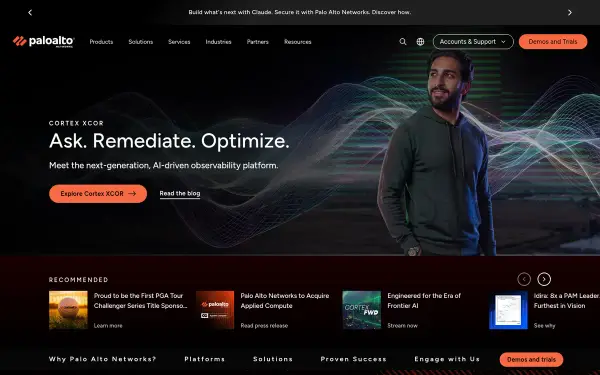
Cortex XSOAR is the reference point most buyers compare against, and the reason is breadth. The integration marketplace carries hundreds of packs, and the playbook library runs into the thousands. For routine work such as phishing triage, endpoint containment and intelligence lookups, an analyst can configure a playbook from existing building blocks instead of writing code. The war room gives responders a shared space per incident, and threat intelligence management and case management are part of the product rather than separate purchases.
Palo Alto is steering the product toward a newer agentic direction, which matters for anyone signing a multi-year renewal. Ask the account team to show what ships now versus what sits on the roadmap, and get renewal terms in writing before committing. The direction is public, but the buyer's job is to confirm which capabilities are generally available on the day you sign, not which ones appear in launch material.
Pricing is entirely quote-based. No pricing page was available, so no price could be verified, and check the vendor site for free plan and trial details. Deployments typically require professional services, and full value depends on dedicated staff to build and maintain playbooks. That staffing requirement is the hidden cost: the license is one line, the people who keep content current are another. Ask whether multi-year terms change the number, but have that conversation after the roadmap discussion rather than before it.
Pick it if you run a large SOC that already standardizes on Cortex and can fund content engineering. Skip it if you are a small team without an owner for playbook maintenance, or if you need a published price before you can build a budget.
You run a large SOC already standardized on Cortex with staff to own content.
You need a published price or have nobody to maintain playbooks.
Entry II of IX / Enterprise Security integration

Our verdict
Best automation for Splunk Enterprise Security shops, but it now comes bundled inside a platform rather than sold on its own.
SOAR in the Splunk world started life as Phantom, and the visual playbook editor still shows that heritage: non-coders can assemble a workflow from blocks, while coders can drop into custom logic. Connectors reach more than 300 third-party tools and the platform ships thousands of automated actions, so enrichment and containment for common products rarely need custom work. Case management covers the investigation workflow, not just the automation step, which is what separates it from a pure scripting tool.
The bigger change is packaging. In 2026 Splunk describes SOAR as a native capability of Splunk Enterprise Security rather than a fully standalone product, sitting alongside SIEM, UEBA and agentic AI in one platform. That is good news if you already run Enterprise Security, because the automation sits close to the detections and the data. It is less good news if you run a different SIEM, because you need written confirmation of what the Enterprise Security subscription includes before you assume SOAR arrives with it.
Pricing is not published: no pricing page was available, so no price could be verified, and check the vendor site for free plan and trial details. Budget conversations start with your existing Splunk footprint, which is either a bundled uplift or a lock-in risk depending on how you read it. Ask for the delta in writing rather than a verbal assurance that automation is included.
Pick it if Splunk Enterprise Security is already your detection layer and you want native automation next to the data. Skip it if you run a competing SIEM, or if you want a standalone SOAR platform that is priced and deployed independently of your analytics stack.
Splunk Enterprise Security already runs your detection and you want automation beside the data.
You run a different SIEM or want a genuinely standalone SOAR product.
Entry III of IX / Multitenant MSSP delivery
Our verdict
A genuine MSSP platform with multitenant reporting, wrapped in AI messaging that makes the SOAR fundamentals harder to judge.
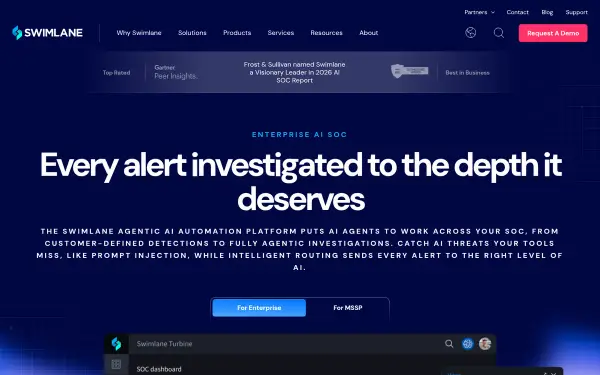
Swimlane has been in the SOAR category since 2014 and now sells itself as an agentic AI automation platform under the Turbine brand. In practice the product routes alerts through two paths: deterministic playbooks where the steps are known, and agentic investigation where the platform assembles context and proposes next actions. Case management and playbook building remain the core, and the marketplace builds connectors on demand when an integration does not exist yet, which matters when you depend on a niche tool nobody has packaged.
Multitenancy is the differentiator. Per-client dashboards and reporting plus a multitenant architecture make it a natural fit for managed security service providers that run many customers from one instance and need to show each of them their own view. Enterprises with separate business units can use the same structure to keep teams apart without buying separate deployments.
The tradeoff is clarity. AI-first messaging makes the underlying SOAR fundamentals harder to assess from the outside, and the AI compute pricing model needs to be confirmed in writing rather than inferred from a demo. Pricing is not published: no pricing page was available, so no price could be verified, and check the vendor site for free plan and trial details. Ask whether AI usage is included, capped or billed separately, and get the answer in the contract rather than the slide deck.
During evaluation, ask for a direct demo of three things: building a playbook from scratch, running the case management workflow end to end, and maintaining an existing connector when a vendor API changes. Those three show whether the fundamentals are strong or whether the AI layer is carrying the pitch.
Pick it if you are an MSSP or a large enterprise that needs multitenant automation and wants agentic AI layered on established playbooks. Skip it if you need a published price and a fixed AI cost before you commit.
You are an MSSP needing multitenant automation with agentic AI on top of real playbooks.
You need a published price and a fixed AI cost before signature.
Entry IV of IX / No-code analyst workflows

Our verdict
The easiest automation for analysts to adopt themselves, with a free edition, but lighter on classic case management than pure SOAR suites.
Tines approaches automation from a no-code angle rather than as a traditional SOAR suite, and that is the whole point. The workflow builder is designed for analysts to use directly, so phishing response, vulnerability management, access reviews and IT-adjacent tasks can be automated without waiting in an engineering queue. The company was built by former security practitioners, and the product shows it in the way a workflow reads like a sequence of actions rather than a program.
The breadth beyond incident response is unusual. Teams often start with one painful workflow, such as phishing intake, then extend the same builder to onboarding reviews or patch coordination. That makes the business case easier to defend than a platform that only counts incidents handled, because the hours saved show up in more than one team's week.
Tines publishes a free edition with three live workflows and paid editions with unlimited users, though the site shows a get pricing button rather than a paid number. It has a self-serve signup path, which matters if you want to test before you talk to sales. The free edition cap of three live workflows is enough to prove a use case and not enough to run a SOC, so treat it as an evaluation tier rather than a production plan.
The limit is depth. As a classic SOAR case-management suite it is less deep than platforms built around incident war rooms, and pure SOC buyers may miss that structure, the shared incident timeline and the formal escalation state machine. If your problem is analysts waiting on engineering time rather than case management, that trade is worth making.
Pick it if you want analysts automating their own work without code, across security and adjacent IT tasks. Skip it if you need heavyweight case management and incident command features.
Your security work stalls waiting on engineering time and you want analysts to automate it themselves.
You need formal war room case management and incident command depth.
Entry V of IX / AI SOC analyst
Our verdict
An AI-led platform built to displace legacy SOAR, with fast no-code workflows that still need proving on your own alerts.
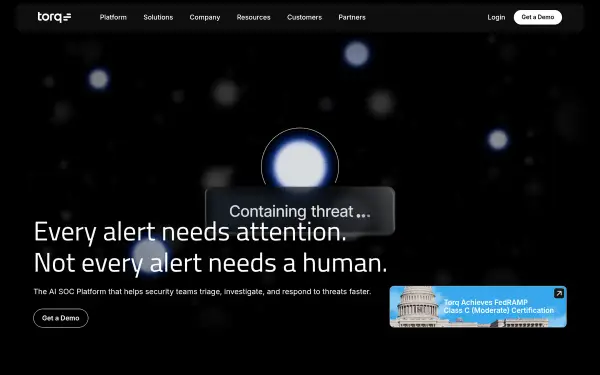
Torq positions itself as the replacement for legacy SOAR, and the pitch is speed: no-code workflow creation, an AI SOC analyst handling tier-one and tier-two cases, and full case lifecycle coverage from detection to resolution. The company argues that traditional deployments take months and need engineers to maintain, while its customers deploy first workflows in days. That claim is worth testing rather than accepting, because time to value depends heavily on which integrations you need and how clean your alert data is.
The hyperautomation framing means Torq wants to sit across the security stack rather than handle only incident response. Enrichment, triage, response and case handling are meant to run in one place, with the AI analyst absorbing repetitive tier-one volume so humans handle exceptions. That is the right architecture for a team drowning in low-fidelity alerts, and the wrong one if your alerts are already well tuned and your gaps sit elsewhere.
Pricing is not published. No pricing page was available, so no price could be verified, and check the vendor site for free plan and trial details. The marketing is loud about replacing legacy tools, which is fine as a message and useless as an evaluation method: prove the fundamentals on your own alerts, your own integrations and your own analyst workflow during a proof of concept, with a fixed success measure agreed before you start.
Two things to test specifically. First, how the AI analyst behaves when it is wrong, since tier-one automation that mislabels incidents costs more time than it saves. Second, how much of the no-code builder your analysts can use unaided once workflows get complex and branch.
Pick it if you want a modern, AI-led platform and are willing to run a structured proof of concept against real alerts. Skip it if you need published pricing before you can build a budget, or if you want a neutral evaluation without an anti-legacy sales pitch.
You want AI-led automation and will run a structured proof of concept on your own alerts.
You need published pricing before you can open a budget line.
Entry VI of IX / Evidence-graded verdicts
Our verdict
Evidence-graded verdicts and one audit trail make this the compliance-friendly choice, at enterprise cost and enterprise sales pace.
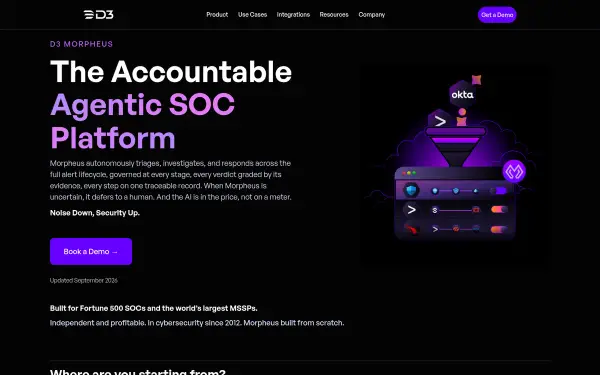
D3 now leads with Morpheus, an agentic SOC platform that includes its SOAR engine, and the design choice that stands out is evidence handling. Verdicts are graded as confirmed, inferred or gap, so an analyst can see whether a conclusion rests on hard evidence, on inference, or on something the platform could not determine. Every incident carries a single audit trail. For regulated enterprises, that structure is often the difference between an automation project that clears review and one that stalls in it.
Case management is included, and governance and auditability controls run through the platform rather than sitting in a separate reporting module bolted on at the end. The company also runs a migration program aimed at Cortex XSOAR customers, which tells you where it expects to win accounts: large, established SOCs that want a different operating model without rebuilding every integration from nothing.
Pricing is an annual subscription sized by alert volume, with AI included rather than metered. That is a meaningful difference, because it keeps cost predictable as automation volume grows and makes the budget conversation about detection volume instead of model usage. No pricing page was available, so no specific price could be verified, and check the vendor site for free plan and trial details.
The tradeoff is weight. Enterprise positioning means a heavyweight sales process and enterprise pricing, and this is not a tool for a five-person team that wants a cheap automation layer. Expect a longer evaluation, a security review and a contract negotiation, and plan the internal effort accordingly.
Pick it if you need governed, auditable automation with evidence grading and can handle an enterprise purchase cycle. Skip it if you want a light, low-cost tool you can switch on this quarter.
You need governed, auditable AI automation and evidence grading for compliance review.
You want a lightweight, low-cost tool with a short buying cycle.
Entry VII of IX / CMDB-linked response
Our verdict
The strongest security-to-IT connection available, but only justified if ServiceNow already runs your change and asset processes.
ServiceNow's SOAR engine is less a separate product than a set of workflows on the Now Platform, and that is exactly why some buyers choose it. The configuration management database maps incidents to business services and infrastructure, so a security alert can be understood in terms of which service is affected and who owns it. Response workflows can trigger change requests, and patching and asset actions happen in the same system IT already uses to run the estate.
The strength is the connection between security response and IT execution. When containment requires a change advisory step, or when a vulnerability finding needs an owner and a deadline, having both sides in one platform removes a class of handoff failures that pure security tools cannot solve at any price. The case record then reflects what actually changed in production, not just what the SOC intended.
The weakness follows directly. It only makes sense for organizations already committed to ServiceNow. Licensing follows the Now Platform model, which is enterprise-grade in cost and complexity, and no pricing page was available, so no specific price could be verified, and check the vendor site for free plan and trial details. For a non-ServiceNow shop, standing up the platform to get SOAR is a heavy lift that rarely pays back inside a reasonable window.
Evaluate it as part of a broader ServiceNow strategy rather than as a standalone SOAR purchase. If your security team already files tickets into ServiceNow and your change process lives there, the integration argument is strong and the automation reaches further than a SOC-only tool. If your IT service management lives elsewhere, the same money buys a specialist platform with deeper playbook tooling.
Pick it if you run the Now Platform and want security response wired into IT workflows and the CMDB. Skip it if you are not a ServiceNow customer or you need SOAR without a platform migration.
ServiceNow already runs your change, asset and ticketing processes end to end.
Your ITSM lives elsewhere or you need SOAR without a platform project.
Entry VIII of IX / Rapid7 stack depth
Our verdict
A solid automation companion for Rapid7 detection customers, less compelling as a standalone pick for a mixed security stack.
InsightConnect is the automation layer inside Rapid7's Command Platform, with a visual workflow builder and a large extension library of plugins. The classic use cases are the ones it handles best: alert enrichment, phishing investigation, ticket creation and remediation coordination across tools. Workflows can span SIEM, vulnerability management and managed detection data, which is the point of owning the whole stack from one vendor rather than stitching three consoles together.
Rapid7 now treats SOAR as a platform capability rather than a standalone product, and that shapes how you should evaluate it. If you already run Rapid7 detection and exposure management, the automation sits close to the data and the extensions are maintained inside the same ecosystem you already pay for. If you run a mixed stack, you need written confirmation of what current packaging includes and whether the connectors you depend on are covered without extra work.
Pricing is not published. No pricing page was available, so no price could be verified, and check the vendor site for free plan and trial details. Budget discussions should start with your existing Rapid7 agreement, because the automation is sold as part of the platform rather than as a separate line you can price in isolation. Ask for the renewal delta rather than a new quote, so you can see what the automation actually adds to the bill.
The honest limit is ambition. InsightConnect is capable at enrichment and remediation coordination, but it is not the deepest case-management suite in this list, and Rapid7's positioning makes it a companion to detection rather than a best-of-breed automation platform you would buy on its own merits. For Rapid7 customers that is a fair trade. For everyone else it is a reason to shortlist vendor-neutral options first.
Pick it if you are a Rapid7 customer and want automation inside the Command Platform without adding another vendor. Skip it if you need standalone, best-of-breed SOAR or run a mixed detection stack.
Rapid7 already runs your detection and you want automation inside the Command Platform.
You need best-of-breed standalone SOAR across a mixed vendor stack.
Entry IX of IX / Multitenant with SLAs
Our verdict
Deep Fortinet fabric integration and real MSSP tenancy features, with less pull once you step outside the Fortinet estate.
FortiSOAR covers the classic SOAR brief, with playbook automation, hundreds of API connections and solution packs for incident and vulnerability management, then adds multitenancy features that matter to service providers. It can be deployed as SaaS or self-managed, with shared and dedicated tenancy plus SLA tracking. For an MSSP running many customers under contractual response times, those are operational features rather than marketing lines, because they decide whether you can prove you met the SLA.
The 8.0 release added agentic AI features, including prebuilt expert agents and support for bringing your own model. Bringing your own model matters for buyers with data residency rules or an internal model approval process, since it lets automation run against a model the security team has already cleared rather than one imposed by the vendor. That is a practical advantage in regulated accounts.
The ecosystem advantage is the Fortinet fabric. Integration with FortiSIEM and FortiGate is deep, so detection, enforcement and automation share context in ways a vendor-neutral platform has to rebuild through APIs. That is a real benefit inside a Fortinet estate and a much smaller one outside it, where the same playbook work costs more effort and the connectors may be thinner.
Pricing is not published, and no pricing page was available, so no price could be verified. Check the vendor site for free plan and trial details. Non-Fortinet environments also get less of the ecosystem benefit, so the right comparison is head to head with a vendor-neutral platform on your own integration list rather than on the Fortinet feature sheet.
Pick it if you run Fortinet security products or you are an MSSP that needs multitenant automation with SLA tracking. Skip it if your estate is mostly non-Fortinet and you want a neutral platform.
You run Fortinet products or need multitenant automation with SLA tracking for MSSP clients.
Your estate is mostly non-Fortinet and you want a vendor-neutral platform.
VIBackground
A SOAR platform takes the repetitive parts of security operations and runs them without an analyst clicking through tabs. The core loop is familiar: an alert arrives from a SIEM or endpoint tool, the platform enriches it with identity, asset, threat intelligence and historical context, then applies a decision path that either closes it, escalates it or starts a response such as isolating a host or disabling an account. Case management wraps the loop so the record of what happened survives the shift change.
Three capabilities separate a real SOAR platform from a general automation tool. The first is a playbook engine that non-coders can maintain, because a workflow is only useful if it stays current after the analyst who built it moves teams. The second is integration coverage: hundreds of connectors, plus a way to build new ones when a vendor changes its API. The third is case management with an audit trail, since regulated buyers need to show why an action was taken, not only that it was taken.
A short list of what teams automate first:
SOAR is not the same thing as XDR. XDR detects and correlates across endpoint, network and identity telemetry, and it ships with some built-in response actions. SOAR sits above detection tools and orchestrates across them, including products from other vendors. In practice most mature teams run both, with XDR containing threats inside its own estate and SOAR handling cross-vendor workflows plus the investigation record.
Does SOAR replace analysts? No. It removes the manual steps around a decision so analysts can make more of them. Teams typically keep a human approval step for high-impact actions, especially anything that touches production.
This comparison sits in the software register. Further along the shore: baby tracking app and kennel software.
VIIPricing
No platform on this list publishes a paid price. Tines publishes a free edition with three live workflows and paid editions with unlimited users, with the paid figure behind a get pricing button. For the other platforms, no pricing page was available when we checked on November 25, 2026, so no price could be verified.
That is not laziness. A SOAR deal is sized by alert volume, analyst seats, integration count, deployment model and support tier, and those variables can move the number enormously between two buyers of the same product. Vendors also prefer the volume conversation to happen before a figure exists in writing.
The commercial patterns below are what you will actually be negotiating.
| Model | How it bills | Typical fit | Example from this list |
|---|---|---|---|
| No published price | Pricing not shown on the vendor site | Enterprise SOCs that can wait for a quote | Cortex XSOAR, Splunk SOAR, Torq, FortiSOAR |
| Alert-volume subscription | Annual subscription sized by alert volume, AI included rather than metered | Compliance-heavy buyers who want predictable AI cost | D3 Security |
| Platform bundle | Licensed as part of a broader platform agreement | Organizations already committed to that platform | ServiceNow Security Operations, Rapid7 InsightConnect |
| Free plus paid editions | Free edition with 3 live workflows, paid editions with unlimited users | Small teams and first projects | Tines |
| Deployment choice | See website, SaaS or self-managed, shared or dedicated tenancy with SLA tracking | MSSPs running many customers | FortiSOAR |
Three questions make quotes comparable. Ask for a pricing sheet that shows the volume tier you expect rather than a pilot tier, because the pilot is always cheaper. Ask what happens to the price when alert volume doubles, since automation tends to increase the work the platform does. And ask whether professional services are mandatory, because Cortex XSOAR deployments typically require them and that line adds to the first-year cost.
Where AI is metered, get the unit cost and a worked example in writing. D3 Security includes AI in an alert-volume subscription rather than metering it, which is the cleaner structure for budgeting.
Each entry card shows the starting price as it appeared on the vendor's own pricing page on November 25, 2026. When a vendor shows no figure we could confirm, or only a promotional rate, the card says "See website" or gives the regular price instead of a guess. Usage, overage and add-on rates in the text change more often than plan prices, so confirm them on the vendor page before you set a budget. To test the numbers against your own volume, try the free User Research Budget Planner. The Event Break-Even Calculator is a second way to check the same decision.
VIIIDecision
Map the repetitive work first. List the five alert types that consume the most analyst time, with the tools each one touches. That list is your requirement document, and it decides which platforms are even viable before a demo is booked.
Check integrations against your stack. Count how many of those tools already have connectors on each platform. Coverage of your own estate matters far more than a headline connector total, and a gap on a core tool can sink a deployment.
Decide whether SOAR must live inside your SIEM. If Splunk Enterprise Security or the Rapid7 Command Platform already runs detection, a bundled capability may be enough. If not, stay vendor-neutral so the automation outlives your analytics choice.
Test the build, not the demo. During a proof of concept, have your own analyst build one real playbook with the vendor watching but not typing. How fast your people move in the builder decides more than any feature comparison.
Pin down AI costs and approval flow. Where AI is metered, ask what a busy month costs. Where actions can run automatically, confirm who approves them and how the approval is logged for audit.
Price the whole thing, including content ownership. Ask for a pricing sheet, the professional services estimate and the internal hours to maintain playbooks. Compare that total against the hours saved in a year, not against a competitor's license line.
IXPitfalls
Buying the biggest marketplace. A connector count is a vanity metric. Count how many connectors cover the tools your alerts actually touch, then ask each vendor to demonstrate the three integrations you cannot live without.
Skipping the build test. Watching someone else's playbook run tells you almost nothing. Have your own analyst build a real workflow during the proof of concept, on your data, with your integrations attached and no vendor hands on the keyboard.
Ignoring content maintenance. Playbooks break when vendor APIs change and when your environment shifts. Ask who owns updates internally, how many hours a month that takes, and whether the vendor supplies maintained content packs.
Assuming the SIEM bundle includes SOAR. Splunk and Rapid7 both describe SOAR as a capability of a broader platform rather than a standalone product. Read the subscription terms before assuming automation is already covered by what you pay today.
Signing multi-year terms before the roadmap is clear. Cortex XSOAR, Swimlane and FortiSOAR all have agentic AI directions in flight. Confirm which capabilities are generally available now and what renewal terms apply if packaging changes underneath you.
XQuestions
It automates the steps around an alert so analysts spend time on decisions instead of data gathering. When an alert fires, the platform pulls context from identity, asset inventory, threat intelligence and past tickets, then runs a playbook that can close the alert, escalate it with a summary, or start a response such as disabling an account. Case management keeps the record and the audit trail.
Because deals are sized by variables that differ per customer: alert volume, seats, integration count, deployment model and support tier. No platform here publishes a paid price, and Tines publishes a free edition with three live workflows. Ask for a pricing sheet showing the volume tier you expect, the support level you need and the professional services attached to deployment.
Usually not. SOAR pays back when there is enough repetitive alert volume to automate, and a business without a SOC rarely has that volume or the analyst time to maintain playbooks. If you have a small team and one recurring task, a no-code tool with a free edition such as Tines is a cheaper starting point than an enterprise SOAR contract.
XDR detects and correlates across endpoint, network and identity telemetry and includes some built-in response actions. SOAR sits above detection tools and orchestrates across them, including products from other vendors, and it holds the case record and audit trail. Most mature teams run both, with XDR containing threats in its own estate and SOAR handling cross-vendor workflows.
It varies more by integration than by platform. Torq describes first workflows in days, while Cortex XSOAR deployments typically require professional services and longer timelines. Three things move the date: how clean your alert data is, whether the connectors you need already exist, and who is allowed to approve automated actions in your organization.
It keeps humans in the loop. SOAR removes manual steps around an alert so analysts can handle more decisions, and teams typically keep human approval for high-impact actions such as disabling an account or isolating a host. The staffing change is a shift in mix: less enrichment and data gathering, more investigation, hunting and tuning the automations.
XIFurther along the shore
Vendors can ask for a correction or apply for a Featured listing. Paid or not, the entry is scored on the same rubric and its limits stay in print. Partner with Umberlake.
Free tools
Our free browser tools turn the prices on this page into a figure for your own volume. Nothing you type leaves your device.