
Vagaro
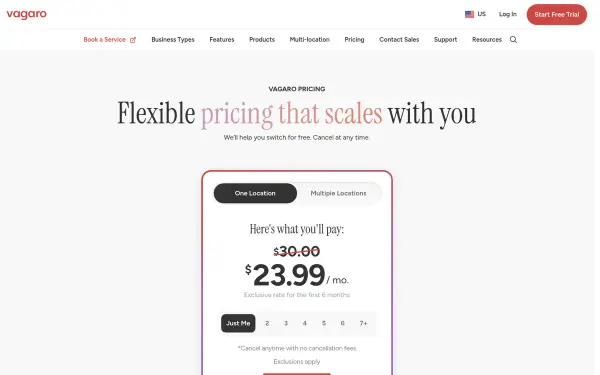
$30One bookable calendar, per month, promotional $23.99 per month for the first 6 months
Best for 3- to 7-chair salons wanting an all-in-one platform with a cost ceiling
- Free plan
- No
- Rubric
- 7.9 of 10
Ten salon platforms compared on real monthly cost, processing fees and marketplace commissions, so you can match the bill to your chair count and your growth plan.

IThe short answer
In November 2026 the best salon software depends on where your money leaks. Vagaro is the strongest all-round pick for 3- to 7-chair salons because its monthly cost plateaus near $84 to $85 once you pass seven bookable calendars. Fresha suits early-stage businesses that want marketplace discovery and can live with a 20% one-time commission on new clients. GlossGenius fits solo stylists and small teams who want one predictable bill and a flat 2.6% processing rate. Square Appointments remains the only real free tier.
10 tools compared from vendor pages on November 25, 2026. 6 publish a starting price we could read; the rest say "See website".
IITop three berths
Register order is editorial fit for the buyer each entry describes. Prices are the starting figures read on November 25, 2026.
$30One bookable calendar, per month, promotional $23.99 per month for the first 6 months
Best for 3- to 7-chair salons wanting an all-in-one platform with a cost ceiling

See website
Best for early-stage businesses that need discovery more than cost predictability

$29.99Per month plus tax, +$20 per month per additional team member, all features included
Best for independent stylists and barbers with an established book
How this page is paid for. All 10 tools here are unpaid editorial picks.
A paid listing's position can be part of what the vendor pays for. Every entry, paid or not, is scored on the same rubric and keeps its limits in print. Advertising disclosure.
IIIThe register
Starting prices as shown on each vendor's pricing page on November 25, 2026. "See website" means no figure we could confirm.
| No. | Tool | From | Free plan | Trial | Rubric | Actions |
|---|---|---|---|---|---|---|
| 01 | Vagaro3- to 7-chair salons wanting an all-in-one platform with a cost ceiling | $30One bookable calendar, per month, promotional $23.99 per month for the first 6 monthsRead on vendor page | No | 30 days | 7.9 | |
| 02 | FreshaEarly-stage businesses that need discovery more than cost predictability | See websiteNot shown publicly | No | 7-day trial | 6.6 | |
| 03 | BooksyIndependent stylists and barbers with an established book | $29.99Per month plus tax, +$20 per month per additional team member, all features includedRead on vendor page | No | 14 days | 7.1 | |
| 04 |  Square AppointmentsSalons already running Square POS or retail | See websiteNot shown publicly | Yes | 30 days on paid plans | 8.0 | |
| 05 |  MindbodyMulti-location studios, gyms, spas and salon groups | $79Starter tier, per location per month, higher tiers quote onlyRead on vendor page | No | Demo only | 6.6 | |
| 06 |  GlossGeniusSolo stylists and 2- to 9-person teams wanting one predictable bill | $24Standard, per month billed annually, $28 per month on monthly billingRead on vendor page | No | 14 days, no credit card required | 7.6 | |
| 07 |  BoulevardUpscale and boutique salons where client experience is part of the brand | See websiteDemo call required, tiers not publicly listedNot shown publicly | No | Demo only | 5.8 | |
| 08 | MangomintGrowing salons with 2 to 20+ staff and a busy front desk | $120Per location per month, plus $10 per month per userRead on vendor page | No | 14 days, no credit card required | 7.5 | |
| 09 | ZenotiSalon, spa and medspa chains that need enterprise controls | See websiteCustom quote only, annual contracts standardNot shown publicly | No | Demo only | 6.3 | |
| 10 |  PandaCueSolo pros wanting a free start and groups wanting flat pricing | FreeFree plan, 1 location and 1 staff, 50 bookings per month, Studio $197 per monthRead on vendor page | Yes | 30 days on paid plans | 6.6 |
Pinned:
IVMethod
What the subscription, add-ons and card processing add up to at a realistic seat count.
Whether booking, payments, inventory, payroll and marketing live inside one account.
How well pricing and tooling hold up as chairs, staff members and locations are added.
Whether processing rates, commissions and add-on prices are published before a demo call.
How much work it takes to import clients, learn the interface and leave again later.
VMethod
We built this list for operators who sign the invoice, not for anyone browsing screenshots. Every price, plan term and processing rate below was read from vendor pricing pages and checked on November 25, 2026. Where a page returned no content or a vendor publishes nothing, the listing says pricing is on the vendor site or quote only, and we did not estimate a number to fill the gap.
Five criteria drive the scoring, and each tool gets the same treatment. Total monthly cost carries 30 percent because the subscription is rarely the real bill. Feature breadth carries 20 percent, scale fit 20 percent, fee transparency 15 percent and setup plus migration 15 percent. Scores are integers from 1 to 10 and they describe fit for the buyer each entry names, which is why a strong enterprise tool can score modestly for a two-chair studio.
Featured positions are paid placements. Where one appears, it is labeled as a Featured position and keeps its cons. The order of this list is editorial, based on fit for the buyer described in each entry plus the disclosed Featured position, and it is not a sorting of the scores.
We also read the plan notes closely, because two tools with the same headline price can differ by hundreds of dollars a month once per-user charges, add-ons and processing are counted. Where the terms are unclear or unpublished, the review says so rather than smoothing it over.
The full routine, from price reads to corrections, is on the methodology page. Paid listings follow the advertising disclosure.
Entry I of X / One-account scope
Our verdict
A broad single-account platform for mid-size salons, held back by processing lock-in and a long add-on list.
Vagaro is the broadest single-account option here: online booking with a multi-staff calendar, point of sale with card processing, inventory, payroll, marketing campaigns and a client marketplace that brings in new bookings. A salon that would otherwise stitch three subscriptions together gets one login instead. Payroll being built in at this price is unusual in a category that usually sells it as an upgrade.
Pricing starts at $30 per month for one bookable calendar, with a promotional $23.99 per month for the first six months. Every staff member who takes bookings needs a calendar, so cost tracks headcount early: a four-person salon typically lands around $94 to $150 per month once add-ons are counted. Past seven bookable calendars the monthly bill plateaus near $84 to $85, which is what makes it work for mid-size shops rather than only for solos.
Deposits, intake forms, text marketing and the website builder are each priced separately at roughly $10 to $20 per month, so the add-on list can quietly add $40 or more. Card processing has to run through Vagaro at about 2.2% to 3.5%. Every additional location needs its own full-price subscription, and client data has to be imported by hand at setup, which takes setup time.
The marketplace is a mixed gift: it puts your listing beside competing salons in the same town, but it does not charge a per-booking commission the way some rivals do. It suits 3- to 7-chair salons that want booking, payments, inventory and payroll in one place and can live with a few add-ons. A solo renter pays for shelf space they never open. Salons with more than one site should price the second subscription before committing.
You run 3 to 7 chairs and want one account for booking, payments, inventory and payroll.
You refuse to move card processing to the platform or need several locations on one subscription.
Entry II of X / Marketplace discovery
Our verdict
Best discovery engine in the category, but the 20% marketplace commission makes it a growth bet, not a budget pick.
Fresha sells discovery first and software second. The consumer marketplace is the biggest source of brand-new clients in this comparison, and online booking, client records, team calendars and marketing tools all sit behind it. Month-to-month terms mean no cancellation penalty if the marketplace does not deliver, which is worth something when you are testing a channel.
The subscription sits at the lowest headline rate here and card payments run at 2.29% plus 20 cents in person, also the lowest in this list. The catch is the marketplace: a 20% one-time commission applies to each new client who books through it, with a $6 minimum. That is the decisive cost factor, not the subscription. A salon adding 30 marketplace clients a month at an $80 average ticket pays roughly $480 in commissions on top of the monthly fee.
Two changes matter for planning. The free-forever tier is gone, so solo operators now need the entry paid plan, and phone support costs extra on solo plans. Payroll is not built in, and returning-client billing logic has drawn complaints. Importing your existing client list before launch keeps those clients out of the commission net, which is the single highest-leverage setup task you will do that week.
Pricing is on the vendor site rather than in a published plan grid, so the monthly figure has to be confirmed at signup. It fits early-stage businesses that need bookings more than cost predictability, and it punishes anyone who builds growth on marketplace traffic without modelling the commission first. Established salons with a full book usually get more from a flat per-chair price than from a discovery channel they no longer need.
You are building a book from scratch and can convert marketplace traffic into regulars fast.
Your calendar is already full or you cannot absorb a 20% cut of every new client's first visit.
Entry III of X / Flat per-chair price
Our verdict
A clean flat per-chair price with unlimited texting, best for established independent stylists and barbers.
Booksy is priced per chair and behaves like it. $29.99 per month plus tax covers one professional with every feature included, and each additional team member adds $20 per month. There is no per-booking commission on the standard plan, which is the main reason independent stylists and barbers pick it. Flat pricing is unusual in a category that leans on commissions.
The bundle is generous for the money: online booking, a consumer marketplace app with a large audience, unlimited transactional SMS reminders, marketing tools, client reviews inside the platform, and card processing at 2.49% plus 15 cents. Unlimited reminders at no extra cost is a real saving for shops that text every client. A 3-chair barbershop runs $69.99 per month before processing, and a 5-chair shop approaches $110.
The Boost add-on is where the model changes shape. It takes 30% of a new client's first visit, which is higher than the comparable Fresha commission, so it needs modelling against growth plans rather than switched on by default. Reviews live inside Booksy and do not transfer if you leave, which makes the platform harder to walk away from than the monthly price suggests.
The 14-day trial is short for a decision that touches every booking, so build the client import during the trial rather than after it. It fits established independent stylists and barbers who already have a book and want flat costs. Salons with five or more chairs should run the per-chair math against a per-location tool first, because per-staff pricing compounds quietly as the team grows.
You are an established stylist or barber who wants a flat bill and unlimited texts.
You run five or more chairs, where the per-person charge outgrows per-location pricing.
Entry IV of X / Free entry tier
Our verdict
A genuine free tier, and the easiest sell for any salon already running Square hardware at the front desk.
Square Appointments has a genuine free tier, and it bills per location rather than per staff member, which changes the arithmetic for growing teams. The free plan covers online booking, calendar sync and email reminders, enough for a solo operator who does not need deposits or waitlists. Billing is per location, so adding chairs does not raise the subscription.
Paid tiers do the heavy lifting. Plus at $49 per location adds no-show fees, cancellation policies, waitlists and email marketing. Premium at $149 per location adds resource scheduling for larger teams but is costly for what it includes. A 30-day trial applies to paid plans. Feature gating is the tradeoff for a free entry point, and busy salons may find they need Plus early.
The reason to choose it is the ecosystem: native point of sale, inventory, loyalty and payroll inside Square, with familiar Square hardware and transparent published pricing. The reason to hesitate is processing. Card payments have to run through Square at roughly 2.6% of revenue regardless of subscription level, and that cost does not shrink as you grow.
Setup is fast and the interface needs little training, which matters in a shop with high staff turnover. Salons already running Square for retail get the most from it, since inventory and loyalty are shared. Shops with no Square hardware in place should weigh the processing rate before switching, because the free tier saves a subscription and not a percentage.
You already use Square for payments or retail and want booking on the same account.
You need deposits, waitlists or email marketing free, or cannot tolerate Square-only processing.
Entry V of X / Multi-location controls
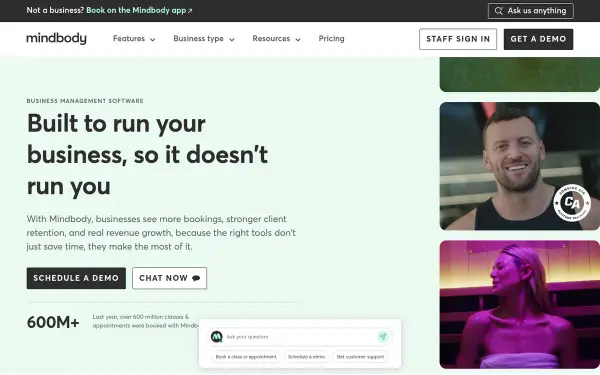
Our verdict
Enterprise-grade scheduling for groups and spas, with quote-only tiers and 24-month contracts that solo salons should avoid.
Mindbody is built for groups, not for a single chair. Centralized multi-location scheduling, franchise support, memberships and packages, retention automation, unlimited staff logins per location and more than 100 integrations make it the deepest enterprise tool in the wellness segment, and the AI front desk on upper tiers is part of that pitch. Nothing here is designed around a two-chair studio.
Only the Starter tier has a published price: $79 per location per month. The tier most groups actually want, with email and SMS marketing plus lead management, is quote only, and pricing per location means a three-location business pays the base rate three times. There is no trial, only a demo, so budget for a sales process rather than a signup form.
Two costs sit outside the subscription. A 20% marketplace commission applies to new clients, capped at $30, and 24-month contracts are standard. The consumer app is a real asset with a large active user base, but it is also the mechanism that generates the commission. Deeper tooling also means a longer rollout, and staff training is not optional.
This is the right tool for multi-location studios, gyms, spas and salon groups that need franchise controls and one dashboard across sites. A single-location salon pays enterprise prices for controls it will never open, and lighter tools handle booking and payments for far less. Ask for the contract term in writing before the demo ends, and model the commission at your expected new-client volume rather than at last year's.
You run multiple studios or a spa group that needs one dashboard and franchise controls.
You have one location, want published pricing, or cannot commit to a 24-month term.
Entry VI of X / Flat 2.6% processing
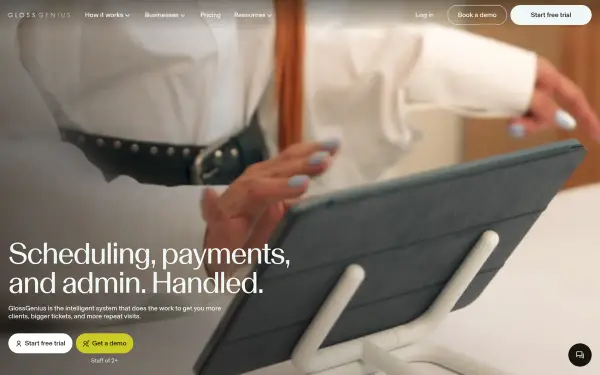
Our verdict
The cleanest bill in the category, with a flat 2.6% processing rate that rewards high volumes of small appointments.
GlossGenius targets the independent stylist and the small team behind her. Booking pages are mobile-first and polished, marketing tools are bundled rather than sold back as add-ons, and card processing is a flat 2.6% with no per-transaction cents, which suits high volumes of small-ticket appointments.
The headline price is $24 per month on the Standard plan when billed annually, $28 on monthly billing, and a 14-day trial needs no credit card. Standard covers up to two users. Gold, at $48 per month on annual billing, covers up to nine team members, and Platinum at $148 adds advanced staff management. The jumps between tiers are steep enough to plan against before you hire.
The flat processing rate is the differentiator worth calculating. A stylist running 60 to 120 appointments a month at moderate ticket sizes usually comes out ahead against a percentage-plus-cents rate. The tradeoff is a ceiling: this is not built for large multi-stylist operations, and moving to a bigger platform later involves a painful migration, so the ceiling should be weighed up front rather than in year three.
There is no free tier, so a brand-new stylist pays from day one, but the bill is predictable and setup is quick. It fits solos and 2- to 9-person teams who want one bill, bundled marketing and a booking page that looks right on a phone. Salons with a front desk, deposits and inventory needs will hit the limits sooner than the price suggests.
You are a solo stylist or a team of up to nine who wants one predictable monthly bill.
You need a free start, a front desk with deposits, or room to grow past nine staff.
Entry VII of X / Client self-checkout
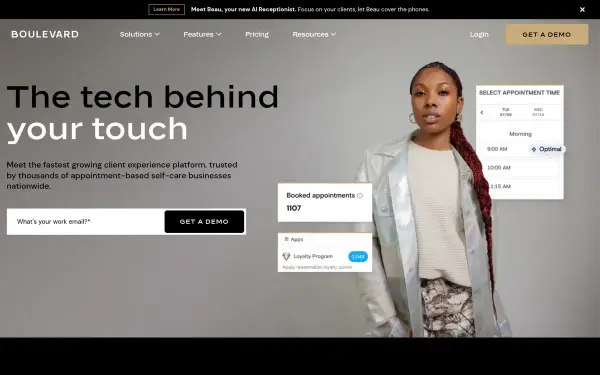
Our verdict
A premium client experience with real inventory depth, wrapped in unpublished pricing and a stack of paid add-ons.
Boulevard sells the client experience. Self-checkout, personalized booking flows and detailed front-desk and client-profile tooling are aimed at upscale and boutique salons where the appointment feels like part of the brand, not a transaction at a screen.
Real-time inventory with automatic reordering is a genuine operational advantage for retail-heavy salons, and the Offset feature can push card processing down to 1% by passing 3% to the client. Both are the kind of detail that separates a premium shop from a software-first one, and both are worth pricing against your actual retail and ticket mix.
Now the costs. Pricing is not published and a demo call is required before a quote, so there is no way to compare it line by line without talking to sales. Annual commitments are standard, additional locations bill at full price, and key capabilities are paid add-ons: Forms and Charts and QuickBooks integration are paid add-ons; ask the vendor for current pricing. There is no free trial, so the evaluation happens on a demo rather than on your own calendar with your own clients.
It fits salons where a higher ticket justifies both the subscription and the add-ons, particularly retail-heavy shops that will use inventory reordering daily. It is a poor match for a price-sensitive shop, a solo renter, or anyone who wants to see a pricing sheet before booking a call. Ask directly which capabilities are included and which are billed monthly before you compare quotes.
You run an upscale, retail-heavy salon where the checkout experience is part of the brand.
You need published pricing or a trial before committing to an annual contract.
Entry VIII of X / Front desk speed
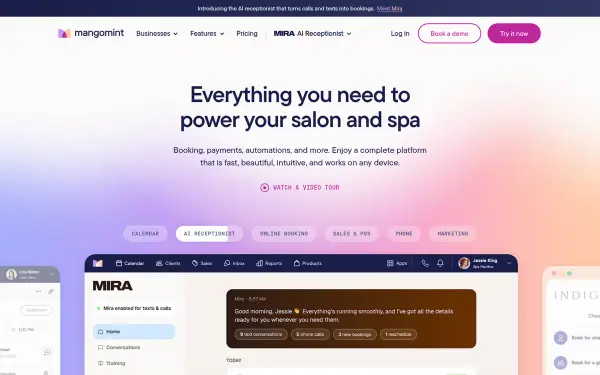
Our verdict
The fastest front desk in the comparison, priced for busy salons rather than for solo operators working alone.
Mangomint wins on speed at the front desk. The booking and checkout interface is the fastest in this comparison, Express Booking shortens the rebooking conversation, and smart automations pick up the reminders and follow-ups a busy desk forgets. Reporting and client management sit in the same flow.
Since August 2026 the pricing model is simple: $120 per location per month plus $10 per month per user, with every feature included and no tier gating. A 6-person salon pays about $180 per month. There is a 14-day trial with no credit card required, which is enough time to run a real week of appointments if you import clients on day one.
Add-ons sit outside that number. Phone and texting, payroll and marketing are charged separately, so the inclusive-features message needs a caveat: the core platform is all-in, but the surrounding services are not. HIPAA compliance is available, which matters for medspa-adjacent work. Confirm the add-on prices before signing, because they move the effective bill above the headline rate.
The audience is a salon with 2 to 20+ staff and enough volume that front-desk seconds convert into money. Premium pricing makes it a poor fit for solo operators and very small salons, and the US-focused feature set with English-only support rules it out for some international teams. Growing salons should price the per-user component at year-two headcount, not today's.
You run 2 to 20 staff behind a busy front desk and want every core feature included.
You are solo, need payroll and texting inside the base price, or operate outside the US.
Entry IX of X / Franchise controls

Our verdict
Real enterprise machinery for chains, but quote-only pricing and implementation fees put it out of reach for small shops.
Zenoti is enterprise software for salon, spa and medspa chains. Multi-location dashboards, franchise controls, cross-center redemption, CRM, inventory, marketing automation and an AI receptionist all live in one login, and the vendor reports more than 30,000 businesses using it globally.
Pricing is quote only, on annual contracts, with no published pricing sheet. Implementation fees are quoted separately before the subscription starts, and marketing, reputation and AI features are paid add-ons on top. For a chain generating roughly $30,000 or more per month in revenue, that fee is a small share of turnover; for anyone smaller it is a barrier.
The case for adopting it early is migration. Moving from a small salon tool to Zenoti after three years of client history is far more painful than starting on it, so a group with expansion plans may reasonably choose it before it strictly needs the controls. The case against is that single-location salons never open most of what they pay for, and the annual term locks in that mistake for a year.
Expect a sales-led rollout with implementation time built into the timeline. It fits salon, spa and medspa chains that need franchise controls and cross-center redemption, and it is overkill for a two-location shop that mainly wants good booking and clean payments. Ask for a written scope of what implementation covers before signing anything.
You run a chain needs franchise controls, cross-center redemption and one enterprise dashboard.
You have one or two locations or cannot take on a sales-led implementation.
Entry X of X / Free forever plan
Our verdict
A free plan that suits solos and flat pricing that suits groups, with an awkward gap for two- and three-person salons.
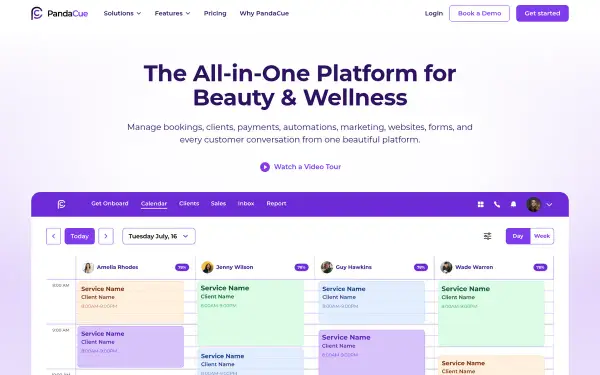
PandaCue starts free, and Square Appointments also offers a free tier. The free plan covers one location and one staff member with 50 bookings per month, and paid Studio plans at $197 per month allow unlimited staff on a month-to-month subscription with a 30-day all-feature trial.
The paid model is location-based, so headcount does not increase the bill. For a group with eight stylists sharing one front desk, that is a genuinely flat cost and easy to forecast. Online scheduling, point of sale, client records, staff management and automated reminders are all in the same login, with more than 25 features listed, and paid plans cancel anytime.
The gap between free and paid is the problem. There is no middle tier, so hiring a second staff member moves the bill from $0 to $197 per month in one step. A two- or three-person salon usually finds that jump hard to justify, and the free plan caps out at a single location and a single staff member by design.
It fits solo professionals who want a free start and groups that want flat, predictable pricing with unlimited staff. Anyone between those two positions, such as a two- or three-person salon, should compare the Studio price against a per-seat tool at their actual headcount before deciding. Take the 30-day trial and run it with a second user to see whether the jump is worth it.
You are solo and want a free start, or you run a group that wants flat pricing for unlimited staff.
You are a two- or three-person salon that cannot justify $197 per month.
VIBackground
Salon software is the system of record for everything between a client finding you and a client paying you. At its core it holds a booking calendar, a client record with visit history and service notes, and a checkout flow tied to card processing. Everything else in the category is built on top of those three pieces.
The differences show up in what surrounds the core. Inventory tracking tells you when color or retail stock is running low. Payroll turns commission structures and hours into a pay run. Marketing tools send reminders, win-back offers and birthday messages. A consumer marketplace puts your open slots in front of people who are not yet your clients, usually for a commission. Reporting shows which service, staff member and day of the week actually makes money.
Four checks sort most of the market:
A solo stylist renting a chair usually needs a calendar, card payments, text reminders and a client list. A five-chair salon needs deposits, no-show protection, inventory and payroll, and those are often paid extras. A multi-location group needs cross-center reporting and franchise controls, which is a different product category at a different price.
One practical note: the marketplace attached to a platform is a marketing channel, not a feature to tick off a comparison list. It brings genuinely new clients and it also places your listing beside nearby competitors, so judge it on the commission it charges and the clients it actually converts, not on the size of the app's audience.
This comparison sits in the software register. Further along the shore: baby tracking app and kennel software.
VIIPricing
Salon software rarely bills the way the headline price suggests. Three models dominate this list, and each one shifts cost to a different place: your staff count, your locations, or your new clients.
Per chair or per calendar pricing is the most common. Vagaro charges $30 per bookable calendar per month and Booksy charges $29.99 plus $20 per additional team member. Both look cheap for a solo operator and both compound as you hire, which is why Vagaro's plateau near $84 to $85 past seven calendars matters.
Per location pricing inverts that. Mangomint charges $120 per location plus $10 per user, PandaCue charges $197 per month for unlimited staff, and Square Appointments bills per location on every tier, so a growing team stays cheap while a second site does not.
Marketplace commission is the third model and the easiest to underestimate. Fresha takes 20% of a new marketplace client's first visit with a $6 minimum, Booksy's Boost takes 30%, and Mindbody takes 20% capped at $30.
Then there is quote-only enterprise pricing. Boulevard and Zenoti publish nothing, require a demo, and standardly ask for annual commitments.
| Model | How it bills | Typical fit | Example from this list |
|---|---|---|---|
| Per bookable calendar | Monthly fee per staff calendar, flattening at higher counts | Salons adding chairs gradually | Vagaro at $30 per bookable calendar per month |
| Flat per user | One subscription per chair with all features included | Independent stylists and barbers | Booksy at $29.99 plus $20 per additional team member |
| Per location plus per user | Location fee plus a small charge per user | Busy front desks with 2 to 20+ staff | Mangomint at $120 per location plus $10 per user |
| Free tier, paid tiers per location | Free entry plan, upgrades priced by location | Solo operators and shops already on the vendor's POS | Square Appointments free tier, Plus at $49, Premium at $149 |
| Subscription plus marketplace commission | Monthly fee plus a one-time cut of new marketplace clients | New businesses buying discovery | Fresha at 20% with a $6 minimum |
| Quote only | Custom quote, annual contract | Chains and multi-location groups | Zenoti, and Boulevard |
The practical rule: compare tools at your headcount twelve months from now, add your processing rate to the subscription, and check whether the add-ons you need are included or sold separately.
Each entry card shows the starting price as it appeared on the vendor's own pricing page on November 25, 2026. When a vendor shows no figure we could confirm, or only a promotional rate, the card says "See website" or gives the regular price instead of a guess. Usage, overage and add-on rates in the text change more often than plan prices, so confirm them on the vendor page before you set a budget. To test the numbers against your own volume, try the free User Research Budget Planner. The Event Break-Even Calculator is a second way to check the same decision.
VIIIDecision
Count chairs, not features. Write down how many people take bookings today and how many you expect in a year. Vagaro's plateau past seven calendars and Booksy's $20 per additional team member produce very different year-two bills from the same starting point.
Add your processing rate to the subscription. A flat 2.6% at GlossGenius, 2.29% plus 20 cents at Fresha and 2.2% to 3.5% at Vagaro land in different places depending on your average ticket size and monthly appointment volume.
Price the add-ons you actually need. Deposits, intake forms, text marketing, payroll and accounting integration are separate line items on several platforms, and they can double a small subscription quietly.
Model marketplace commission at your real growth rate. Fresha's 20% with a $6 minimum and Booksy's 30% Boost fee only pay off if those clients are genuinely new. Import your existing list before launch so regulars never enter the net.
Run the trial with your own data. A 14-day or 30-day trial is only useful if you import clients and take real appointments inside it. Booksy's 14 days is tight; Square Appointments and PandaCue give 30.
Ask what leaving costs. Reviews that stay inside Booksy, manual client imports at Vagaro and painful migrations off GlossGenius all raise the price of a later switch. Confirm export formats and contract length before you sign.
IXPitfalls
Buying on the sticker price. The monthly subscription is rarely the whole bill. Processing at 2.2% to 3.5% of revenue and paid add-ons can outrank it within a quarter.
Assuming the free tier covers a team. Square Appointments bills per location, which is generous, but no-show fees, waitlists and email marketing all sit on the $49 Plus plan, so the free advantage fades fast.
Leaving marketplace boosts on by default. Booksy's Boost takes 30% of a first visit and Fresha takes 20% with a $6 minimum. Both are defensible for new clients and expensive for anyone who was already going to book.
Skipping the client import before launch. Vagaro requires manual data import, and marketplace commission on existing clients is avoidable if those clients book through your own link rather than the app. Do this in week one.
Signing a long contract for one location. Mindbody runs 24-month terms and Zenoti and Boulevard work on annual commitments. Match the term to your expansion plans, not to the salesperson's quarter.
XQuestions
More than the sticker price. A four-person salon on Vagaro typically lands around $94 to $150 per month once add-ons are included, before card processing at 2.2% to 3.5%. GlossGenius charges $24 per month on annual billing plus a flat 2.6% processing rate. Add marketplace commission where it applies: Fresha takes 20% of a new client's first visit, with a $6 minimum, which alone can exceed the subscription.
No. The free-forever tier is no longer offered, so solo operators now need the entry paid plan. Pricing is on the vendor site rather than in a published grid, so the monthly figure has to be confirmed at signup. Card payments run at 2.29% plus 20 cents in person, and a 20% one-time commission applies to each new marketplace client with a $6 minimum.
Start with Square Appointments, which has a genuine free tier and covers online booking, calendar sync and email reminders per location. GlossGenius at $24 per month on annual billing is the better fit once you want marketing bundled and a flat 2.6% processing rate. PandaCue also runs a free plan for one staff member, capped at 50 bookings per month.
Quickly. At an $80 average ticket, 30 new marketplace clients a month generates roughly $480 in Fresha commissions, far more than the gap between any two subscriptions in this list. Booksy's Boost takes 30% of a first visit. Import your existing client list before launch so returning clients never enter the commission net, and watch how many marketplace bookings become repeat visits.
Harder than the sales demo suggests. Vagaro requires manual client data import, Booksy reviews stay inside the platform and do not transfer, and moving off GlossGenius to a larger platform involves a painful migration. Ask for a data export sample before you sign, confirm whether visit history and service notes come with it, and keep your own copy of the client list.
Vagaro is the clearest yes: payroll, inventory and marketing sit in one account at $30 per bookable calendar per month. Square Appointments reaches payroll and inventory through the wider Square ecosystem. Mangomint includes point of sale and payments but charges payroll as an add-on, Boulevard tracks inventory in real time with automatic reordering, and Zenoti lists inventory management and CRM. Booksy, Fresha, GlossGenius and PandaCue do not list payroll as included.
XIFurther along the shore
Vendors can ask for a correction or apply for a Featured listing. Paid or not, the entry is scored on the same rubric and its limits stay in print. Partner with Umberlake.
Free tools
Our free browser tools turn the prices on this page into a figure for your own volume. Nothing you type leaves your device.