
Stripe Billing
See website
Best for early SaaS under $50K MRR already taking payments on Stripe
- Free plan
- No
- Rubric
- 7.9 of 10
Nine billing platforms compared on metering, dunning, tax handling and pricing model, with the costs you can expect at $10K and $100K in monthly recurring revenue.

IThe short answer
Stripe Billing is the best SaaS billing software for early teams under $50K MRR already taking payments on Stripe, as of November 2026. Chargebee suits firms between $20K and $500K MRR with complex pricing or finance requirements, and Recurly fits subscription businesses where failed-payment recovery is the biggest revenue leak. All three were checked against vendor pricing pages on November 25, 2026. Below, nine platforms ranked for fit, with entry prices, metering limits and the honest trade-offs of each.
9 tools compared from vendor pages on November 25, 2026. 5 publish a starting price we could read; the rest say "See website".
IITop three berths
Register order is editorial fit for the buyer each entry describes. Prices are the starting figures read on November 25, 2026.
See website
Best for early SaaS under $50K MRR already taking payments on Stripe

FreeFlow, per month, plus 0.80% of monthly invoicing volume, includes 100M usage events per month
Best for firms at $20K-$500K MRR with complex billing or finance needs
$249Starter, per month, plus 0.9% of billing volume, first $40K of monthly billings included
Best for subscription businesses where failed-payment recovery is the main leak
How this page is paid for. All 9 tools here are unpaid editorial picks.
A paid listing's position can be part of what the vendor pays for. Every entry, paid or not, is scored on the same rubric and keeps its limits in print. Advertising disclosure.
IIIThe register
Starting prices as shown on each vendor's pricing page on November 25, 2026. "See website" means no figure we could confirm.
| No. | Tool | From | Free plan | Trial | Rubric | Actions |
|---|---|---|---|---|---|---|
| 01 | Stripe BillingEarly SaaS under $50K MRR already taking payments on Stripe | See websiteNot shown publicly | No | No | 7.9 | |
| 02 | ChargebeeFirms at $20K-$500K MRR with complex billing or finance needs | FreeFlow, per month, plus 0.80% of monthly invoicing volume, includes 100M usage events per monthRead on vendor page | No | Free trial | 8.7 | |
| 03 | RecurlySubscription businesses where failed-payment recovery is the main leak | $249Starter, per month, plus 0.9% of billing volume, first $40K of monthly billings includedRead on vendor page | No | 90-day free trial | 7.8 | |
| 04 | Zoho BillingBootstrapped SaaS under $20K MRR, especially Zoho users | $39Standard, per organization per month, billed annually, up to 3 usersUpdated on vendor page | No | 14-day free trial | 7.4 | |
| 05 |  PaddleIndie and early SaaS selling internationally from day one | FreePay-as-you-go, 5% plus 50 cents per Checkout transaction, no monthly feeRead on vendor page | No | Demo only, developer sandbox | 7.9 | |
| 06 |  MaxioSales-led B2B SaaS at $50K-$500K+ MRR with negotiated contracts | See websiteNot shown publicly | No | 30-day developer sandbox | 7.5 | |
| 07 |  LagoEngineering-led SaaS and AI startups with in-house DevOps capacity | See websiteLaunch, no minimum commitment, first $100,000 of billings free then 0.7%, open-source code includedNot shown publicly | Yes | Free sandbox coming soon | 6.9 | |
| 08 |  OrbAI, infrastructure and API companies with usage-driven pricing | See websiteNot shown publicly | No | Free developer sandbox | 6.6 | |
| 09 |  ChargeOverSMB and mid-market SaaS that want billing without a revenue percentage | $229Per month, flat rate, no annual contracts, tiers scale with active customer countRead on vendor page | No | Free trial | 7.4 |
Pinned:
IVMethod
How openly the vendor publishes entry costs and how predictably the bill scales as revenue grows.
Coverage of proration, usage metering, tiers and pricing model changes without custom code.
Dunning, retry logic, revenue recognition and reporting that keep cash collection and the books accurate.
Gateway, accounting, CRM and warehouse connections that match how the buyer already operates.
How much engineering and admin work the buyer carries to run billing month after month.
VMethod
We ranked these nine platforms by fit for the buyer each entry names. The ordering is editorial, plus any disclosed Featured position. A Featured listing is a paid placement, and it is scored with the same rubric as every other entry.
The rubric weights pricing clarity at 25 percent, billing depth at 25 percent, recovery and finance at 20 percent, integration fit at 15 percent and operational load at 15 percent. Pricing clarity asks how openly a vendor publishes entry costs and how predictably the bill scales with revenue. Billing depth covers proration, usage metering, tiered and prepaid models, and whether a pricing change needs custom code. Recovery and finance covers dunning, retry logic, revenue recognition and reporting. Integration fit looks at gateway, accounting, CRM and warehouse connections. Operational load is the work your team carries after go live.
Prices were checked on vendor pricing pages on November 25, 2026. Where a page would not load or did not show a figure, the entry says so and the price is listed as see website rather than estimated. We did not convert currencies and we did not invent tiers that vendors do not publish.
Feature facts come from vendor documentation. Where a vendor page and other published sources disagreed, as with Zoho Billing, we say so and point you back to the vendor page. Platforms quoted only through sales, such as Maxio and Orb, are described as quote only. No review quotes, customer names or ratings appear here. The trade-offs come from the product design, the published plan limits and the pricing model itself.
The full routine, from price reads to corrections, is on the methodology page. Paid listings follow the advertising disclosure.
Entry I of IX / Smart Retries engine

Our verdict
The cheapest entry point for teams already on Stripe, with recovery automation included and metering left to a separate product.
Stripe Billing suits early SaaS teams under $50K MRR that already take payments through Stripe. There is no new account to open and no second processor to reconcile, which matters when the finance function is one founder and a spreadsheet. Billing arrives as a layer on top of the account you already have, so the work is configuration rather than migration.
The feature set covers recurring subscription and invoice billing, machine-learning Smart Retries that pick retry timing for failed cards, and automated missed-payment reminder sequences. You can invoice customers who are billed outside Stripe, so a handful of enterprise accounts does not force a second system. Subscription analytics and revenue reporting are included rather than sold as an add-on, which is unusual at this price point.
Pricing is on the vendor site. The published structure is 0.7% of billing volume with no monthly fee, plus an optional annual plan around $620 per month for up to $100K in volume. Payment processing is priced separately, so the effective cost of the full stack runs higher than the headline rate. Cost scales with volume and there is no flat ceiling. The page we fetched on November 25, 2026 showed transaction rates but not the Billing percentage, so confirm the rate in writing before you model it.
The limits are metering and predictability. Heavy token or API-call metering needs a separate quote-based product, and a business with lumpy volume has no flat option to fall back on. Pick it if you are already on Stripe and want recovery automation without a fixed bill. Skip it if usage metering is the core of your pricing rather than an edge case.
You already run payments on Stripe and want retry automation without adding a fixed monthly bill.
Token or API-call metering is central to your pricing, or if you need a cost that stops moving with revenue.
Entry II of IX / Gateway agnostic engine
Our verdict
The deepest subscription logic here, gateway agnostic, and priced as a percentage that never stops following your revenue.
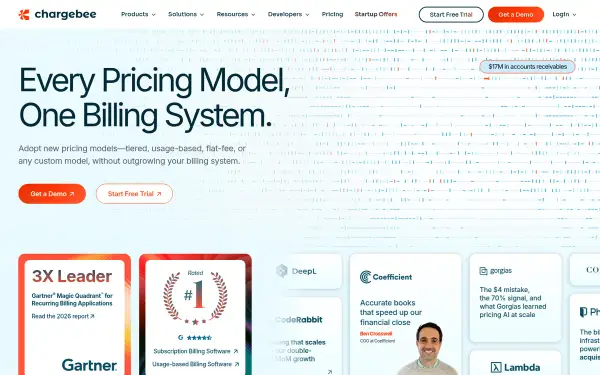
Chargebee fits firms between $20K and $500K MRR whose pricing has outgrown a simple monthly plan. The platform handles usage tiers, proration and pricing model changes without custom code, which is the work that otherwise lands on an engineering team every quarter. It does not process payments itself, so it sits on top of a gateway and keeps you free of processor lock-in.
Connections reach more than 40 payment gateways, and the Flow plan includes ingestion of up to 100M usage events per month, which is generous for a metered product. Smart and basic dunning cover failed payments, and a dedicated line handles ASC 606 revenue recognition for finance. Support for more than 120 currencies matters if you sell across regions. CPQ, RevRec and the Growth product line are sold separately rather than bundled.
Flow is $0 per month plus 0.80% of monthly invoicing volume, so a $20K MRR business pays roughly $160 monthly. A commit variant near $99 plus 0.65% becomes cheaper once monthly billings pass roughly $66K, at which point the platform fee pays for itself. A startup program, granted by application rather than open signup, is free until $1M in cumulative billing. A free trial is also available.
The percentage fee is the main objection. It follows revenue indefinitely with no flat ceiling, and gateway fees sit on top because Chargebee never touches the money. Pick it if complex pricing and finance reporting are the bottleneck. Skip it if you want a cost that stops moving when revenue rises, which is the ground ChargeOver and Zoho Billing occupy.
Your pricing has tiers, usage or frequent changes and you want to keep your current payment gateway.
You want a bill that caps out, since the 0.80% keeps scaling with invoicing volume.
Entry III of IX / Retry timing tuned

Our verdict
Recovery tooling is the product, a published $249 entry price helps, and the best dunning sits behind quoted tiers.
Recurly fits subscription businesses where failed payments are the main revenue leak. Retry timing is tuned on large transaction datasets, and higher tiers support multiple dunning campaigns rather than a single schedule, which is the difference between recovering an expired card and writing the balance off. The product also handles subscription lifecycle management and plan changes, connections to more than 20 payment gateways and support for 140+ currencies.
Entry pricing is published rather than quote only. Starter runs $249 per month plus 0.9% of billing volume, with the first $40K of monthly billings included, so a business at $10K MRR pays the flat $249 and nothing on top. There is a 90-day free trial, long enough to run recovery tests against your own decline data before you commit. Higher tiers are quoted rather than published, which slows budgeting for a finance team.
The catches are structural. Starter includes only one static dunning campaign, so the strongest recovery tooling sits behind a sales conversation. Engage, the customer communication product, and RevRec are paid add-ons rather than part of the subscription. Currency and gateway coverage are broad, with connections to more than 20 payment gateways and support for 140+ currencies.
Pick it if involuntary churn is the number you are trying to move and you want a published entry price rather than a quote. Skip it if you need deep usage metering, where Orb and Chargebee go further, or if you want a bill with no revenue component at all, which is ChargeOver's ground.
Failed payments are your biggest leak and you want a 90-day window to test recovery against real declines.
You need multi-campaign dunning from day one on a published price, since that sits in quoted tiers.
Entry IV of IX / Flat per organization
Our verdict
A flat per-organization fee with no revenue share, but the subscription essentials most teams need sit above the base plan.
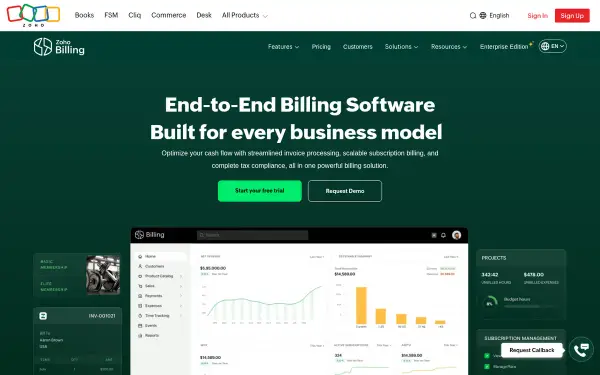
Zoho Billing suits bootstrapped SaaS under $20K MRR, especially teams already running on Zoho applications. Standard is charged per organization rather than per seat, with up to 3 users, which keeps the bill small for a founding team that adds the occasional part-time admin. A 14-day free trial is available and there is no free plan.
The base plan covers recurring subscription invoicing and billing. Features that most subscription businesses treat as essential sit one tier up. Coupons, hosted pages and multi-currency arrive on Professional, while metered and usage-based billing, consolidated billing and trial management need Premium. Automatic payment retries are listed on Standard, with manual dunning on Premium. Integrations cover QuickBooks, Xero, Stripe and PayPal, which is the shortlist most small teams actually use.
Pricing starts at $39 on Standard, per organization per month, billed annually for up to 3 users, with Professional and Premium stepping up from there. Published figures differ between sources, including older quotes near $15 per month billed annually and $20 month to month for Standard, so check the vendor page before you budget. What is clear is the shape: a flat per-organization fee with no percentage of revenue attached to it.
That flat shape is both the appeal and the ceiling. The base plan is closer to invoicing than to full subscription management, and usage billing or stronger dunning pushes you into Premium. Pick it if you want a low fixed cost and already live in the Zoho ecosystem. Skip it if your product bills on tokens, overages or per-unit metering today.
You want a low fixed cost, up to 3 users and QuickBooks or Xero sync without a revenue share.
You need coupons, multi-currency or metered billing, since each one moves you to a higher plan.
Entry V of IX / Merchant of record

Our verdict
Tax and fraud handled as merchant of record, paid for with a per-transaction rate that hurts cheap plans.
Paddle suits indie and early-stage SaaS selling internationally from the first invoice. It acts as merchant of record, so it is the seller on record, collects and remits VAT, GST and US sales tax in more than 200 countries, and handles fraud screening and chargebacks. For a two-person team that would otherwise register for tax in several jurisdictions, that is the whole argument for choosing it.
Subscription billing and checkout sit inside a single fee, alongside the Paddle Retain dunning product and bundled subscription analytics. A developer sandbox is provided for testing, but there is no free plan and no conventional trial, only a demo and the sandbox. Checkout customization is thinner than Stripe's, so a heavily branded purchase flow will feel constrained by what the platform allows.
Starter charges 5% plus 50 cents per Checkout transaction with no monthly fee. That is workable from the first sale and expensive on low ticket prices: a $12 plan gives an effective rate near 9.2%. The fee keeps scaling with revenue and there is no flat option. Higher-volume sellers are expected to negotiate toward roughly 3.5 to 4.5 percent past about $50K MRR, which is a conversation rather than a published tier.
Pick it if tax registration and remittance are the work you want gone and you sell into many countries. Skip it if you sell low ticket subscriptions at volume, where the percentage becomes a large line item, or if you need deep checkout control and a free plan to test with.
You sell into many countries and want VAT, GST and US sales tax handled without registrations.
Your average plan price is low, since the 5% plus 50 cents model gets heavy fast.
Entry VI of IX / ASC 606 recognition

Our verdict
Finance-grade revenue recognition and contract billing for sales-led B2B, with a steep floor and quotes instead of prices.
Maxio suits sales-led B2B SaaS at $50K to $500K+ MRR with negotiated contracts. It was formed by combining Chargify and SaaSOptics into one billing and finance system, and the result leans toward the finance side: GAAP and IFRS revenue recognition under ASC 606, expense recognition and SaaS metrics reporting are part of the core product rather than a bolt-on. Audit-ready revenue schedules are the reason most buyers arrive.
On the billing side it covers CPQ and contract billing for negotiated deals, usage metering and hybrid pricing, and multi-entity revenue management on the quoted tier. A 30-day developer sandbox is offered so implementation can be tested before a contract is signed. What it is not is a light tool for a $10K MRR product with a single monthly plan and self-serve checkout at the end of a marketing site.
Pricing is on the vendor site and could not be retrieved on November 25, 2026, so treat any figure as provisional. The numbers we hold describe a Grow tier at a flat $599 per month up to $100K in monthly billings, with larger tiers quoted only. Most buyers end up in a sales-led quote process, and advanced revenue management plus multi-entity support sit behind that quote.
The trade-off is cost and complexity against a single platform. A $599 floor is steep for an early company, but it buys revenue recognition that would otherwise mean spreadsheets and an accountant's time. Pick it if an audit or a full-time CFO is in your near future. Skip it if self-serve subscription billing is all you need.
You sell negotiated contracts and need ASC 606 schedules your auditor will accept.
You run simple self-serve plans and $599 per month buys reporting you will not use.
Entry VII of IX / Self-hosted engine

Our verdict
Open-source billing you host yourself: no licence fee, no revenue share, and a real engineering bill.
Lago suits engineering-led SaaS and AI startups with in-house DevOps capacity. It is an open-source billing engine under AGPL-3.0 that you deploy on your own infrastructure, with billable metrics, usage metering, coupons and invoicing, and an API built for engineers rather than finance users. Data residency friendly deployment is the reason some regulated teams choose it over a managed platform.
The trade is ownership. There is no licence fee and no revenue percentage, and you control the data and the infrastructure. In exchange, upgrades, monitoring, backups and month-end runs fall on your team, and tax automation and automatic dunning are paid Premium edition features rather than part of the open-source code. Total cost of ownership can exceed a managed platform at lower volume once engineering hours are counted honestly.
Pricing is on the vendor site. The Launch plan carries no minimum commitment, includes the first $100,000 of billings free and charges 0.7% after that, with the open-source code included and a documented API. A free sandbox is listed as coming soon, so there is no trial to evaluate today. The commercial Premium edition is quoted, which is where tax integrations and dunning live.
Pick it if owning the billing engine is a feature rather than a chore and your team can run stateful infrastructure on call. Skip it if nobody is on call at month end, or if you need tax handling and automatic dunning on day one, where a merchant of record or a managed platform is cheaper in practice.
Data residency matters, you have DevOps capacity and you want billing code you can inspect.
You need dunning and tax automation on day one or have no engineer to run infrastructure.
Entry VIII of IX / SQL billable metrics

Our verdict
SQL-defined metering for usage pricing, sold as a backend that needs a separate processor to collect the money.
Orb suits AI, infrastructure and API companies whose pricing is usage-driven. Billable metrics are defined in custom SQL, raw events arrive through an API or from S3, and per-unit, tiered, volume, prepaid and hybrid models are supported. A simulation feature lets you run a price change against historical usage before you ship it, which is the most useful tool here for a company still tuning how it charges.
It is a rating and metering backend, not a full billing stack. There is no payment processing, checkout or customer portal, so it is typically paired with a processor such as Stripe for collection. Finance-grade reporting syncs to a warehouse, and native Salesforce, Snowflake and NetSuite connections cover the systems a data-heavy company already runs. A free developer sandbox is offered for evaluation.
Orb publishes no list pricing, so procurement means a sales conversation and a quote. Implementation is real work: someone has to write the SQL metrics, maintain the warehouse sync and own the pairing with your processor. A developer sandbox only goes so far in proving that a price change is safe, and there is no published figure to budget against before that call.
Pick it if token, API-call and seat-plus-overage pricing is the core of your business and your data team wants control of the model. Skip it if you want one vendor to meter, bill, collect and support customers, because you will need at least two systems here.
Your pricing runs on tokens or API calls and you want to simulate changes against real usage first.
You need checkout and payment collection from one vendor or a published price to budget against.
Entry IX of IX / Flat-rate pricing

Our verdict
Flat $229 billing with dunning and accounting integrations, from a smaller vendor with a narrower ecosystem.
ChargeOver suits SMB and mid-market SaaS that want billing without a revenue percentage. Pricing starts at $229 per month flat, with no annual contract required, and tiers scale with active customer count rather than with the size of your contracts. For a business whose average deal value keeps climbing, that is the appeal: the bill does not move when revenue moves.
The feature set covers flat-rate subscription billing and invoicing, dunning automation for failed payments, MRR reporting and revenue recognition reporting, and connections to more than 50 payment gateways. Native integrations include QuickBooks, Xero, HubSpot and Salesforce, which covers the accounting and CRM stack most small teams already run. A free trial is offered so those integrations can be tested against real records before you switch.
The limits come with the size of the vendor. ChargeOver is an independent operator with a narrower ecosystem than Chargebee or Stripe, and deep usage metering is less mature, so anything metered should be tested hard on a trial. Tiers step up with customer count regardless of revenue, which means a high-volume, low-touch product pays on the same curve as a high-touch one with fewer, larger accounts.
Pick it if predictable cost and QuickBooks depth matter more than a large partner ecosystem. Skip it if your product bills on tokens or API calls, or if you need the integration breadth and finance tooling that Maxio and Chargebee provide.
You want a flat monthly fee that ignores contract value and native QuickBooks or Xero sync.
You bill on usage or want the partner ecosystem of a larger billing platform.
VIBackground
SaaS billing software turns a price list into invoices, payments and revenue reports. It sits between your product and your payment processor: the product reports what a customer used, the billing system converts that into a charge with the right proration, discount, tax treatment and retry logic, and the processor moves the money. Stripe Billing, Chargebee, Recurly, Zoho Billing, Paddle, Maxio, Lago, Orb and ChargeOver all occupy that layer but disagree sharply about what belongs inside it.
Three jobs sit at the core. The first is rating: converting seats, usage events, tokens or negotiated contract terms into an amount due. The second is collection: charging a card or sending an invoice, then handling failures with retries and reminder sequences so a soft decline does not become churn. The third is accounting: showing the finance team deferred revenue, monthly recurring revenue and, on the larger platforms, ASC 606 schedules an auditor will accept.
Around those sit the decisions that change the bill:
The category splits into billing layers and merchant of record platforms. A billing layer such as Chargebee or ChargeOver works with your existing processor and keeps you in control of the merchant relationship. A merchant of record such as Paddle takes on tax registration, remittance, fraud screening and chargebacks, which is valuable for a small team selling into many countries and costs more per transaction as a result. A third group, including Orb and Lago, treats billing as an engineering problem and exposes APIs, SQL metrics and, in Lago's case, source code you host yourself.
The practical question is not which product has the longest feature list. It is which of these three jobs your team currently does badly, and how much billing work you want to own after go live.
This comparison sits in the software register. Further along the shore: baby tracking app and kennel software.
VIIPricing
Pricing takes six shapes in this category, and the shape matters more than the sticker. Revenue share models are cheap at the start and expensive at scale, flat fees are the reverse, and merchant of record pricing bundles tax and fraud work into a higher per-transaction rate.
| Model | How it bills | Typical fit | Example from this list |
|---|---|---|---|
| Flat fee plus revenue share | Monthly platform charge plus a percentage of billings | Firms past $20K MRR with complex billing | Recurly Starter at $249 per month plus 0.9% of volume |
| Pure revenue share | No monthly fee, a percentage of invoiced volume | New products with unpredictable volume | Chargebee Flow at $0 per month plus 0.80% of monthly invoicing volume |
| Flat platform fee | Fixed monthly fee, tiers by customer count or billing volume | Teams that want a predictable bill | ChargeOver at $229 per month flat |
| Per organization | Fixed fee per organization with a user cap | Small teams inside a wider suite | Zoho Billing Standard at $39 per organization per month, billed annually, up to 3 users |
| Merchant of record | Percentage plus cents per transaction, tax included | Sellers going international early | Paddle at 5% plus 50 cents per Checkout transaction |
| Quote only or open source | Negotiated contract, or free code you host | Sales-led B2B and engineering-led teams | Maxio and Orb quote only; Lago includes open-source code, with the first $100,000 of billings free then 0.7% |
Two crossover points are worth modeling before you sign. Chargebee's near $99 commit plan at 0.65% beats its $0 plus 0.80% Flow plan once monthly billings pass roughly $66K. Recurly's Starter includes the first $40K of monthly billings, so the 0.9% only bites above that line, and a $10K MRR business pays the flat $249.
Run your own numbers at $10K, $50K and $100K in monthly billings through each model. Add gateway fees wherever the vendor does not process payments itself, which applies to Chargebee and Orb. Add engineering hours for anything self-hosted. Then ask which figure you would rather explain to a board: a bill that grows every month or a flat fee that ignores revenue.
Each entry card shows the starting price as it appeared on the vendor's own pricing page on November 25, 2026. When a vendor shows no figure we could confirm, or only a promotional rate, the card says "See website" or gives the regular price instead of a guess. Usage, overage and add-on rates in the text change more often than plan prices, so confirm them on the vendor page before you set a budget. To test the numbers against your own volume, try the free User Research Budget Planner. The Event Break-Even Calculator is a second way to check the same decision.
VIIIDecision
Answer three questions first: what you bill on, who owns tax, and how much engineering you can spare. Then walk these steps.
Map your pricing model. Write down whether you charge flat seats, usage events, tokens, negotiated contracts or a mix. Chargebee handles tiers and proration natively, Orb handles SQL-defined usage metrics, and Zoho Billing needs Premium for metered billing.
Decide who owns tax. If registering and remitting VAT, GST and US sales tax in many countries is work you cannot staff, a merchant of record such as Paddle takes it on for a higher per-transaction rate.
Price three revenue points. Model your bill at $10K, $50K and $100K in monthly billings. Recurly's Starter is flat $249 below $40K of monthly billings, while percentage models keep climbing.
Test recovery against real declines. Ask what retry logic is included, not what exists. Stripe Billing includes Smart Retries at the base level; Recurly includes one static campaign on Starter and multiple campaigns higher up.
Check integrations against your stack. Confirm QuickBooks, Xero, HubSpot, Salesforce or warehouse sync before you commit. ChargeOver covers all four application names; Orb covers Snowflake and NetSuite.
Set a migration trigger in writing. Name the signal in advance, such as a percentage fee exceeding a flat plan or finance rebuilding revenue schedules by hand, so the decision is not made in a crisis.
IXPitfalls
Most billing failures are decisions made before implementation, not bugs found after it.
XQuestions
At $10K MRR most of this list costs a flat fee or almost nothing, while at $100K revenue share dominates. Recurly Starter charges $249 per month and includes the first $40K of monthly billings, so a $10K business pays $249. Chargebee Flow charges $0 plus 0.80% of volume, roughly $80 at $10K and about $800 at $100K before the commit variant is applied.
It crosses over at different points per vendor, and few publish the line. Chargebee's near $99 commit plan at 0.65% beats its $0 plus 0.80% Flow plan once monthly billings pass roughly $66K. ChargeOver charges $229 flat regardless of contract value, so percentage models lose ground as average deal size and volume rise.
A merchant of record becomes the seller on record and handles tax for you. Paddle collects and remits VAT, GST and US sales tax in more than 200 countries, and also handles fraud screening and chargebacks. You pay for that in the transaction rate: 5% plus 50 cents per Checkout transaction, with no monthly fee.
They recover payments that fail for temporary reasons such as expired cards or bank declines. Stripe Billing uses machine-learning Smart Retries plus automated reminder sequences at the base level. Recurly tunes retry timing on large transaction datasets but includes only one static dunning campaign on Starter, with multiple campaigns reserved for higher tiers.
Orb goes furthest for engineering-led usage pricing, with billable metrics defined in custom SQL and event ingestion through an API or S3. Chargebee includes up to 100M usage events per month on Flow, Lago supports billable metrics, and Maxio covers usage metering with hybrid pricing. Zoho Billing offers metered billing on Premium, and Stripe Billing needs a separate quote-based product for heavy metering.
Finance rebuilding revenue schedules in spreadsheets, a percentage fee that now exceeds what a flat plan would cost, and engineering tickets for every pricing change are the three clearest. Add manual dunning, hand-built multi-currency work, and a quoted tier you keep deferring. Maxio covers ASC 606 recognition; ChargeOver charges a flat $229; both are common destinations for those signals.
XIFurther along the shore
Vendors can ask for a correction or apply for a Featured listing. Paid or not, the entry is scored on the same rubric and its limits stay in print. Partner with Umberlake.
Free tools
Our free browser tools turn the prices on this page into a figure for your own volume. Nothing you type leaves your device.