
Stessa
FreeEssentials, free plan, unlimited properties, paid tiers start at Manage $12 per month billed annually
Best for buy-and-hold investors who want free portfolio tracking
- Free plan
- Yes, Essentials
- Rubric
- 6.9 of 10
Nine tools for tracking rentals, collecting rent and closing the books, organized by which portfolio each one actually suits, with pricing verified on November 25, 2026.

IThe short answer
Stessa is the best real estate portfolio management software for buy-and-hold investors who want free tracking, and it stays free on the Essentials plan. Baselane suits landlords who want banking and bookkeeping bundled at no monthly cost. RentRedi fits self-managing landlords who prefer one flat $12 per month on annual billing with unlimited units. All prices were checked on November 25, 2026. The rest of this list moves from free tracking tools up to quote-only platforms built for staffed management companies.
9 tools compared from vendor pages on November 25, 2026. 5 publish a starting price we could read; the rest say "See website".
IITop three berths
Register order is editorial fit for the buyer each entry describes. Prices are the starting figures read on November 25, 2026.
FreeEssentials, free plan, unlimited properties, paid tiers start at Manage $12 per month billed annually
Best for buy-and-hold investors who want free portfolio tracking

See website
Best for landlords who want free banking and bookkeeping

$12Annual plan, per month billed annually, unlimited units and teammates
Best for self-managing landlords who want one flat rate
How this page is paid for. All 9 tools here are unpaid editorial picks.
A paid listing's position can be part of what the vendor pays for. Every entry, paid or not, is scored on the same rubric and keeps its limits in print. Advertising disclosure.
IIIThe register
Starting prices as shown on each vendor's pricing page on November 25, 2026. "See website" means no figure we could confirm.
| No. | Tool | From | Free plan | Trial | Rubric | Actions |
|---|---|---|---|---|---|---|
| 01 | StessaBuy-and-hold investors who want free portfolio tracking | FreeEssentials, free plan, unlimited properties, paid tiers start at Manage $12 per month billed annuallyRead on vendor page | Yes | No | 6.9 | |
| 02 | BaselaneLandlords who want free banking and bookkeeping | See websiteNot shown publicly | Yes | No | 5.9 | |
| 03 | RentRediSelf-managing landlords who want one flat rate | $12Annual plan, per month billed annually, unlimited units and teammatesRead on vendor page | No | No, 30-day money-back guarantee | 8.0 | |
| 04 |  Landlord StudioMobile-first accounting for small landlords | FreeGo plan free up to 3 units, Pro $12.00 per month billed annuallyRead on vendor page | Yes | 14-day free trial | 7.0 | |
| 05 |  DoorLoopGrowing portfolios that want modern full-featured software | $2.50DoorLoop One, per unit per month, minimum spend and units applyUpdated on vendor page | No | No, demos and 30-day guarantee | 7.9 | |
| 06 |  BuildiumSmall to mid-size managers needing accounting depth | $65Essential, starting price per month, unit count and term set at checkoutUpdated on vendor page | No | 14-day free trial | 8.3 | |
| 07 |  AppFolioLarge property management companies with staff | See websiteNot shown publicly | No | No | 7.4 | |
| 08 |  Yardi BreezeSmall landlords scaling toward professional management | See websiteNot shown publicly | No | No | 5.7 | |
| 09 |  Rent ManagerManagers with complex or mixed asset portfolios | See websiteNot shown publicly | No | Demo only | 7.4 |
Pinned:
IVMethod
Ledger depth, bank feeds, per-property reporting and tax-ready output.
Payment options, deposit speed and whether collection is central or an add-on.
Screening, lease handling, maintenance workflows and owner communication.
Published rates, predictable billing and a free plan or trial you can test without a sales call.
Whether the product holds up at the portfolio size it targets without punishing growth.
VMethod
We compared nine tools on what a portfolio owner actually does each month: recording income and expenses, collecting rent, handling tenants, understanding the price and fitting the software to the size of the book. Each tool was scored 1 to 10 on the five criteria set out above.
Portfolio accounting covers the ledger, bank feeds, per-property reporting and tax output. Rent collection covers payment options, deposit speed and how central the feature is to the product rather than an afterthought. Tenant operations covers screening, leases, maintenance and owner communication. Pricing clarity rewards published rates, predictable billing and a free plan or trial you can evaluate without a sales call. Scale fit asks whether the product holds up at the portfolio size it targets without punishing growth.
Prices, plan names, unit caps and trial terms come from vendor pricing pages checked on November 25, 2026. Where a vendor publishes nothing, this review says so and does not guess a number. Outside figures are labeled as outside figures and are not treated as quotes. Free plan details are stated exactly as the vendor states them, including unit limits, because a free tier that caps at three units is a different offer from one that covers unlimited properties.
The Featured listing is a paid placement. It was scored with the same criteria and carries the same kind of honest drawbacks as every other entry. Order in this list is editorial: it reflects which buyer each tool suits, plus the disclosed Featured position. It is not a weighted total of the scores.
The full routine, from price reads to corrections, is on the methodology page. Paid listings follow the advertising disclosure.
Entry I of IX / Free portfolio tracking
Our verdict
A free way to track a rental portfolio, provided you run tenant operations somewhere else.
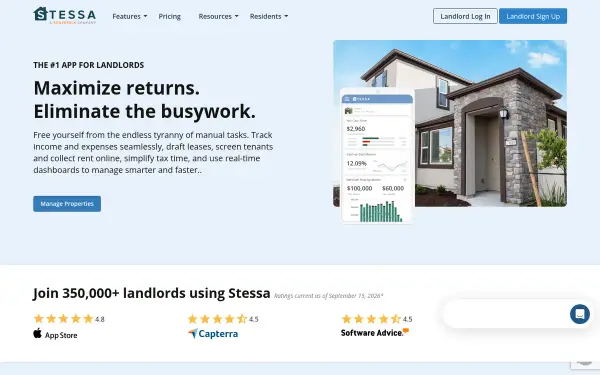
Stessa is built for the investor who owns rentals and needs clean numbers, not for the landlord chasing a maintenance ticket. Essentials is free and covers unlimited properties, and the portfolio dashboard rolls every property into one view. Once bank accounts are linked, income and expense capture is automatic and each transaction lands against the right property, which is the part spreadsheets get wrong. Rental bookkeeping and tax-ready reporting carry through to filing season, and ownership and performance reporting shows how each property is doing.
Rent collection exists but it is not the center of the product. Stessa earns its place with the accounting spine: bank connections feed per-property income and expense tracking, and reporting is organized around rental tax preparation rather than generic small business categories. For a buy-and-hold investor with a dozen doors, that replaces a monthly bookkeeping cleanup.
The gaps are operational. There is no tenant screening and no lease signing, so applications and contracts happen elsewhere. Maintenance coordination workflows are absent, which means work orders live in email or another system. The product came into the vendor's portfolio through Roofstock, so investor workflows shape its direction, and that shows in what it does not attempt.
Pricing is the simplest here: Essentials is free and paid tiers start at Manage at $12 per month billed annually. If your portfolio is stable and tenant operations are light, the free tier is usable rather than a trial in disguise. If you need screening, leases and maintenance in one login, budget for a second tool alongside it.
You own buy-and-hold rentals and want free, automated bookkeeping and tax reporting across every property.
You need screening, leases and maintenance handled in the same system as your books.
Entry II of IX / Banking plus books

Our verdict
Banking, bookkeeping and rent collection under one free roof, with tenant operations left to other tools.
Baselane bundles landlord banking, bookkeeping and rent collection instead of selling them separately. Accounts are built for rentals, transactions are categorized by property and tax category automatically, and per-property financial reporting follows from that. Rent collection deposits in about two business days, which matters when the rent is funding the mortgage payment.
The bookkeeping is the strongest part. Because money moves through the vendor's own accounts, categorization does not depend on a third-party feed guessing at memos. Books stay split by property and tax category without manual entry, and the reports read like rental schedules rather than a generic profit and loss. For a landlord who wants the banking and the books to be the same system, that removes a monthly reconciliation habit.
The limits are clear. There is no lease management and no maintenance ticketing, so tenant operations stay outside. Tenant screening is a separate purchase billed per applicant rather than something built into the platform, and the free tier does not include every advanced feature. Pricing could not be confirmed at the time of writing, because the vendor's pricing page returned no content, so check the current plans and rates on the vendor site before you commit.
Check the vendor site for current plans and any per-applicant screening fees before you commit. Baselane fits a landlord with steady tenants, straightforward books and no appetite for a monthly software bill. It does not fit an operator who needs to run applications, leases and repairs through one dashboard.
You want landlord banking, automatic bookkeeping and rent collection without a monthly software fee.
You need lease management, maintenance ticketing and screening inside one platform.
Entry III of IX / Flat unlimited pricing
Our verdict
One flat fee for screening, rent collection, maintenance and accounting, with no penalty for adding doors.
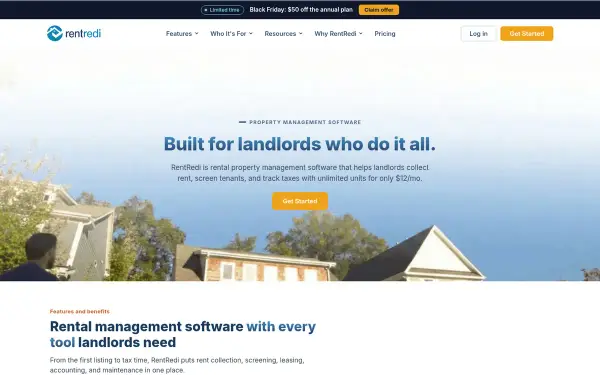
RentRedi sells a single plan at a flat rate, and unit count does not change it. At $12 per month billed annually you get online rent collection, tenant screening, maintenance request tracking, accounting with Schedule E reporting, rent payment reporting to credit bureaus, and mobile apps for both sides. Teammates are included at the same rate, which is unusual at this price.
The billing model is the argument. A landlord with four doors and a landlord with forty pay the same, so the effective cost per unit falls as the portfolio grows. Screening, maintenance and accounting are bundled rather than sold as add-ons, and there is no long-term contract, with round-the-clock live support. The accounting is not as deep as the specialist platforms, but Schedule E reporting covers a common filing need for self-managing landlords.
The trade-offs are about depth. There is no free tier, only a 30-day money-back guarantee, so you cannot test indefinitely before paying. Companies with staff, owner reporting requirements and layered approvals will find less to work with than Buildium or AppFolio offer. The interface favors simplicity over configurability, which is the right call for a self-manager and the wrong one for an operator who needs custom fields and workflow rules.
The vendor advertises an annual rate and may run promotions, so confirm the current rate before signing up. For a self-managing landlord with a growing portfolio of ordinary residential units, the flat rate is hard to beat on total cost, and the refund window covers most of the evaluation you would get from a trial.
You self-manage residential rentals and want one predictable fee no matter how many units you add.
You run a staffed company that needs layered owner reporting and configurable workflows.
Entry IV of IX / Mobile receipt capture
Our verdict
A mobile accounting app with a permanent free tier for three units and strong receipt and bank feed capture.
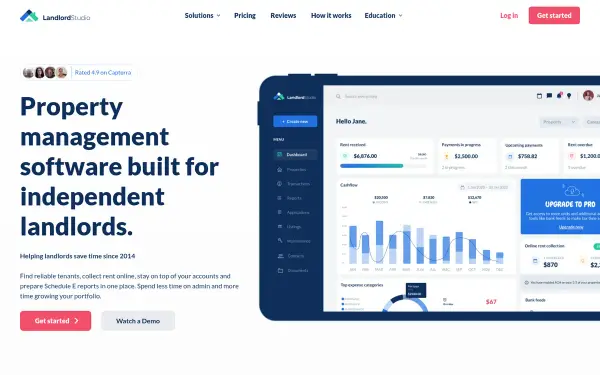
Landlord Studio leans on accounting and mobile capture. The Go plan is free for up to three units with rent tracking and basic reporting; Pro lists at $12.00 per month billed annually plus $1 for each unit beyond the first three. Bank feed connections, receipt scanning and automatic reconciliation do the heavy lifting, and Schedule E ready tax reports come out the other end. Everything sits behind one login rather than a bank plus an accounting tool plus a spreadsheet.
The mobile experience is the differentiator. Receipts get photographed at the hardware store rather than accumulated in a glovebox, and reconciliation happens on a phone between showings. For a landlord with a day job and a handful of units, that is the difference between books that are current and books that are reconstructed in April.
Tenant management is thinner. Screening, listing and maintenance tools exist but are light, so a landlord who wants applications, leases and work orders handled in the same place will still need another product. Above three units the per-unit charge raises the effective cost, and there is no enterprise depth for anything resembling a management company. A 14-day free trial sits alongside the permanent free tier, so evaluation is straightforward.
The fit is narrow and honest: small portfolios, mobile-first recording, tax time handled without a spreadsheet. A landlord with two or three units can run entirely on the free tier, which is rare in this category. A landlord with twenty units should compare the per-unit total against RentRedi's flat rate before committing.
You keep the books on your phone and your portfolio is small enough for the free or low-cost tiers.
You need deep tenant operations or you manage dozens of units where per-unit fees add up.
Entry V of IX / Owner portals
Our verdict
Modern, quick to learn and genuinely full-featured, with per-unit pricing and add-on fees that shape the total.
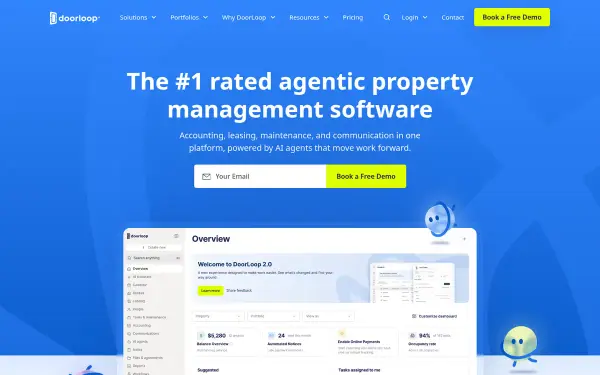
DoorLoop positions itself as the modern alternative to older property management suites, and the interface is the reason people switch. Full accounting with a chart of accounts, property-level financial statements, leasing and tenant records, maintenance work orders, online rent payments, owner portals and communication tools all sit in one system, and accounting is included from the entry tier rather than sold separately.
For a portfolio growing past spreadsheets and into staff, that coverage matters. Owner portals and property-level statements answer the questions owners actually ask, and maintenance work orders create a record instead of a text thread. The starting point is listed as $2.50 per unit per month on the DoorLoop One plan, with a minimum spend and unit rules that apply, so the true entry cost depends on portfolio size rather than the headline rate. Higher tiers add communication tooling and QuickBooks sync.
Watch the add-ons. E-signatures and ACH fees increase the total bill beyond the plan rate, and the entry tier carries unit limits with per-unit charges above them. There is no free trial, only demos and a 30-day guarantee, so evaluation means a guided walkthrough rather than unsupervised use.
Older tiered plans were replaced by per-unit pricing, which changes how budgets scale. A 25-unit portfolio and a 100-unit portfolio land in very different places. DoorLoop fits a growing portfolio that wants modern software with accounting built in, and it suits a buyer willing to run the per-unit math and confirm the minimum spend in writing first.
You are outgrowing spreadsheets and want one modern system for accounting, leasing, maintenance and owners.
You need a hands-on trial before buying or your portfolio is too small to clear the minimum spend.
Entry VI of IX / Trust accounting
Our verdict
A long track record in rental accounting for small and mid-size managers, wrapped in an interface that shows its age.
Buildium's case rests on accounting. Trust accounting, owner statements and financial reporting that accountants accept without argument are the core, and leasing and applicant workflows, maintenance management, online payments and a resident portal fill out the rest. Essential starts at $65 per month, with unit count and term set at checkout, and a 14-day free trial allows a real evaluation rather than a sales call.
For a manager with a few dozen to a couple of hundred doors, that combination is the point. Trust accounting is not a feature you appreciate until an audit or an owner asks a pointed question, and owner statements that come out right the first time save hours each month. No unit minimums means smaller managers can start without overbuying, and onboarding is where new buyers underestimate the work, since migrating opening balances and owner records takes planning.
The weaknesses are visible. The interface feels dated next to DoorLoop or RentRedi, price rises with unit count above the plan allotment, and onboarding plus some features carry extra charges. Essential starts at $65 per month, with unit count and term set at checkout. Confirm the current rate and unit allotment with the vendor.
Buildium fits a manager who cares more about the general ledger than the dashboard animation, and who needs owner reporting that stands up to scrutiny. It fits less well for a self-managing landlord with four units who would pay for accounting depth they will never use.
You manage other people's property and need trust accounting and owner statements that hold up.
You self-manage a few units or you weight interface polish heavily.
Entry VII of IX / Workflow automation
Our verdict
Serious automation and reporting for staffed management firms, priced by quote and built for volume.
AppFolio is built for companies with staff. Workflow automation, portfolio reporting and analytics, an AI leasing assistant, owner and investor portals, accounting and payment processing, and leasing pipeline management are aimed at teams running many doors, not at an individual landlord. Published rates were withdrawn in 2026, so pricing is quote only, and the orientation is toward portfolios of 50 units or more.
Where it earns its reputation is repeatable process. Configurable workflows mean a maintenance request routes the same way every time regardless of who is on duty, and portfolio analytics answer questions across a whole book rather than one property. The AI leasing assistant handles inquiry volume that would otherwise consume a leasing agent's morning, and owner portals reduce inbound status calls.
The costs are real and partly hidden. Monthly minimums make it expensive per door for smaller portfolios, and onboarding fees run from $400 to over $1,000. Pricing is quote only, so ask for the per-unit rate, the minimum and the onboarding fee in writing. There is no free trial. Ask for the minimum, the onboarding fee and the per-unit rate in writing before comparing quotes.
AppFolio fits a management company with staff, a leasing pipeline and owners who expect reporting. It does not fit a landlord with eight units, who would pay a minimum and an onboarding fee for capacity they cannot use, and it does not fit a buyer who needs a firm number before the first call.
You run a staffed management company with dozens of doors and need automation across the whole book.
You manage a small portfolio or you need published pricing before you will take a call.
Entry VIII of IX / Low per-unit cost
Our verdict
A low per-unit entry point into a large vendor ecosystem, sold by quote and lighter on features than mid-market rivals.
Yardi Breeze is the simplified entry point to a vendor whose main business is enterprise property software. Unit and property management, rental accounting, maintenance tracking, online rent payment, and tenant and owner records cover the basics, with an upgrade path into the wider product line if the portfolio outgrows it. That matters if you expect to grow into software you will not have to replace.
The appeal is price per unit at small scale. Pricing is quote only, so ask for the per-unit rate and any minimum that applies. The trade is feature depth: simpler than mid-market rivals, and the broader product family is genuinely hard to navigate when you try to work out what sits above Breeze.
Pricing is not published on the vendor site, so you cannot get a number without a conversation. For a buyer who wants to compare three options on a screen before calling anyone, that is friction. Ask specifically what the minimum buys and whether setup is included. For a buyer already talking to sales teams, ask what the minimum buys and whether setup is included.
Breeze fits a small landlord who expects to scale and wants a low per-unit cost with a route upward. It fits less well for a manager who needs deep reporting now, and it is a poor match for anyone who needs a public price before evaluating. Confirm the minimum and any setup fees before you compare it against a flat rate like RentRedi's.
You want a low per-unit entry point from an established vendor and expect to scale into more software later.
You need a published price before evaluating or deep reporting from day one.
Entry IX of IX / Mixed-asset support
Our verdict
Deep customization for mixed residential, commercial and HOA books, sold through demos and implementation projects.
Rent Manager handles residential, commercial and HOA management inside one system, which is unusual and is the reason mixed-asset managers end up there. Configurable accounting and workflows, custom reporting, owner and tenant portals, maintenance and work order handling, and deep customization options round it out. Buying is quote based and demo led, often with an implementation project attached, and a demo is the only entry point.
The customization depth is the product. A manager with unusual chart of accounts structures, commercial lease terms or HOA billing rules can usually make Rent Manager do it rather than changing how the business works. Custom reporting means an owner packet can be built once and reused. That is a different value proposition from the flat-rate self-management tools higher up this list, and it is worth paying for only if you have the complexity to match.
The learning curve is steep and the capability is larger than most straight residential portfolios need. There is no self-serve trial, so evaluation runs through sales and often through implementation scoping. Pricing is fully quote based, which makes budget comparison against published-price tools awkward, and small landlords will find the whole exercise disproportionate to their needs.
Rent Manager fits a manager with mixed asset types and accounting requirements that resist off-the-shelf products. It fits less well for a landlord with twelve residential doors, who would pay for configurability and never touch it. Bring your worst reporting requirement to the demo and see how it is handled, and ask what implementation includes before comparing quotes, because the project cost can outweigh the subscription.
Your portfolio mixes residential, commercial and HOA assets and standard software keeps forcing workarounds.
You manage straightforward residential units or you want a self-serve trial and a published price.
VIBackground
Real estate portfolio management software keeps the financial and operational record of several rental properties in one place. Instead of a spreadsheet per property and a folder of receipts, you get one ledger where every transaction is tagged to a unit, a property and a tax category, and where reports roll up from the unit to the property, and from the property to the owner.
The category covers four jobs, and many products are strong at some of them:
Buyers get into trouble when they assume one product covers all four. The free tracking tools usually do accounting and reporting well and touch nothing else. The landlord banking products fold payments into the books and leave leases to someone else. The full platforms cover all four but charge per unit and often charge onboarding as well.
There is also a size question. A landlord with three units needs books that are current at tax time and a way to take rent. A manager with 200 doors needs trust accounting, staff permissions, work order routing and owner statements that survive scrutiny. Those are different products with different price structures, and the gap between them is where most buying mistakes happen. A tool that is excellent at four units can be a liability at forty, and a platform built for four hundred can bury a small landlord in configuration.
The practical test is to list the jobs you do every month, then check which of them the software handles without an add-on or a second login. Anything left over is either a second tool or a reason to pay more.
This comparison sits in the software register. Further along the shore: baby tracking app and kennel software.
VIIPricing
Pricing in this category follows the portfolio size and the number of jobs you want handled. Free tiers exist, but they cover tracking and reporting rather than tenant operations, and paid tiers that unlock more are usually billed annually. Flat rates reward growth: RentRedi charges $12 per month billed annually no matter how many units you add. Per-unit pricing does the opposite, because the rate applies from the first door and minimum spends push small portfolios above the headline number.
| Model | How it bills | Typical fit | Example from this list |
|---|---|---|---|
| Free tracking | No monthly cost, paid tiers for extras | Buy-and-hold investors who want books and tax reports | Stessa Essentials, free with unlimited properties |
| Landlord banking | Pricing is on the vendor site | Landlords who want banking and bookkeeping together | Baselane, free plan listed |
| Flat rate | One monthly fee, unlimited units | Self-managing landlords | RentRedi, $12 per month billed annually |
| Free tier plus per unit | Free to a unit cap, per unit above it | Small landlords working on mobile | Landlord Studio, Go free to 3 units; Pro $12.00 per month billed annually plus $1 per unit beyond three |
| Per unit with minimum | Per unit per month, minimum spend applies | Growing portfolios with staff | DoorLoop, $2.50 per unit per month on DoorLoop One |
| Tiered by unit count | Monthly plan tiers with unit allotments | Small to mid-size managers | Buildium, Essential from $65 per month |
| Quote only | Sales-led quote, onboarding often extra | Large, mixed or enterprise portfolios | AppFolio, Yardi Breeze, Rent Manager |
Two costs sit outside the plan rate. Onboarding is charged separately by several platforms, with AppFolio listing fees from $400 to over $1,000, and add-ons such as eSignatures and ACH processing add to DoorLoop's bill. Screening is often priced per applicant, so check the vendor site for current fees. When you compare a free plan against a paid one, add those costs first, and ask whether the plan price includes support, setup and any unit caps.
Each entry card shows the starting price as it appeared on the vendor's own pricing page on November 25, 2026. When a vendor shows no figure we could confirm, or only a promotional rate, the card says "See website" or gives the regular price instead of a guess. Usage, overage and add-on rates in the text change more often than plan prices, so confirm them on the vendor page before you set a budget. To test the numbers against your own volume, try the free User Research Budget Planner. The Event Break-Even Calculator is a second way to check the same decision.
VIIIDecision
Write down your monthly jobs. List what you actually do each month: recording expenses, chasing rent, handling repairs, answering owners. Software that covers four of five jobs beats software that claims all five and does two well.
Count your doors and asset types. Three units, thirty units and a mix of residential, commercial and HOA space each point at a different product. Some free tiers cap at three units, while Stessa's Essentials covers unlimited properties, and the quote-only platforms start making sense at scale.
Decide whether you will handle tenants yourself. If you screen applicants, sign leases and route repairs, you need tenant operations in the same login. If a manager does that work, tracking and reporting tools are enough.
Check whether you owe anyone a statement. Managing other people's property changes the requirement, because trust accounting and owner statements move to the top of the list and free tracking tools drop out.
Run the total cost, not the headline rate. Add the minimum spend, the onboarding fee, the per-applicant screening charge and the payment processing fee before comparing two plans on price.
Test with your own numbers. Use the free tier or the trial to enter one real property with real transactions. If the trial is only a demo, ask for a walkthrough using your own chart of accounts.
IXPitfalls
XQuestions
The free options are Stessa Essentials, which covers unlimited properties for tracking and tax reporting, and Landlord Studio's Go plan, which covers up to three units. Baselane lists a free plan for banking and bookkeeping, but its pricing page returned no content, so confirm before you rely on it. Stessa and Baselane leave lease management and maintenance to other tools, and Landlord Studio's tenant tools are light.
Self-managing landlords pay $12 per month on RentRedi's annual plan with unlimited units, or $12.00 per month on Landlord Studio Pro billed annually plus $1 per unit beyond three. DoorLoop lists $2.50 per unit per month on DoorLoop One. Buildium Essential starts at $65 per month. AppFolio, Yardi Breeze and Rent Manager quote per portfolio rather than publishing rates.
Generally no. AppFolio withdrew published pricing in 2026 and orients toward portfolios of 50 units or more, with monthly minimums and onboarding fees from $400 to over $1,000. A small portfolio pays for capacity it cannot use. Small landlords are better served by Stessa, Landlord Studio or RentRedi until headcount and owner reporting needs appear.
Free tracking tools such as Stessa record what happened in accounts you already have. Free banking products such as Baselane want your deposits held with them, then categorize transactions automatically because the money moves inside their system. Tracking keeps your existing bank; banking replaces it. Neither free model includes lease management or maintenance ticketing, so both need a partner tool.
It becomes worth it when the hours you spend chasing rent, coordinating repairs and answering owner questions cost more than the subscription, or when an accountant charges to clean up your books each quarter. Per-unit platforms such as DoorLoop and tiered platforms such as Buildium start making sense once you have staff, outside owners, or enough doors that manual coordination breaks down.
Unit pricing scales with the portfolio, so the per-door cost is highest at the start. DoorLoop charges $2.50 per unit per month on DoorLoop One with a minimum spend and unit rules, which means small portfolios pay above the headline rate. Buildium's tiered plans and Landlord Studio's $1 per unit above three behave the same way. Flat rates such as RentRedi's $12 do not move.
XIFurther along the shore
Vendors can ask for a correction or apply for a Featured listing. Paid or not, the entry is scored on the same rubric and its limits stay in print. Partner with Umberlake.
Free tools
Our free browser tools turn the prices on this page into a figure for your own volume. Nothing you type leaves your device.