
Lattice
$4Engagement, per seat per month
Best for mid-market companies wanting a dedicated performance platform
- Free plan
- No
- Rubric
- 7.3 of 10
Eight performance platforms compared on review depth, feedback habits, goal tracking, pricing clarity and setup effort, with published prices where vendors provide them and honest gaps where they do not.

IThe short answer
Lattice, 15Five and Culture Amp are the three strongest picks in this November 2026 list of eight performance management tools, and each suits a different buyer. Lattice is the pick for mid-market companies that want dedicated review and calibration depth. 15Five suits teams that treat performance as a weekly conversation rather than an annual event. Culture Amp suits mid-market and enterprise buyers who care most about engagement surveys and benchmark context. Prices and plan details were checked on November 25, 2026 against vendor pricing pages, and every entry below carries the limits as well as the strengths: Best Performance Management Software.
8 tools compared from vendor pages on November 25, 2026. 3 publish a starting price we could read; the rest say "See website".
IITop three berths
Register order is editorial fit for the buyer each entry describes. Prices are the starting figures read on November 25, 2026.
$4Engagement, per seat per month
Best for mid-market companies wanting a dedicated performance platform

$4Engage, per user per month, billed annually
Best for companies that want performance as an ongoing conversation

See websiteCustom quote, annual contract
Best for mid-market and enterprise companies focused on employee listening
How this page is paid for. All 8 tools here are unpaid editorial picks.
A paid listing's position can be part of what the vendor pays for. Every entry, paid or not, is scored on the same rubric and keeps its limits in print. Advertising disclosure.
IIIThe register
Starting prices as shown on each vendor's pricing page on November 25, 2026. "See website" means no figure we could confirm.
| No. | Tool | From | Free plan | Trial | Rubric | Actions |
|---|---|---|---|---|---|---|
| 01 | LatticeMid-market companies wanting a dedicated performance platform | $4Engagement, per seat per monthUpdated on vendor page | No | Demo only | 7.3 | |
| 02 | 15FiveCompanies that want performance as an ongoing conversation | $4Engage, per user per month, billed annuallyRead on vendor page | No | Free trial, terms vary | 7.6 | |
| 03 | Culture AmpMid-market and enterprise companies focused on employee listening | See websiteCustom quote, annual contractNot shown publicly | No | Demo only | 5.4 | |
| 04 |  LeapsomeEuropean and global companies wanting an all-in-one people platform | See websiteCustom quote, modular modulesNot shown publicly | No | Yes | 5.8 | |
| 05 |  ReflektiveCompanies wanting continuous feedback plus formal reviews | See websiteCustom quoteNot shown publicly | No | Demo only | 5.9 | |
| 06 |  PerformYardSMBs wanting proper performance reviews without enterprise cost | $5Performance, per person per month, billed annually, range $5 to $15Read on vendor page | No | Free trial reported; confirm with vendor | 7.3 | |
| 07 | Small ImprovementsSmall to mid-size companies wanting lightweight performance tooling | See websiteLaunch, per user per month, billed annuallyNot shown publicly | No | 30-day free trial | 6.7 | |
| 08 | EngagedlyMid-market companies wanting performance, engagement and learning in one suite | See websiteManage Performance, per user per month, billed annually, range $5 to $8, $7,500 annual minimumNot shown publicly | No | Free trial reported; confirm with vendor | 6.0 |
Pinned:
IVMethod
Depth of review cycles, calibration sessions and 360 degree feedback, judged on what the tool ships rather than what it demos.
Whether a published per-seat rate, plan name and annual minimum exist, so a buyer can budget without a sales call.
How well the tool builds a habit of feedback between formal cycles, through check-ins, praise or a continuous stream.
Whether goals, OKRs and competency frameworks connect to the review rather than sitting on a separate screen.
How quickly a team can run a live cycle without a long implementation project or a systems integrator.
VMethod
Every tool on this list was scored against the same five criteria. Review workflows carry the most weight at 25 percent, because review cycles, calibration and 360 degree feedback are the reason most teams buy. Pricing clarity and feedback cadence take 20 percent each, and setup speed takes another 20 percent. Goals and OKRs take the remaining 15 percent. Each criterion is scored 1 to 10, and the scores appear on every entry so you can see where a tool is strong before you read the prose.
Prices and plan details come from vendor pricing pages checked on November 25, 2026. Where a vendor publishes a figure, we quote it exactly as listed, including the plan name, billing term and any annual minimum. Where the pricing page was empty or the rate could not be verified, the entry says so and the starting price reads See website. We did not fill a gap with an estimate.
The Featured listing is a paid placement. It is scored with the same rubric and it carries the same honest cons as every other entry, and placement affects position on the page rather than the score. The order of this list is editorial: it reflects fit for the buyer each entry describes, plus the disclosed Featured position. We do not claim the order is derived from the scores.
We also checked the practical details operators ask about: whether a trial exists, whether implementation is self-serve or a project, and whether the platform holds employee records or expects another system to hold them.
The full routine, from price reads to corrections, is on the methodology page. Paid listings follow the advertising disclosure.
Entry I of VIII / Calibration depth
Our verdict
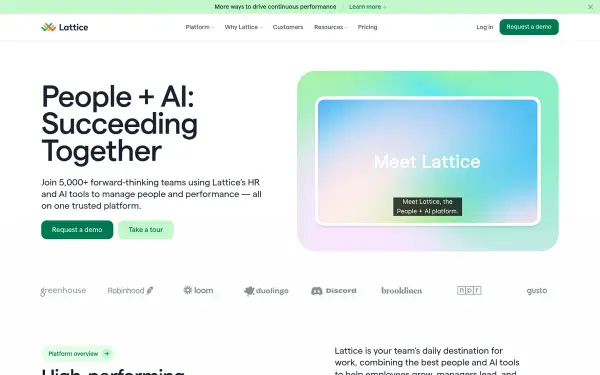
The deepest dedicated review and calibration platform here, priced for mid-market budgets with a $4,000 yearly floor.
Lattice is the deepest dedicated performance product on this list. Review cycles and calibration sessions are the core, with 360 degree feedback, goals and OKRs, engagement surveys and manager tooling built as separate modules, so a people team can buy the review pack alone and add the rest later. Employees tend to finish cycles without chasing, which matters because an uncompleted review round is worse than no round at all.
Pricing is modular and per seat. The starting figure is $4 per seat per month on the Engagement module, and the vendor page lists a lower base product price than the $10 Performance pack price, so the pack you actually want costs more than the headline. A $4,000 yearly floor applies, which means a 20 person company pays roughly $200 per head per year before add-ons. That math is fine at 200 seats and painful at 20.
Two limits need planning. Lattice retired its HRIS product on 31 July 2026, so employee records now live in a separate system and you should expect a second vendor or an existing payroll tool to hold the roster. There is also no self-serve trial; evaluation runs through a demo, which slows a small team that just wants to test the form builder.
It fits mid-market companies that want review and calibration depth and are willing to run employee data elsewhere. Teams under about 40 seats should model the annual floor before they book a demo, because the per-seat headline hides it and the modules add up quickly.
You run a formal review and calibration process across 100 or more seats and need depth over breadth.
You have fewer than 40 employees or still need a performance tool that also holds HR records.
Entry II of VIII / Weekly check-in habit
Our verdict
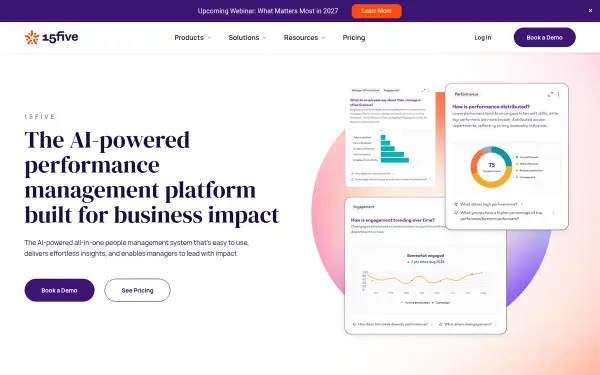
The best tool here for making performance a weekly habit, provided your managers will actually write the check-in.
15Five sells performance as a habit rather than an event. Weekly check-ins carry the week, engagement surveys run alongside them, and review cycles pull from the check-ins that came before, so a manager writing a review has months of notes in front of them instead of a blank form. Manager coaching prompts and manager effectiveness reporting push the tool toward the person doing the reviewing rather than the HR administrator.
Three tiers are sold: Engage at the entry point, Perform with the full review toolset, and a bundled Total Platform option. Pricing is per user with annual billing, and the starting figure is $4 per user per month on Engage. That entry price buys check-ins and surveys rather than the full review engine, so budget for Perform if formal cycles are the reason you are buying.
Setup is quick and templates are usable within days, which is unusual in a category where implementations run for weeks. A free trial is offered with terms that vary, so ask what the trial includes before you plan a pilot around it. HRIS integrations sit on the upper tiers, which means a small team on Engage should check its payroll connection before committing.
The real constraint is adoption. Value depends on managers running the weekly check-in, and where adoption lags the check-ins turn into extra admin that people resent and then quietly skip. Advanced integrations are limited to higher tiers as well. It fits companies with a manager population willing to write every week, and fits less well where managers are already overloaded.
Your managers will commit to weekly check-ins and you want reviews informed by a year of notes.
Managers are already stretched or you need full review functionality at the $4 entry price.
Entry III of VIII / Survey benchmarks
Our verdict
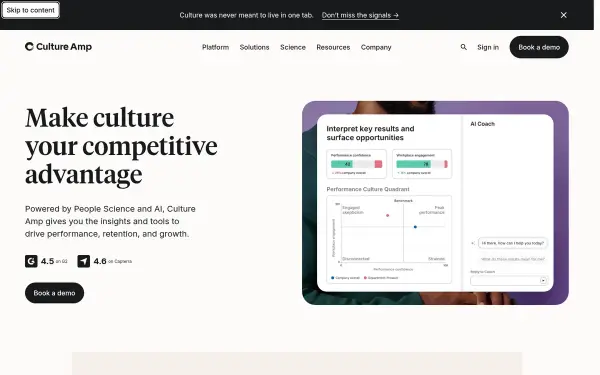
The strongest listening platform here, with review workflows that will disappoint anyone buying primarily for reviews.
Culture Amp is a listening platform first and a performance tool second. Engagement surveys, lifecycle surveys and effectiveness surveys form the core, backed by external benchmark comparisons that tell you whether a score of 71 is good, plus action planning tools and manager dashboards that push the result back into a team meeting. Review workflows exist and are usable, but they are basic next to the dedicated review tools in this list.
Pricing is quoted only. The vendor publishes no figures, the pricing page was empty when checked on November 25, 2026, and the custom quote status could not be verified, so treat any budget as provisional until a sales conversation produces a number. Contracts run annually and evaluation is demo-led, which means a small team can lose a quarter before it has a price to compare against anyone else.
What you get for that is survey methodology grounded in research and benchmarks that give scores context. A percentage in isolation is impossible to act on, and most engagement tools hand you exactly that. Action planning is the other differentiator: the platform pushes managers toward follow-through instead of letting results sit in a dashboard nobody reopens after the all-hands.
The trade-off is review depth. If calibration sessions, multi-stage review routing and competency frameworks are the center of your process, a dedicated review platform will serve you better and Culture Amp will frustrate the people running the cycle. It fits mid-market and enterprise companies where employee listening is the main purchase and reviews are a secondary need supplied at a basic level.
Employee listening is your main purchase and you need benchmarks to interpret survey scores.
Review cycles and calibration administration are the core of what you are buying.
Entry IV of VIII / EU data residency
Our verdict
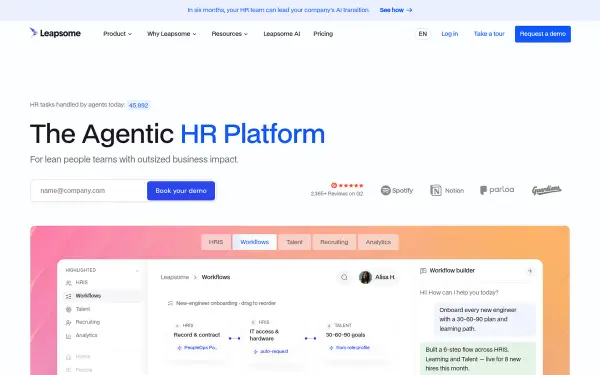
The broadest all-in-one people platform here, strongest for European buyers who need EU data residency.
Leapsome is the broadest people platform here that still ships a serious review engine. Review cycles, OKRs and goals, engagement surveys, learning modules and competency frameworks sit in one product, with customizable review templates and EU data residency. The pitch is consolidation: one vendor, one login, one dataset spanning how people are reviewed, how they are developing and how engaged they say they are.
Pricing is quote only. There is no public price list and no self-serve signup, so evaluation runs through sales, and the pricing page was empty when checked on November 25, 2026, which leaves pricing unverified. Modules are sold in combinations rather than one flat rate, which means the quote you receive depends on how much of the suite you take. A free trial is offered, so ask for it before you commit to an annual contract.
Inside the product, configurability is both the strength and the risk. Cycles and competency frameworks can be shaped to an existing process rather than forcing a rewrite, and the EU data residency stance is a genuine differentiator for European buyers facing works council or GDPR scrutiny.
Advanced analytics sit on higher tiers, and implementation runs several weeks rather than days, so a small team should weigh whether the configuration effort is worth the consolidation. It fits European and global companies of roughly 200 seats and up that want reviews, goals, surveys and learning from one vendor and can absorb a sales-led purchase. A 30 person company will spend more time configuring than reviewing.
You need reviews, goals, surveys and learning from one vendor with EU data residency.
You need a published price or a self-serve signup to get started this month.
Entry V of VIII / Always-on feedback
Our verdict
A genuine blend of continuous feedback and formal reviews, with a quieter release cadence worth questioning.
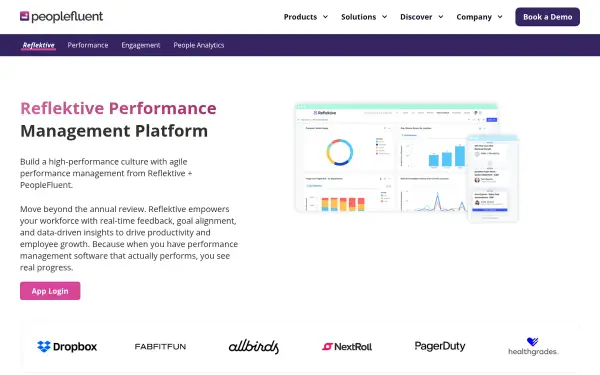
Reflektive puts a real-time feedback feed at the center and layers formal process around it. Colleagues post feedback and recognition into a shared stream, goals are tracked alongside, one-on-one meeting tools structure manager conversations, and structured review cycles pull the collected feedback into a formal assessment. Calibration support is built into the cycle, so rating conversations have a place to happen rather than a spreadsheet.
There is no public pricing. Terms come through a sales cycle, the pricing page was empty when checked on November 25, 2026, and pricing remains unverified. Evaluation is demo-led with no free trial, so a buyer cannot test the form builder or the feedback feed before talking to sales, which is a real cost when the whole value proposition rests on whether your people will post into a feed.
The combination of always-on feedback and scheduled reviews is the reason to look. Most tools do one or the other well: continuous feedback products produce a stream nobody reads, and review tools produce a form that appears once a year. The one-on-one tooling is the quieter strength, because it gives managers a structured place to record what was discussed and carry it into the review.
The caution is product direction. The release cadence has been quieter than at larger rivals, and buyers should get roadmap commitments in writing before signing an annual contract, particularly on integrations and reporting. It fits companies that want feedback flowing continuously and will use calibration and one-on-one tools to tie that stream back to a formal cycle. Teams that need a public price, a trial or a busy release cadence should look elsewhere first.
You want feedback flowing all year and will use calibration and one-on-ones to connect it to reviews.
You need a trial, a published price or a fast-moving roadmap commitment.
Entry VI of VIII / Low cost reviews
Our verdict
The easiest tool here to budget for, with full review functionality at a published per-person price.
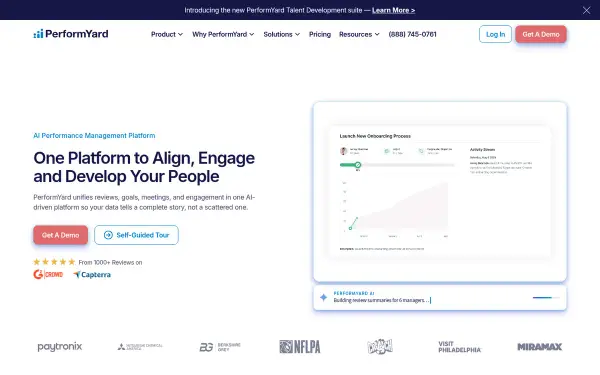
PerformYard is the value pick for straight review administration. Review cycles, 360 degree feedback and goal tracking cover the core, and review forms can be built differently by role, which matters in a company where a warehouse supervisor and a staff engineer should not answer identical questions. An engagement add-on is available, guided implementation is included, and customer success support is frequently singled out for help.
Pricing is published. The Performance plan runs from $5 to $15 per person per month, billed annually, and the starting figure is $5, matching the range shown on the vendor page. At 50 seats that is somewhere between $250 and $750 per month depending on where you land in the range, which makes it one of the few tools here you can budget for without a sales call.
Implementation is guided and typically live within a few weeks, so a team can run a real cycle in the same quarter it buys. Trial availability is reported by third parties rather than confirmed on the vendor site, so ask the vendor directly before you plan a pilot around one.
The limits are integration count and analytics. Native integrations are fewer than on the larger platforms, and reporting is lighter than enterprise rivals, so a people team that wants to slice engagement by tenure and manager will hit the ceiling. The engagement features are a basic add-on rather than a listening platform. It fits SMBs of roughly 30 to 300 seats that want proper performance reviews without enterprise cost and will trade suite breadth for a low per-person price.
You are an SMB that wants full review functionality at a price you can budget without a sales call.
You need deep analytics, many native integrations or a real engagement platform.
Entry VII of VIII / Fast setup
Our verdict
The lightest tool here, quick to learn and honest about having fewer analytics than enterprise rivals.
Small Improvements aims at teams that want reviews, goals, 360 degree feedback and praise without a six week rollout. The feature set is deliberately narrow: review cycles, goals, 360 degree feedback and a praise and recognition stream, with quick team onboarding and basic reporting. There is no learning module, no succession planning and no survey science, and for a 40 person company that restraint is usually the point rather than a gap.
The Launch plan bills per user per month on an annual term, but the pricing page was empty when checked on November 25, 2026 and the $3 pack price could not be verified, so the starting price reads See website. Ask for a written quote naming the plan, the seat count and the annual term. Plan names and inclusions have shifted over time and third-party sources disagree on the specifics, so current packaging needs confirmation before you sign.
A 30-day free trial is offered, which is long enough to pilot with a single team and see whether managers complete a cycle without reminders. That is the cheapest way to test the product before committing to a year, and it is a longer trial than Lattice, Culture Amp or Reflektive offer.
The entry price is positioned as the lowest in this set, though the rate itself could not be verified. Analytics depth trails the enterprise platforms, and a team that grows into benchmarking, succession or learning will outgrow the product. It fits small to mid-size companies that want lightweight performance tooling and would rather buy a narrow product that works than configure a suite they use a third of.
You want lightweight review, goal and praise tooling that a small team can learn in a week.
You need benchmarking, succession planning, learning modules or deep reporting.
Entry VIII of VIII / Suite breadth
Our verdict
One suite covering performance, engagement and learning, with succession planning rare at this price point and a floor that excludes small teams.
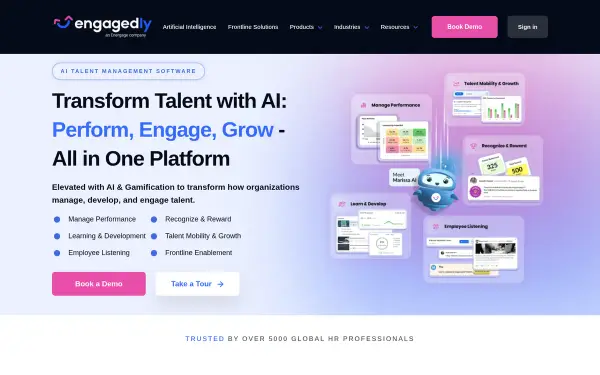
Engagedly sells three products in one: performance reviews, engagement surveys and learning and development, with succession planning, competency-based reviews, gamification and rewards, and participation tracking across them. The gamification is not decoration. It exists to lift participation rates in reviews and learning modules, and participation is where most performance rollouts fail quietly.
Pricing is published as a range for the Manage Performance plan: $5 to $8 per user per month, billed annually, with a $7,500 annual minimum. The pricing page was empty when checked on November 25, 2026 and the $5 pack price could not be verified, so confirm the current rate. The annual minimum sets a practical company-size threshold of roughly 80 employees, below which the math stops working however attractive the per-user figure looks.
Inside the suite, succession planning at this price point is unusual. Competency-based reviews tie ratings to a framework rather than a free text form, and performance, engagement and learning sit in one suite rather than three separate products.
The cost of that breadth is configuration. Setup is an implementation project rather than self-serve, the rollout spans several weeks, and a broad suite takes effort to tune before it feels right. Trial availability is reported by third parties rather than confirmed on the vendor site, so ask before you plan around it. It fits mid-market companies around 100 to 500 seats that want performance, engagement and learning from one vendor and have someone who can own the configuration.
You want performance, engagement, learning and succession from one vendor and can clear the $7,500 minimum.
You have fewer than about 80 employees or need something live in a week.
VIBackground
Performance management software runs the recurring process that connects goals, feedback and a formal rating. It is the system that schedules a review cycle, sends the form, collects 360 degree feedback, holds the calibration session where managers compare ratings, and stores the result. Goals and OKRs usually live in the same product, so a review can reference what someone committed to in January instead of starting from an empty page.
The category overlaps with engagement software, and the overlap causes most of the confusion at buying time. Engagement platforms measure how people feel through surveys, benchmarks and action planning. Performance platforms record what happened against goals and how it was judged. Several tools here sell both: Lattice and 15Five offer engagement surveys beside the review engine, Culture Amp comes from the listening side and adds basic review workflows, and Engagedly bundles performance, engagement and learning in one suite.
A core performance module typically ships with:
What it does not do matters just as much. It does not hold your HR records unless the vendor sells an HRIS, and Lattice retired its HRIS product on 31 July 2026, so most buyers pair a performance tool with a separate system of record. It does not run payroll or compensation benchmarking. It does not replace the judgment of a manager who has to sit down and explain a rating. Teams that expect the annual review to disappear after implementation usually find the same review with more administration attached to it.
One more boundary is worth stating. Performance software is not project management. Goals tracked in these tools are company, team and individual objectives rather than tasks, and a team shopping for task tracking will be disappointed by every product on this list.
This comparison sits in the software register. Further along the shore: baby tracking app and kennel software.
VIIPricing
Performance management software bills on four models, and the model matters more than the per-seat number. A low per-seat rate with an annual floor can cost a 20 person company more than a higher rate without one, and a quote-only platform can land anywhere.
| Model | How it bills | Typical fit | Example from this list |
|---|---|---|---|
| Per-seat entry module | Per user per month, billed annually | Teams buying reviews or surveys first | 15Five Engage at $4 per user per month, billed annually |
| Per-seat with annual minimum | Per seat per month plus a yearly floor | Mid-market teams past 40 seats | Lattice Engagement at $4 per seat per month, with a $4,000 yearly floor |
| Per-seat range | Per person per month, billed annually | SMBs wanting full review features | PerformYard Performance plan, $5 to $15 per person per month |
| Suite with annual minimum | Per user per month plus a yearly floor | Mid-market suites | Engagedly Manage Performance, $5 to $8 per user per month, $7,500 annual minimum |
| Custom quote | Annual contract, no published rate | Mid-market and enterprise | Culture Amp, Leapsome and Reflektive |
Annual minimums are the item buyers miss. Lattice's $4,000 floor means a 20 person company pays about $200 per head per year before add-ons. Engagedly's $7,500 minimum sets a practical threshold near 80 employees. Neither is unreasonable at scale and both are expensive at 30 seats.
Module pricing is the second variable. Lattice, 15Five, Leapsome and Engagedly all sell parts of the platform separately, so the entry price often buys check-ins or surveys rather than the review engine. Ask what the pack you actually need costs.
Quote-only vendors are not hiding a fixed number; they price by seats, modules and term. Get a written annual figure that names the seats, the modules and implementation, then compare it against the published rates above. Small Improvements bills per user per month on an annual term on its Launch plan, but the rate was unverified on November 25, 2026.
Each entry card shows the starting price as it appeared on the vendor's own pricing page on November 25, 2026. When a vendor shows no figure we could confirm, or only a promotional rate, the card says "See website" or gives the regular price instead of a guess. Usage, overage and add-on rates in the text change more often than plan prices, so confirm them on the vendor page before you set a budget. To test the numbers against your own volume, try the free User Research Budget Planner. The Event Break-Even Calculator is a second way to check the same decision.
VIIIDecision
IXPitfalls
XQuestions
Budget roughly $250 to $750 per month before add-ons on a per-seat tool, and expect an annual minimum to set a floor. PerformYard's published range of $5 to $15 per person per month puts 50 seats in that band. Lattice's $4,000 yearly minimum works out to about $333 per month at that size regardless of seat count. Culture Amp, Leapsome and Reflektive need a sales call before you have a number.
They overlap, but the center of gravity differs. Performance management software runs the review cycle: forms, 360 degree feedback, calibration sessions and goal tracking. Engagement software measures how people feel through surveys and benchmarks, then pushes managers to act on the results. Culture Amp leans toward listening, Lattice and 15Five sell engagement as a module beside reviews, and Engagedly bundles both in one suite.
Often not, and the annual minimums decide it more than headcount does. Lattice's $4,000 floor and Engagedly's $7,500 minimum make both expensive at 30 seats. A small team is better served by a published per-seat price, such as PerformYard at $5 per person per month, or a real trial, such as Small Improvements with its 30-day trial. One light review round a year may need no software at all.
Self-serve tools go live in days and enterprise platforms take weeks. 15Five ships templates usable within days, and PerformYard's guided implementation typically goes live within a few weeks. Leapsome runs several weeks, Engagedly's rollout is an implementation project rather than self-serve, and Reflektive is demo-led from first contact. Quote-only platforms add a sales cycle before implementation even starts.
No. Software runs the review cycle, but it cannot replace the judgment behind a rating. A platform can collect 360 degree feedback, route forms by role and hold a calibration session, yet the rating scale, the pay decision and the conversation still belong to your managers. Teams that buy a tool expecting the annual review to vanish usually end up with the same review plus extra administration.
Start with the module that fixes the problem you have now. Lattice, 15Five, Leapsome and Engagedly all sell modular or tiered packages, so a review-only purchase is possible and cheaper. Add engagement or learning once a review cycle is running and adopted. Buying the full suite first usually produces configured features nobody uses and a longer implementation.
XIFurther along the shore
Vendors can ask for a correction or apply for a Featured listing. Paid or not, the entry is scored on the same rubric and its limits stay in print. Partner with Umberlake.
Free tools
Our free browser tools turn the prices on this page into a figure for your own volume. Nothing you type leaves your device.