
WebFX
$2,500Average SEO spend, per month, guide figure
Best for small to mid-market firms wanting full-service with revenue tracking
- Free plan
- No
- Rubric
- 7.8 of 10
Eight agencies compared on entry price, channel coverage, reporting and contract terms, with the cheapest local option starting at $500 a month and the widest channel mix priced on request.

IThe short answer
WebFX, Thrive Agency and SmartSites are the three best online marketing companies for small business in November 2026, for different buyers. WebFX suits established firms that want SEO, paid media, content and revenue attribution under one contract and can support roughly $2,500 a month. Thrive Agency suits local and service-area businesses, with an SEO range from $500 a month and a $1,000 project minimum. SmartSites suits small businesses and online stores that want SEO, PPC and web design from one team, though you have to confirm entry pricing directly.
8 tools compared from vendor pages on November 25, 2026. 2 publish a starting price we could read; the rest say "See website".
IITop three berths
Register order is editorial fit for the buyer each entry describes. Prices are the starting figures read on November 25, 2026.
$2,500Average SEO spend, per month, guide figure
Best for small to mid-market firms wanting full-service with revenue tracking

$500SEO marketing range, per month
Best for local and service-area small businesses

See website
Best for sMBs and ecommerce stores needing SEO, PPC and design
How this page is paid for. All 8 tools here are unpaid editorial picks.
A paid listing's position can be part of what the vendor pays for. Every entry, paid or not, is scored on the same rubric and keeps its limits in print. Advertising disclosure.
IIIThe register
Starting prices as shown on each vendor's pricing page on November 25, 2026. "See website" means no figure we could confirm.
| No. | Tool | From | Free plan | Trial | Rubric | Actions |
|---|---|---|---|---|---|---|
| 01 | WebFXSmall to mid-market firms wanting full-service with revenue tracking | $2,500Average SEO spend, per month, guide figureRead on vendor page | No | No | 7.8 | |
| 02 | Thrive AgencyLocal and service-area small businesses | $500SEO marketing range, per monthUpdated on vendor page | No | No | 7.7 | |
| 03 | SmartSitesSMBs and ecommerce stores needing SEO, PPC and design | See websiteNot shown publicly | No | No | 7.1 | |
| 04 |  Ignite VisibilityFranchise and multi-location brands | See websiteNot shown publicly | No | No | 6.6 | |
| 05 |  Disruptive AdvertisingBusinesses whose growth runs through paid ads | See websiteNot shown publicly | No | No | 6.4 | |
| 06 |  Power DigitalConsumer and direct-to-consumer brands scaling across channels | See websiteNot shown publicly | No | No | 6.1 | |
| 07 |  Single GrainGrowth-stage tech and consumer companies | See websiteNot shown publicly | No | No | 5.7 | |
| 08 |  Coalition TechnologiesOnline stores needing marketing plus store development | See websitecustom quoteQuote only | No | No | 6.0 |
Pinned:
IVMethod
Whether the agency's minimums, program shapes and process match a small business budget and a thin internal team.
How many acquisition channels the agency actually runs end to end, not how many it lists on a services page.
Whether published figures, ranges or calculators exist, or whether every number waits behind a sales call.
Whether monthly reporting connects spend to leads and revenue, or stops at traffic, clicks and impressions.
What buyers can learn about minimum terms, notice periods and who owns the accounts and creative after exit.
VMethod
We built this list for the person who signs the contract: an owner or marketing manager at a small business with a marketing budget that has to be defended to someone else.
The criteria carried the decisions. Fit for size (25 percent) asks whether the agency's minimums and program shapes match a small business budget and a thin internal team. Channel depth (20 percent) covers how many acquisition channels the agency actually runs, not how many it lists. Pricing clarity (20 percent) rewards published figures, ranges or calculators over a contact form. Reporting depth (20 percent) looks at whether monthly reports connect spend to revenue or stop at traffic and impressions. Contract terms (15 percent) weighs what we could learn about notice periods, minimum terms and account ownership.
Every price here comes from the vendor's own pricing page or published guide figure, checked on November 25, 2026. Where a page gave a range or an average rather than a fixed plan, we say so in the entry and treat the number as a budget indicator. Where no page was captured, the entry states that pricing could not be verified, and we did not fill that gap with a guess.
Any Featured placement in this format is paid. A Featured vendor is scored on the same five criteria and carries the same kind of cons as everyone else. The order of the list is editorial: it reflects who each entry fits, plus the disclosed placement where one exists, not a weighted total of the scores.
The full routine, from price reads to corrections, is on the methodology page. Paid listings follow the advertising disclosure.
Entry I of VIII / Revenue attribution
Our verdict
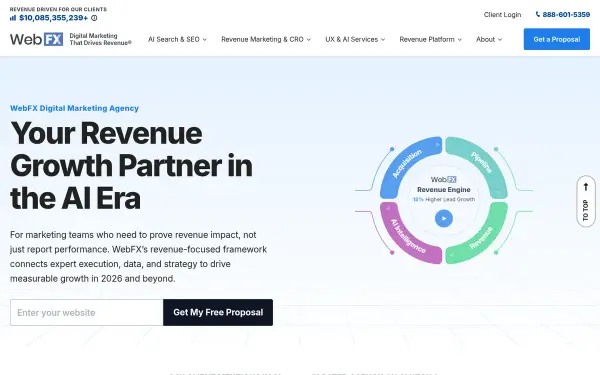
Full-service coverage with revenue attribution, priced for established small firms rather than one-person operations.
WebFX is a full-service agency that has been running long enough to build processes for nearly every acquisition channel. A small business can buy SEO, paid media, content, email, social and conversion work under one contract, plus web development if the site needs rebuilding before any of that lands. The AI search visibility line covers AI search visibility work alongside the other channels.
The pitch for a small firm is consolidation: one account team, one reporting view, one invoice instead of several specialists who never speak to each other. WebFX also reports revenue attribution across channels, which helps when you need to see which channel produced pipeline. If the owner needs to see which channel produced pipeline rather than which channel produced clicks, that is the argument for paying more here.
Pricing is the friction. The vendor's guide figure is $2,500 average monthly SEO spend, so treat $2,500 as a budget indicator rather than a quote for a specific scope. That can be out of reach for many smaller businesses, so treat the figure as a budget test rather than a sign of affordability. Ask for a written scope that names deliverables, hours and the channels included before you compare it with a cheaper proposal.
Large-firm workflows are the second issue. Process can feel heavy when your marketing decision maker is also the person answering the phone. Teams with an in-house marketing coordinator get the most from it. A one-person operation should ask who the day-to-day contact is and how quickly that person responds.
You want several channels managed together with revenue reporting and can support a budget near the guide figure.
Your total monthly marketing budget is well below the guide figure or you need a single small project done.
Entry II of VIII / Lowest entry price
Our verdict
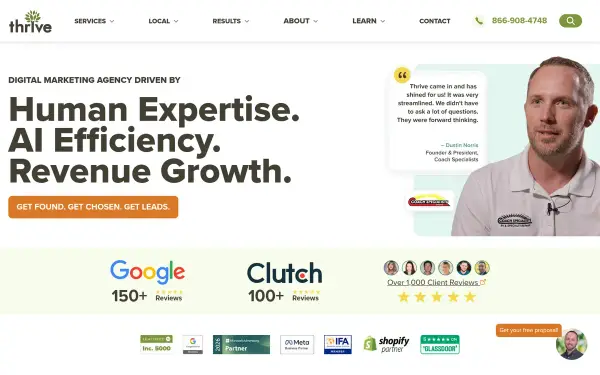
The lowest entry point here for an SEO-led local program, with a $1,000 project minimum to clear first.
Thrive Agency is a clearly small-business-oriented firm on this list. Its programs are built around local and service-area companies: the plumber, the dental group, the landscaping business with several crews. SEO anchors the engagement, with paid search, social media marketing and web design available alongside it. Content and reporting round out the package, so a business can start in one channel and add others without changing vendors.
The pricing structure is the reason it lands second. The published SEO range starts at $500 per month, the lowest entry point among the full-service agencies here. A minimum project size of $1,000 applies, so the smallest engagements still clear four figures. That combination makes agency work realistic for a business testing it for the first time, without committing a large annual budget before seeing a single report.
Scale cuts both ways. Thrive works with recognizable names, but account manager quality can vary across a large team. Ask specifically who will run your account, how many clients that person carries and what happens if they leave. Get a reporting sample from a local client rather than a national brand, because the two are not the same document.
Local SEO for a service-area business comes down to work that is hard to fake: accurate location data, review flow, service page depth and a site fast enough for mobile searchers. Confirm the proposal names those tasks rather than a generic list of deliverables. Headquartered in Arlington, Texas, the firm sits alongside many small local clients rather than only large accounts.
You run a local or service-area business and want an SEO-led program starting near $500 per month.
Your engagement would fall below the $1,000 project minimum or you need ecommerce catalog work.
Entry III of VIII / One team, three channels
Our verdict
One team for SEO, PPC and design, with entry pricing you have to confirm rather than read.
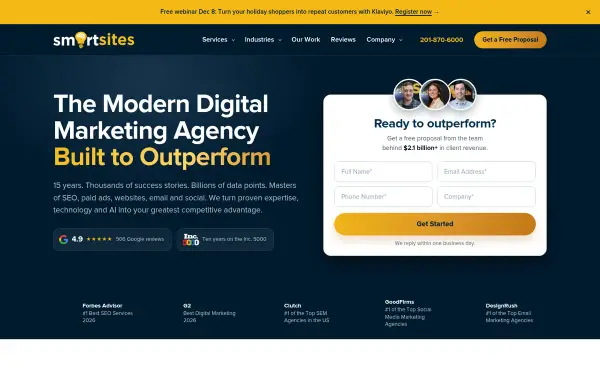
SmartSites bundles three things small businesses usually buy separately: SEO, paid search and web design. That combination is the point. A store or a service firm that needs a faster site, a clearer category structure and a paid program that matches can hand all of it to one team rather than coordinating several specialists.
The client mix leans SMB and ecommerce, and the agency publishes an hourly rate range plus a low project minimum, which is unusual transparency for this category. For a buyer who wants to start with a defined project, such as a site rebuild or a technical cleanup, and grow into a retainer, that structure is easier to justify internally than an open-ended monthly fee with no visible unit of work.
Pricing is where the picture blurs. No starting price appeared on the pages reviewed, so pricing sits on the vendor site and you have to ask. No starting price is published, so confirm current entry pricing directly before you build a budget. Demand is high, and onboarding can take longer than the sales conversation implies.
Who it fits: an established small business or online store with a working product and a site that needs to perform better than it does now. Publicly listed clients include IHG, Samsung and BMW, which tells you the team can operate at scale, though your account will be staffed for its size. Based in Paramus, New Jersey. Who it does not fit: a solo operator with a very small hourly need, or a business that wants organic social only.
You want SEO, PPC and design from one team and can hold a budget near the guide figure.
You need a published starting price before you will take a sales call.
Entry IV of VIII / Multi-location SEO

Our verdict
Deep technical and local SEO built for multi-location brands, which is more structure than a single shop needs.
Ignite Visibility is built for franchise and multi-location brands, and that shapes everything else about how it works. The service list covers technical SEO audits and fixes, local SEO across multiple locations, paid media on search and social, email marketing, social management and performance reporting. Multi-location work is not a side service here: local SEO across multiple locations sits at the center of the engagement.
For a single-location small business, that specialization is mostly overhead. You get capable technical SEO and integrated paid work, but the process is designed around a client with many locations and a marketing director to match. Published case work leans on franchise and multi-location engagements rather than single-site businesses, so ask for references that look like you before you assume the fit carries over.
Pricing is not published. The contact form is the only route, so ask for a quote. That can be more than many small businesses spend on marketing in total, which is why this entry is a specialist choice rather than a budget pick. Based in San Diego, the firm sells on specialization rather than on price, and the sales process reflects that.
Where it earns its place: a franchise with multiple locations where inconsistent local pages and duplicate listings are costing leads. Technical SEO is a core skill on offer, and paired with paid media it covers more of the funnel. A business with one address and a modest budget should look at Thrive Agency first and come back here after it expands to multiple locations.
You run a franchise or multi-location brand and need technical and local SEO at scale.
You have one location or a budget below its range.
Entry V of VIII / Creative testing
Our verdict
A paid media specialist that treats creative testing as routine, with entry pricing available on request.
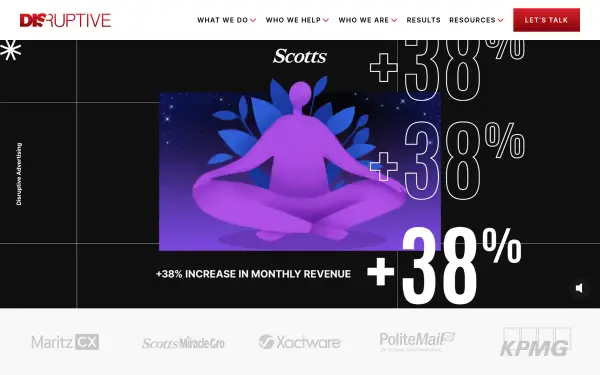
Disruptive Advertising is a paid media shop. Google Ads management, Microsoft Advertising, paid social campaigns, creative testing, landing page optimization and conversion tracking, with organic SEO as a secondary service. If your growth runs through ad spend and the constraint is cost per acquisition rather than traffic volume, the shape of the offer matches the problem you actually have.
Creative testing built into campaigns is the differentiator that matters in 2026. Ad platforms reward fresh creative, and an agency that treats testing as a scheduled part of every month rather than a quarterly project keeps accounts from going stale. Conversion tracking and landing page work sit alongside it, which is where paid programs can leak money quietly: the click is fine, the page after it is not.
Pricing is the sticking point. No starting price is published, so ask for a quote. Ask which figure applies to your scope, since project minimums can differ from monthly guide figures. Budget for management fees plus media spend separately, because agency figures in this category may cover fees only. Headquartered in Pleasant Grove, Utah.
The firm manages a large recurring client base, so you will be one account among many. Ask who owns strategy, what the first 30 days look like and how much of the account work is done offshore versus in house. If organic search is your main channel, this is the wrong specialist.
Paid ads are your main channel and you want creative testing handled as routine work.
Organic search visibility is the primary gap you need closed.
Entry VI of VIII / Full-funnel measurement
Our verdict
The widest channel mix with full-funnel measurement, priced well beyond typical small business budgets.
Power Digital has the broadest channel mix on this list: paid social, paid search, retail media, influencer marketing, organic search and content, tied together by full-funnel measurement that links awareness spend to revenue. For a consumer or direct-to-consumer brand selling across several surfaces, that coverage is genuinely hard to assemble from smaller shops without hiring twice.
The methodology is the argument for hiring an agency rather than a media buyer. Retail media and influencer work sit inside the same plan as search and content, so budget can shift between channels within one relationship. Consumer and DTC experience shows in how programs are structured for brands selling across channels.
Pricing can keep it out of reach for small businesses. No pricing is published on the site, so you have to request a quote, and the entry point is likely to rule out a typical small business budget before scope is even discussed. The growth-stage focus also means there is little tailoring for a tiny local firm with one location and a modest ad budget. Confirm the current figure and scope directly, and treat any quote as a starting point, not a final number.
Where it fits well: a consumer brand with product-market fit, a working acquisition engine and a need to coordinate spend across marketplaces, social and search. Where it does not: a service business that needs local SEO and a website refresh. Ask for the measurement plan in writing, because full-funnel attribution is only useful if you can see the model and challenge the assumptions inside it.
You are a consumer or DTC brand scaling across channels with a budget that fits its range.
You are a local service business or your total budget is below its range.
Entry VII of VIII / Growth strategy
Our verdict
Growth strategy and performance reporting, sized for funded companies rather than local businesses.
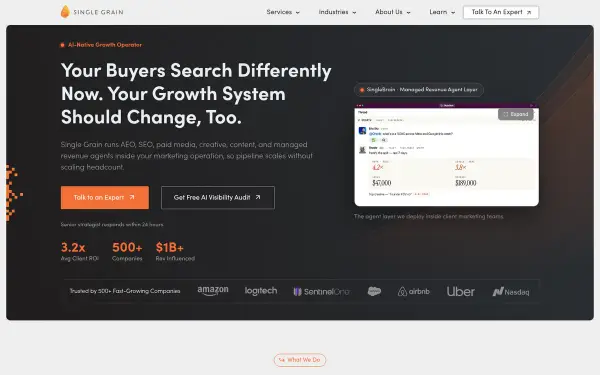
Single Grain is a growth marketing agency with an enterprise-leaning client roster and a service mix of SEO, paid media, content marketing, conversion rate optimization and growth strategy. Organic and paid are covered together, which suits companies where both channels feed the same funnel and a single strategy should govern the split between them.
The roster signals venture-scale work. That has real advantages for a smaller company: the team has growth marketing experience with large tech and consumer brands, and organic and paid are covered together. Publicly cited clients include Amazon, Uber and Airbnb, so the playbooks are not untested. It also means the agency is organized around larger clients. No pricing is published, so you have to request a quote.
For a growth-stage tech or consumer company that has raised money and needs to spend it well, that trade is reasonable. For a very small local business, the engagement will feel mismatched: strategy depth you cannot act on without a team, and a fee that can consume much of the marketing budget before any media is bought. Built for companies in a growth phase rather than pre-revenue startups.
Ask how much senior attention a smaller account receives, and get a named team in the proposal before signing. Enterprise-leaning agencies sometimes sell with partners and staff with associates, and the difference shows up in month two. Ask too which channels the first 90 days cover, since growth strategy work can run long before anything ships.
You are a funded growth-stage company that wants SEO, paid and content strategy from one team.
You are pre-revenue or running a single-location small business.
Entry VIII of VIII / Store plus marketing
Our verdict
Ecommerce marketing and store development in one relationship, with pricing you have to request through a calculator.
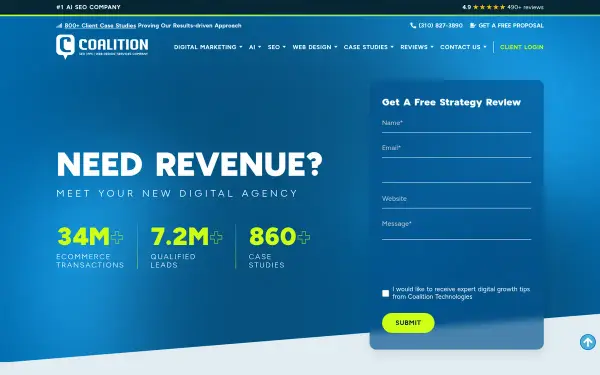
Coalition Technologies is the ecommerce specialist on this list. Ecommerce SEO, store design and development, conversion optimization, paid search for online stores, site speed improvements and analytics. The positioning is a store where search visibility, page speed and conversion rate all have to improve at the same time, which can be the case for a store doing real volume and losing sales at checkout.
Marketing and development under one team is the practical advantage. Stores can end up with an SEO consultant recommending changes and a developer with no incentive to prioritize them, and the recommendations expire in a backlog. Here the same relationship owns both. SEO programs are built for catalog and category pages rather than blog content, which is the right emphasis for a store with a large catalog.
Pricing is the weak point. Budget figures are not disclosed publicly: an interactive calculator estimates a range and a custom proposal follows. That works for buyers who already know their scope, and frustrates anyone building a budget from nothing. Use the calculator to estimate a range, and ask what the low end actually buys in hours and deliverables before you treat it as a number.
The fit is narrow on purpose. Local service businesses, professional firms and B2B companies with long sales cycles will find little here, and should not be talked into a store-focused program. Stores with large catalogs will find a lot, especially where organic search and site speed are both underperforming. Pricing requires a quote.
You run an online store and want marketing and site development handled together.
You are a local service business or you need a price before any conversation.
VIBackground
An online marketing company is an outside firm that plans and runs some or all of a business's digital acquisition: search engine optimization, paid search and social, content, email, conversion work and often the website itself. You buy a team and a process on a monthly retainer instead of hiring specialists one by one.
For a small business, the practical difference from a freelancer is breadth and coordination. A freelancer usually owns one channel well and costs less. An agency brings several channels plus account management, reporting and often development capacity, at a higher monthly cost and with more process to absorb.
You likely need one when:
You likely do not need one when the budget covers only a few hours of senior time a month, or when the problem is one narrow task such as a tracking setup or a landing page rebuild. In those cases an independent specialist is cheaper and faster, and no agency will say so.
What the work looks like month to month varies by channel. SEO engagements cover technical fixes, content and local listings. Paid engagements cover campaign structure, creative testing and bid management. A typical engagement includes a report, a call and a list of recommended changes. Quality shows in whether that list gets shorter because the work is being completed rather than re-recommended.
The category also includes specialists. Some firms focus on paid media, such as Disruptive Advertising. Some focus on ecommerce, such as Coalition Technologies. Some are built for multi-location brands, such as Ignite Visibility. Generalists such as WebFX cover most channels, which helps coordination and raises the entry price.
Ask one question before anything else: what will you change in the first 60 days? A specific answer tells you more than any capabilities page.
This comparison sits in the software register. Further along the shore: baby tracking app and kennel software.
VIIPricing
Agencies often bill a monthly retainer for a defined scope, and the scope, not the headline number, decides whether the price is fair. Several billing shapes show up across this list.
| Model | How it bills | Typical fit | Example from this list |
|---|---|---|---|
| Monthly retainer | Fixed fee per month with a scope agreed up front | Ongoing SEO, paid media or content | Thrive Agency, SEO range from $500 per month |
| Average spend guide | Vendor publishes an average figure rather than a floor price | Budget planning before a quote | WebFX, $2,500 average monthly SEO spend |
| Calculator plus proposal | Scope is built first, price follows | Ecommerce and multi-channel programs | Coalition Technologies, calculator and custom quote |
| Contact-only pricing | No figure until a sales conversation | Larger or franchise programs | Ignite Visibility, Power Digital, Single Grain |
| Project or hourly work | One-off fee or hourly rate for defined work | Site builds, audits, migrations | SmartSites, published hourly rate range and low project minimum |
Two things confuse budget conversations more than anything else. The first is fees versus media spend: a monthly management figure can describe fees, and the ad budget sits on top of that. Ask each agency to separate the two on one page.
The second is the guide figure. A number published as an average, a range or a starting point is not a quote for your scope. WebFX publishes $2,500 as average monthly SEO spend, Thrive Agency publishes a range starting at $500 with a $1,000 project minimum, and several firms publish nothing at all. Treat every figure as a floor to test rather than a price to expect.
When you request a proposal, ask for hours, deliverables, channels covered and the review cadence in writing. Two proposals with the same monthly fee can differ widely in actual work.
Each entry card shows the starting price as it appeared on the vendor's own pricing page on November 25, 2026. When a vendor shows no figure we could confirm, or only a promotional rate, the card says "See website" or gives the regular price instead of a guess. Usage, overage and add-on rates in the text change more often than plan prices, so confirm them on the vendor page before you set a budget. To test the numbers against your own volume, try the free User Research Budget Planner. The Event Break-Even Calculator is a second way to check the same decision.
VIIIDecision
IXPitfalls
XQuestions
Plan on $500 to $2,500 a month for a focused program, and treat a larger scope as a multi-channel budget. Thrive Agency publishes an SEO range from $500 per month with a $1,000 project minimum. WebFX cites $2,500 as average monthly SEO spend. Ignite Visibility, Power Digital and Single Grain do not publish starting prices, so ask for a quote. Set the ceiling before you take calls.
Start with a freelancer when the budget is small or the problem is one narrow task. Move to an agency when several channels must improve together, when the site needs development work alongside marketing, or when you need reporting someone else will accept. Agencies carry more process and a higher minimum, and they coordinate work a freelancer cannot cover alone.
Leads or revenue, cost per lead or acquisition, and the channel that produced each one. Ask for conversion data tied to spend, not just sessions and impressions. If the agency reports return on ad spend, ask to see the attribution model and the lookback window. A report that cannot show which channel produced pipeline is a channel report, not a business report.
Paid search gives usable data inside the first month of spend, which is why it is easier to judge early. SEO work on site speed, structure and content usually needs a full quarter before trend lines mean anything, and competitive terms take longer. Ask each agency to put a timeline and a first-90-days plan in the proposal, then hold them to it at the review.
Check the minimum term, the notice period and who owns the ad accounts, analytics property, site access and creative. Confirm what happens to work in progress if you leave, and whether fees are billed in advance. Ask for a 90-day review point. If any of those terms are missing from the document, get them added before signing rather than after.
Ask for a written scope with hours, deliverables and channels, then compare those documents side by side instead of the fees. Not every agency here publishes a starting price. A proposal that names concrete hours and channels is comparable to another proposal. A proposal that names a monthly figure and nothing else is not, so send it back.
XIFurther along the shore
Vendors can ask for a correction or apply for a Featured listing. Paid or not, the entry is scored on the same rubric and its limits stay in print. Partner with Umberlake.
Free tools
Our free browser tools turn the prices on this page into a figure for your own volume. Nothing you type leaves your device.