
Mindbody
See websitecustom quote
Best for studios wanting the largest consumer booking marketplace
- Free plan
- No
- Rubric
- 7.7 of 10
We ranked eight gym and studio scheduling platforms on fit, real monthly cost, migration support and scheduling depth, with prices checked on 25 November 2026.

IThe short answer
Mindbody suits studios that want the biggest consumer marketplace feeding new bookings, WellnessLiving suits operators who want AI-driven retention and one platform from $69 per month, and Gymdesk suits owners who want one flat bill with every feature included. Prices were checked on 25 November 2026. The rest of this list covers tools built for martial arts schools, CrossFit boxes, multi-site franchises and lean studios, with the pricing model and the hidden extras spelled out for each so you can budget the bill you will actually pay in month three: Best Gym Scheduling Software.
8 tools compared from vendor pages on November 25, 2026. 3 publish a starting price we could read; the rest say "See website".
IITop three berths
Register order is editorial fit for the buyer each entry describes. Prices are the starting figures read on November 25, 2026.
See websitecustom quote
Best for studios wanting the largest consumer booking marketplace

See website
Best for budget-conscious single-location businesses

$119Per month, 0-100 active customers, first 6 months then standard pricing
Best for fitness studios with flexible membership models
How this page is paid for. All 8 tools here are unpaid editorial picks.
A paid listing's position can be part of what the vendor pays for. Every entry, paid or not, is scored on the same rubric and keeps its limits in print. Advertising disclosure.
IIIThe register
Starting prices as shown on each vendor's pricing page on November 25, 2026. "See website" means no figure we could confirm.
| No. | Tool | From | Free plan | Trial | Rubric | Actions |
|---|---|---|---|---|---|---|
| 01 | MindbodyStudios wanting the largest consumer booking marketplace | See websitecustom quoteNot shown publicly | No | See website | 7.7 | |
| 02 | VagaroBudget-conscious single-location businesses | See websiteNot shown publicly | No | See website | 4.8 | |
| 03 | TeamUpFitness studios with flexible membership models | $119Per month, 0-100 active customers, first 6 months then standard pricingRead on vendor page | No | 30-day free trial | 7.6 | |
| 04 |  Pike13Activity businesses such as swim, music and martial arts schools | See websiteNot shown publicly | No | See website | 6.6 | |
| 05 |  WodifyCrossFit, martial arts and boutique gyms | See websiteNot shown publicly | No | See website | 6.5 | |
| 06 |  WellnessLivingAI-forward all-in-one studio and gym management | $69Starter, per month, paid monthly, annual billing saves 10%Updated on vendor page | No | See website | 7.5 | |
| 07 |  GymdeskOwners wanting one predictable bill with all features | See websiteNot shown publicly | No | 30-day free trial, no credit card | 6.7 | |
| 08 |  ABC GlofoxOperators scaling from a single site to franchises | $275Essential, per month, new studios $99 per month for the first yearUpdated on vendor page | No | See website | 7.3 |
Pinned:
IVMethod
How well class calendars, waitlists, memberships and recurring bookings handle a real gym week.
Whether rates are published, what the entry price includes and how costs scale with members, staff, calendars and add-ons.
Marketing automation, churn flags and member apps that keep people booking month after month.
Whether the product serves a single room or a franchise, and how well it handles niches such as martial arts or CrossFit.
How much help you get moving member records, billing and stored payment details off your current platform.
VMethod
Every tool here was scored against the same five criteria, and the weights reflect what tends to go wrong after the sale. Scheduling depth carries 25 percent because a calendar that cannot handle waitlists, recurring memberships or add-on bookings creates daily workarounds. Pricing clarity (20 percent) asks whether a rate is published, what the entry price includes and how the bill scales with members, staff, calendars and add-ons. Retention tools (20 percent) covers marketing automation, churn flags and member apps that keep bookings coming. Fit and scale (20 percent) checks whether the product serves a single room or a franchise, and how honestly it handles niches such as martial arts or CrossFit. Migration support (15 percent) weighs how much help you get moving member records, billing and stored payment details off your current system.
Prices come from vendor pricing pages checked on 25 November 2026. Where a vendor publishes no rate, we say pricing is on the vendor site and do not estimate. Where a page could not be loaded, we say so in the tool's note rather than fill the gap with a number from memory.
The order reflects fit for the buyer each entry describes. When a listing is a paid placement, it is labelled and scored with the same rubric, with the same cons and the same pricing disclosure as every other entry.
We do not test drive every product hands-on. We read vendor documentation, published feature lists and pricing terms, and we separate what the vendor claims from what its published materials support.
The full routine, from price reads to corrections, is on the methodology page. Paid listings follow the advertising disclosure.
Entry I of VIII / Consumer booking marketplace
Our verdict
The widest all-in-one platform with the biggest consumer marketplace, but quote-only pricing and long contracts demand a careful read.
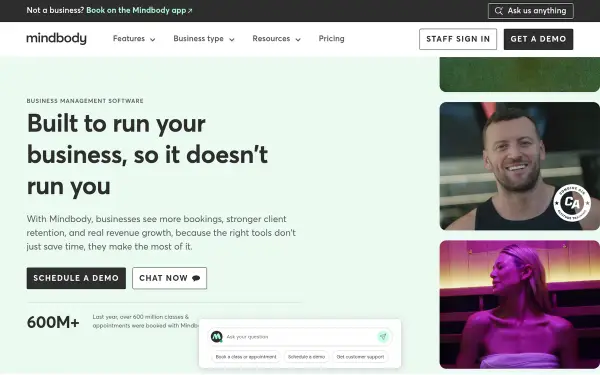
Mindbody covers the full operational spread in one account: class and appointment scheduling with waitlists, point of sale for in-studio retail and packages, automated marketing campaigns, staff scheduling with payroll integrations, reporting dashboards and an optional branded member app. For a studio running drop-in classes, private sessions and retail from the same front desk, that removes a spreadsheet and a second login.
The differentiator is the consumer app. The vendor states 40,000+ businesses on the platform, more than 600 million classes and appointments booked in the past year, and over 3 million active users on its consumer app. In a crowded neighborhood that discovery channel can fill quiet slots without you spending on ads. It is not free acquisition: clients sourced through the marketplace carry a commission cost, so the effective value of each new member is lower than the sticker suggests.
Pricing works by quote. No pricing sheet is published, so expect a demo and a conversation, and expect the number to sit at the premium end of this list. Contract terms can be long. Ask for the term length and the exit terms in writing, and model the full term rather than the first month.
Setup and training assistance plus data migration support are part of onboarding, which helps if you are moving years of member records and payment details from another system. The fit is a multi-service studio or small chain that wants discovery and one system for scheduling, payments and marketing. A single-room gym with a tight budget and a full class roster pays for marketplace reach it may never use.
You want one system for scheduling, retail, marketing and staff plus a consumer app that can send you new clients.
You need a published rate before the demo or a short, flexible contract from day one.
Entry II of VIII / Per-calendar billing
Our verdict
Cheapest published entry rate here, but add-ons and per-calendar charges mean the real bill lands well above it.
Vagaro runs on a calendar: classes and appointments book into it, payments run through its point of sale, and the marketplace listing puts the business in front of new clients. Text marketing, custom intake forms and the website builder are paid add-ons rather than part of the base subscription, which is the detail that decides whether the low entry rate holds up over a year.
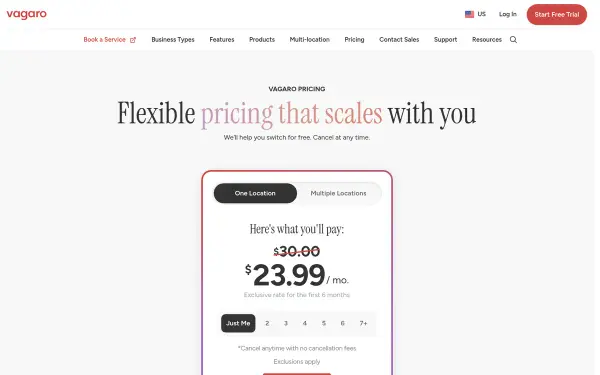
The billing model is the interesting part. Vagaro charges per bookable calendar rather than per feature tier. Subscription terms documented in the vendor help center in September 2026 cover one calendar on the base rate and up to seven paid licenses, with staff beyond seven free. Each additional calendar adds $10 per month. There is no commission on new clients who arrive through the marketplace, which is unusual at this level and matters if discovery is the reason you are looking.
Add-ons are where the real monthly bill lands. Add-ons can push the real monthly bill well above the entry figure once marketing, intake and website tools are switched on, so build the stack you would actually use before comparing it with a flat-rate platform. A two-room studio with several trainers also needs to count calendars, because the per-calendar math compounds quickly.
The product is aimed at salons, spas and small studios more than large gyms. Scheduling logic is calendar-first, and there is less depth in class capacity rules, waitlists and multi-location reporting than the fitness specialists offer. Pricing is on the vendor site, so confirm the current figure before you budget.
You run one or two small rooms, want a marketplace listing with no commission and can live without bundled marketing.
You have several rooms and trainers, where per-calendar charges and add-ons stack past a flat-rate competitor.
Entry III of VIII / Configurable class rules
Our verdict
A configurable studio scheduler with clear published pricing and free migration, best for gyms with varied membership models.
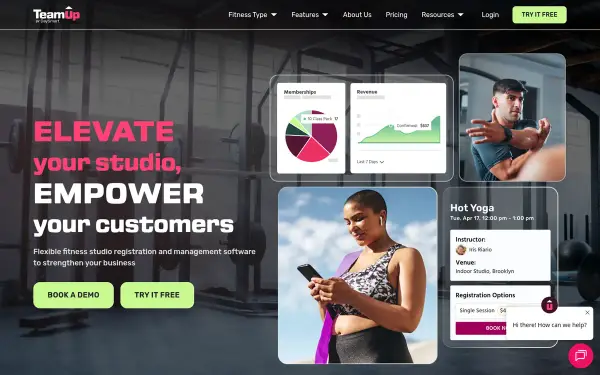
TeamUp puts its weight behind the calendar. Class scheduling runs on customizable calendar rules, and the membership side handles tiers, class packs, recurring plans, private coaching, workshops and add-on bookings in the same system. Point of sale, customer records and reporting are included, so a studio can bill a member, book them into a class and see attendance without opening a second tool.
Pricing is published and simple to read: $119 per month covers 0 to 100 active customers for the first 6 months, then standard pricing applies. That is one price point, not a ladder. Very small teams with a handful of weekly classes get no cheaper tier, and a studio that grows past 100 active customers should ask what the next band costs before assuming the rate holds.
Onboarding is a genuine strength. Free data migration and one-to-one setup are included, and the integration list covers Stripe, GoCardless, Zoom, Mailchimp, Zapier and Kisi door access. The Zoom link matters for hybrid schedules where a class runs in the room and online at the same time, and door access integration removes the key fob routine at the front desk.
The limits are around marketing. Native automation is thinner than on the all-in-one platforms, so campaigns and nurture journeys usually mean Mailchimp or Zapier. Support hours centre on US and UK time zones, which is worth knowing if you run classes in Asia or Australia. The product has been operating since 2011, and a 30-day trial with free data import is available, so you can test the calendar rules against your own timetable before committing to the paid rate.
Your timetable and membership rules are unusual and you want a published rate plus free migration.
You run a tiny schedule, need heavy native marketing automation, or operate outside US and UK support hours.
Entry IV of VIII / Level and skill tracking

Our verdict
Built for leveled activity programs like swim and martial arts schools, with skill tracking gyms rarely get elsewhere.
Pike13 schedules recurring activities rather than gym classes, and that distinction shapes everything else. Enrollment, payments and billing, skill and progression tracking, and client profiles all assume a program with levels: a swim course that moves a child from one stage to the next, a martial arts class with a belt path, a music school with graded lessons. A gym running drop-in sessions can use it, but the course structures are where the product earns its place.
Reach is modest but real. The vendor reports more than 1,700 customer companies, and its homepage names fitness studios, swim schools, martial arts academies, music schools and tutoring centers as target segments. That spread explains both the flexibility and the compromise: the workflows are generalized enough to serve a tutoring center, which means gym-specific touches such as waitlist logic or class capacity rules can feel thinner than on a dedicated fitness platform.
Onboarding includes a dedicated specialist plus data transfer, which is more hands-on help than several larger vendors provide. Ask what the specialist does during the first month and whether stored payment details move with the member records, since billing continuity is the part that goes wrong in most switches.
Pricing sits on the vendor site, which lists a single rate rather than a tier ladder or a budget option, so there is no cheap entry for a small operation. Check the vendor site for the current rate. Pick it when progression matters: belt ranks, swim levels, graded music lessons. Skip it when you need deep gym scheduling, a marketplace feeding new bookings or a low starting rate for a single room.
Your members move through levels, ranks or graded courses and you want enrollment and skill tracking in one place.
You run drop-in classes only and want fitness-specific waitlist logic or a low entry rate.
Entry V of VIII / Workout and churn tracking
Our verdict
CrossFit-rooted platform with workout tracking and churn tooling that general gyms will find opinionated but useful.
Wodify grew out of CrossFit, and the feature set still shows it. Class management sits alongside workout tracking, a whiteboard and results display that members check after a session, lead capture, automated billing, digital contracts and waivers, payroll tools and multi-location management. The vendor has extended the same core to martial arts, HIIT, bootcamps and personal training, but the daily rhythm it was designed around is a gym with a workout of the day and members who post scores.
Retention tooling is the strongest part. Churn risk prediction flags members who are drifting, and automated re-engagement journeys follow up without a coach remembering to text. Community and milestone features feed the same loyalty, which is a better use of the platform than another spreadsheet.
Pricing is quote only. Plans are listed as Essentials, Accelerate and Ultimate, but no rate is published, only demo and call options. That makes comparison hard before a sales conversation, and extra modules push the total up once you move past the base plan. Ask which tier includes payroll, multi-location management and churn prediction, because those are the pieces that justify the platform and they are not all in the entry plan.
The vendor describes itself as independently built without outside venture funding, which is a useful signal on roadmap stability in a market where ownership changes have reshuffled product direction elsewhere. The fit is a CrossFit box, martial arts gym or boutique studio that wants workout tracking and retention automation in one place and is comfortable with a demo-led purchase. A general fitness club with no scored workouts will find the CrossFit-first design opinionated.
Your members log scores and you want churn flags and re-engagement journeys running without a coach chasing them.
You need a published rate to compare vendors or run a general fitness club with no workout tracking.
Entry VI of VIII / AI front desk
Our verdict
Strong automation at a published $69 entry rate, with AI tools that need real testing.
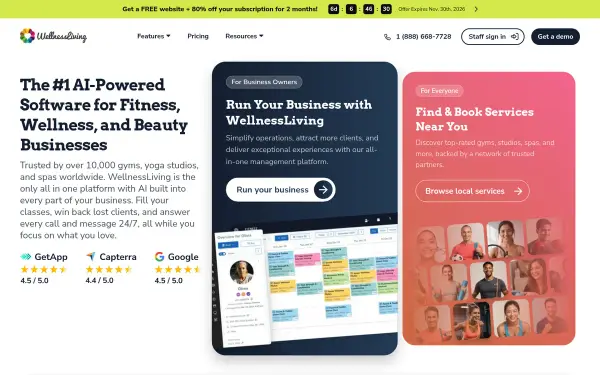
WellnessLiving bundles scheduling, membership and billing management, marketing automation, a branded member app, website widgets, point of sale and integrations with QuickBooks, Zapier and door access systems. The 2026 positioning is built around AI: churn prediction that flags members at risk, and an AI front desk that handles calls and messages around the clock. That second piece is the one to test properly, because a front desk that answers booking questions at 10pm is worth money and one that misroutes them is not.
Pricing now has a public starting point: $69 per month on the Starter plan, billed monthly, with 10 percent saved on annual billing. That is a change from the quote-only pattern of most of this list and makes the product easier to budget against. Confirm what Starter includes before assuming the AI features are in it, since the entry tier and the full automation stack are rarely the same thing.
Scale is real. The vendor states more than 10,000 gyms, yoga studios and spas use the platform, and it publishes a direct comparison page aimed at Mindbody customers, which tells you where it expects to win. The breadth that makes that possible also creates the main complaint: a small team can open the dashboard and not know where to start, and turning on every automation at once tends to produce noise rather than retention.
The fit is an established studio or gym with enough member volume for automation to matter, run by someone willing to configure it. Pick it for the breadth and the published entry price, and test the AI pieces against real member questions before you build a front desk process around them.
You want published pricing and automation across retention, marketing and the front desk in one account.
You have a small team with no time to configure automation or you only need a class calendar.
Entry VII of VIII / All features included
Our verdict
One flat bill, every feature included and no contracts, which makes budgeting simple even for small gyms.
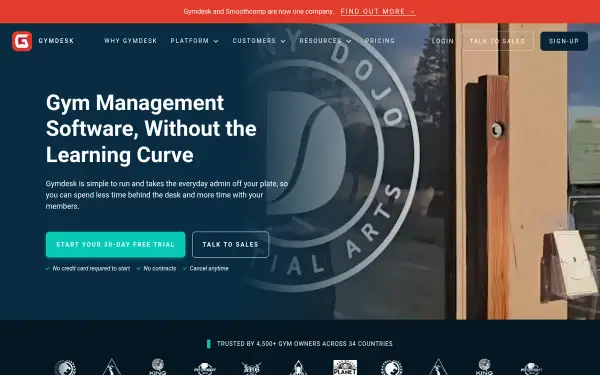
Gymdesk makes one promise and keeps it: every feature in every plan. Membership and billing management with failed-payment recovery, attendance tracking and class booking, a free gym website, point of sale, marketing automation, reporting, a member app, smart-lock door access, and belt, rank and skills tracking all come as standard. There are no tiers to compare and no add-on fees, which removes the most tedious part of buying software.
The billing model is worth understanding before you get a quote. Price scales only with active member count, with no per-staff charges, no contracts and the option to cancel anytime. A 30-day trial needs no credit card and no sales call, which is rarer than it should be. Pricing is on the vendor site; check the current rate against your member count.
The martial arts origin is still visible in the feature set. Belt, rank and skills tracking are native rather than bolted on, and the vendor began in martial arts before extending to fitness gyms, yoga, CrossFit and clubs. It reports more than 4,500 gym owners across 34 countries. For a dojo or a Taekwondo school, that means the progression tools work the way the front desk already thinks about them.
The trade-offs are around scale and marketing. The integration ecosystem is smaller than the largest platforms, so check that your payment processor and door hardware are supported. Advanced marketing is lighter than on marketplace-led competitors: there is no consumer app feeding new bookings. The fit is an owner who wants one predictable bill and is willing to trade marketplace reach for cost certainty.
You want one predictable bill, every feature included and no contract to sign.
You need a large integration ecosystem or a consumer marketplace feeding new bookings.
Entry VIII of VIII / Multi-site reporting
Our verdict
Scalable multi-site management with a published $275 rate, though a missing marketplace and merger churn warrant questions.
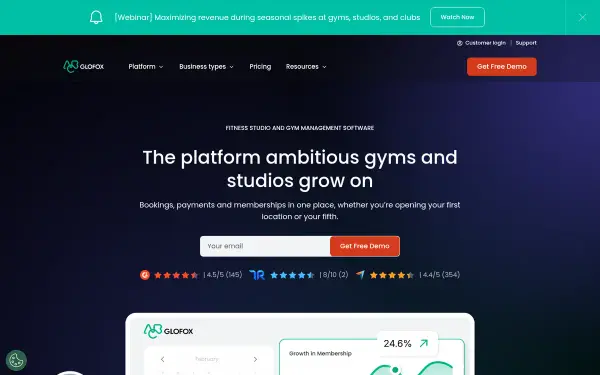
ABC Glofox is built for operators who expect to add locations. Flexible class scheduling with waitlists and reminders, memberships and credit packs, automated payment recovery, marketing automation with nurture journeys, multi-location management with centralized reporting and a branded member app all assume a business with sites to compare rather than a single room.
Pricing is now published. Essential sits at $275 per month, and new studios pay $99 per month for the first year. That discount makes the first year easy to approve and the second year the number that matters, so model both before signing. Confirm what Essential includes, since multi-location reporting and the branded app are the features that justify the platform and they are not always in the entry plan.
The company is now branded ABC Glofox after being absorbed into the ABC Fitness group, and the vendor claims 30,000+ studios and gyms worldwide. Scale brings stability of a kind, but the merger also puts the roadmap in flux. Ask in the demo which features ship this year and which are on a slide, and ask how existing customers are being moved onto the group platform. Operators comparing it with Mindbody should note one clear gap: there is no consumer marketplace to feed new bookings, so acquisition stays your job.
The fit is a studio or gym with a second site in the plan, or a franchise operation that needs centralized reporting across locations and a branded app members keep on their phones. A single-site gym with no expansion plans pays for multi-location machinery it will not use, and one that relies on marketplace discovery should look elsewhere.
You plan a second site or already run several and need centralized reporting plus a branded member app.
You rely on a consumer marketplace for discovery or run one site with no expansion plans.
VIBackground
Gym scheduling software manages the calendar: which classes run, who is booked, who is on the waitlist, how many spots remain and what each member pays to attend. At its simplest it replaces a paper sign-up sheet and a group chat. At its most complete it runs the commercial relationship with every member, from the first trial pass to the recurring card payment.
The core pieces are consistent across the eight tools here:
The category then splits by scope. A scheduling-first product such as TeamUp concentrates on configurable calendar rules and flexible membership structures, and expects you to bring your own marketing stack. An all-in-one platform such as Mindbody or WellnessLiving adds point of sale, marketing automation, payroll and door access, and charges accordingly. A niche platform such as Wodify or Pike13 builds the calendar around a specific format: scored workouts in one case, leveled programs and belt progression in the other.
Full gym management software covers everything a gym does, including staff payroll, retail, multi-location reporting and franchise controls. Scheduling software covers the booking layer and the member relationship around it. The overlap is large, which is why the marketing language is confusing: most vendors now describe themselves as all-in-one regardless of where they started.
The practical question is not which label a vendor uses but which jobs you need the software to do on a Tuesday morning. If the front desk spends its day fixing double bookings and chasing failed payments, a scheduling-first tool may be enough. If you also want retail, marketing and payroll in the same login, you are shopping for a management platform with a strong calendar attached, and the scheduling depth becomes one score among several rather than the whole decision.
This comparison sits in the software register. Further along the shore: baby tracking app and kennel software.
VIIPricing
Gym scheduling software bills in five broad ways, and the model matters more than the headline rate because it decides what happens when you add a room, a class or a member.
| Model | How it bills | Typical fit | Example from this list |
|---|---|---|---|
| Per active member | Price scales with active member count only, no per-staff charges, every feature in every plan | Gyms that want one predictable bill | Gymdesk |
| Per bookable calendar | Base rate covers one calendar, each additional calendar costs more | Salons, spas and small studios with several rooms | Vagaro, where each additional calendar adds $10 per month |
| Flat rate with a customer cap | One published monthly rate covering a band of active customers | Single-site studios with a steady roster | TeamUp at $119 per month for 0 to 100 active customers |
| Published tiers | Named plans at published rates, sometimes with a first-year discount | Studios planning to add locations | ABC Glofox Essential at $275 per month, new studios $99 per month for the first year |
| Quote only | Rate set after a demo, with no pricing sheet published | Multi-service studios and franchises with complex needs | Mindbody and Wodify |
WellnessLiving sits between the published tier and quote-only models: $69 per month on Starter, billed monthly, with 10 percent saved on annual billing.
Three costs sit outside the pricing sheet. Payment processing is charged on every transaction and is rarely included in the subscription. Add-ons such as text marketing, intake forms and website builders are sold separately at Vagaro. Marketplace commission applies to clients sourced through a consumer app at Mindbody. Contract terms also differ: Gymdesk states no contracts, while Mindbody contract terms are worth checking closely.
That is why a published starting price is a starting point, not a budget. Put the same scope on both sides of a comparison before the numbers mean anything: same member count, same rooms, same add-ons, same payment volume.
Each entry card shows the starting price as it appeared on the vendor's own pricing page on November 25, 2026. When a vendor shows no figure we could confirm, or only a promotional rate, the card says "See website" or gives the regular price instead of a guess. Usage, overage and add-on rates in the text change more often than plan prices, so confirm them on the vendor page before you set a budget. To test the numbers against your own volume, try the free User Research Budget Planner. The Event Break-Even Calculator is a second way to check the same decision.
VIIIDecision
Count what you actually bill. List active members, staff, bookable rooms and the add-ons you would genuinely switch on. A per-calendar model like Vagaro and a per-member model like Gymdesk produce very different bills from the same gym.
Test the calendar against your worst week. Put a full class with a waitlist, a recurring membership, a private session and a late cancellation into a trial. If the tool needs a workaround for any of those, the workaround becomes daily.
Price the full stack, not the entry tier. Add payment processing, marketing add-ons and extra capacity to the published rate. Ask which features sit outside the plan you were quoted, especially payroll, multi-location reporting and churn tooling.
Ask how stored payment details migrate. A platform that imports names and email addresses but not stored cards creates weeks of front-desk work. Get the answer in writing, and ask whether recurring billing continues without an interruption.
Read the contract term and exit terms. Mindbody contract terms can be long. Ask what happens if you close a site, change ownership or want to leave early, and get the notice period in writing.
Score the niche features that matter to you. Belt ranks, swim levels, workout scores or hybrid Zoom classes decide more day-to-day satisfaction than a dashboard. If a feature is the reason you shortlisted a tool, confirm it is in the plan you are buying.
IXPitfalls
Buying on the entry price. The lowest published rate rarely survives contact with add-ons, extra calendars and payment processing. Budget the stack you will run in month three, not the base plan.
Assuming migration includes stored cards. Member names and email addresses move easily; saved payment details often do not. If every member must re-enter card details, plan staff hours and a member communications sequence for it.
Signing a long contract before a trial. Committing to a long contract on a product you have not tested against your own timetable is the most expensive mistake in this category. Trial first, then negotiate the term.
Paying for marketplace reach you will not use. Commission on marketplace-sourced clients only pays off if the marketplace sends bookings. If your classes fill from referrals, put that money into retention tooling instead.
Turning on every automation at once. Churn flags and AI front desks send a lot of messages. Start with one journey, measure whether attendance changes, and add the next only after the first shows a result.
XQuestions
Full gym management software covers the whole business: billing, payroll, marketing, reporting and door access, with the class calendar as one part of it. Scheduling software focuses on the calendar, bookings, waitlists, capacity and member self-service. The line has blurred, because most platforms on this list now sell themselves as all-in-one. A scheduling-first tool is usually cheaper and quicker to learn; a full platform replaces several subscriptions but takes more setup before it earns its keep.
Published rates cover the base subscription and the limits attached to it. TeamUp lists $119 per month for 0 to 100 active customers, WellnessLiving lists $69 per month on Starter, billed monthly, and ABC Glofox lists $275 per month on Essential with new studios at $99 per month for the first year. Expect the real bill to add payment processing, extra capacity, add-on modules and, at Vagaro, $10 per month for each additional calendar.
Not among the tools here. None of the eight offers a free plan. The closest options are trials: Gymdesk runs a 30-day free trial with no credit card and no sales call, and TeamUp offers a 30-day free trial with free data import. A free tier in this category usually means transaction fees or a hard cap on members, so compare the total cost of a paid entry plan against a free product that charges per booking.
It depends on whether stored payment details move with the member records. TeamUp includes free data migration and one-to-one onboarding, Pike13 includes a dedicated onboarding specialist plus data transfer, and Mindbody offers setup and migration support. The hard part is recurring billing: ask in writing whether saved cards transfer or whether every member must re-enter payment details. Re-entering cards across hundreds of members is the task that eats weeks.
Gymdesk and Pike13 are the two that treat progression as a first-class feature. Gymdesk includes belt, rank and skills tracking in every plan and started in martial arts before extending to fitness gyms. Pike13 tracks skill and progression for leveled programs, and its vendor names martial arts academies as a target segment. Wodify also serves martial arts gyms, but its roots are CrossFit, so workout tracking leads and rank tracking is secondary.
No, but it changes what you are paying for. Mindbody has the largest marketplace in this category by its own figures, with over 3 million active users on its consumer app, and marketplace-sourced clients carry a commission. Vagaro lists in a marketplace with no commission on new clients. ABC Glofox has no consumer marketplace at all. If your classes fill from referrals and your own marketing, you are paying for reach you will not use.
XIFurther along the shore
Vendors can ask for a correction or apply for a Featured listing. Paid or not, the entry is scored on the same rubric and its limits stay in print. Partner with Umberlake.
Free tools
Our free browser tools turn the prices on this page into a figure for your own volume. Nothing you type leaves your device.