
Vanta
See websitecustom quote
Best for startups and SaaS teams chasing SOC 2 or ISO 27001 quickly
- Free plan
- No
- Rubric
- 7.5 of 10
Nine GRC tools compared on framework coverage, evidence automation, pricing transparency and fit for audit and risk teams, with prices checked on 25 November 2026.

IThe short answer
Vanta is the best fit for startups and SaaS teams chasing SOC 2 or ISO 27001 quickly, Drata suits engineering-led teams automating SOC 2, ISO 27001 and HIPAA, and Secureframe fits small and mid-size firms that want guided first-time compliance. Those matches reflect the buyer each entry describes, checked on 25 November 2026. Secureframe publishes a starting price of $7,500 a year for Fundamentals, and most other vendors quote privately: Best Grc Software.
9 tools compared from vendor pages on November 25, 2026. 1 publish a starting price we could read; the rest say "See website".
IITop three berths
Register order is editorial fit for the buyer each entry describes. Prices are the starting figures read on November 25, 2026.
See websitecustom quote
Best for startups and SaaS teams chasing SOC 2 or ISO 27001 quickly
See websitecustom quote
Best for engineering-led teams automating SOC 2, ISO 27001 and HIPAA
$7,500Fundamentals, per year
Best for small and mid-size firms wanting guided first-time compliance
How this page is paid for. All 9 tools here are unpaid editorial picks.
A paid listing's position can be part of what the vendor pays for. Every entry, paid or not, is scored on the same rubric and keeps its limits in print. Advertising disclosure.
IIIThe register
Starting prices as shown on each vendor's pricing page on November 25, 2026. "See website" means no figure we could confirm.
| No. | Tool | From | Free plan | Trial | Rubric | Actions |
|---|---|---|---|---|---|---|
| 01 | VantaStartups and SaaS teams chasing SOC 2 or ISO 27001 quickly | See websitecustom quoteQuote only | No | See website | 7.5 | |
| 02 | DrataEngineering-led teams automating SOC 2, ISO 27001 and HIPAA | See websitecustom quoteQuote only | No | See website | 7.2 | |
| 03 | SecureframeSmall and mid-size firms wanting guided first-time compliance | $7,500Fundamentals, per yearUpdated on vendor page | No | See website | 7.1 | |
| 04 | Optro (formerly AuditBoard)Enterprise internal audit and risk functions running permanent programs | See websiteNot shown publicly | No | See website | 6.3 | |
| 05 |  LogicGateTeams needing no-code configurable risk workflows across departments | See websiteNot shown publicly | No | See website | 6.2 | |
| 06 | ServiceNow GRCEnterprises already standardized on the ServiceNow platform | See websiteNot shown publicly | No | See website | 6.3 | |
| 07 |  MetricStreamGlobal banks and heavily regulated institutions | See websiteNot shown publicly | No | See website | 6.4 | |
| 08 | OneTrustEnterprises combining privacy, GRC and AI governance programs | See websiteNot shown publicly | No | See website | 6.2 | |
| 09 |  HyperproofMid-market firms running several frameworks at once | See websiteNot shown publicly | No | See website | 6.7 |
Pinned:
IVMethod
How many frameworks the tool maps, monitors and reuses evidence across.
How quickly a team can reach audit readiness or a live risk program.
Whether a buyer can see a number before the sales call, and how predictable total cost is.
How much evidence collection, control monitoring and policy work runs without manual effort.
How well the product serves either a first certification or a global multi-module program.
VMethod
We scored each of the nine tools against five criteria, then wrote the entries in the order that best matches the buyer described in each one. The rubric is shown above with its weights: framework coverage, ease of setup, pricing clarity, automation depth and scale fit. A tool that publishes a number scores better on pricing clarity than one that hides behind a demo, even when the hidden price turns out to be reasonable.
Prices come from vendor pricing pages, checked on November 25, 2026. Where a vendor publishes nothing, we say so and point you to the vendor for a quote. We do not convert currencies, we do not average quotes, and we do not present an estimate as a list price. Secureframe is the only tool in this list with a published starting figure, $7,500 per year on Fundamentals.
We also weighed what sits outside the license: external audit fees, implementation partners and the internal staff hours a program consumes. Those costs are real and should be budgeted separately from the subscription.
This page includes a Featured position, which is a paid placement. It was scored with the same rubric as every other entry and carries the same kind of honest cons. Featured status affects placement, not the scores, and it never moved a weak product above a strong one in the writing.
The full routine, from price reads to corrections, is on the methodology page. Paid listings follow the advertising disclosure.
Entry I of IX / Auditor network
Our verdict
Best first compliance platform for a SaaS team with a SOC 2 deadline and no dedicated compliance staff.
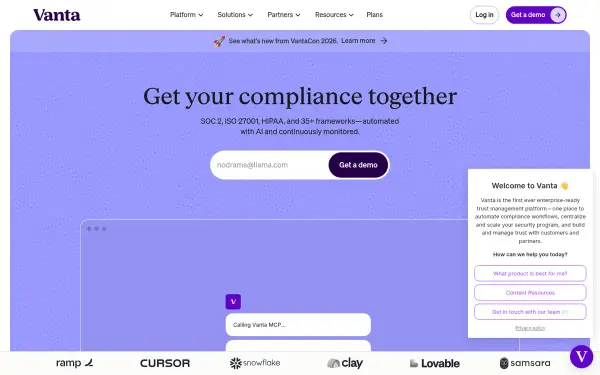
Vanta is the default choice for a startup that needs a SOC 2 Type II report on a deadline and has no dedicated compliance staff. Connectors reach into cloud infrastructure, identity providers and HR systems, evidence is collected continuously, and control templates arrive already mapped to framework requirements. Coverage extends past security certifications to 35 or more frameworks, which matters to a company that sells into several markets and keeps inheriting new questionnaires.
The practical advantage is the auditor network. Firms in that network accept platform evidence, so you are not rebuilding a spreadsheet for a CPA firm that has never seen the tool. Guided paths to SOC 2 and ISO 27001 walk a first-time owner through scoping, policy adoption and control testing in a sequence that reflects how the audit actually runs. Policy templates are the least glamorous part and the one most teams underestimate; Vanta ships them pre-written and mapped.
Pricing is quoted, never published. Plan tiers appear on the site with no numbers next to them, and the quote moves with headcount and with how many frameworks you switch on. Pricing is on the vendor site, and any quote depends on headcount and the number of frameworks. The audit itself is separate: the report comes from an outside CPA firm and is invoiced by that firm.
That combination is why Vanta sits first for its described buyer and why it stops being the obvious answer later. A team that grows into enterprise risk registers, third-party risk programs and board reporting will find itself buying a second system. The widest integration library in the category does not fix a gap in risk quantification.
You need a SOC 2 Type II or ISO 27001 report soon and want auditors who already trust the platform's evidence.
You need a transparent price before the first call, or a risk register and vendor program that outlive certification.
Entry II of IX / Parallel frameworks
Our verdict
Strongest monitoring experience for engineering-led teams, provided you can scope a quote before you budget.
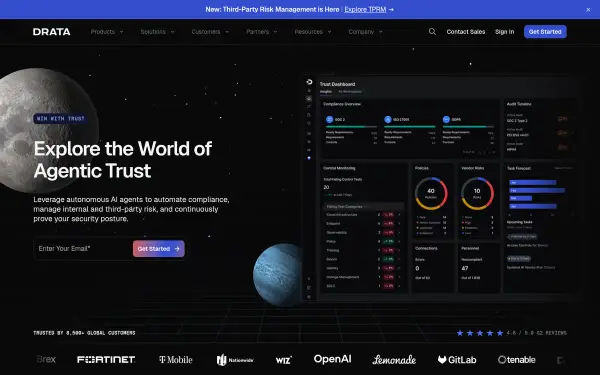
Drata is built for the team where engineers own compliance tasks and resent anything that looks like a second job. Continuous monitoring runs against technical environments, evidence is collected with an audit trail attached, and each control maps to framework requirements so a reviewer can trace it. Running SOC 2 and ISO 27001 in parallel is a first-class workflow rather than a workaround, and HIPAA sits in the same coverage set.
The strongest point is the monitoring experience. Dashboards read as operational tooling rather than compliance paperwork, which raises the chance that a control failure gets fixed quickly. Integration setup covers engineering and business systems, so HR records and ticketing data land in the same place as cloud configuration. Simultaneous framework programs share evidence where the requirements overlap.
Pricing only arrives through a scoped quote. The site lists Foundation, Advanced and Enterprise tiers with no figures, and the spread between deals can be wide because headcount, frameworks and integration count all move the number. Budgeting from an average is a mistake; scope first, then ask for a proposal. Audit fees are billed separately by the firm that issues the opinion.
Where Drata struggles is outside its center of gravity. A company that wants one platform for audit, enterprise risk, vendor risk and policy attestation across a large organization will find the seams. Multi-entity structures and regulated subsidiaries add work. It is a superb compliance automation engine for engineering-led teams, and a narrower thing than an enterprise GRC suite.
Your engineers own the controls and you plan to run SOC 2 plus ISO 27001 at the same time.
Procurement needs a number before a scoping call, or if enterprise risk and vendor programs are in scope.
Entry III of IX / Guided onboarding
Our verdict
The easiest entry point for a first certification, with the only published starting price in this list.
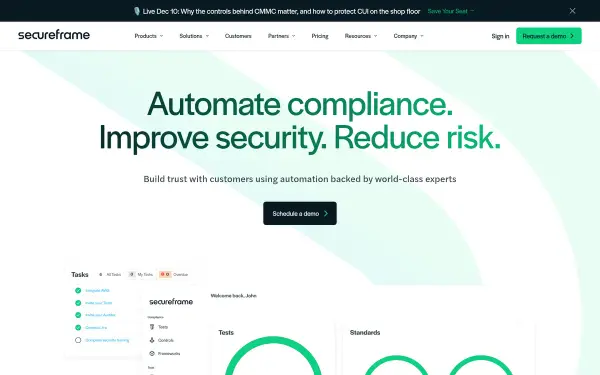
Secureframe aims at the company doing this for the first time with nobody dedicated to it. Onboarding workflows hold your hand through scoping, policy adoption and evidence setup, and AI assistance drafts policies and handles much of the evidence wrangling that normally eats weeks. Continuous monitoring keeps controls in view once the program is live, and framework support covers SOC 2, ISO 27001 and comparable standards.
The trade is depth for speed. Where Vanta or Drata give an experienced security lead room to build a bespoke control set, Secureframe tends to tell you what to do next. For a small SaaS company that is exactly right. For a fintech with a mature control library and a demanding auditor, the guidance becomes a constraint and the integration catalog, smaller than the largest automation platform, starts to show.
Pricing has one number attached: $7,500 per year on the Fundamentals plan. That published figure is unusual in this category and it makes Secureframe the easiest tool here to put in a first-pass budget. Everything above Fundamentals is quoted, so a team that needs more frameworks or more automation should expect the figure to move. Audit fees remain separate.
Secureframe is the most approachable of the major compliance automation platforms, and the one most likely to be outgrown. Once risk registers, vendor risk and board reporting enter the picture, buyers are usually pointed toward mid-market GRC or an enterprise suite. Buy it to get certified, not to run risk forever. There is no free plan and no trial is stated, so evaluation runs through a demo.
This is your first certification and you want a real number, $7,500 a year on Fundamentals, before you talk to sales.
You already have a mature control library, multiple entities, or a risk program that spans departments.
Entry IV of IX / Audit workflows
Our verdict
Purpose-built audit and risk platform for enterprises where internal audit is a standing function, not a project.
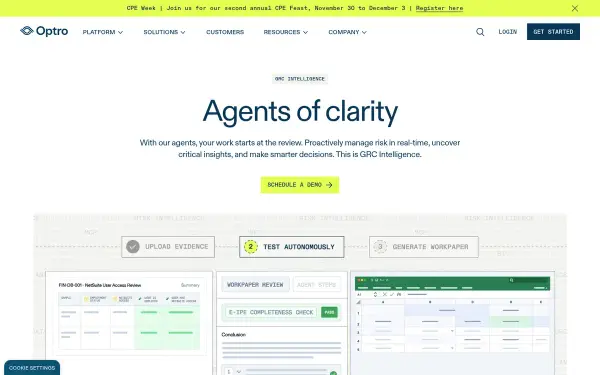
Optro, known as AuditBoard until early 2026, is built for organizations where internal audit and risk are permanent functions with staff, calendars and a committee waiting for output. Connected modules cover audit management, risk registers, risk assessment, compliance tracking and control testing, and the workflows replace the spreadsheet-and-email arrangement most audit teams start with. Reporting and analytics serve the audit leader who has to present to a board.
The fit is narrow and deep. A company that needs one SOC 2 report has no use for this, and would pay enterprise prices for capability it will never open. A company with an internal audit plan, a risk appetite statement and a vendor inventory gets a system that matches how the work is actually organized. Analytics capabilities are continuing to mature rather than leading the category.
Pricing is not published. Expect an enterprise sales cycle with a scoped quote, plus procurement, security review and implementation planning. The rebrand adds a short-term wrinkle: older contracts, security questionnaires and internal budget documents may still say AuditBoard, and evaluations started now should use the Optro name so the paper trail stays clean.
Judge it against enterprise GRC suites, not against compliance automation. On that comparison its audit heritage is the differentiator and its analytics are still maturing. Buyers who mostly want risk quantification from a regulated-industry lens should look at MetricStream; buyers already inside a platform ecosystem should look at ServiceNow. Both are enterprise options with quoted pricing, so the comparison should be deliberate.
Internal audit and risk are permanent functions with staff, an audit plan and a board committee to report to.
You need one certification, a quick start, or a price you can see without a sales cycle.
Entry V of IX / No-code builder
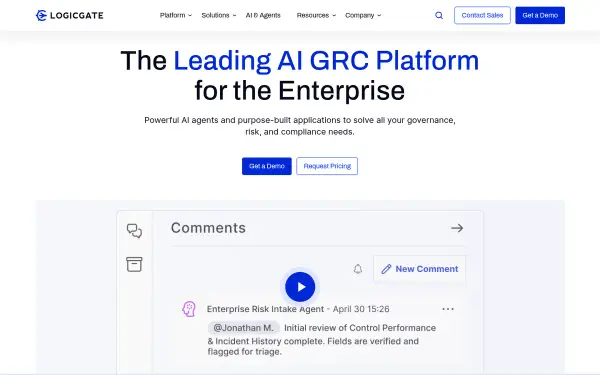
Our verdict
Best when each risk program is genuinely different, since business users can model the process themselves.
LogicGate sells a no-code application builder with prebuilt applications for enterprise risk, third-party risk, audit and compliance, and the point is that business users reshape the process without waiting for IT. A risk team that has to model a vendor onboarding flow unique to its industry can build it, adjust it and report on it inside the tool. Prebuilt applications cover the common starting points, and the drag-and-drop layer handles the rest.
Licensing is modular by application, plus power-user licenses for the people who build rather than submit. That structure rewards focus and punishes sprawl: a few applications with a small number of builders is easier to manage than many applications with many power users. Model the domains you intend to license before you ask for a proposal, and ask what happens to the price when a new risk program starts.
Pricing is on the vendor site, with the final figure driven by application count and power users. That positions LogicGate as a distinct middle option rather than a marketing one. Implementation is shorter than an enterprise suite because configuration replaces custom code, but it is not a weekend project.
The honest limits are reporting depth and cost creep: standalone reporting is less developed, and total cost rises once each department wants its own application. LogicGate earns its place for organizations whose risk programs genuinely differ from each other. If every program is a copy of the same template, cheaper options do the same work.
Your third-party, audit and enterprise risk workflows genuinely differ and business users need to change them.
Your risk programs follow one template, or if board-grade reporting has to ship inside the tool.
Entry VI of IX / Platform-native risk data
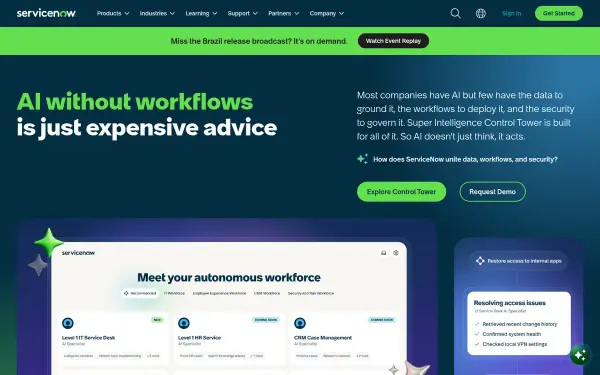
Our verdict
Compelling only where ServiceNow already runs IT operations, where risk data needs no integration project.
ServiceNow GRC is a module inside a platform most large enterprises already run, and that fact drives both the value and the cost. Risk data is pulled from IT operations and IT service management records that already live in the same system, so a control failure in a configuration item flows into the risk register without a connector project. Workflows run on the shared platform, and the wider ServiceNow application ecosystem is available to teams that already know it.
For an organization with a mature IT service management practice, the integration argument is strong. Ownership, escalation and change records already exist, and GRC becomes another lens on data that is already governed. Deployments are substantial multi-team programs, which suits global organizations with the staff to run them and frustrates lean ones. Implementation is a program, not a switch-on.
Pricing is not published. A scoped quote rises with modules and user scale as the program expands from one risk domain to several. Buyers should model three years, not one, because the second and third modules are where the platform case actually pays off. Module-by-module expansion keeps the first invoice smaller and the long-run total larger.
The honest question is whether the product carries itself without the platform. For a company on a different ITSM stack, ServiceNow GRC means a platform migration project sold as a compliance purchase, and the total cost of ownership is dominated by that migration rather than the license. That is why it ranks here for the platform-native buyer and not for a company choosing GRC software from scratch.
IT operations, change records and configuration data already live on ServiceNow and risk should read from them.
You run a different ITSM stack, or if you need a first certification rather than a multi-year platform program.
Entry VII of IX / Risk quantification
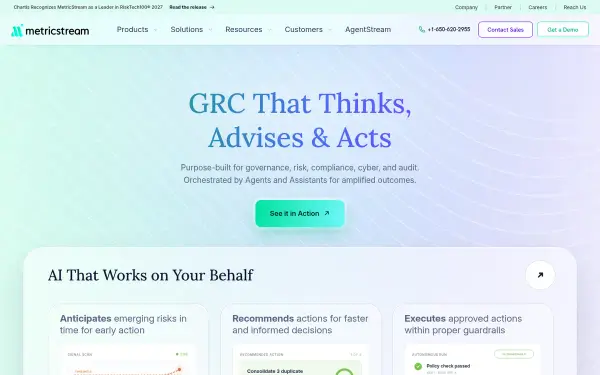
Our verdict
The deepest risk coverage for regulated institutions, with implementation weight and pricing that match the scope.
MetricStream is the deepest general-purpose risk platform in this list and the least forgiving. Its taxonomy spans operational, IT, third-party, compliance and audit risk in one model, with risk quantification on top and regulatory obligation tracking feeding the compliance side. Banks, insurers and other heavily regulated institutions buy it because their examiners ask questions that narrower tools cannot answer.
The strengths follow from that ambition. Risk quantification is mature rather than bolted on, the financial services footprint is large, and reporting is built for boards and regulators rather than for a weekly standup. A risk team that has to aggregate exposure across business units and produce a defensible number for a committee gets a system designed for the job.
The costs are equally clear. Enterprise pricing is high, implementations run in multiple phases and usually require outside support, and the elapsed time from contract to a live program is substantial. Organizations below large-enterprise scale should not start here, however attractive the feature list looks in a demo. Pricing is on the vendor site and depends on modules and user components.
Comparisons with OneTrust and ServiceNow GRC are the useful ones. OneTrust leads with privacy and AI governance and adds risk; ServiceNow leads with a platform and adds risk; MetricStream leads with risk and stays there. If the board question is about quantified exposure across a regulated group, this is the tool that answers it. If the question is how to close a SOC 2 gap, this is far more capability than needed.
A bank, insurer or regulated group needs quantified exposure and regulator-ready reporting in one model.
You are below large-enterprise scale, or if the goal is a certification rather than a risk program.
Entry VIII of IX / Privacy plus AI governance
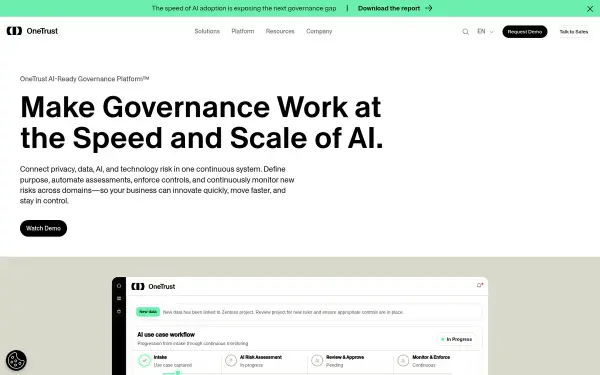
Our verdict
Right when privacy, AI governance and risk overlap, wrong when you only need one of the three.
OneTrust started in privacy and expanded outward, so the platform now carries privacy management, GRC modules and AI governance tooling on one system of record. For an enterprise whose privacy team already runs OneTrust, adding risk and compliance work to the same vendor removes a whole class of duplicate assessments. Regulatory intelligence feeds update across jurisdictions, which is the part that costs the most to maintain internally.
The strategic argument is convergence. Privacy impact assessments, AI system inventories and risk assessments increasingly ask overlapping questions, and one platform keeps them from being answered three times in three tools. Modular adoption means a buyer can start with one domain and add the next, which softens the first-year cost and hides the long-run total.
That hiding is the problem. The platform is sold as separate modules across privacy, GRC and AI governance, pricing is on the vendor site, and forecasting three years of spend means predicting which modules your organization will want. Buyers who need one domain are usually better served by a focused vendor that does that one thing deeply and charges accordingly. Platform breadth is a benefit only when you intend to use it.
Where OneTrust fits best is the large enterprise with privacy, AI governance and risk obligations that overlap and a compliance function big enough to run all three. Where it fits worst is a mid-market company that wants a risk register and a vendor questionnaire workflow, which can be bought elsewhere from a focused vendor. Module sprawl also makes renewal negotiations harder than they need to be.
Privacy, AI governance and risk obligations overlap in your organization and one system of record saves duplicate work.
You need a single domain, a mid-market budget, or a total you can forecast without module guessing.
Entry IX of IX / Evidence reuse
Our verdict
The mid-market middle ground: more than certification automation, lighter than a full enterprise suite.
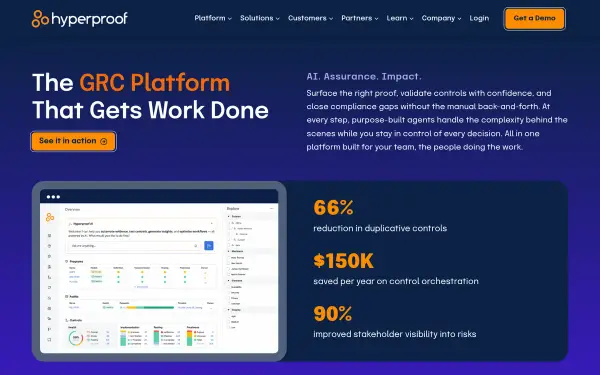
Hyperproof occupies the gap between certification automation and enterprise GRC, and does so more deliberately than most. Evidence is collected once and reused across frameworks, so a control that satisfies SOC 2 also feeds ISO 27001 and a customer security questionnaire without a rebuild. Compliance program management goes further than basic automation, with audit preparation workflows, risk tracking inside programs and reporting aimed at program owners.
For a mid-market company running several frameworks at once, that reuse is the whole business case. The efficiency shows up in the number of hours spent chasing screenshots and in the number of times the same question is answered by a different team. Multi-framework control mapping is the mechanism, and it is executed well enough that the efficiency gains are practical rather than theoretical.
Pricing is custom and available on request from the vendor. That fits Hyperproof's mid-market positioning. Audit preparation is included in the platform, the audit opinion is not: expect a separate fee from the CPA firm, as with every tool in this list.
The limits are brand and depth. Hyperproof has lower recognition than the leading automation platforms, which matters when a buyer wants the tool their auditor has seen a hundred times, and enterprise-scale depth is still developing. Companies with multi-entity structures, regulated subsidiaries and a global audit committee should test it hard before committing, then compare against a full suite. Companies that simply run several frameworks will find the price and the effort well matched.
You run several frameworks at once and want evidence reuse without an enterprise suite's price and timeline.
Your auditor needs the best-known platform, or if multi-entity and regulated subsidiary depth is the deciding factor.
VIBackground
GRC software is a system of record for the things a governance, risk and compliance function has to prove: which controls exist, who owns them, what evidence shows they operated, which risks are open, and which regulations apply. Teams buy it to stop rebuilding the same answers in spreadsheets every audit cycle and to give a board or a regulator one defensible version of the truth.
The category splits into three families, and buyers who do not know which one they are shopping in waste a lot of demo time.
Typical uses include mapping controls to frameworks, collecting evidence automatically, running a risk register and assessment cycle, tracking vendor risk, managing policies and attestations, logging issues and remediation, and reporting to leadership. Privacy and AI governance increasingly sit in the same purchase, which is why OneTrust leads with convergence.
The distinction that matters most is between certifying and governing. Compliance automation answers the question 'can we pass the audit' and does it in weeks. Enterprise GRC answers 'what is our exposure and can we prove we manage it' and takes quarters. A company that buys the second when it needs the first pays several times over for capability it will not open. A company that buys the first when it needs the second ends up with a certification and no risk program, then buys again.
This comparison sits in the software register. Further along the shore: baby tracking app and kennel software.
VIIPricing
Most GRC software is quoted, not listed. The quote moves with three variables: how many people need access, how many frameworks or modules you switch on, and how much implementation help you buy. Annual costs can differ widely between companies using the same product, which is why budgeting from an average is a reliable way to be surprised.
| Model | How it bills | Typical fit | Example from this list |
|---|---|---|---|
| Published subscription | Annual, per plan tier | First certification on a fixed budget | Secureframe, $7,500 per year on Fundamentals |
| Quoted compliance automation | Annual quote, scaled by seats and frameworks | SaaS teams with an audit deadline | Vanta and Drata, both custom quote |
| Application plus power user | Annual, per application and per builder | Departments with genuinely different workflows | LogicGate, See website |
| Enterprise platform modules | Annual, per module and user scale | Global regulated organizations | ServiceNow GRC, MetricStream and OneTrust, all See website |
| Mid-market program platform | Annual, custom quote | Several frameworks running at once | Hyperproof, See website |
Three costs sit outside every license on this list. The audit opinion comes from an outside CPA firm and is invoiced by that firm. Implementation support, whether a partner or the vendor's own services team, is usually a separate line. Internal staff time is a major and least visible cost: a first SOC 2 consumes engineering attention that shows up nowhere in the contract.
Enterprise suites also tend to bill in phases. A ServiceNow GRC or MetricStream deployment that starts with one module may add the next one later, so the year one number can understate the steady state. Ask for a three-year view and for the price of the modules you expect to add, not just the ones you are buying now.
The practical rule: get a scoped quote before you compare vendors, and compare the three-year total including the audit fee.
Each entry card shows the starting price as it appeared on the vendor's own pricing page on November 25, 2026. When a vendor shows no figure we could confirm, or only a promotional rate, the card says "See website" or gives the regular price instead of a guess. Usage, overage and add-on rates in the text change more often than plan prices, so confirm them on the vendor page before you set a budget. To test the numbers against your own volume, try the free User Research Budget Planner. The Event Break-Even Calculator is a second way to check the same decision.
VIIIDecision
IXPitfalls
XQuestions
GRC software is a system of record for controls, risks, regulatory obligations and the evidence that shows controls operated. Teams use it to map controls to frameworks such as SOC 2 and ISO 27001, collect evidence automatically, run risk registers and assessments, track vendor risk, manage policies and report to a board or regulator. The main use cases are certification, internal audit and enterprise risk management.
Annual costs usually depend on seats, frameworks or modules and implementation help. Secureframe publishes $7,500 per year on Fundamentals, while Vanta, Drata, LogicGate, Hyperproof, ServiceNow GRC, MetricStream and OneTrust quote privately. Check each vendor site for pricing.
A startup chasing SOC 2 should buy compliance automation, and Secureframe is the easiest starting point because it publishes a $7,500 per year Fundamentals figure. Vanta is the stronger pick when the team wants the widest integration library and an auditor network that already accepts platform evidence. Drata fits engineering-led teams running SOC 2 and ISO 27001 in parallel. None of the three includes the audit fee.
They differ mainly in coverage, audience and pricing transparency. Vanta stands out for integration breadth, auditor relationships and 35 or more frameworks. Drata stands out for monitoring experience and parallel framework programs for engineering-owned controls. Secureframe stands out for guided onboarding plus AI-assisted policy and evidence work for first-time teams, and it is the only one publishing a starting price. Hyperproof stands out for evidence reuse across several frameworks.
It means the vendor you evaluate and the vendor you contract with is Optro, the name adopted in early 2026. Older contracts, security questionnaires and budget documents may still say AuditBoard, so buyers should confirm which legal entity is signing and make sure procurement records move to the Optro name. The product scope and enterprise positioning carry over with the new name.
Timelines depend on the tool family and scope. A first SOC 2 with compliance automation is usually fastest, with the observation window set by the auditor. A configurable mid-market platform takes longer because processes have to be modeled first. An enterprise suite such as MetricStream or ServiceNow GRC is a multi-phase program, often with outside implementation support.
XIFurther along the shore
Vendors can ask for a correction or apply for a Featured listing. Paid or not, the entry is scored on the same rubric and its limits stay in print. Partner with Umberlake.
Free tools
Our free browser tools turn the prices on this page into a figure for your own volume. Nothing you type leaves your device.