
AirMason
$999Startup, per year, for 1 to 99 employees, $149 per month if billed monthly
Best for small US firms wanting polished signed handbooks
- Free plan
- No
- Rubric
- 6.9 of 10
Eight tools that hold your policies, collect signatures, and keep versions straight, matched to how much legal text and HR you need.

IThe short answer
AirMason is the best fit for small US firms that want a polished, signed handbook, at $999 per year covering 1 to 99 employees. Blissbook suits compliance-led HR teams needing branded handbooks and signature reporting, and Handbooks.io is the pick when you need state-specific policy wording, with a free preview builder and one-time packages from $179. Prices below were checked on November 25, 2026. Every tool here stores policy text, but they differ sharply on whether they write it for you, collect signatures, or sit inside a wider HR system: Best Employee Handbook Software.
8 tools compared from vendor pages on November 25, 2026. 7 publish a starting price we could read; the rest say "See website".
IITop three berths
Register order is editorial fit for the buyer each entry describes. Prices are the starting figures read on November 25, 2026.
$999Startup, per year, for 1 to 99 employees, $149 per month if billed monthly
Best for small US firms wanting polished signed handbooks

$249Blissbook plan, per month, paid annually, 301-400 employees tier, add-ons extra
Best for compliance-led HR teams needing branded signed handbooks

$10Core, per employee per month, volume and non-profit discounts available
Best for uS teams already using BambooHR for HR
How this page is paid for. All 8 tools here are unpaid editorial picks.
A paid listing's position can be part of what the vendor pays for. Every entry, paid or not, is scored on the same rubric and keeps its limits in print. Advertising disclosure.
IIIThe register
Starting prices as shown on each vendor's pricing page on November 25, 2026. "See website" means no figure we could confirm.
| No. | Tool | From | Free plan | Trial | Rubric | Actions |
|---|---|---|---|---|---|---|
| 01 | AirMasonSmall US firms wanting polished signed handbooks | $999Startup, per year, for 1 to 99 employees, $149 per month if billed monthlyRead on vendor page | No | Trial on request | 6.9 | |
| 02 | BlissbookCompliance-led HR teams needing branded signed handbooks | $249Blissbook plan, per month, paid annually, 301-400 employees tier, add-ons extraUpdated on vendor page | No | Free trial on request | 7.6 | |
| 03 | BambooHRUS teams already using BambooHR for HR | $10Core, per employee per month, volume and non-profit discounts availableRead on vendor page | No | Free trial | 6.0 | |
| 04 |  WaybookTeams of 10 to 200 needing policies and procedures | $139Core, per month for 10 seats, billed annually, plus $3 per additional memberUpdated on vendor page | No | 7-day free trial | 6.4 | |
| 05 |  Handbooks.ioUS businesses needing state-specific handbook text | FreeFree Preview handbook builder, no credit card required, Starter $179 one-time for up to 10 employees in 1 stateRead on vendor page | Yes | No | 7.3 | |
| 06 |  TrainualFirms bundling handbook with training and SOPs | See websiteCore, Pro, Premium and Enterprise plans shown without pricesNot shown publicly | No | Demo only | 5.8 | |
| 07 |  ConnecteamFrontline and shift teams needing mobile access | FreeSmall Business plan free for up to 10 users, hubs from $29 per month for first 30 users, billed yearlyRead on vendor page | Yes | 14-day free trial | 5.6 | |
| 08 |  ConfluenceAtlassian-standardized companies needing searchable handbook wiki | FreeFree forever for 10 users, Standard $5.78 per user per monthRead on vendor page | Yes | Free trial | 4.6 |
Pinned:
IVMethod
Does the tool draft, structure, and version policy text, or only host a file you made elsewhere?
How acknowledgment is captured, tied to a handbook version, chased, and reported.
Whether state and city policy wording is supplied and whether law changes get flagged.
Entry cost and how billing behaves as your headcount grows past the first band.
Whether the handbook sits usefully inside a broader HR, training, or communications stack.
VMethod
Every tool here was scored against the same five criteria, whatever its size or price. Handbook authoring (25 percent) asks whether the tool drafts, structures, and versions policy text or only hosts a file you made elsewhere. Signature proof (20 percent) covers how acknowledgment is captured, tied to a version, chased, and reported. Compliance content (20 percent) covers state and city wording and law change alerts. Price fit (20 percent) looks at the entry cost and how billing behaves as headcount grows. Wider HR fit (15 percent) asks whether the handbook sits usefully inside a broader HR, training, or communications stack.
Prices, plan names, seat limits, and trial terms come from each vendor's own pricing page, checked on November 25, 2026. Where a current page conflicts with an earlier note, we say so in the review and tell you to confirm at checkout. We did not convert currencies, estimate quotes, or fill gaps with averages.
The order is editorial. It reflects how well each tool serves the specific buyer named in its entry, not a weighted total, and it is not a ranking of overall quality. A cheap tool that solves one buyer's problem sits above a broad system that solves it badly.
One entry may be marked Featured, which is a paid placement. It is scored with the same rubric, keeps the same honest cons, and does not get a pass on price.
The full routine, from price reads to corrections, is on the methodology page. Paid listings follow the advertising disclosure.
Entry I of VIII / Versioned signatures
Our verdict
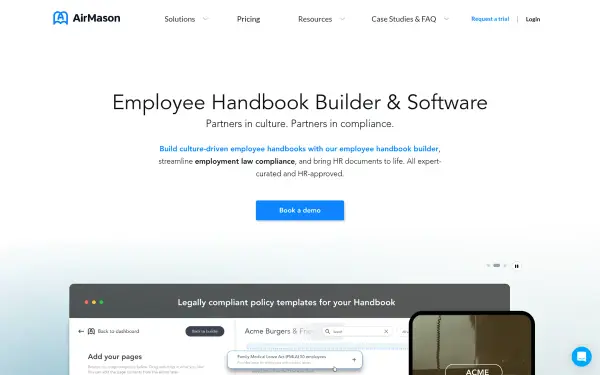
A focused handbook tool that writes, versions, and collects signatures on your policy document, with no wider HR attached.
AirMason does one job end to end: it builds a digital handbook, collects signatures against a specific version, and keeps a version history you can point to later. Automatic versioning matters more than it sounds, because a signature only has value if you can show which text the employee agreed to. Signature reminders chase the people who ignore the first email, which is where most handbook rollouts stall.
The Startup tier is $999 per year for 1 to 99 employees. On monthly billing the same plan is $149 per month, which costs more over a year, so annual billing is the sensible default if you are staying put. That flat band is unusual in this category and it is the reason the tool lands first here: a 90 person company pays the same as a 10 person company.
The creative and copywriting services are optional extras. If you have no HR generalist, paying someone to turn your draft into a presentable handbook is a real shortcut. If you have a legal team with its own approved wording, you will use the builder and ignore the services entirely.
The limits are clear. There is no payroll, no time tracking, no training module, and no AI question answering shown for employees who want to know how much leave they have left. It is not an HR system and should not be bought as one.
Pick AirMason if the handbook is the deliverable and you want signatures tied to versions at a predictable annual price. Skip it if you need onboarding, training, or a policy library with law change alerts.
The handbook itself is the project and you need signed proof against each version.
You need onboarding, training, or automatic policy updates when laws change.
Entry II of VIII / Audit-ready reporting
Our verdict
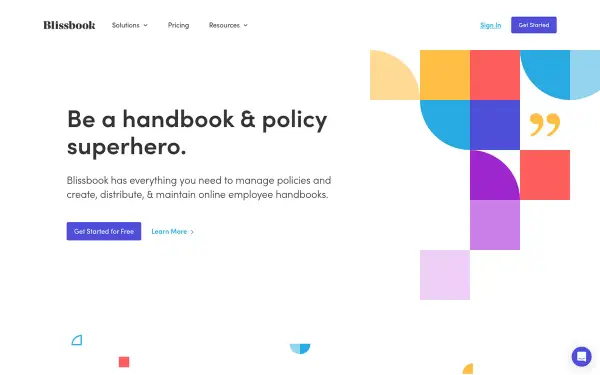
Best for HR teams that must prove every employee signed the current policy, with law change alerts and clean signature reporting.
Blissbook is built for the moment an auditor, a lawyer, or a new operations lead asks who signed which policy and when. Handbooks are branded, published digitally, and tracked with signature due dates, manager escalation, and signature reporting you can hand over without cleanup. That combination is why it sits second: narrower than AirMason on presentation, stronger on proof.
The compliance side carries real weight. Law change alerts cover federal, state, county, and city changes. HRIS integrations push employee data in, so new hires are added without a spreadsheet, and policy management keeps the library organized.
Pricing scales with headcount rather than sitting flat. The listed plan is $249 per month paid annually for the 301 to 400 employee tier, and add-ons cost extra. A Pro tier sits above that at higher prices. A 350 person employer should confirm the renewal price before signing, because the entry price in a demo is not the price at scale.
The scope is deliberately narrow. Handbooks and policies only, no payroll, no training, and no AI answers for employees hunting a policy detail on their own.
Pick Blissbook if audits and signature evidence are the reason you are buying. Skip it if you want one system for handbook, training, and time off.
You must show a clean signature trail when a regulator or lawyer asks.
You need payroll, training, or a broader HR record system.
Entry III of VIII / Handbook inside HR
Our verdict
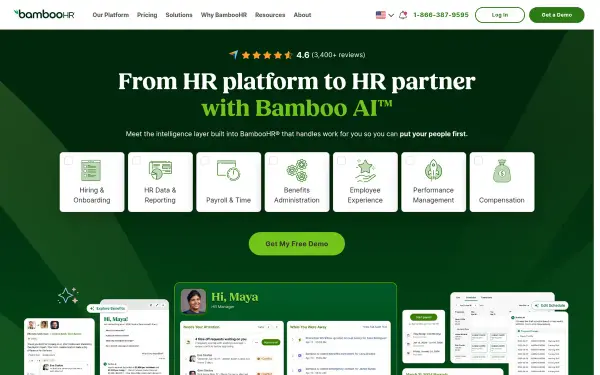
Worth it only if you already run HR in BambooHR, where handbook acknowledgments sit next to records, onboarding, and time off.
BambooHR is an HR system first. The handbook piece is a file you upload and route for acknowledgment inside the same place employees already check time off and update their details. That is the whole argument: acknowledgments arrive next to employee records, onboarding tasks, and time off, so nobody has to reconcile a separate signature tool against a separate HR database.
Core is $10 per employee per month, Pro $17, and Elite $25, with a $250 monthly minimum on Core. That minimum bites small teams, because a 12 person company still pays $250 per month. AI answers appear on Pro and above, which is worth noting if employees pester HR with policy questions that a search box could handle.
What you do not get is authorship. BambooHR hosts a file; it does not draft policy text, structure clause libraries, or flag that your state changed its leave rules. You write the handbook, you keep it current, and you re-upload when it changes. Signature reminders help, but version discipline stays with you.
The trade is simple arithmetic. If you are already paying for BambooHR, adding handbook acknowledgment costs almost nothing and saves a vendor review. If you are not, you are buying an HR suite to solve a document problem, and a dedicated handbook tool will cost less and do more on signatures.
Pick BambooHR if it already runs your HR records and you want signatures without a new system. Skip it if the handbook itself is the project and you need content help or state-specific text.
BambooHR already holds your employee records and you want signatures there too.
You are not using BambooHR and only need a signed policy document.
Entry IV of VIII / Policies plus procedures
Our verdict
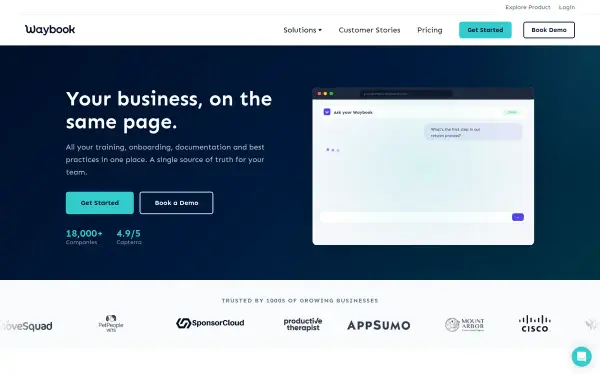
A maintained library for policies, procedures, and role paths, with read confirmation that records a name and a date.
Waybook treats the handbook as one document type among several: policies, procedures, and role manuals live in the same library, share version history, and each carry a named document owner. Read confirmation records the person and the date, which is lighter than a formal e-signature but enough for most internal expectations.
That mix is why it suits teams of 10 to 200. A 40 person company usually needs a handbook, an onboarding path, and a handful of procedure documents, and buying three separate tools for that is overkill. Role paths push the right content to new hires by job, so a warehouse lead and a bookkeeper see different material on day one, and version history keeps the current procedure visible instead of buried in a folder.
Pricing is member-based: $139 per month for 10 seats billed annually, plus $3 per additional member. Confirm the seat block and the per-member rate at checkout before you budget. The 7-day trial is short for a full rollout, so plan to test only the core flow before it lapses.
The honest limit is legal text. Waybook does not write state-specific clauses, so your counsel or a template library supplies the wording, and there is no law change alerting. It also sits outside payroll, scheduling, and time tracking, so it is a document home rather than an HR home.
Pick Waybook if you want policies and procedures in one maintained library with clear read confirmation. Skip it if you need authored legal content or a long evaluation window.
You need a handbook plus procedures that somebody actually owns and updates.
You need authored state law text or a long trial before rolling out.
Entry V of VIII / State-specific wording
Our verdict
The shortest path from blank page to defensible state-specific policy text, with a free preview before you pay.
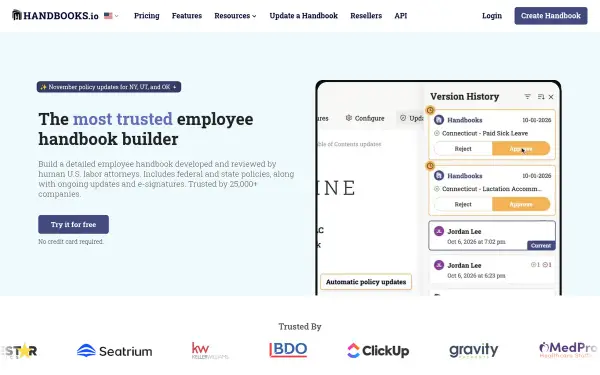
Handbooks.io is the content play. It generates handbook text with state and city policies built in, which is the part most tools leave to you and your lawyer. If your problem is that you have no idea what your state leave language should say, this is the shortest path from blank page to a document your counsel can review in an afternoon rather than draft over a month.
There is a free preview builder with no credit card required, so you can see the actual output before paying anything. Paid packages are one-time: Starter is $179 for up to 10 employees in one state, and Growth is $369 for up to 50 employees in five states. A one-time price suits a company that needs a handbook once and does not want another subscription, though you will pay again when the law moves. An optional yearly subscription adds updates and e-signatures.
E-signatures being optional rather than included is the main gap. If you need a signature trail for every hire, budget for the subscription or run acknowledgment in another tool, which means two systems to maintain.
The other limit is scope. This is not a procedures library, a training tool, or an HR system, and it will not help with onboarding checklists. Employee counts and state counts also cap each tier, so a 60 person employer spread across eight states needs a pricing conversation rather than a checkout.
Pick Handbooks.io if state-specific wording is the blocker and you want a one-time purchase. Skip it if you need signed acknowledgments in the base price or ongoing procedure management.
You need defensible state-specific wording and prefer to pay once.
Signatures and ongoing policy updates must be in the base price.
Entry VI of VIII / Training bundled in
Our verdict
A training system that happens to include a handbook builder, strongest when you will build SOPs and onboarding anyway.
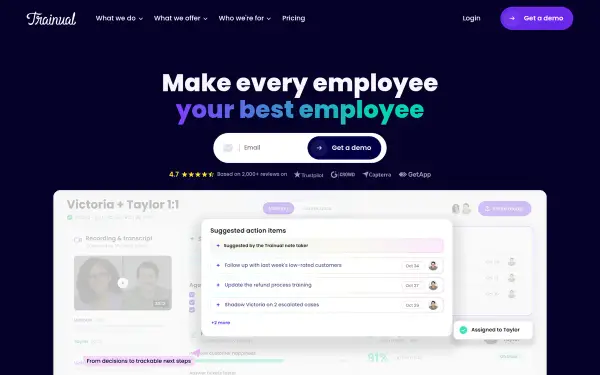
Trainual bundles a handbook builder with training content: videos, quizzes, screen recordings, role-based content, completion tracking, and automated reminders, plus a library of 700 or more templates and space for standard operating procedures. If your onboarding currently lives in a shared drive and a spreadsheet, this replaces both with one searchable system.
The handbook is one section of a training system rather than the center of it. That is fine if you were going to buy training anyway, and heavy if you were not. Setup takes real effort: someone has to decide the role structure, record or write the content, and keep it current as jobs change. Role-based content means a new shift lead and a new bookkeeper see different material, which is genuinely useful.
Pricing is on the vendor site. The plan comparison shows Core, Pro, Premium, and Enterprise without prices displayed, so ask for a quote against your seat count and compare it with the annual handbook options here.
There are no automated law-change alerts, so policy wording stays your responsibility.
Pick Trainual if the handbook is part of a training and SOP program you will actually build and maintain. Skip it if you want a signed policy document and nothing else.
You are building onboarding and SOPs alongside the handbook.
You need a signed policy document with no training attached.
Entry VII of VIII / Mobile frontline access
Our verdict
A mobile app for deskless crews where policies, training, scheduling, and push notifications reach people who never open a laptop.
Connecteam is a deskless employee app, and the handbook is one document type inside a hub that also covers scheduling, chat, tasks, courses, and push notifications. For frontline and shift teams that is the point: a warehouse worker who never opens a laptop still gets the policy update on a phone, with a notification they cannot miss in a shift handover.
The free Small Business plan covers up to 10 users across all hubs, which makes a trial genuinely free rather than a 14-day countdown. Paid hubs start at $29 per month for the first 30 users on yearly billing. For a 30 person restaurant group, that is a low entry price for documents, courses, and scheduling in one app, and there is a 14-day free trial if you want to test before committing.
The trade is depth. Handbook design is basic next to dedicated tools, there is no AI-powered compliance updating, and the document module does not do the legal drafting that Handbooks.io does. The document module is one part of a broader app, and design customization is limited next to dedicated handbook tools.
It is also a communications tool at heart. Expect to spend setup time on hubs, user groups, and notification habits, because a handbook nobody opens is the failure mode here just as it is anywhere else.
Pick Connecteam if most of your staff are on their feet and you want policies, training, and scheduling in one mobile app. Skip it if the handbook must look polished or withstand a formal audit.
Your team works shifts and reads company documents on a phone.
You need polished handbook design or strong signature reporting.
Entry VIII of VIII / Searchable policy wiki
Our verdict
A cheap, searchable policy wiki for Atlassian shops, provided you accept that nobody signs anything inside it.
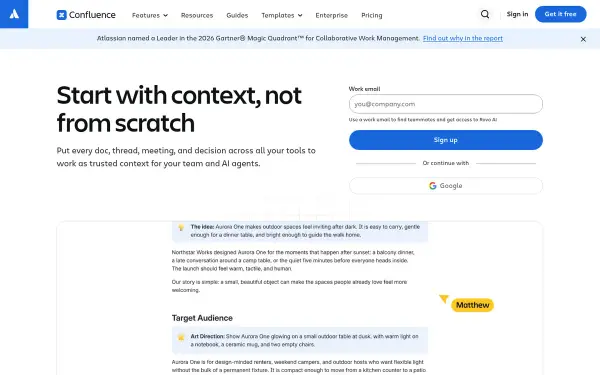
Confluence is a wiki, and a handbook is a natural wiki page tree. You get searchable pages, page permissions, templates, page hierarchy, and integration with the rest of the Atlassian suite. It scales to large readerships, which matters for a 2,000 person company that wants everyone to find the leave policy in three clicks without mailing a PDF around.
Price is the draw. Free forever for up to 10 users, and Standard at $5.78 per user per month, with a free trial available. For a company already standardized on Atlassian, the handbook costs almost nothing extra and needs no new vendor review, which is a real advantage in a busy quarter.
Two gaps are serious. There are no e-signatures, so proof of acknowledgment has to be collected somewhere else, typically a form or a separate HR tool, and the two records will drift apart. Ownership is also unclear by default: wikis rot because nobody is assigned to update them, and Confluence provides no workflow that fixes it. AI answers need demo pricing, so do not assume they are included.
Navigation depends on discipline. A well-tended page tree is excellent; an untended one buries the current policy under three drafts with slightly different titles, and employees learn to stop looking.
Pick Confluence if you already run Atlassian and need a searchable, permissioned policy library that most of the company can read. Skip it if you must prove individual acknowledgment or want drafting help.
You want a searchable policy wiki inside the Atlassian tools you already pay for.
You need versioned signatures or help writing policy text.
VIBackground
Employee handbook software keeps one authoritative policy document, gets it in front of every employee, and produces a record that they read it. That is the core job. Everything else is a variation on how much of the work the tool does for you.
Four jobs show up repeatedly:
The tools in this list sit at different points on that spread. Handbooks.io and AirMason lean toward writing and publishing. Blissbook leans toward acknowledgment and compliance reporting. BambooHR, Connecteam, and Confluence treat the handbook as one document type inside a wider system, so acknowledgments end up next to employee records, shift schedules, or wiki pages.
The distinction that matters most at purchase is authored content versus hosted content. If a tool supplies state-specific wording, you are buying a content library with software attached, and you need to check which states and cities are covered and how often the text is refreshed. If a tool hosts an uploaded file, you are buying distribution and tracking, and your own counsel supplies the words.
A second distinction is signature versus read receipt. A signature is a formal acknowledgment attached to a specific version, which matters when you must show an employee agreed to the policy in force on a given date. A read confirmation is lighter: it records a name and a date. Both are useful, but only one holds up in a serious dispute.
Finally, consider who edits the handbook after launch. Tools with document owners, version history, and role-based paths keep that job small. Tools without them quietly decay into a stale PDF that nobody trusts.
Your frontline staff will read the handbook on a phone. Check the mobile view before you buy.
This comparison sits in the software register. Further along the shore: baby tracking app and kennel software.
VIIPricing
Five billing models show up in this category, and the model matters more than the headline number, because it decides what you pay at 200 employees.
| Model | How it bills | Typical fit | Example from this list |
|---|---|---|---|
| Per employee, per month | A monthly charge that rises with every hire | Teams wanting handbooks inside a wider HR system | BambooHR at $10 per employee per month on Core, with a $250 monthly minimum |
| Annual flat fee by headcount band | One yearly price covering a size range | Small firms wanting a fixed number | AirMason at $999 per year for 1 to 99 employees |
| Monthly seat block | A monthly fee for a set number of seats, billed annually | Teams of 10 to 200 | Waybook at $139 per month for 10 seats plus $3 per additional member |
| One-time purchase | Paid once, with an optional yearly updates plan | Businesses needing state-specific text once | Handbooks.io Starter at $179 one-time for up to 10 employees in one state |
| Free tier then paid upgrade | A user cap, then a per user rate | Small teams testing adoption | Confluence free for 10 users, Standard at $5.78 per user per month |
Flat annual bands are the friendliest for a stable small employer: at 90 employees, AirMason costs the same as it does at 10. Per employee pricing is the least predictable, which is why BambooHR's $250 monthly minimum matters more to a 15 person firm than its $10 rate. Seat blocks sit in between and reward you for knowing your headcount before you sign.
Watch for three extras. Monthly billing usually costs more than annual, as with AirMason at $149 per month against $999 per year. Higher tiers often appear without a listed price, as with the Trainual plan comparison. And trials are short: Waybook gives 7 days, so scope your test before you start it.
Each entry card shows the starting price as it appeared on the vendor's own pricing page on November 25, 2026. When a vendor shows no figure we could confirm, or only a promotional rate, the card says "See website" or gives the regular price instead of a guess. Usage, overage and add-on rates in the text change more often than plan prices, so confirm them on the vendor page before you set a budget. To test the numbers against your own volume, try the free User Research Budget Planner. The Event Break-Even Calculator is a second way to check the same decision.
VIIIDecision
IXPitfalls
XQuestions
AirMason is the strongest single purpose pick for a small US firm, at $999 per year for 1 to 99 employees, with signatures tied to handbook versions. Blissbook is better when you must produce audit-grade signature reporting, and Handbooks.io is better when state-specific wording is the blocker. None of the three is an HR system, so pair them with payroll if you need records.
Signatures matter when you may have to prove which policy text a specific employee accepted on a specific date, which comes up in disputes over leave, conduct, or remote work rules. A read receipt records a name and a date but is not tied to a version. Blissbook provides signature reporting and AirMason ties signatures to handbook versions; Confluence collects no acknowledgment at all.
Yes, two do. Handbooks.io generates handbook text with state and city policies built in and sells one-time packages starting at $179 for up to 10 employees in one state. Blissbook adds law change alerts across federal, state, county, and city changes. Everything else here hosts or structures text you write, so your counsel supplies the legal wording.
Entry costs range from free to about $1,000 a year. Confluence and Connecteam are free for up to 10 users, Handbooks.io has a free preview with one-time packages from $179, AirMason charges $999 per year for 1 to 99 employees, and Blissbook is $249 per month paid annually for the 301 to 400 employee tier. Per employee pricing, as with BambooHR at $10, adds up quickly.
Review annually at minimum, and after any material law change in a state where you employ people. Blissbook is the tool here that alerts on federal, state, county, and city changes. Handbooks.io sells an optional yearly updates subscription. Every other tool leaves monitoring to you, so set a calendar reminder and assign a named owner for the document.
Yes, if you choose a mobile-first tool. Connecteam is free for up to 10 users and puts documents, courses, scheduling, and push notifications in one app built for deskless staff, with paid hubs from $29 per month for the first 30 users on yearly billing. Most other tools here assume a desktop or an email address for signature reminders.
XIFurther along the shore
Vendors can ask for a correction or apply for a Featured listing. Paid or not, the entry is scored on the same rubric and its limits stay in print. Partner with Umberlake.
Free tools
Our free browser tools turn the prices on this page into a figure for your own volume. Nothing you type leaves your device.