
Jackrabbit Dance
$49Tiered pricing based on student count at month end, per month
Best for dance studios of any size wanting dance-specific management tools
- Free plan
- No
- Rubric
- 8.5 of 10
Eight dance studio management platforms compared on dance-specific depth, pricing model, transparency and total cost, with entry prices from $25 to $79 a month checked in November 2026.

IThe short answer
Jackrabbit Dance is the best overall pick for November 2026: it is built around dance workflows, including recital planning and costume sizing, and starts at $49 per month on student-count tiers. Mindbody suits established and multi-location studios that want scheduling, payments and marketing in one system, from $79 per location per month. DanceStudio-Pro fits growing studios that want flat-rate pricing instead of per-student step-ups, though its pricing is not published and needs vendor confirmation: Best Dance Studio Management Software.
8 tools compared from vendor pages on November 25, 2026. 6 publish a starting price we could read; the rest say "See website".
IITop three berths
Register order is editorial fit for the buyer each entry describes. Prices are the starting figures read on November 25, 2026.
$49Tiered pricing based on student count at month end, per month
Best for dance studios of any size wanting dance-specific management tools

$79Starter, per location per month
Best for established and multi-location dance, fitness and wellness studios

See website
Best for growing studios wanting flat-rate pricing regardless of enrollment
How this page is paid for. All 8 tools here are unpaid editorial picks.
A paid listing's position can be part of what the vendor pays for. Every entry, paid or not, is scored on the same rubric and keeps its limits in print. Advertising disclosure.
IIIThe register
Starting prices as shown on each vendor's pricing page on November 25, 2026. "See website" means no figure we could confirm.
| No. | Tool | From | Free plan | Trial | Rubric | Actions |
|---|---|---|---|---|---|---|
| 01 | Jackrabbit DanceDance studios of any size wanting dance-specific management tools | $49Tiered pricing based on student count at month end, per monthRead on vendor page | No | Unclear, sources conflict; confirm with vendor | 8.5 | |
| 02 | MindbodyEstablished and multi-location dance, fitness and wellness studios | $79Starter, per location per monthRead on vendor page | No | No | 6.0 | |
| 03 | DanceStudio-ProGrowing studios wanting flat-rate pricing regardless of enrollment | See websiteNot shown publicly | No | Free trial reported | 7.2 | |
| 04 | StudioGrowthSmall to mid-size studios wanting modern tooling and hands-on support | See websiteNot shown publicly | No | Unclear, sources conflict; confirm with vendor | 5.8 | |
| 05 |  PembeeSmall to mid-size studios that dislike per-student pricing | $45Standard, per month, up to 5 admin users, 0.59% Stripe application feeRead on vendor page | No | Free 30-day trial, no credit card required | 7.9 | |
| 06 |  WellnessLivingStudios wanting scheduling, payments, marketing automation and rewards in one place | $69Starter, per month, one staff memberUpdated on vendor page | No | Free trial reported | 5.9 | |
| 07 |  StudioBookingsBudget-conscious small studios prioritizing function over polish | $251 instructor, per month, all features includedUpdated on vendor page | No | 14-day free trial, no payment required | 6.8 | |
| 08 |  UplifterMulti-discipline clubs and studios running varied programs | $29Uplifter Club, per month, prices shown in USDUpdated on vendor page | No | Trial terms vary by plan; confirm with vendor | 6.4 |
Pinned:
IVMethod
How much recital planning, costume sizing and term enrollment the tool handles natively.
How the billing model behaves as enrollment grows and whether entry tiers stay affordable.
Whether online registration, tuition billing and payment collection are included rather than bolted on.
Whether plans, fees and processing costs are published and easy to compare before a sales call.
How much guided setup, migration help and responsive support the vendor provides.
VMethod
We scored eight tools on five criteria. Dance-specific depth (25 percent) asks how much recital planning, costume sizing and term enrollment a platform handles natively rather than through workarounds. Pricing fit (25 percent) asks how the billing model behaves as enrollment grows, since a plan that is cheap at 80 dancers can be the most expensive one at 300. Registration and payments (20 percent) covers whether online registration, tuition billing and payment collection are included rather than bolted on. Cost transparency (15 percent) rewards vendors that publish plans, fees and processing costs before a sales call. Support and onboarding (15 percent) looks at guided setup, migration help and how quickly a studio gets live.
Prices and plan details come from vendor pricing pages checked on 25 November 2026, and only figures we could see are quoted. Where a vendor page returned no content or listed no number, we say so and do not guess. That is why DanceStudio-Pro and StudioGrowth show pricing on the vendor site rather than a figure here. Re-verify anything you plan to sign, because promotions and tiers change.
The Featured listing is a paid placement. It is scored with the same rubric as every other tool and carries the same kind of honest cons. Placement affects where an entry sits in the list; it does not change the criteria, the scoring or the weaknesses we describe.
The order is editorial. Each entry is written for the buyer it describes, so a tool lower on the page can be the better purchase for a specific studio. Read the pick and skip lines under each entry before you build a shortlist.
The full routine, from price reads to corrections, is on the methodology page. Paid listings follow the advertising disclosure.
Entry I of VIII / Recital and costume tools
Our verdict
The safest dance-first choice for most studios, with recital and costume tools the fitness platforms do not match.
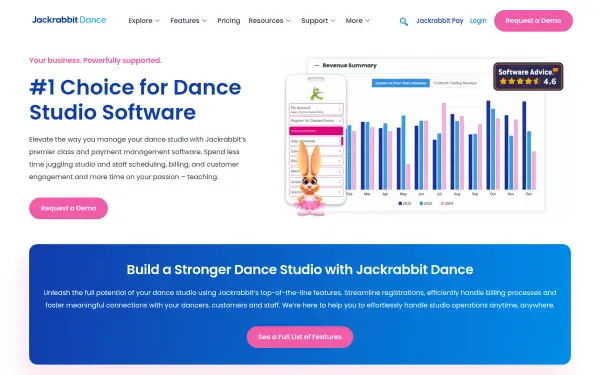
Jackrabbit Dance is the tool most dance studios end up comparing everything else against. Class and schedule management, online student registration, tuition billing and attendance tracking are native, so the front desk is not stitching a booking app to a spreadsheet. The parts that matter most to dance are also the parts general fitness platforms skip: recital planning, costume management and costume sizing sit in the same system as the enrollment data.
Pricing is tiered by student count at month end, starting at $49 per month and running to $245 per month at 3,000 or more students. That model keeps a small studio cheap and makes a large studio predictable, but every enrollment milestone is also a billing milestone. Model the tiers against projected headcount for the next two years rather than this term's roster, because the step-ups are the whole pricing story. The vendor publishes the tiers, which several competitors do not, and states a 90-day money-back guarantee on the pricing page.
Onboarding is guided, with a product coach, which matters if you are moving years of family accounts and payment history. The product is operated by Jackrabbit Technologies, and the published tiers run from the $49 entry point to $245 per month, so the same system covers a single-room school and a large academy.
The gaps are practical rather than functional. Trial availability is not consistently documented, so ask directly before you plan a test window. The student-count model rewards growth and charges for it at the same time, which is the trade you accept. Pick it if you want one system that speaks dance without translation.
You run a dance studio and want recital, costume and tuition workflows in one system.
You want a single flat fee that does not move when enrollment grows.
Entry II of VIII / Marketplace discovery
Our verdict
Built for scale and discovery, priced per location with a 12-month contract and marketplace commission on new students.
Mindbody is the platform a studio graduates to when it opens a second location or starts thinking about demand generation rather than just administration. Class and appointment scheduling, integrated payment processing, marketing automation and reporting sit in one account, and staff user seats are unlimited, so adding a front desk person does not add a line item. The consumer marketplace app is the differentiator: it puts your schedule in front of people already browsing for classes nearby.
The cost structure is where you need to read carefully. Starter is $79 per location per month, and upper plans are quote-only. Contracts run 12 months. Card processing rates are not published, and a commission of roughly 20 percent applies to new clients' first purchases, capped near $30. None of those numbers appear on a plan comparison the way a subscription does, so build them into the quote comparison rather than treating the $79 as the real price.
For dance specifically, the platform is fitness and wellness first. Recital planning and costume management are not part of the pitch, and studios with heavy recital operations usually keep a separate process for costume lists and rehearsal schedules. What you get instead is multi-location management, client management and marketing automation that single-studio tools rarely match.
Pick it if your problem is filling classes and running several rooms or sites under one brand. Skip it if you are a single studio whose year revolves around a recital.
You run multiple locations and want scheduling, payments and marketing in one system.
You are a single studio that needs recital planning and costume management built in.
Entry III of VIII / Flat-rate billing
Our verdict
The flat-rate option for growing studios, held back by pricing that is not published anywhere official.
DanceStudio-Pro sells itself against the per-student model, and for a studio adding dancers every term that pitch lands. Online registration, tuition and fee management, payment collection, a parent portal and recital planning are listed as core, and the flat plan covers unlimited students and classes. If you have ever watched your software bill climb in the same month your enrollment did, the appeal is obvious.
The problem is verification. The vendor page returned no content when checked on 25 November 2026, so no starting figure is quoted here. Pricing is on the vendor site, so confirm the current rate directly with the vendor rather than budgeting against a directory figure. A free trial is reported, which is the cleanest way to check whether the flat plan really covers your class structure.
DanceStudio-Pro is a smaller vendor with a shorter track record than Jackrabbit Dance or Mindbody. That is not automatically disqualifying, but it changes the questions you ask: how long the company has operated, what happens to your data if you leave, and how quickly support answers during recital season.
Pick it if flat-rate billing is the deciding factor and you are willing to verify the contract terms directly. Skip it if you need published pricing and a long customer history before you sign.
You want a flat monthly rate that does not move when enrollment grows.
You will not sign without published prices and a long track record to check.
Entry IV of VIII / Modern interface
Our verdict
A modern interface and hands-on migration support, but pricing and trial terms are inconsistent across sources.
StudioGrowth competes on feel as much as features. The interface is contemporary compared with platforms that have been around for a decade, and class scheduling, enrollment management and payment processing through Stripe cover the daily loop. Email marketing runs through a Mailchimp integration and ClassPass integration is reported, which matters to studios that fill empty slots through class aggregators. Guided data migration is part of the offer, and customer service during that migration is reported as strong.
Pricing is the weak spot. The vendor page returned no content when checked on 25 November 2026, so pricing is on the vendor site and needs direct confirmation before you budget. Trial terms are also unclear across sources, so ask what the trial includes and whether migration help is bundled or billed separately. Some rough edges have been reported on a platform this new, which is worth testing hard during a trial.
The fit is a small to mid-size studio that wants modern tooling and a real person helping with the switch, and that values a clean interface over dance-specific depth. Recital planning and costume management are not part of the feature list here, so a studio with a heavy performance calendar should plan a separate workflow for costume lists and rehearsals.
Pick it if a modern interface and guided migration outweigh having a longer vendor history. Skip it if you need published prices and dance-specific recital tools before you commit.
You want a modern interface and hands-on help moving your data.
You need published pricing or built-in recital planning before you commit.
Entry V of VIII / Family accounts
Our verdict
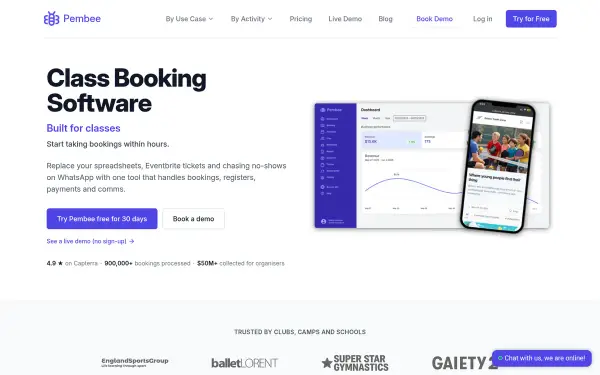
Flat $45 pricing with family accounts, term enrollment and costume sizing, plus a no-card 30-day trial.
Pembee is aimed squarely at studios that resent paying more as they grow. Standard is $45 per month with up to five admin users and no per-student fee, Premium is $105 per month, and both bill monthly with no contract. There is a 30-day trial with no credit card required, which is the shortest path to checking whether the flat model fits your class structure. Setup is self-serve.
The dance details are in the right places. Family accounts handle parents with several dancers, enrollment is term-based rather than rolling, and class registers, attendance and costume sizing are included. Unlimited locations are part of the flat billing, so a studio running two spaces does not get a second invoice. That combination is closer to how a dance school actually operates than most general-purpose booking tools.
There are real limits. There is no native mobile app, only a mobile-optimized web interface, which you should test on the phones your parents actually use. Waitlists, marketing tools and unlimited admin seats sit on the Premium tier, so $45 is only the comparison point if you can live with five admins. Payment processing adds 0.59 percent on top of Stripe fees, a small but permanent cost.
Pick it if you want flat billing, a no-card trial and family-first enrollment without a sales call. Skip it if you need a native app or expect marketing automation at the entry price.
You want flat billing, family accounts and a no-card trial you can start today.
You need a native app or want waitlists and marketing tools at entry price.
Entry VI of VIII / Retention automation

Our verdict
Marketing automation and rewards are genuinely strong, but recital and costume support is thin for dance studios.
WellnessLiving bundles more marketing machinery than most studio tools at this price. Class scheduling and booking, payment processing, marketing automation, a client rewards program, review generation and retention workflows all sit in one platform. For a studio whose growth problem is keeping students past the first term, the rewards and follow-up tools are the reason to look, and the review-generation features do work that studios usually handle by emailing parents one at a time.
Pricing needs care. Starter is listed at $69 per month for one staff member, and a Business plan appears on the vendor comparison sheet, but figures conflict across sources and third-party listings show different tiers. A temporary 80 percent discount on higher tiers was showing at the time of checking, which makes any quoted number a moving target. Ask for the price that applies after the promotion ends.
The dance gap is the deciding issue for many studios. This is a fitness and wellness platform first, with thinner recital and costume support than Jackrabbit Dance or Pembee. Term enrollment and costume sizing are the things to confirm in a trial rather than assume, and a studio that runs a full recital season should plan on handling part of that outside the platform.
Pick it if retention, reviews and automated follow-up are your priority and your recital needs are simple. Skip it if costume sizing and recital planning are central to how your studio runs.
Retention and review generation matter more than recital tooling.
Costume sizing and recital planning are central to your term.
Entry VII of VIII / No feature gating

Our verdict
The lowest entry price on this list, with every feature on every plan and a plainer interface.
StudioBookings wins on price and simplicity. A single instructor is $25 per month, and every feature is included on every plan, so there is no tier where scheduling works but payment collection does not. Class scheduling, online booking for parents, payment collection, Stripe integration and Google Calendar integration are all in, and setup is self-serve. Rates for larger instructor counts are on the vendor site.
The trade-off is polish. The interface is considered less polished than competing tools, which mostly shows up in the parent-facing booking flow: fewer shortcuts, more clicks, less forgiving on a phone. That flow is what parents use every week, so test it during the 14-day trial rather than judging the admin side alone. The trial requires no payment.
One caveat on the numbers. Pricing comes from third-party listings in some sources, while the vendor page showing $25 per month for a single instructor was checked on 25 November 2026. Confirm the rate for your instructor count before you budget, because the per-instructor model scales in a different direction than per-student pricing: a small faculty stays cheap, and a large one keeps climbing.
Pick it if you are a small studio that wants function over finish and a low fixed cost per instructor. Skip it if a polished parent-facing booking experience is a priority.
You are a small studio that wants every feature at the lowest entry price.
A polished parent-facing booking flow is what you are buying.
Entry VIII of VIII / Multi-discipline support

Our verdict
A multi-discipline fit for clubs running dance alongside other programs, with a reported free Lite plan.
Uplifter is built for organizations that run several programs under one roof: gymnastics, skating, dance, martial arts. Registration management, payment processing, class and program scheduling and participant tracking all work across disciplines in one account, which is the point. A dance school that also runs acro, conditioning or a competition team gets one roster instead of two systems that disagree about who is enrolled.
The entry point is $29 per month on the Uplifter Club plan, with prices shown in USD. A free Lite plan at $0 has been reported but does not appear on the page checked on 25 November 2026, so confirm before you plan around it. Paid tier figures come from third-party listings, and trial terms vary by plan, so the tiers that accommodate growing organizations need a direct conversation rather than a price page read.
The caveat is dance depth. Club-first design means recital planning and costume management need checking rather than assuming. The largest footprint is among Canadian and US sports clubs, which tells you the product's center of gravity even if dance studios do use it successfully.
Pick it if you run dance alongside other disciplines and want one registration and payment system. Skip it if your studio is dance only and recital season drives your software needs.
You run dance alongside other programs and want one registration system.
You are dance-only and need recital and costume tools out of the box.
VIBackground
Dance studio management software is the system a studio uses to run enrollment, tuition and the daily class schedule in one place. It replaces the mix of spreadsheets, paper sign-in sheets and a payment app that most small studios start with. The core modules repeat across vendors: online registration, class and schedule management, tuition billing and payment collection, attendance tracking, and a parent portal where families can see what they owe and what their dancer is enrolled in.
What separates a dance product from a general fitness or wellness platform is the shape of the year. Dance studios enroll by term or season, bill families rather than individuals, and build toward a recital. That creates requirements gym software rarely handles:
General fitness platforms compete on scheduling, payments and marketing automation. They tend to be stronger at filling empty slots and weaker at costume lists, which is why some studios run both and some accept the gap. Where a platform sits on that spectrum should drive your shortlist more than a feature count does.
The other half of the decision is commercial. Most tools here charge either a flat monthly fee or a tier based on student count at month end, and those two models diverge fast as a studio grows. A per-student tier that looks cheap at 80 dancers can cost more than a flat plan by 250. Payment processing sits outside the subscription in nearly every case, sometimes with a platform fee stacked on the processor's rate. Budget subscription, processing and any commission together, because the subscription is often the smallest of the three.
This comparison sits in the software register. Further along the shore: baby tracking app and kennel software.
VIIPricing
Entry prices in this category run from $25 to $79 a month, and the number on the pricing page is rarely the number on the invoice. Three things sit outside it: the billing model that decides how the price moves, the payment processing rate, and any marketplace or platform commission.
| Model | How it bills | Typical fit | Example from this list |
|---|---|---|---|
| Per-student tiers | Monthly fee set by student count at month end | Studios expecting steady growth that want cost to track enrollment | Jackrabbit Dance, from $49 rising to $245 per month at 3,000+ students |
| Per-location | Monthly fee per site, often with a contract term | Multi-site operators | Mindbody Starter at $79 per location per month |
| Flat monthly | One fee regardless of student count | Studios that grow enrollment without wanting a bigger bill | Pembee Standard at $45 per month |
| Per-instructor | Fee scales with teaching staff | Small studios with one or two teachers | StudioBookings at $25 per month for one instructor |
| Quote-only | Custom pricing after a sales conversation | Larger or multi-discipline organizations | Mindbody upper plans |
The billing model matters most. A per-student tier keeps a small studio cheap and charges more as it succeeds. A flat plan costs more on day one and less at scale. Neither is wrong; they pay off at different enrollment levels. Model both against headcount two years out, not this term's roster.
Processing is the second cost. Card fees are usually set by the processor, but some platforms add their own slice. Pembee adds 0.59 percent on top of Stripe. Mindbody does not publish processing rates and applies a commission of roughly 20 percent, capped near $30, on new clients' first purchases. No subscription comparison shows those.
The third is contract shape. Mindbody runs 12-month terms; Pembee bills monthly with no contract. Ask what a mid-term exit costs, and ask whether a trial lets you import real data. Prices here were checked on 25 November 2026, so re-verify before you sign.
Each entry card shows the starting price as it appeared on the vendor's own pricing page on November 25, 2026. When a vendor shows no figure we could confirm, or only a promotional rate, the card says "See website" or gives the regular price instead of a guess. Usage, overage and add-on rates in the text change more often than plan prices, so confirm them on the vendor page before you set a budget. To test the numbers against your own volume, try the free User Research Budget Planner. The Event Break-Even Calculator is a second way to check the same decision.
VIIIDecision
Narrow the list on enrollment size first, then recital depth, then total monthly cost.
IXPitfalls
XQuestions
Entry prices in this list run from $25 to $79 per month as of November 2026. StudioBookings starts at $25 for one instructor, Pembee at $45 flat, Jackrabbit Dance at $49 on a student-count tier, and Mindbody at $79 per location. How the price scales matters more than the entry figure: per-student tiers rise with enrollment, and flat plans do not.
Dance software handles family accounts, term-based enrollment, costume sizing and recital planning. Fitness and wellness platforms focus on class scheduling, payment processing and marketing automation, and tend to be thinner on costume and recital tools. If your year revolves around a recital, check that the platform holds costume lists and recital rosters before you commit.
Yes. Every tool in this list includes online registration and payment collection, and most integrate with Stripe or run a built-in processor. What varies is the cost layered on top. Pembee adds 0.59 percent over Stripe fees, and Mindbody applies a commission of roughly 20 percent, capped near $30, on new clients' first purchases. Ask for the rate first.
Jackrabbit Dance is the strongest, with recital planning plus costume management and sizing built in. DanceStudio-Pro lists recital planning, and Pembee includes costume sizing tools. WellnessLiving, Mindbody and StudioGrowth are fitness-first and list neither, so a studio with a heavy performance calendar should plan a separate workflow or choose a dance-specific tool.
It is possible but harder, because family accounts, payment history and outstanding balances all have to move while parents are still paying. Most vendors offer guided migration or self-serve import; StudioGrowth lists guided data migration and Pembee offers self-serve setup. Ask in writing how historical balances transfer, and if you can, switch between terms.
Processing sits outside the subscription, charged per transaction by the processor, often with a platform fee added on top. Subscription prices in this list start between $25 and $79 a month. Mindbody does not publish card rates and applies a commission on new clients' first purchases, so ask for subscription and processing costs together.
XIFurther along the shore
Vendors can ask for a correction or apply for a Featured listing. Paid or not, the entry is scored on the same rubric and its limits stay in print. Partner with Umberlake.
Free tools
Our free browser tools turn the prices on this page into a figure for your own volume. Nothing you type leaves your device.