Demandbase
See websiteAnnual subscription quoted by account volume, users and modules
Best for enterprise B2B teams wanting one full ABM platform
- Free plan
- No
- Rubric
- 7.8 of 10
Eight account-based marketing tools that can replace 6sense, ranked by fit for the buyer each one serves, with prices checked on November 25, 2026.

IThe short answer
Demandbase is the closest full platform replacement for an intent-driven ABM suite, and it fits large enterprise teams that want advertising, orchestration and reporting in one contract. RollWorks suits mid-size B2B teams that mainly need account-based advertising without a long enterprise rollout. ZoomInfo fits teams whose priority is contact and company data with intent signals attached. All three are quote-priced, so book a demo and a scoping call before comparing figures. Prices below were checked on November 25, 2026: 6sense Alternatives.
8 tools compared from vendor pages on November 25, 2026. 2 publish a starting price we could read; the rest say "See website".
IITop three berths
Register order is editorial fit for the buyer each entry describes. Prices are the starting figures read on November 25, 2026.
See websiteAnnual subscription quoted by account volume, users and modules
Best for enterprise B2B teams wanting one full ABM platform

See websiteAnnual subscription quoted by account volume and features
Best for mid-size B2B teams running ABM advertising

See websitecustom quote
Best for teams that need contact data plus intent signals
How this page is paid for. All 8 tools here are unpaid editorial picks.
A paid listing's position can be part of what the vendor pays for. Every entry, paid or not, is scored on the same rubric and keeps its limits in print. Advertising disclosure.
IIIThe register
Starting prices as shown on each vendor's pricing page on November 25, 2026. "See website" means no figure we could confirm.
| No. | Tool | From | Free plan | Trial | Rubric | Actions |
|---|---|---|---|---|---|---|
| 01 | DemandbaseEnterprise B2B teams wanting one full ABM platform | See websiteAnnual subscription quoted by account volume, users and modulesNot shown publicly | No | Demo only | 7.8 | |
| 02 | RollWorksMid-size B2B teams running ABM advertising | See websiteAnnual subscription quoted by account volume and featuresNot shown publicly | No | Demo only | 6.5 | |
| 03 | ZoomInfoTeams that need contact data plus intent signals | See websitecustom quoteQuote only | No | Free trial | 6.7 | |
| 04 |  Apollo.ioSales-led teams wanting data and outreach together | $49Basic, per seat per month, billed annuallyUpdated on vendor page | Yes | 14-day free trial | 6.6 | |
| 05 |  CognismTeams selling into European markets needing compliant data | See websitecustom quoteQuote only | No | Free data sample | 5.4 | |
| 06 | BomboraTeams with existing stack that need pure intent data | See websiteAnnual data subscription quoted by topic and account volumeNot shown publicly | No | Demo only | 6.0 | |
| 07 |  DealfrontB2B sites wanting to identify anonymous company traffic | €79Discover, per month, billed annuallyUpdated on vendor page | No | 14-day free trial | 6.4 | |
| 08 |  ClearbitHubSpot teams needing enrichment and lead routing | See websiteUsage-based tiers priced by enrichment volume and API callsNot shown publicly | No | Demo only | 5.5 |
Pinned:
IVMethod
How strong and usable the intent signals are for prioritizing target accounts.
Whether the tool can run account-based advertising, orchestration and reporting, not just supply data.
Depth of contact and company data, including the regional coverage each vendor states.
How quickly a team can get live without a long implementation project.
Whether entry pricing is published and predictable before a sales call.
VMethod
We ranked these eight tools on five criteria that decide whether an ABM purchase works in practice, then ordered them by fit for the buyer each entry describes. Intent data depth carries 25 percent, because intent is usually the reason a team starts looking at 6sense alternatives. ABM execution carries another 25 percent: a tool that cannot advertise to buying groups or orchestrate account plays is a data supplier, not a platform. Data coverage takes 20 percent, ease of setup 15 percent and price clarity 15 percent. Price clarity scores low for every vendor that hides entry pricing behind a form, which is why several well-built products score poorly on that one line.
Prices and plan details come from vendor pricing pages checked on November 25, 2026. Where a page published an entry price, we used it exactly as shown and named the plan and billing term. Where a page routed every plan to a form or a sales contact, we recorded quote-only pricing and said so rather than estimating. Two entries moved since our previous check: Apollo.io now publishes a paid entry price above its free tier, and Dealfront publishes a euro entry price on annual billing.
Position in this list does not follow a weighted total. The order is editorial, based on fit for the buyer described in each entry. Featured placement is a paid position: where a tool carries it, the payment buys the position and nothing else. That tool is scored on the same five criteria as every other entry, with the same kind of honest cons, and nothing about the placement changes the verdict or the skip line.
The full routine, from price reads to corrections, is on the methodology page. Paid listings follow the advertising disclosure.
Entry I of VIII / Full ABM suite
Our verdict
The most complete ABM suite here, and the one that best replaces 6sense for large teams that can absorb a multi-week rollout.
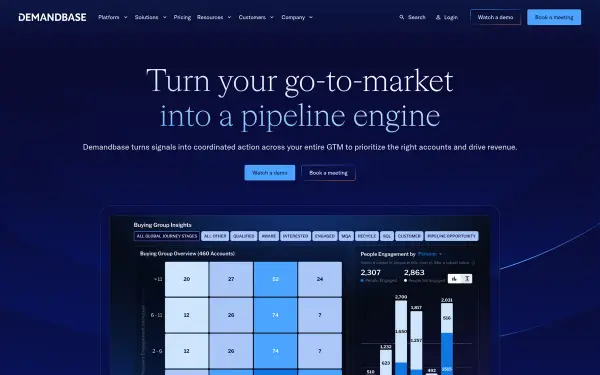
Demandbase is the closest thing in this list to a full replacement for an intent-driven ABM suite. Account identification and target list building feed third-party and first-party intent signals, and those signals drive display and social advertising aimed at buying groups rather than single leads. Sales orchestration and account surge alerts push that activity into the CRM, funnel and campaign analytics close the loop, and the platform carries its own B2B firmographic and contact data, so a team can build and score lists without a second database contract.
The breadth is the point. One contract covers intent, advertising, orchestration and reporting, which removes the integration work of stitching an intent feed to an ad platform and a CRM. The trade-offs are scale and speed. Onboarding takes weeks rather than days, and the product rewards teams with enough account volume and operations support to justify the configuration. Smaller teams often find the setup heavier than their motion needs, and the reporting only pays off once target lists, campaigns and CRM stages are wired together properly.
Pricing is quoted annually and depends on account volume, users and modules, so there is no public tier to compare against. Ask for a written scope that names the modules included and the account ceiling, because module additions and account growth are how a quote changes after year one.
Fits enterprise B2B marketing and sales teams with a defined target account list, a dedicated operations owner and a budget for a multi-week implementation. If you want one platform and can staff it, this is the shortest path away from 6sense.
You want one enterprise platform covering intent, advertising, orchestration and reporting.
You need live campaigns within days or run a small target account list.
Entry II of VIII / Fast ad deployment
Our verdict
A faster, simpler route to account-based advertising for mid-market teams, with less orchestration depth than the enterprise suites.
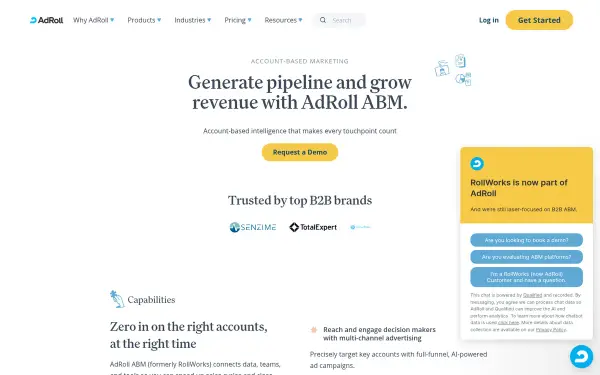
RollWorks is built around one job: get account-based display and social campaigns live quickly from a target account list. You build or upload the list, apply intent signals to rank which accounts deserve budget first, and serve ads to those accounts. HubSpot and Salesforce integrations keep sales working the same accounts, target list management is straightforward enough for a marketing manager to own, and campaign reporting shows which lists moved.
Where it wins is time to first campaign. Demandbase, for example, describes a multi-week implementation, while RollWorks is positioned around faster setup for mid-market teams that need live ads in a shorter window and a setup they can run internally. The CRM integrations are the practical reason it holds together: target lists stay in sync, so sales sees the same accounts marketing is advertising to instead of a spreadsheet that ages out.
The limits show up once you want more than advertising. Sales orchestration is shallower than in a full suite, so account playbooks, alerts and stage-based triggers still live in the CRM. Data scale is smaller than the largest contact databases, which matters if you sell into long-tail segments or unusual industries. Analytics are narrower too: campaign reporting rather than a full funnel view that ties ad exposure to pipeline without extra work.
Pricing runs as an annual subscription quoted by account volume and features, with no published tiers, so the quote depends on how many target accounts you want to reach. Ask what happens when you exceed the account count mid-term, and confirm whether the intent signals are included or added.
Account-based advertising is the main gap and you want campaigns live in weeks.
You need deep account playbooks and full funnel attribution in one tool.
Entry III of VIII / Data breadth
Our verdict
The data backbone pick: a very large B2B contact and company database with intent and trigger events, less of an ABM execution layer.
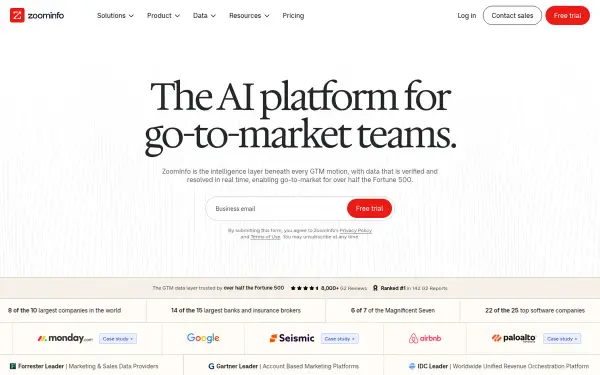
ZoomInfo is a data layer to consider for contact and company data. The B2B contact and company database is the core: search on firmographics, build lists, then export or sync to Salesforce. Organizational charts and reporting lines help you work a buying group rather than a single title. Intent signals on researched topics and buying scoops such as funding rounds or leadership changes help identify accounts worth a push, and prospecting tools turn that into lists a rep can work.
The strength is breadth combined with trigger events. Depth is strongest in North America, and record accuracy varies by region and niche, so validate a sample against your own closed-won accounts before you commit to seat counts and data credits. Contracts are quoted annually on seats and credits, and every plan on the pricing page routes to a form or a sales contact, with no published figure to compare. A free trial exists, which is the right way to test accuracy in your segments rather than trusting a demo.
It is not an ABM execution platform. Advertising to buying groups, account playbooks and orchestration sit in other tools, so teams pair ZoomInfo with an ad platform and their CRM. What you get is inputs: contacts, firmographics, intent and triggers, at a large scale.
Fits teams whose bottleneck is finding and prioritizing the right accounts, especially those selling into North America on a Salesforce-based motion. Budget for premium pricing and plan the renewal conversation around actual credit use.
Your gap is data depth and you need intent plus trigger events on top of a large database.
You need advertising and orchestration in the same contract.
Entry IV of VIII / Price and reach
Our verdict
The affordable all-rounder: contact data, sequences and a dialer from $49 per seat per month, with lighter intent modelling.
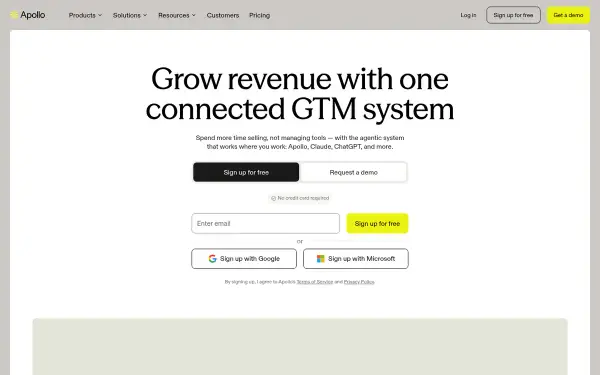
Apollo.io puts contact data and outbound execution in one place. You search its B2B contact database, build lists, then run multi-step email sequences with a built-in dialer from the same screen. Reply and activity analytics show which steps land, CRM sync keeps records current, and basic intent signals flag accounts researching relevant topics, though the modelling is lighter than dedicated intent providers offer.
The appeal is price and packaging. The Basic plan is $49 per seat per month billed annually, there is a free plan with 900 credits for small teams, and a 14-day free trial to test data quality before you pay. For a sales-led team running outbound into defined segments, that covers list building and first touch without a separate data contract. Credits and deliverability are the practical ceiling: heavy sending and large exports push you into higher tiers or extra credits.
Data quality varies by niche, which matters more than headline database size. Pull a sample of your target titles in your key regions and check emails and mobiles before you standardize. Intent is the weakest part of the package, so treat it as a prioritization hint rather than a buying-group signal engine, and do not expect it to replace a dedicated intent feed inside an ABM program.
Fits outbound-led teams and smaller sales organizations that want data plus sequences on one bill and a low entry price. It is not a substitute for a full ABM suite when you need advertising to buying groups and account-level orchestration, and the free plan is best treated as an evaluation tool rather than a long-term home.
You want one affordable tool for prospecting data and outbound sequences.
Intent signals or buying-group advertising must carry your ABM program.
Entry V of VIII / Europe and compliance
Our verdict
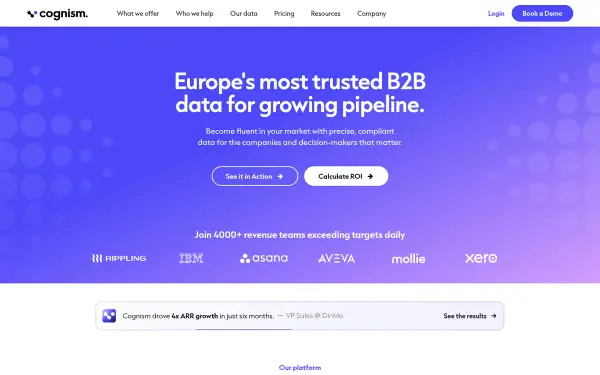
The Europe-first data pick, built around compliant sourcing and human-verified mobile numbers, with thinner North American coverage.
Cognism is built for teams selling into European markets, and the product reflects that. The B2B contact data leans European, and the sourcing workflow is designed around GDPR-oriented compliance requirements, which matters when legal reviews your data provider. Mobile numbers are verified by human review, which supports calling motions. Intent signals plus Salesforce and HubSpot integrations make it usable inside an ABM motion you already run.
Europe is the differentiator and also the boundary. North American coverage trails the large US-centric databases, so a team splitting effort evenly across the Atlantic will likely need a second source. The overall dataset is smaller than the biggest contact databases, so check coverage in long-tail segments and niche industries.
Pricing is quote-based. Standard and Pro tiers are listed without figures and priced through sales, and the trial is a free data sample rather than a time-limited product trial. That sample is the right first step: request records for the titles and countries you actually sell to, then check fill rates and mobile accuracy against your CRM. Ask how the sample maps to the tiers so you are not comparing a curated extract to a general export.
Fits European go-to-market teams with calling motions and a compliance review process, particularly those who have been burned by weak mobile data. It complements rather than replaces an ABM platform: you still need advertising and orchestration tooling around it, so budget for both lines.
Most of your pipeline is European and compliance sign-off is part of the buying process.
North America is your primary market or you need a platform, not data.
Entry VI of VIII / Surge scoring
Our verdict
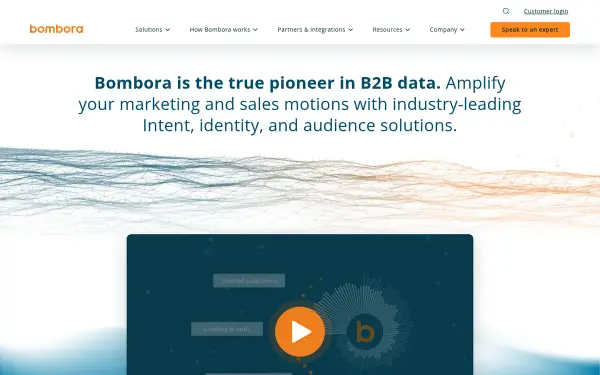
Pure intent data with a large cooperative footprint, useful only if you already have tools to act on the signals.
Bombora sells intent data, not a platform. Its cooperative tracks research across a large set of publisher sites, aggregates that behavior to the company level, and publishes Company Surge scores showing when an account's interest in a topic spikes above its own baseline. Delivery runs through CRM sync, advertising platform integrations, ABM platform feeds and topic-level reporting, so the signal lands where your team already works.
The value depends entirely on what you own. If you run an ABM platform, a demand-side platform and a CRM, Bombora supplies a clean prioritization signal that plugs into all three. If you do not, you are buying a list of surging accounts with no way to act on it: there is no advertising layer, no outreach tooling and no contact data, so the platform cost sits on top of the data cost. Several ABM platforms in this list license or embed its signals, so check whether you already have access before signing a separate contract.
Surge scores are widely recognized, which helps adoption. The limit is interpretation. A surge tells you an account is researching a topic, not that a deal is forming, so pair it with first-party signals and CRM activity before you rewrite territory plans.
Pricing is an annual data subscription quoted by topic and account volume, with no published tiers and a demo rather than a trial. Scope topic count carefully, since topics and account volume are the levers that move the contract.
You already run an ABM platform and ad stack and only need a stronger intent signal.
You need one tool that identifies accounts and acts on them.
Entry VII of VIII / Free visitor ID
Our verdict
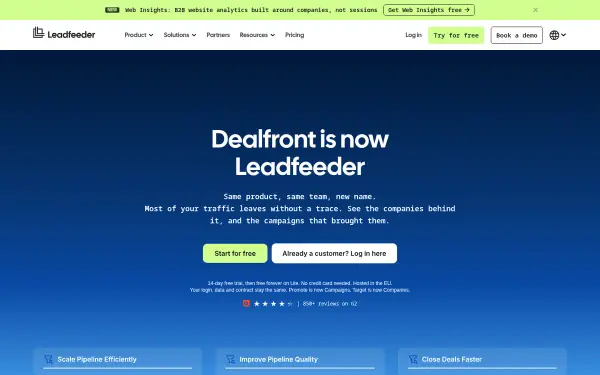
The cheapest way here to turn anonymous website traffic into a company-level account list, starting at €79 per month.
Dealfront identifies the companies visiting your website and turns that anonymous traffic into an account list. You get firmographic enrichment on each identified company, intent data on those accounts, visitor reporting and filters, and integrations that push accounts into your CRM and sales tools. European market coverage is the strong suit, which fits its history as Leadfeeder.
The mechanics matter for expectations. Matching happens at company level and is probabilistic, so you learn that a company visited, not which individual did. For ABM that is usually enough: a spike in visits from a target account is a reasonable trigger for advertising or a sales touch. It is not a replacement for contact-level data, and a sales team expecting named visitors will be disappointed. Scale also trails the larger data vendors, so very large or global sites may hit coverage limits.
Packaging includes a free tier and a published entry price. Discover is €79 per month billed annually, Lite is free forever, and a 14-day free trial is available. That makes it a low-risk first ABM purchase for a marketing site that already receives meaningful B2B traffic, and a sensible way to prove whether website behavior predicts pipeline before you buy a bigger suite.
Fits European B2B sites that want traffic converted into target account lists without a large contract. Pair it with a contact data source and an ad platform to complete the motion, and set expectations that company-level matching will never name people.
You want an affordable first ABM data layer built on your own website traffic.
You need named contacts or global enterprise scale.
Entry VIII of VIII / Real-time enrichment
Our verdict
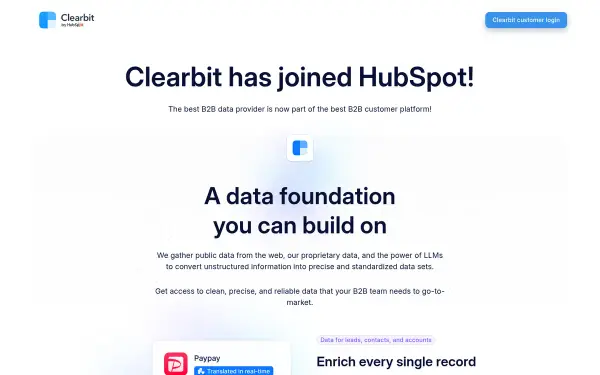
Real-time enrichment and lead routing for HubSpot teams, narrower than a contact database and steered by the HubSpot roadmap.
Clearbit fills in the blanks on a record you already have. Give it an email address and it returns company, role, size and industry attributes in real time, which lets you shorten forms and route leads without asking visitors for information they resent typing. Lead routing and scoring use those attributes to send the right account to the right rep, documented APIs let product-led teams enrich signups inside their own application, and HubSpot integration is native.
Real-time enrichment is the core strength. The trade-off is scope: this is enrichment and routing, not prospecting. You cannot build a net-new target account list the way you can in ZoomInfo or Apollo.io, and intent is not its job, so any ABM program built on Clearbit alone will be missing the prioritization layer. Teams outside the HubSpot ecosystem get less value, since product direction follows the HubSpot roadmap now that HubSpot owns the company.
Pricing is usage-based, with tiers set by enrichment volume and API calls. No pricing page could be fetched, so there is no published figure to plan against and the quote depends on your traffic and form volume. Model your monthly enrichment calls and API requests before you talk to sales, because volume is the lever that moves the number, and enrichment can grow quietly as traffic grows.
Fits HubSpot teams that want cleaner forms, faster routing and better lead scoring without buying a data platform. Treat it as a component in an ABM motion rather than the platform itself.
You run HubSpot and want shorter forms plus reliable lead routing.
You need prospecting lists, intent signals or advertising.
VIBackground
ABM software helps a B2B team treat a set of named accounts as the unit of marketing and sales work, instead of treating individual leads as the unit. A CRM records what already happened. ABM tooling decides which accounts deserve attention before anything happens, then pushes advertising, content and sales activity at the buying group inside those accounts.
The category splits into three layers that are often sold together but do different jobs.
A full platform covers all three. A point tool covers one, which is why buyers end up comparing a suite against a stack of three vendors with overlapping contracts and three renewal dates.
Intent data is the piece buyers ask about most. A vendor observes research behavior across publisher sites, search or review content, aggregates it to the company level rather than the person, and scores a topic against that account's own baseline. A spike means the account is reading about a problem you solve. It does not mean a deal exists. Teams that get value from intent set a threshold, route surging accounts to sales with context, and check after a quarter or two whether the signal actually predicted pipeline in their own closed-won data.
6sense is the reference point for this list. The alternatives here cover the same ground in different combinations, and Bombora supplies intent data that several ABM platforms license or embed. Deciding which layer you are actually missing is the whole purchase decision, and it is cheaper to answer that question before you take a demo.
This comparison sits in the software register. Further along the shore: baby tracking app and kennel software.
VIIPricing
Most ABM contracts are annual and quoted, not listed. When a published figure does exist, it is an entry point for one plan and one billing term, not the price you pay once account volume, seats and modules are known.
Four things move the number. Account volume sets how many target accounts you can advertise to or track. Seats set how many people log in. Data volume, whether contacts, credits or enrichment calls, sets the ceiling on exports and enrichment. Modules set whether you are buying advertising, orchestration, analytics or all three at once. Enterprise suites quote on all four together, which is why two teams can report very different prices for the same product and both be accurate.
| Model | How it bills | Typical fit | Example from this list | | Annual platform subscription | Quoted by account volume, users and modules | Enterprise teams replacing a full suite | Demandbase | | Annual data subscription | Quoted by topic and account volume | Teams with an existing ABM and ad stack | Bombora | | Seat plus credits | Per seat per month, billed annually | Outbound-led sales teams | Apollo.io, $49 Basic per seat per month | | Usage-based tiers | Priced by enrichment volume and API calls | Product-led and HubSpot teams | Clearbit | | Visitor identification | Per month, billed annually, with a free tier | Marketing sites building account lists | Dealfront, €79 per month on Discover | | Custom quote | Annual contract, no published tiers | Teams needing data plus intent | ZoomInfo, Cognism |
Two practical notes before you sign. First, several vendors here offer a demo and only a few offer a real trial or free tier: Apollo.io gives 14 days plus a 900 credit free plan, Dealfront gives 14 days plus Lite free forever, ZoomInfo offers a free trial, and Cognism sends a free data sample. Second, ask what happens at renewal when account volume grows, because that clause, not the first-year figure, decides what you actually pay.
Each entry card shows the starting price as it appeared on the vendor's own pricing page on November 25, 2026. When a vendor shows no figure we could confirm, or only a promotional rate, the card says "See website" or gives the regular price instead of a guess. Usage, overage and add-on rates in the text change more often than plan prices, so confirm them on the vendor page before you set a budget. To test the numbers against your own volume, try the free User Research Budget Planner. The Event Break-Even Calculator is a second way to check the same decision.
VIIIDecision
IXPitfalls
XQuestions
Demandbase. It is the only tool here combining account identification, third-party and first-party intent, display and social advertising to buying groups, sales orchestration with account surge alerts, and funnel reporting in one contract. It is quote-priced and onboarding typically runs over several weeks, so treat it as an enterprise purchase. RollWorks is the lighter alternative when advertising is the main need.
A provider observes research across publisher sites, search or review content, aggregates it to the company level, and scores topics against each account's own baseline. A spike means the account is reading about a problem you solve, not that a deal exists. Teams set a threshold, route surging accounts to sales with context, then check whether the signal predicted pipeline.
It depends which layer is missing. If you already run ads and CRM playbooks, a data provider such as Bombora, Cognism or ZoomInfo can fill the gap. If activation and orchestration are missing, a platform such as Demandbase or RollWorks is the better buy. Buying both when you only need one is the most common overspend.
Yes, at the data and traffic layer. Apollo.io has a free plan with 900 credits and a $49 Basic plan per seat per month billed annually, and Dealfront has a Lite free tier plus Discover at €79 per month billed annually. Both give a small team real account data before any enterprise contract. Advertising and orchestration are where costs climb.
Pilot your own accounts, not a demo list. Load 50 to 100 target accounts, run one campaign or sequence, and compare surging accounts with the deals that actually progressed. Use free tiers and trials where they exist, and ask the vendor what a realistic result looks like in 30 days before you discuss renewal terms.
Cognism for European contact data with GDPR-oriented sourcing and human-verified mobiles, and Dealfront for identifying European companies visiting your site at company level. Both are strong on EMEA and thinner elsewhere. North American depth generally favors ZoomInfo, so teams selling across both regions often end up with two data sources.
XIFurther along the shore
Vendors can ask for a correction or apply for a Featured listing. Paid or not, the entry is scored on the same rubric and its limits stay in print. Partner with Umberlake.
Free tools
Our free browser tools turn the prices on this page into a figure for your own volume. Nothing you type leaves your device.