
AppFolio
See websiteQuote-based with a minimum monthly commitment
Best for mid-size and large management companies
- Free plan
- No
- Rubric
- 7.8 of 10
Ten property management accounting tools compared on trust accounting, owner statements, reconciliation and price, with published rates where vendors show them and clear notes where they do not.

IThe short answer
AppFolio is the best fit for mid-size and large management companies, Buildium for growing companies that want accounting built around rental workflows, and DoorLoop for teams that want a modern interface at published per-unit rates. Prices in this list were checked on November 25, 2026. Ten tools are ranked, covering quote-based suites, per-unit platforms and general ledgers like QuickBooks Online and Xero that need property add-ons. Flat-rate options such as RentRedi, and the free core accounting in Wave, serve the smallest portfolios: Best Accounting Software For Property Management.
10 tools compared from vendor pages on November 25, 2026. 7 publish a starting price we could read; the rest say "See website".
IITop three berths
Register order is editorial fit for the buyer each entry describes. Prices are the starting figures read on November 25, 2026.
See websiteQuote-based with a minimum monthly commitment
Best for mid-size and large management companies

$65Essential, per month
Best for growing management companies

$2.50DoorLoop One, per unit per month, minimum spend and units apply
Best for modern interface and ease of use
How this page is paid for. All 10 tools here are unpaid editorial picks.
A paid listing's position can be part of what the vendor pays for. Every entry, paid or not, is scored on the same rubric and keeps its limits in print. Advertising disclosure.
IIIThe register
Starting prices as shown on each vendor's pricing page on November 25, 2026. "See website" means no figure we could confirm.
| No. | Tool | From | Free plan | Trial | Rubric | Actions |
|---|---|---|---|---|---|---|
| 01 | AppFolioMid-size and large management companies | See websiteQuote-based with a minimum monthly commitmentNot shown publicly | No | Demo only | 7.8 | |
| 02 | BuildiumGrowing management companies | $65Essential, per monthUpdated on vendor page | No | 14-day free trial | 7.8 | |
| 03 | DoorLoopModern interface and ease of use | $2.50DoorLoop One, per unit per month, minimum spend and units applyUpdated on vendor page | No | Demo only | 8.0 | |
| 04 |  Yardi BreezeSmall portfolios wanting Yardi accounting | $1Breeze, per unit per month, annual agreement, $100 minimum per monthRead on vendor page | No | No | 7.4 | |
| 05 |  Rentec DirectBudget-conscious managers | See websiteLandlord plan, per unit per month, manager plan from $2.50Not shown publicly | No | Free trial | 6.4 | |
| 06 |  PropertywareSingle-family portfolios at scale | See websiteQuote-based with per-unit pricing and implementation feesNot shown publicly | No | No | 7.2 | |
| 07 | QuickBooks OnlineFirms with a bookkeeper | $38Simple Start, per month, 1 user, promo $11.40 per month for 3 monthsRead on vendor page | Yes | 30-day free trial | 5.1 | |
| 08 |  XeroClean UI lovers and international portfolios | $27Early, per month USD, promo $2.70 per month for first 6 monthsUpdated on vendor page | No | 30-day free trial | 4.8 | |
| 09 |  WaveFree accounting for tiny portfolios | FreeStarter, free plan, Pro $190 USD per year billed annuallyRead on vendor page | Yes | No | 4.4 | |
| 10 |  RentRediLandlords wanting flat-rate simplicity | $12Single plan, per month, billed annually, unlimited unitsRead on vendor page | No | 30-day money-back guarantee | 6.3 |
Pinned:
IVMethod
How completely the ledger handles rent, deposits, owner funds and property-level reporting without manual workarounds.
Whether owner statements, distributions and trust or escrow reconciliation are produced from the same transactions that feed the books.
Whether rates, minimums and contract terms are published where a buyer can find them before a sales call.
How quickly a small team reaches a first reconciliation and a first owner statement without paid setup help.
The breadth of connections and the ability to keep working as unit counts, entities and staff numbers grow.
VMethod
Every tool here was scored against the same five criteria, and the weights are shown above. Property accounting carries the most at 35 percent, because a general ledger that does not understand rent, deposits and owner funds creates work elsewhere. Owner reporting is 25 percent, since most buyers are producing statements for someone else. Pricing clarity, ease of use and integrations and scale split the remaining 40 percent, and each is scored on what a buyer can verify before signing: published rates, time to a first reconciliation, and whether the product connects to tools already in place.
Prices and plan details come from vendor pricing pages and were checked on November 25, 2026. Where a vendor does not publish rates, this list says so and does not fill the gap with a guessed number. Where a page could not be fetched or a plan structure had changed, the entry says that too. Several listings carry a "See website" price, either because pricing is quote-based or because it could not be confirmed at check time.
The order is editorial. It reflects fit for the buyer described in each entry, plus any Featured position on the page, which is a paid placement. The Featured listing is scored with the same rubric and carries the same kind of cons as everything else here.
Anything a vendor could not confirm at check time, such as a rate that appears in older material but not on the live pricing sheet, is flagged in the entry rather than smoothed over. Recheck rates before you sign, because per-unit plans and tier boundaries change.
The full routine, from price reads to corrections, is on the methodology page. Paid listings follow the advertising disclosure.
Entry I of X / Accounting tied to operations
Our verdict
The strongest accounting-to-operations link here, but only if you are big enough to absorb a quote-based minimum commitment.
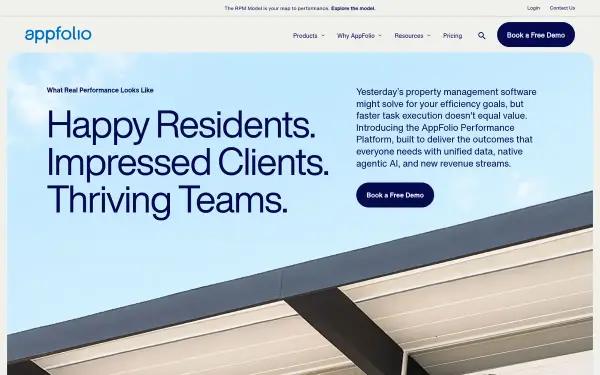
AppFolio runs the general ledger inside the same system that handles leasing, maintenance and resident management. When a work order closes or a lease renews, the accounting side updates without a re-keying step. Bank reconciliation, budgeting and automated owner statements are native, and the rent collection flow posts payments directly to the ledger. For a company running several hundred doors, that removes the spreadsheet bridge between operations and the books.
Owner reporting is the part operators notice first. Statements are generated on a schedule and reconciliation is built in. The resident and staff mobile apps extend the same data to the field, so a maintenance update is visible to accounting immediately rather than at month end.
The tradeoff is cost and commitment. Pricing is quote-based with a minimum monthly commitment, so there is no published number to budget against and no self-serve checkout. Pricing is quote-based with a minimum monthly commitment, so confirm the figure with a quote. No free trial is offered, and evaluation runs through a sales demo.
That structure suits mid-size and large management companies with enough units to spread the minimum across a portfolio. A landlord with four units pays for capability they never touch. Below roughly a hundred doors, and especially if published rates matter to you, Buildium or DoorLoop are easier starting points.
You manage hundreds of doors and want one system where leasing, maintenance and the ledger cannot drift apart.
You need a published rate and a self-serve trial before you commit.
Entry II of X / Rental-first ledger
Our verdict
The safest step up from spreadsheets: rental-first accounting, no unit minimums, and a trial you can test before you commit.
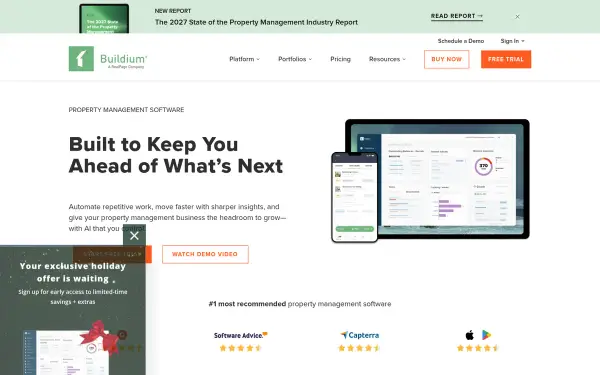
Buildium is the middle of the market done well. The general ledger is double-entry, and the workflows around it assume rentals rather than retail: online rent collection that posts to the tenant ledger, owner and vendor management, security deposit tracking, 1099 preparation support, and bank reconciliation covering operating and trust accounts separately. There are no unit minimums, which is unusual at this level and makes it practical to start small and grow into the higher tiers.
Pricing starts at $65 per month on the Essential plan. Higher tiers scale by unit count, so the cost curve steepens as the portfolio grows, and the jump between tiers is where buyers should do the most arithmetic. Earlier material for this listing recorded Essential at $62 per month, which is a reminder to confirm the live pricing sheet before signing rather than trusting any single figure on a comparison page. A 14-day free trial is long enough to run a reconciliation and produce one owner statement.
The weaknesses are real but manageable. The interface feels dated in places, and navigation takes a few sessions to learn. Reporting is dependable rather than flexible, and unusual owner splits may still need a spreadsheet alongside it. Ask what support your tier includes.
It fits growing management companies that want accounting designed around rental workflows and will accept an older interface in exchange. It also fits a manager moving off a spreadsheet or a basic landlord tool who wants a trial period rather than a sales demo.
You want owner statements, deposit tracking and trust reconciliation without a sales call or a unit minimum.
You manage thousands of doors and need deep portfolio reporting from day one.
Entry III of X / Short learning curve
Our verdict
A modern interface and published per-unit rates, held back by a demo-only evaluation and a smaller integration marketplace.
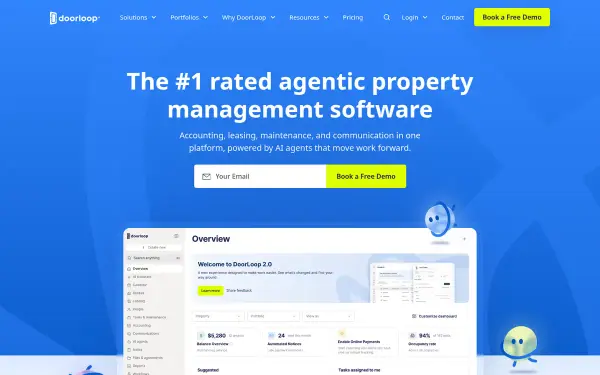
The draw here is speed of adoption. DoorLoop presents a modern interface with a short learning curve, and the accounting pieces a manager needs are present: chart of accounts, bank reconciliation, owner statements and customizable financial reports. Rent collection, maintenance tracking and TransUnion tenant screening sit in the same product, so a small team can run operations and the books from one login. An open API covers the integrations the built-in marketplace does not.
Pricing is published rather than gated behind a sales call, which is unusual at this end of the market. The current structure is per unit per month on DoorLoop One, with minimum spend and unit counts applying. The earlier Starter, Pro and Premium tiers, where Starter covered up to 20 units at $69 per month billed annually, have been replaced by the One, Connect and Multiply plans. Because the floor depends on unit count, run your own numbers before comparing against a flat-rate product.
Two limits matter. There is no free trial, so evaluation happens through a demo and you commit without a hands-on period. The integration marketplace is smaller than what older platforms offer, which matters if you already depend on specific accounting or utility tools. DoorLoop is also a newer platform than Buildium or Yardi, so its track record is shorter.
It fits growing managers who want clean software and are willing to pay per unit for it, particularly small teams who will use the interface every day. Companies with a handful of units may find the minimum spend hard to justify against RentRedi or Wave.
Your team lives in the software daily and you value a clean interface over a long integration list.
You will not sign without a free trial or you need a specific third-party connection.
Entry IV of X / Published per-unit pricing
Our verdict
Yardi accounting at a published rate, but the $100 monthly minimum decides whether it makes sense for your portfolio.
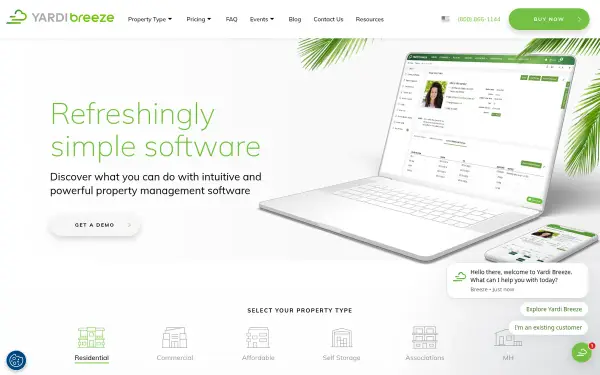
Yardi Breeze puts a Yardi-grade accounting engine behind a simpler product. The tenant ledger sits on top of general ledger accounting, with accounts receivable and payable, online rent collection, maintenance tracking and reporting. Implementation is free, there are no onboarding fees, and ACH fees are listed at $0. For a manager who wants recognizable property accounting without an enterprise contract, that combination is hard to match at the entry rate.
The pricing is published, which is worth noting in a category full of quotes. Residential Breeze starts at $1 per unit per month on an annual agreement with a $100 monthly minimum. Premier is $2 per unit per month with a $400 minimum and adds CAM reconciliation. The minimum is the number that matters: a landlord with 30 units pays the $100 floor, not $30, and the effective rate per unit falls as the portfolio grows.
Weaknesses cluster around automation and fit. Workflow automation is thinner than newer rivals, so recurring tasks take more clicks than they should. The monthly minimum makes small portfolios expensive relative to a flat-rate product. No free trial is offered, so evaluation means a demo and a conversation with sales rather than a hands-on test.
It fits small to mid-size portfolios that want Yardi accounting at a published rate and can clear the minimum, especially those that will use CAM reconciliation on Premier. Portfolios under roughly 100 units should price Buildium or RentRedi beside it before deciding.
You want Yardi accounting with no onboarding fees and your unit count clears the monthly minimum comfortably.
You manage 40 units or fewer and a flat monthly price would serve you better.
Entry V of X / Free ACH and support
Our verdict
A low-cost workhorse with free ACH and free support, wrapped in an interface that has not kept up with newer platforms.
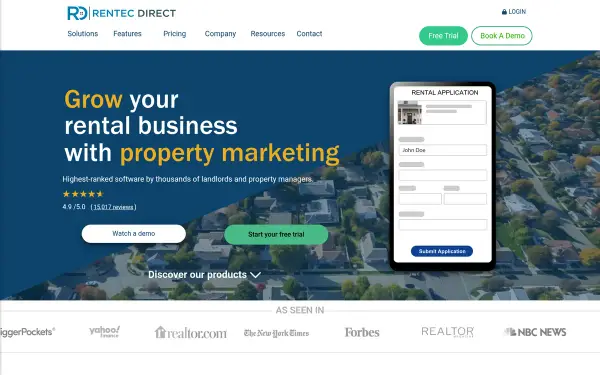
Rentec Direct has served landlords and property managers since 2007, and the feature list reflects that history: general ledger, bank reconciliation, property-level reporting, owner statements, 1099 support and tenant and property accounting. Tenant ACH payments are free, and support is unlimited and US-based. That is a complete accounting stack for a small management company, and the per-unit cost is low enough that price alone rarely rules it out.
Pricing sits on the vendor site and could not be confirmed at check time. The plan structure puts landlords on a per-unit monthly rate and professional managers from $2.50 per unit per month, with a no-cost trial available. Because the page did not return, treat that manager figure as a starting point and confirm the current landlord rate directly with the vendor before you budget. Per-unit costs also grow with the portfolio, so a manager at 400 units pays a very different number than one at 40.
The interface is dated and the mobile experience lags newer platforms. Reporting is dependable rather than modern, and you will not find the workflow automation or portal polish of DoorLoop. What you get instead is free ACH, unlimited support and a ledger that has been tested by landlords for close to two decades.
It fits budget-conscious managers who value low per-unit cost, free tenant payments and free support over interface polish. It also suits a landlord who needs owner statements and 1099s without moving to a platform with a monthly minimum.
Free ACH and unlimited support matter more to you than a modern dashboard.
Your staff work mostly on phones or you need deep workflow automation.
Entry VI of X / Scattered single-family reporting
Our verdict
The right shape for scattered single-family portfolios, with trust accounting and portfolio reporting, if you can absorb a quote and a multi-week setup.
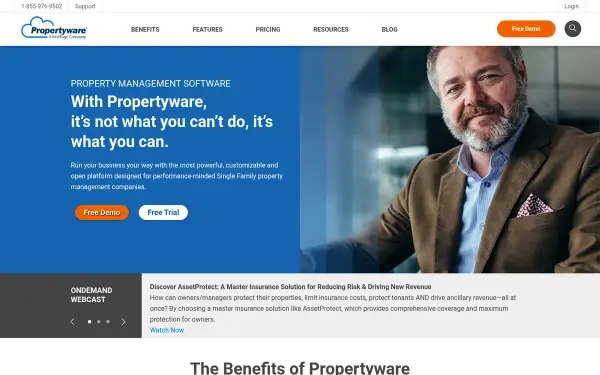
Propertyware is built for scattered single-family rentals, which is a different problem from a single apartment building. Portfolio-level reporting rolls up across properties, owner statements are produced from reconciled transactions, trust accounting is part of the product, and maintenance workflows and single-family marketing and leasing are included. An open API handles integrations with tools outside the suite, and reporting is customizable rather than fixed.
Propertyware is part of RealPage. Pricing is quote-based with per-unit structures and implementation fees, so there is no published number to put beside the others here. Onboarding is typically measured in weeks rather than days, which is appropriate for an operator with staff and multiple owner clients and a burden for someone with 30 doors and a day job.
There is no free trial, and evaluation runs through a sales process. Aimed at larger operators, it assumes a team: someone to configure the chart of accounts, someone to run leasing, someone to reconcile trust accounts every month. Smaller companies often find the configuration effort outweighs the reporting gains, and the absence of a published rate makes the first year hard to forecast.
It fits single-family portfolios at scale, several hundred doors spread across many addresses, where portfolio reporting and trust accounting are daily needs rather than annual ones. It also fits companies already working inside the RealPage ecosystem and set up to absorb a weeks-long onboarding.
You manage dispersed single-family homes at scale and need trust accounting plus portfolio roll-ups.
You want a published rate or need to be live within a week.
Entry VII of X / Class tracking
Our verdict
A capable general ledger that needs a bookkeeper and add-ons before it can handle owners, deposits or trust funds.
QuickBooks Online is a general ledger, not a property management system, and the distinction explains both its usefulness and its limits. Invoicing, expense tracking, bank connections and basic reporting are competent. Simple Start is $38 per month for one user, with a promotional rate of $11.40 per month for three months. Plus is $140 per month and adds class and location tracking, which is the feature that lets you separate properties in the chart of accounts. A free plan covers basic needs and a 30-day trial is available.
What it does not do is property management. There is no native trust accounting, no security deposit workflow, no owner statement generation and no rent collection or owner portal without add-ons. Class tracking can approximate property-level reporting, but it requires disciplined setup and consistent entry, and one miscoded transaction distorts the picture until someone catches it.
That is fine if a bookkeeper or accountant already works in QuickBooks. Many small firms keep QuickBooks Online for tax preparation and use a property platform such as Buildium or AppFolio for operations, accepting some duplicate entry in exchange for an accountant-friendly file at year end. The app ecosystem makes that pairing practical.
It fits firms with a bookkeeper, or owners who already file through QuickBooks and want property-level classes on Plus. It does not fit a manager who needs owner statements and trust reconciliation out of the box.
Your bookkeeper already works in QuickBooks and you pair it with property software for operations.
You need owner statements and deposit tracking from a single system.
Entry VIII of X / Multi-currency bookkeeping

Our verdict
Excellent bookkeeping and multi-currency support, but property tracking depends on categories and third-party apps rather than native features.
Xero is the general ledger for people who care how software feels. Bank reconciliation is quick, bank feeds are reliable, invoicing is clean, and multi-currency support is stronger than most property-specific products here. Tracking categories can separate properties, and the app marketplace lists more than 1,000 integrations, which is where property add-ons come from.
The commercial model is a straightforward subscription. Early is listed at $27 per month with a promotional rate of $2.70 per month for the first six months, and a 30-day trial is offered. The US pricing page did not display plan rates when checked on November 25, 2026, so confirm the current numbers on the vendor site before you budget rather than relying on the figure recorded here.
The limits are structural. Xero is a general accounting product, so property tracking depends on categories and connected apps rather than native lease, deposit or owner statement logic. Trust accounting is not built in. For an international portfolio, or a firm whose bookkeeper prefers Xero, that trade is reasonable and the multi-currency handling may be decisive. For a manager who must produce owner statements every month, it is a gap you fill with software.
It fits clean-interface lovers and international portfolios, and it pairs well with property software through the marketplace. It does not replace property accounting, and should not be bought as though it might.
You run an international portfolio or your bookkeeper already works in Xero.
Property-level owner statements and trust accounting are non-negotiable.
Entry IX of X / Free double-entry accounting
Our verdict
Free, clean double-entry accounting for tiny portfolios, with no property features and no trust accounting at any price.
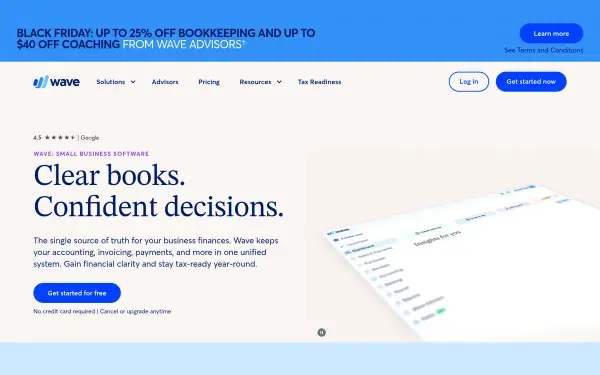
Wave gives away core double-entry accounting: invoicing, expense tracking, bank connections, financial reports, receipt scanning and no unit limits, with no subscription on the Starter plan. For a landlord with a handful of doors, that is a genuinely useful free product rather than a limited trial. Pro is $190 USD per year billed annually for the additional bookkeeping features.
The cost shows up elsewhere. Payment processing carries card fees, payroll is a paid add-on, and reporting depth is limited compared with paid general ledgers. There are no property-specific features at all: no tenant ledger, no owner statements, no security deposit tracking and no trust accounting. Property and trust accounting has to be handled manually, which means spreadsheets and a discipline most small landlords do not keep up past a dozen units.
There is no free trial because the core product is free, so evaluation is just using it. The product assumes a non-accountant user, which is both its strength and its ceiling. Receipt scanning and the simple design make it easy to hand to someone who has never kept books.
It fits tiny portfolios and hobby landlords who want clean records for tax filing without a subscription, and it fits owners testing whether they need software at all before buying. It does not fit anyone managing other people's money or producing owner statements.
You have a few units, want clean books for taxes and will never hold client funds.
You manage other people's properties or need deposit tracking.
Entry X of X / Flat price, unlimited units
Our verdict
One flat price for unlimited units, with owner statements and reconciliation included, as long as your reporting needs stay simple.
RentRedi sells simplicity: one plan, $12 per month when billed annually, unlimited units. For that you get income and expense tracking, bank reconciliation, owner statements, maintenance tracking, tenant screening, online rent collection and 24/7 support. There are no tier jumps and no per-unit math, which makes it the easiest product on this list to budget for and the easiest to explain to an owner.
The accounting is real but shallower than dedicated platforms. Income and expense tracking plus reconciliation cover the basics, and owner statements are included, but a manager with multiple owner clients and trust obligations will find less depth in reporting, deposit handling and general ledger controls than Buildium or AppFolio provide. There is no free trial; instead there is a 30-day money-back guarantee, which is a reasonable substitute if you test reconciliation and a statement in the first two weeks.
The flat price is the argument. At 200 units, $12 per month is a fraction of what per-unit platforms cost, and the gap widens as the portfolio grows. The open question is whether accounting depth holds up as the business gets more complex and owners start asking for detail you cannot produce.
It fits landlords and small managers who want flat-rate simplicity and unlimited units, particularly those who collect rent and produce a basic statement each month. It does not fit a company producing detailed owner statements across many clients or holding trust funds.
You want one predictable monthly price that does not change as you add doors.
You manage trust funds for many owners and need detailed reporting.
VIBackground
Property management accounting software is a general ledger with the rental business wired into it. Double-entry bookkeeping is the foundation: chart of accounts, journal entries, bank reconciliation, accounts payable and receivable, and financial statements. What separates the category from QuickBooks Online or Xero is what sits on top. Rent is billed to tenants and collected, sometimes through the same system, and the payment posts to the tenant ledger and the operating account in one step. Security deposits are tracked as liabilities rather than income. Owner funds are held and disbursed separately from company money, and owner statements are produced from the same transactions that feed the ledger.
The features buyers actually test fall into a short list:
General ledgers can be made to do some of this. Class tracking on QuickBooks Online Plus separates properties, and tracking categories in Xero do something similar, but neither handles trust accounting, deposit liability or owner statements without add-ons or spreadsheet work. That is why so many small firms run both: a property platform for operations and a general ledger for tax filing.
The category then splits by portfolio size. Flat-rate products such as RentRedi and the free core of Wave serve landlords with a handful of units who mainly need income and expense tracking. Per-unit platforms such as Yardi Breeze, DoorLoop and Rentec Direct add tenant ledgers and owner reporting for growing portfolios. Quote-based suites such as AppFolio and Propertyware target companies with staff, multiple owner clients and reporting obligations. Rentec Direct did not return a pricing page when checked, which is why its entry says so rather than quoting a number.
The useful question is not which tool has the longest feature list. It is which workflows you perform every month, and whether the software completes them without a manual step.
This comparison sits in the finance register. Further along the shore: lease accounting software and accounting software for landlords.
VIIPricing
Three billing models dominate this category, and the cheapest headline rate is rarely the cheapest year. Per-unit pricing scales with the portfolio: Yardi Breeze starts at $1 per unit per month but carries a $100 monthly minimum on an annual agreement, so at 40 units the minimum sets the bill. DoorLoop's current structure is per unit per month on DoorLoop One with a minimum spend and unit counts applying. Flat-rate pricing ignores unit count: RentRedi charges $12 per month billed annually for unlimited units. Quote-based pricing, used by AppFolio and Propertyware, produces a number only after a sales conversation and usually carries a minimum commitment or implementation fee.
Tiered subscriptions sit between those models. Buildium's Essential plan is $65 per month with no unit minimums, and higher tiers scale by unit count. General ledgers price per subscription with user or feature limits: QuickBooks Online Simple Start is $38 per month for one user, Plus is $140 per month and adds class and location tracking, Xero's Early plan is listed at $27 per month with a promotional rate for the first six months, and Wave's core accounting is free with Pro at $190 USD per year billed annually.
| Model | How it bills | Typical fit | Example from this list |
|---|---|---|---|
| Quote-based | Sales quote, minimum monthly commitment | Hundreds of units, staff, many owner clients | AppFolio, Propertyware |
| Per-unit with a minimum | Per unit per month, annual agreement, monthly floor | 40 to 300 units | Yardi Breeze at $1 per unit per month with a $100 minimum |
| Per-unit, published | Per unit per month, minimum spend applies | Growing portfolios wanting a public rate | DoorLoop One at $2.50 per unit per month |
| Tiered subscription | Flat monthly rate, higher tiers scale with units | 20 to 200 units | Buildium Essential at $65 per month |
| Flat monthly | One price regardless of unit count | Small landlords, single-family | RentRedi at $12 per month billed annually |
| General ledger | Per month, per user or feature tier | Firms with a bookkeeper | QuickBooks Online at $38, Xero at $27, Wave free |
Run the arithmetic at your own unit count and include every fee a vendor lists. A per-unit rate without the minimum is not the price you will pay, and a free plan without property features is not a property accounting system.
Each entry card shows the starting price as it appeared on the vendor's own pricing page on November 25, 2026. When a vendor shows no figure we could confirm, or only a promotional rate, the card says "See website" or gives the regular price instead of a guess. Usage, overage and add-on rates in the text change more often than plan prices, so confirm them on the vendor page before you set a budget. To test the numbers against your own volume, try the free Lease Liability Calculator. The Event Break-Even Calculator is a second way to check the same decision.
VIIIDecision
Start with unit count and growth plan. Under 20 units, flat-rate and free options make sense. Between 20 and 200, per-unit platforms with published rates give you a defensible budget. Above that, a quote-based suite starts to earn its minimum commitment.
Decide whether you hold client money in trust. Managing other people's properties means trust accounting with separate reconciliation for trust and operating accounts. Buildium lists operating and trust reconciliation, Propertyware lists trust accounting, and QuickBooks Online and Xero do not provide it natively.
List the reports your owners ask for. Owner statements, property-level profit and loss and 1099 support come up most often. Confirm each candidate produces them without a spreadsheet export, then ask how much setup that takes.
Run a reconciliation before you sign. Bank reconciliation is where weak accounting shows up. Use the trial where one exists (Buildium offers 14 days, Xero and QuickBooks Online offer 30) and reconcile a real month of transactions.
Price your own portfolio, not the headline rate. A $1 per unit rate plus a $100 minimum is not the same as $12 flat. Model 12 months at your current unit count and at 50 percent growth, then compare.
Check the exit before you commit. Confirm you can export the general ledger, tenant ledgers and owner history in a usable format. Quote-based platforms with multi-week onboarding are expensive to leave, so ask about data export terms in the first call.
IXPitfalls
Buying per-unit pricing before you have the units. A $1 per unit rate looks cheap until a $100 monthly minimum applies. Run the yearly cost at your current count and at 50 percent growth before comparing.
Assuming a general ledger does property accounting. QuickBooks Online and Xero handle double-entry bookkeeping well, but neither ships trust accounting, owner statements or deposit workflows. Budget for add-ons or a second system.
Ignoring the monthly minimum. Yardi Breeze prices at $1 per unit per month but a $100 floor applies on an annual agreement. At 40 units you pay the floor, which changes the comparison against a flat-rate plan.
Mixing client funds with company money. If you manage other people's properties, trust accounting with separate reconciliation for trust and operating accounts is a practical requirement. Buildium and Propertyware list it; QuickBooks Online does not.
Choosing on interface alone. A clean screen does not produce owner statements or reconcile a trust account. Score the monthly workflows you actually run first, then weigh design, because polish does not close the books.
XQuestions
AppFolio, Buildium, DoorLoop, Yardi Breeze, Rentec Direct, Propertyware and RentRedi are built for rental operations first, with rent collection, owner statements and deposit tracking in the core product. QuickBooks Online, Xero and Wave are general ledgers: they handle double-entry bookkeeping well, but property workflows such as owner statements and trust accounting need add-ons or manual setup.
Flat-rate plans such as RentRedi at $12 per month billed annually cost the same at 5 units or 500. Per-unit plans such as Yardi Breeze at $1 per unit per month scale with the portfolio, and a $100 monthly floor means small portfolios pay above the rate. Quote-based pricing, used by AppFolio and Propertyware, hides the number until a sales conversation and usually carries a minimum commitment.
When a bookkeeper or accountant already runs your books, or when you need multi-currency and a broad app marketplace, keep the general ledger and add property software for rent collection and owner statements. The reverse also works: many managers keep QuickBooks Online for tax filing and use a property platform for operations. Duplicate entry is the cost, so plan the sync before you buy.
Trust accounting means client funds sit in a separate bank account, reconciled separately, with deposits and disbursements tracked per property so a client's money is never mixed with company money. Buildium lists bank reconciliation for operating and trust accounts, Propertyware lists trust accounting, and AppFolio builds owner funds into its ledger. QuickBooks Online, Xero and Wave do not provide it natively.
Wave offers free double-entry accounting with no unit limits, invoicing and receipt scanning, charging only for payment processing and payroll add-ons. RentRedi costs $12 per month billed annually for unlimited units with owner statements and reconciliation. Rentec Direct, Yardi Breeze and DoorLoop sit at low per-unit rates, but Yardi Breeze's $100 monthly minimum pushes the real cost up for small portfolios.
Propertyware is the clearest fit: it was built for scattered single-family rentals, with portfolio-level reporting, single-family marketing and leasing, maintenance workflows and an open API, priced by quote with per-unit structures and implementation fees. AppFolio also handles dispersed portfolios, and Buildium scales without unit minimums. Expect onboarding measured in weeks rather than days at this size.
XIFurther along the shore
Vendors can ask for a correction or apply for a Featured listing. Paid or not, the entry is scored on the same rubric and its limits stay in print. Partner with Umberlake.
Free tools
Our free browser tools turn the prices on this page into a figure for your own volume. Nothing you type leaves your device.